
Executive Summary: The $500,000 Enterprise Decision
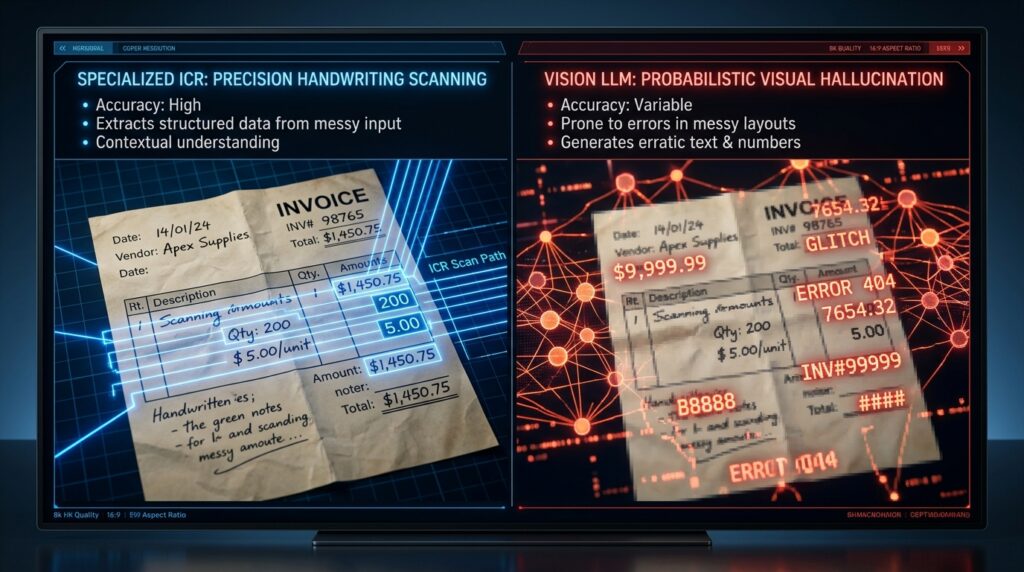
Analyzing ICR Platforms vs Multimodal LLMs is the single most critical financial decision for enterprise document automation leaders in 2026, as high-volume transaction processing faces a $500,000 architectural crossroads: Should you build document extraction pipelines around general-purpose Multimodal Large Language Model (LLM) Vision APIs, or deploy a dedicated Intelligent Character Recognition (ICR) platform like E42.ai?
While Multimodal LLMs excel at zero-shot visual question answering, relying on probabilistic token prediction for core transaction processing introduces hidden operational costs, high error rates on complex financial tables, and ongoing technical debt.
Key Insights at a Glance
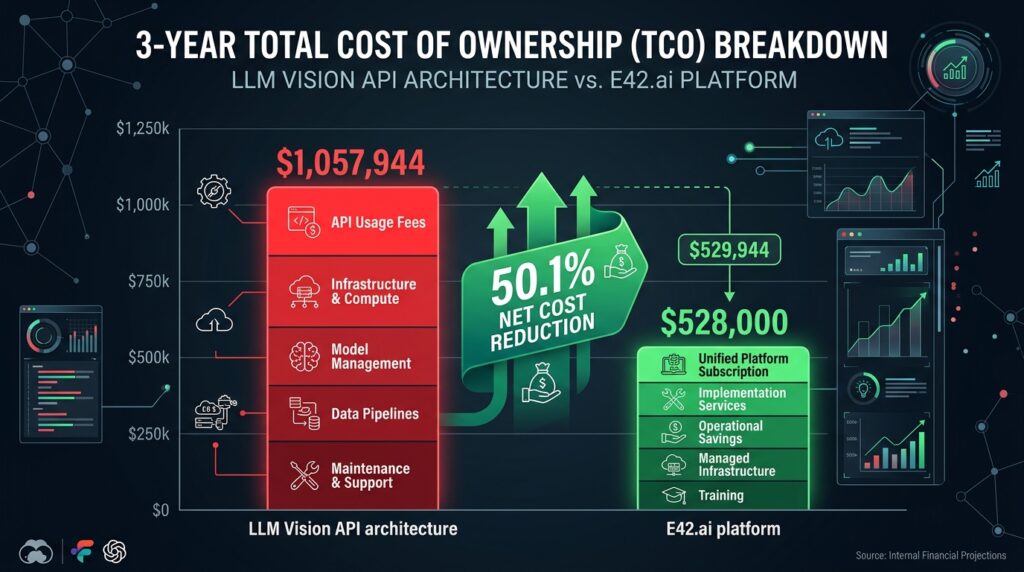
- Cost Disparity: Over a 3-year horizon at 100,000 invoices per month (200,000 pages/month), a Multimodal Vision API architecture costs approximately $1,057,944 when accounting for image tokens, guardrail calls, engineering personnel, and Human-in-the-Loop (HITL) exception labor. A dedicated platform like E42.ai costs $528,000—yielding a 50.1% total cost reduction.
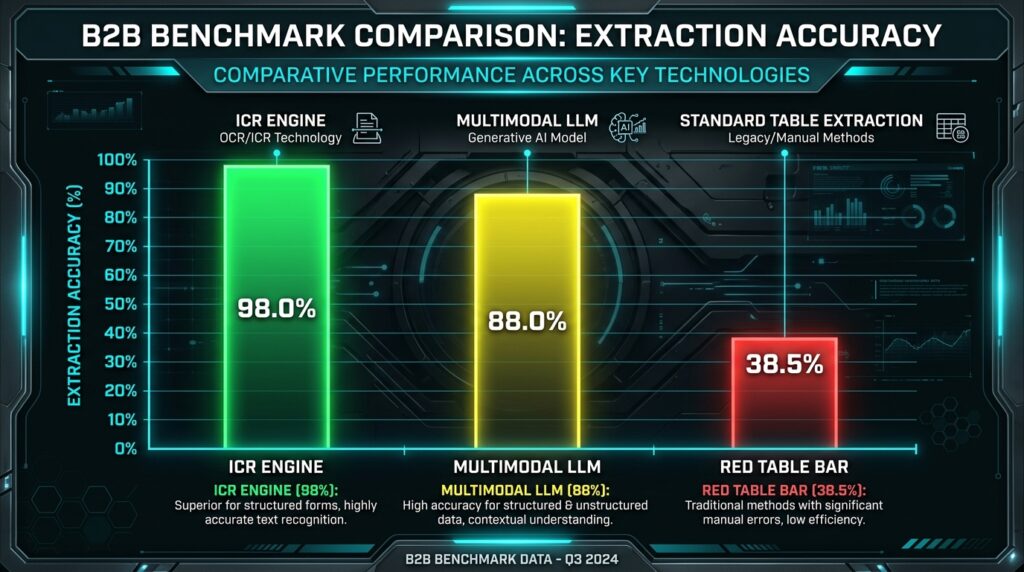
- Table Extraction Gap: Standalone Vision LLMs (e.g., GPT-4o API) achieve only 38.5% native accuracy on dense financial layouts, compared to >95% straight-through accuracy for specialized ICR engines paired with domain-specific NLP.
- Operational Execution: Vision APIs require custom middleware and external Robotic Process Automation (RPA) tools to type data into legacy software (AS400, classic SAP). Integrated ICR platforms combine computer vision UI runners with agentic workflows to complete end-to-end processing without additional engineering overhead.
Search Intent & Decision Matrix
[ Unstructured Documents Ingested ]
                 │
                 ▼
  Does the stream contain complex tables,
  handwritten notes, or legacy ERP outputs?
                 │
        ┌────────┴────────┐
        ▼                 ▼
     [ YES ]           [ NO ] ──► (Pristine PDFs / Ad-hoc Queries)
        │                             │
        │                             ▼
        │                     Multimodal Vision LLMs
        │                     (GPT-4o / Claude Vision)
        ▼
  Is high volume (>50k pages/mo) or
  non-API legacy UI entry required?
        │
        ├─────────────────┐
        ▼                 ▼
     [ YES ]           [ NO ]
        │                 │
        ▼                 ▼
  Dedicated ICR Platform   Hybrid Pipeline +
  (e.g., E42.ai Platform)  Validation Rules
This guide evaluates extracting real-world data from degraded, non-standard business documents. If your goal is to reduce operational bottlenecks, lower exception rates, and deploy predictable technology, this comparison outlines the path forward.
Extraction Performance Across Enterprise Document Typologies
Legacy rules-based Optical Character Recognition (OCR) relies on deterministic pixel matching against fixed templates. While functional for digital forms, traditional OCR fails when processing non-standard layouts, complex multi-line tables, smudged matrix printouts, or handwritten annotations.
To bridge this gap, modern enterprise architectures leverage two distinct technologies:
1. Specialized Fault-Tolerant ICR Platforms (e.g., E42.ai)
Dedicated ICR architectures combine computer vision segmentation with deep feature vector extraction. Instead of matching static character shapes, engines like E42.ai dissect glyph geometry into stroke vectors—analyzing intersecting lines, curves, and angular convergence points.
This visual analysis is paired with domain-specific Natural Language Processing (NLP) layers. If a digit on a smudged invoice is visually obscured, the engine utilizes surrounding semantic context, purchase order history, and line-item arithmetic to restore field confidence deterministically.
2. Multimodal LLM Vision Prompting APIs (e.g., GPT-4o, Claude 3.5 Sonnet)
Multimodal LLMs process document images using Vision Transformers (ViT). Images are sliced into visual patches, projected into high-dimensional embeddings, and decoded autoregressively into text.
While Vision LLMs demonstrate exceptional zero-shot understanding on single-page, digital-native documents, their probabilistic nature presents structural vulnerabilities during dense alphanumeric data capture.
+--------------------------------------------------------------------------------------------------------------------------+
|                                    EXTRACTION ARCHITECTURE COMPARISON                                                    |
+--------------------------------------------------+-----------------------------------------------------------------------+
| Dedicated Fault-Tolerant ICR (e.g., E42.ai)      | Multimodal LLM Vision Prompting (e.g., GPT-4o / Claude Vision APIs)   |
+--------------------------------------------------+-----------------------------------------------------------------------+
| Computer Vision Character Segmentation           | Vision Transformer (ViT) Patchification                               |
| Deep Feature Vector Extraction (Stroke Analysis) | Autoregressive Next-Token Image-to-Text Prediction                    |
| Domain-Specific Contextual NLP Validation        | Probabilistic Vision QA & Zero-Shot Reasoning                         |
| Continuous Reinforcement Learning & Custom Tuning| Static Base Weights / General Prompt Engineering Instructions         |
+--------------------------------------------------+-----------------------------------------------------------------------+
Extraction Performance Benchmarks
| Performance Metric | Traditional Rules-Based OCR | General Multimodal LLM APIs (GPT-4o / Claude) | Dedicated ICR Platform (E42.ai) |
| Clean Digital Form Accuracy | 80.0% – 90.0% | 88.0% – 94.0% | 98.0% – 99.0% |
| Handwritten & Cursive Processing | Failure (< 30.0%) | 70.0% – 88.0% | > 95.0% |
| Smudged / Low-Res Scans | Rapid Degradation (< 50%) | Moderate Degradation (75.0% – 82.0%) | Fault-Tolerant (> 92.0%) |
| Complex Table Extraction Accuracy | Rigid Template Dependent | 38.5% (Native) – 86.5% (Hybrid) | > 95.0% Contextual NLP |
| Deterministic Consistency | 100% Deterministic | Probabilistic (Variability at Temp=0) | Deterministic Post-Validation |
| Average Processing Time / Page | 1.0 – 3.0 Seconds | 15.0 – 33.0 Seconds | < 2.0 Seconds |
Operational Insight: Unstructured accounts payable invoices frequently feature non-contiguous tables, ambiguous date formats, and handwritten approval stamps. A Vision LLM may hallucinate a visually degraded digit to satisfy its language distribution model. Conversely, an ICR platform combines visual stroke verification with ERP master data cross-referencing to isolate corrupted characters, routing low-confidence fields directly to exception workflows.
3-Year Total Cost of Ownership (TCO) & Unit Cost Analysis
Evaluating software financial performance requires looking beyond base API token costs or initial platform licensing fees. A complete 3-year TCO calculation must account for:
- Variable token usage spikes
- Secondary verification API calls
- Cloud hosting infrastructure
- Ongoing engineering maintenance
- Human-in-the-Loop (HITL) exception labor
Modeling Baseline
- Monthly Volume: 100,000 invoices per month (2 pages/invoice = 200,000 pages/month)
- 3-Year Horizon Volume: 7,200,000 total pages (3,600,000 total invoices)
Scenario A: Multimodal LLM Vision API Architecture
In a cloud-hosted vision deployment (GPT-4o / Claude Vision APIs), processing a single page consumes both visual patch tokens and prompt text tokens.
- Direct API Token Execution:
- High-resolution processing averages 1,600 image tokens + 1,000 prompt tokens (2,600 input tokens/page) and 800 JSON output tokens/page.
- Enterprise API rate: $3.00 / 1M input tokens; $15.00 / 1M output tokens.
- Cost per page: $0.0198
- Total 3-Year Token Direct Cost: $142,560.00
- Secondary Guardrails & Self-Consistency Calls:Because probabilistic LLMs yield structural extraction errors, self-consistency calls are required on roughly 30% of pages.
- Guardrail Overhead: $21,384.00
- Cloud Infrastructure & Middleware:Serverless orchestration (AWS Lambda, Azure Functions), blob storage, API gateways, and vector logging average $3,333.33/month.
- Total Infrastructure Cost: $120,000.00
- Human-in-the-Loop (HITL) Exception Labor:An average 87% extraction accuracy leaves a 13% exception rate (468,000 invoices requiring manual review).At 2 minutes per exception ($15.00/hour fully loaded AP specialist = $0.50 per resolution):
- Total HITL Labor Cost: $234,000.00
- Engineering Maintenance & MLOps:Maintaining custom prompt pipelines, schema updates, and integration code requires 1.5 FTE ML/DevOps Engineers ($120,000/year base).
- Total Engineering Personnel Overhead: $540,000.00
$$\text{TCO}_{\text{LLM}} = \$142,560 + \$21,384 + \$120,000 + \$234,000 + \$540,000 = \mathbf{\$1,057,944.00}$$
- Effective Cost per Invoice: $0.294 ($0.147 per page)
Scenario B: Dedicated Enterprise ICR Platform (E42.ai)
E42.ai operates on an enterprise flat-rate platform and AI Co-worker licensing model, decoupling cost from page volume.
- Flat-Rate Enterprise Platform License:Tiered enterprise licensing for 100,000 invoices/month is fixed at $120,000.00 per year.
- Total 3-Year License Cost: $360,000.00
- Cloud/On-Premises Infrastructure:Managed containerized deployment infrastructure is budgeted at $1,000.00/month.
- Total Infrastructure Cost: $36,000.00
- HITL Exception Labor:Fault-tolerant ICR and domain NLP achieve >96% extraction accuracy, reducing the exception rate to 4% (144,000 invoices requiring review).At $0.50 per resolution:
- Total HITL Labor Cost: $72,000.00
- Platform Administration:As a no-code cognitive process automation platform, operational management is handled by existing business SMEs (0.25 FTE overhead at $80,000/year base).
- Total Admin Cost: $60,000.00
$$\text{TCO}_{\text{E42}} = \$360,000 + \$36,000 + \$72,000 + \$60,000 = \mathbf{\$528,000.00}$$
- Effective Cost per Invoice: $0.147 ($0.073 per page)
TCO Comparison Summary
| Financial Metric / Cost Element | Multimodal LLM Vision API Paradigm | Dedicated ICR Platform (E42.ai) | Operational Variance / Benefit |
| Direct Software / Token Cost | $142,560.00 | $360,000.00 (Flat License) | -$217,440.00 |
| Validation / Guardrail Costs | $21,384.00 | $0.00 (Built-in) | +$21,384.00 |
| Cloud Infrastructure & Middleware | $120,000.00 | $36,000.00 | +$84,000.00 |
| HITL Exception Handling Labor | $234,000.00 (13% Error Rate) | $72,000.00 (4% Error Rate) | +$162,000.00 |
| Engineering Personnel Overhead | $540,000.00 (1.5 FTE ML Eng) | $60,000.00 (0.25 FTE Admin) | +$480,000.00 |
| Total 3-Year TCO | $1,057,944.00 | $528,000.00 | +$529,944.00 Savings |
| Effective Cost Per Invoice | $0.294 | $0.147 | 50.1% Net Cost Reduction |
Editor’s Take: While raw API token pricing ($0.0198/page) appears low initially, secondary engineering maintenance, custom middleware development, and high HITL exception handling drive the true cost of an API-first LLM deployment up significantly. A flat-rate platform like E42.ai delivers predictable operational expenses alongside $529,944 in net savings over three years.
Hallucination Mitigation & Verification Architecture
In automated accounts payable, financial document errors directly risk double payments, tax compliance audits, and ledger misalignments. Multimodal LLMs function as autoregressive statistical engines. When faced with low-contrast text or missing values, they generate plausible but incorrect data—a hallucination.
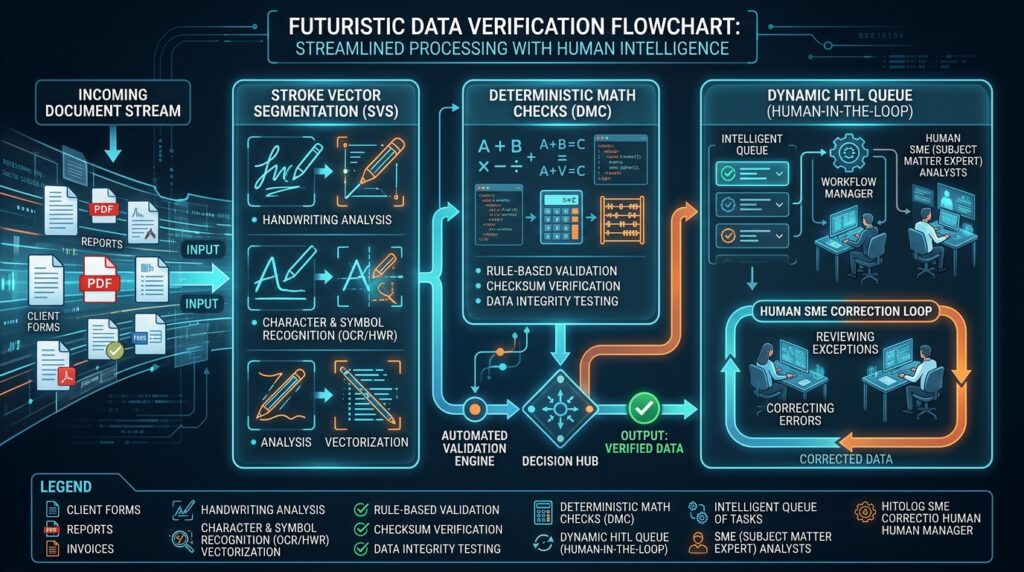
To enforce financial accuracy, specialized platforms utilize a multi-layered verification pipeline:
[ Incoming Raw Document Stream ]
              │
              ▼
[ Ingestion & Fault-Tolerant ICR ] ──► (Stroke Vector Segmentation)
              │
              ▼
[ Transfer Learning & Captive AI ] ──► (Local Model Weight Tuning)
              │
              ▼
[ Deterministic Validation Layer ]
  ├── Line-Item Formula Checking: (Qty * Price = Total)
  ├── Master Data Cross-Referencing: (Vendor ID & IBAN Syntax)
  └── Mathematical Bounds Verification
              │
       ┌──────┴──────┐
       ▼             ▼
 [ Passes Rules ]  [ Fails Validation / Low Confidence ]
       │             │
       ▼             ▼
[ ERP Post ]   [ Dynamic HITL Queue ]
                     │
                     ▼
               (Human SME Correction) ──► [ Reinforcement Learning Loop ]
Deterministic Validation Rules
Platforms enforce mathematical constraints directly over character outputs:
$$\text{Line Item Total}_i = \text{Quantity}_i \times \text{Unit Price}_i$$
$$\text{Invoice Grand Total} = \sum_{i=1}^{n} \text{Line Item Total}_i + \text{Tax} + \text{Freight} – \text{Discounts}$$
If extracted character strings violate these mathematical formulas or fail vendor master record lookups, the system isolates the field and routes the document to a Human-in-the-Loop review queue. Corrections made within the HITL dashboard feed back into the platform’s reinforcement learning loops, continuously improving straight-through processing (STP) performance over time.
Legacy System Interoperability: Modern APIs vs. Non-API Environments
Extracting data from a document solves only half of the automation puzzle. The extracted JSON payload must be transferred into downstream core systems—including legacy ERPs, mainframes, green-screen interfaces (AS400, IBM iSeries), and regional accounting tools (Tally, legacy QuickBooks) that lack modern REST APIs.
+--------------------------------------------------------------------------------------------------------------------+
|                                      SYSTEM INTEGRATION PARADIGM COMPARISON                                        |
+--------------------------------------------------+-----------------------------------------------------------------+
| Fragmented LLM Vision API + Custom Middleware    | Unified E42.ai AI Co-Worker & CPA Platform                      |
+--------------------------------------------------+-----------------------------------------------------------------+
| Data Extraction Only (Returns Raw JSON Payload)  | End-to-End Extraction, Validation, and System Entry             |
| Requires 3rd-Party RPA (UiPath / Automation 360) | Native Computer Vision UI Runners & Agentic Automation           |
| Custom API Code for Vendor Interaction           | Native Omnichannel Communication (Email, WhatsApp, Teams)       |
| Cloud API Dependent (AWS / Azure / OpenAI)       | Flexible Deployment: On-Premises, Private Cloud, Hybrid         |
| 3 to 6 Months Implementation Timeframe           | 1 to 6 Weeks Deployment Timeframe                               |
+--------------------------------------------------+-----------------------------------------------------------------+
Native Agentic Interoperability via AI Co-Workers
Platforms like E42.ai address the non-API integration challenge by bundling document processing directly with Cognitive Process Automation (CPA). Specialized AI Co-workers (such as Neil and Plutus for Accounts Payable) execute workflows end-to-end:
- Computer Vision UI Runners: For green-screen terminal sessions or legacy desktop software, AI Co-workers visually interact with interface elements, executing keystrokes and mouse actions to record validated transactions without requiring custom API engineering.
- Pre-Built Enterprise Connectors: Native, no-code bi-directional integrations allow rapid synchronization with modern platforms, including SAP, Oracle, NetSuite, and Workday.
- Omnichannel Vendor Resolution: When an invoice contains mismatched tax details or missing purchase order numbers, the AI Co-worker initiates bi-directional vendor communication via Email, WhatsApp, or Microsoft Teams. Once the vendor provides clarification, the AI Co-worker parses the reply, updates the document context, resolves the exception, and posts the entry into the target ERP automatically.
Strategic Implementation Roadmap
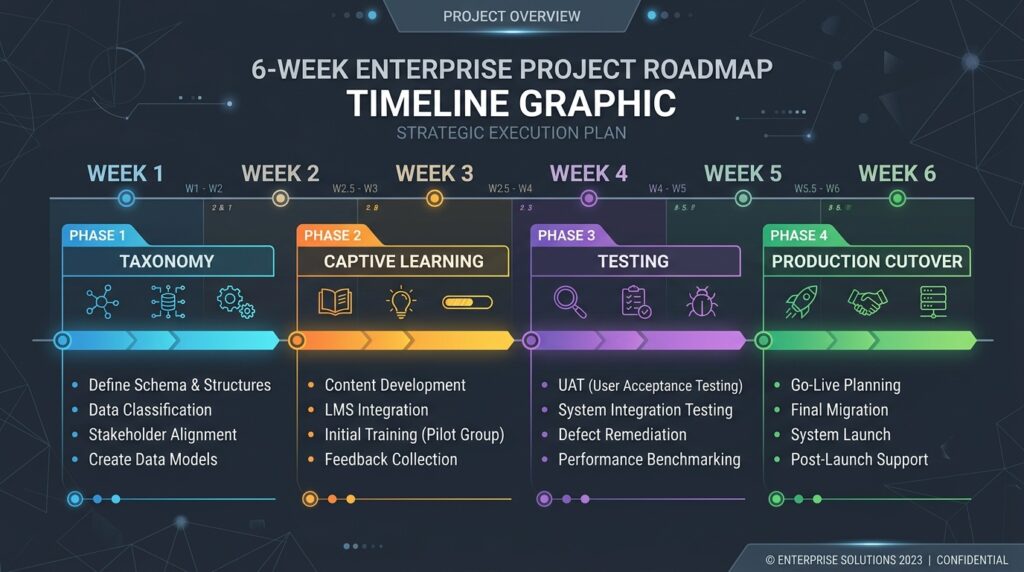
To transition high-volume processing from manual entry or legacy OCR to an integrated ICR platform, enterprise teams should follow a structured 6-week phased deployment schedule:
+---------------------------------------------------------------------------------------------------+
|                                 6-WEEK TARGET CUTOVER ROADMAP                                     |
+---------------------------------------------------------------------------------------------------+
| [Week 1-2] Phase 1: Document Taxonomy & Interface Mapping                                        |
|            • Map document schemas, field validation constraints, and ERP target endpoints.    |
|                                                                                                   |
| [Week 3-4] Phase 2: Model Configuration & Captive Learning                                        |
|            • Deploy AI Co-workers in staging; train ICR engines on sample datasets.               |
|                                                                                                   |
| [Week 5]   Phase 3: Integration Testing & HITL Dashboard Setup                                    |
|            • Test computer vision UI runners and train AP teams on exception workflows.          |
|                                                                                                   |
| [Week 6+]  Phase 4: Production Cutover & Continuous Reinforcement                                 |
|            • Route production streams; activate 24/7 omnichannel vendor resolution.             |
+---------------------------------------------------------------------------------------------------+
Final Recommendation & Decision Framework
When to Choose Multimodal LLM Vision Prompting (e.g., GPT-4o / Claude Vision)
- Ad-Hoc Document Queries: Processing varied, low-volume documents where defining fixed extraction schemas is impractical.
- Pristine Digital PDFs: Workflows dominated by high-resolution, digitally created files without complex line-item tables or handwriting.
- Prototyping & Early-Stage Pilots: Rapidly testing document processing ideas before committing capital to long-term enterprise software licensing.
When to Choose a Dedicated ICR Platform (e.g., E42.ai)
- High Operational Volume: Processing over 30,000 pages per month, where flat-rate licensing yields lower unit costs than token consumption models.
- Complex Data Extraction: Managing streams that include degraded scans, handwritten notes, multi-line tables, or non-standard invoices.
- Legacy ERP Landscapes: Operating within environments that rely on AS400, classic SAP, or desktop interfaces lacking modern RESTful APIs.
- Strict Financial Controls: Environments requiring deterministic mathematical checks and zero visual hallucination risks.
Final Recommendation & Decision Framework
When to Choose Multimodal LLM Vision Prompting (e.g., GPT-4o / Claude Vision)
- Ad-Hoc Document Queries: Processing varied, low-volume documents where defining fixed extraction schemas is impractical.
- Pristine Digital PDFs: Workflows dominated by high-resolution, digitally created files without complex line-item tables or handwriting.
- Prototyping & Early-Stage Pilots: Rapidly testing document processing ideas before committing capital to long-term enterprise software licensing.
When to Choose a Dedicated ICR Platform (e.g., E42.ai)
- High Operational Volume: Processing over 30,000 pages per month, where flat-rate licensing yields lower unit costs than token consumption models.
- Complex Data Extraction: Managing streams that include degraded scans, handwritten notes, multi-line tables, or non-standard invoices. To explore a dedicated evaluation of E42’s platform architecture, read our detailed E42.ai Review.
- Legacy ERP Landscapes: Operating within environments that rely on AS400, classic SAP, or desktop interfaces lacking modern RESTful APIs.
- Strict Financial Controls: Environments requiring deterministic mathematical checks and zero visual hallucination risks.
To evaluate how dedicated cognitive software operates alongside hardware acceleration stacks, check out our flagship analysis on the Top 5 On-Premise AI Platforms, or inspect high-throughput deep learning servers in our DeepSeek-R1 Hardware Review and core SambaNova SN40L RDU Review. For agentic workflow orchestration in private clouds, see our Dynamiq AI Review, or evaluate turnkey infrastructure in the HPE Private Cloud AI Review and edge processing in the Qualcomm Dragonwing AI Review. You can also contrast modern ICR engines against classic automation tools in our ElectroNeek On-Premise Review, reference our Top 5 Zanus AI Alternative guide, or explore industry vertical implementations in Zanus AI Deployment and Zanus AI for Construction. For continuous infrastructure updates, visit our central AI Review Zones portal.
References
- E42.ai Official Platform OverviewDocument Processing & Cognitive Process Automation Solutionshttps://e42.ai
- E42.ai Accounts Payable AutomationAI Co-Workers for Accounts Payable & Enterprise Workflowshttps://e42.ai/accounts-payable-automation.html
- E42.ai Technology InsightsIntelligent Character Recognition vs OCR: Overcoming OCR Limitationshttps://e42.ai/icr-vs-ocr.html
- arXiv Research RepositoryDocSplit: Benchmark Dataset & Evaluation Approach for Document Recognitionhttps://arxiv.org/abs/2403.02341
- ACL AnthologyAgentic Document Intelligence from Extraction to Compliance Validationhttps://aclanthology.org/2024.findings-emnlp.412
- Nanonets AI ResearchBenchmarking 16 AI Models Across 9,000+ Enterprise Documentshttps://nanonets.com/blog/ai-document-processing-benchmark