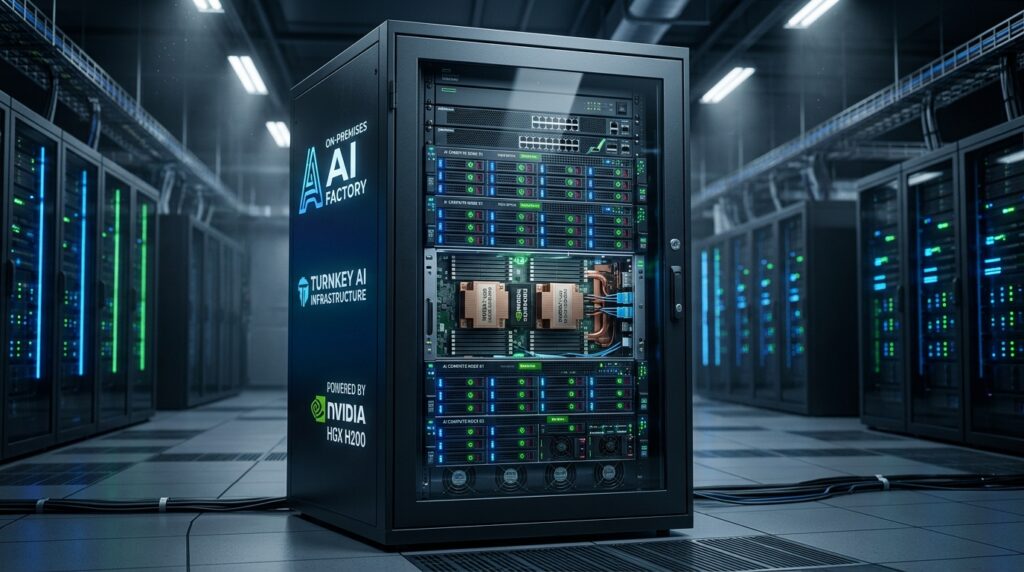
Moving artificial intelligence from an experimental Proof of Concept (PoC) to a production-grade operational framework requires more than buying specialized hardware. It requires an integrated infrastructure architecture that mitigates physical integration risks, eliminates networking bottlenecks, and maintains tight data governance.
Many enterprises fall into the trap of treating AI infrastructure as a traditional compute upgrade. When distributed workloads scale out, the hidden points of friction—such as GPU-to-GPU communication latencies, hypervisor licensing overhead, and data compliance vulnerabilities—often jeopardize the return on investment.
The HPE Private Cloud AI platform, co-developed by Hewlett Packard Enterprise and NVIDIA, presents an integrated turnkey architecture modeled as an on-premises “AI Factory.” This deep-dive evaluation dissects the underlying hardware blueprints, software integration layers, networking choices, and macroeconomic trade-offs that enterprise CTOs and Data Governance Directors must weigh before committing capital.
1. The Hardware Blueprints: HPE Private Cloud AI Review & NVIDIA Accelerated Compute.
At the compute layer, the platform relies on AI-optimized worker nodes built on the HPE ProLiant Compute DL380a Gen12 architecture. These systems pair latest-generation Intel Xeon processors with high-density GPU configurations to handle massive multi-modal inference, agentic AI architectures, and complex fine-tuning workloads.
Memory Bandwidth and Performance Characteristics
Rather than focusing on raw processing speed, the system design prioritizes memory bandwidth. Deploying high-end accelerators like the NVIDIA H200 NVL Tensor Core GPU introduces ultra-fast HBM3e memory. This allows large language models (LLMs) with high parameter counts to reside entirely within the GPU’s dedicated VRAM.
By removing dependencies on the standard system RAM—which requires data to traverse the slower PCIe bus—the architecture bypasses traditional bandwidth bottlenecks. The operational outcome is a substantial reduction in inference latency, higher token throughput, and improved energy efficiency per workload.
Physical Security and Firmware Integrity
Enterprise deployments require stringent infrastructure security. The ProLiant Gen12 hardware establishes hardware-based secure enclaves directly at the firmware level to counter unauthorized modification or malicious injection. This is backed by post-quantum cryptography algorithms and a verified trusted supply chain framework, ensuring component integrity from manufacturing to data center rack assembly.
The table below outlines the core hardware specifications across the standardized deployment tiers:
| Infrastructure Attribute | Developer System | Small Configuration (1-2 Nodes) | Medium Configuration (2 Nodes) | Large Configuration (2 Nodes) |
| Control Nodes | 1x HPE ProLiant DL325 Gen11 | 3x HPE ProLiant DL325 Gen11 | 3x HPE ProLiant DL325 Gen11 | 3x HPE ProLiant DL325 Gen11 |
| Worker Nodes | 1x HPE ProLiant Compute Gen12 | 1-2x HPE ProLiant Gen12 | 2x HPE ProLiant Gen12 | 2x HPE ProLiant Gen12 |
| CPU per Worker Node | 2x Xeon 32 Core | 2x Xeon 64 Core | 2x Xeon 64 Core | 2x Xeon 64 Core |
| Standard GPU Configuration | 2x RTX Pro 6000 Blackwell | 4x or 8x RTX Pro 6000 Blackwell | 8x H200 NVL | 16x H200 NVL or RTX Pro 6000 Blackwell |
| Storage Capacity | 22 TB – 32 TB (Internal NVMe) | 62 TB – 109 TB HPE Alletra Storage MP X10000 | 62 TB – 109 TB HPE Alletra Storage MP X10000 | 124 TB – 217 TB HPE Alletra Storage MP X10000 |
| AI Fabric Banning | 200 GbE | 400 GbE | 400 GbE | 400 GbE |
| Included Switches | None (Direct-connect ports) | NVIDIA SN4700M & Aruba 6300M (oobm) | NVIDIA SN4700M & Aruba 6300M (oobm) | NVIDIA SN4700M & Aruba 6300M (oobm) |
Operational Insight: Hardware performance metrics confirmed via standard industry benchmarks indicate that the HPE ProLiant Compute DL380a Gen12 architecture holds leading positions in MLPerf Inference: Datacenter v5.0 tests. It maintains high processing efficiency across complex architectures including GPT-J, Llama2-70B, ResNet50, and RetinaNet.
2. The Software Engine: Abstracting Complexity via NIM and HPE AI Essentials
Translating raw silicon power into stable enterprise applications requires an integrated, production-ready software stack. The platform tackles this by embedding NVIDIA AI Enterprise (NVAIE) alongside the HPE AI Essentials management layer. This alignment mitigates the compatibility and dependency fragmentation risks that frequently disrupt self-assembled open-source software stacks.
NIM Microservices and Inference Optimization
NVIDIA Inference Microservices (NIM) serve as the core engine for containerized model deployment. A NIM consists of pre-packaged containers optimized for specific GPU architectures. Instead of manually configuring low-level software libraries such as CUDA or TensorRT, engineering teams can call standard APIs to spin up open-source models like Llama 3.
Behind the scenes, the NIM infrastructure automates low-level runtime optimizations, including KV cache management and dynamic continuous batching. This technical abstraction shortens response latency during Retrieval-Augmented Generation (RAG) execution and targeted fine-tuning operations.
ML Lifecycle Synchronization
To ensure consistent management across the full lifecycle, HPE AI Essentials incorporates core operational utilities:
- Experimentation and Tracking: Built-in deployment of Kubeflow, MLflow, and JupyterLab environments.
- Data Processing at Scale: Integrated connectors for Apache Spark and Apache Airflow pipelines.
This synchronization ensures that data ingestion, model validation, and deployment monitoring report up to a centralized control pane, preventing architectural divergence across separate lines of business.
3. Horizontal Scaling Architecture: Hybrid Cloud Economics and Spectrum-X Networking
A significant barrier to scaling artificial intelligence is the infrastructure layout mismatch that occurs when a project transitions from an isolated pilot program into a multi-tenant corporate environment. The system addresses this bottleneck by combining the HPE GreenLake consumption model with the NVIDIA Spectrum-X accelerated networking matrix.
The Consumption Model and Unified Control Plane
The GreenLake framework brings a cloud-like consumption model to on-premises environments, reducing large upfront CapEx barriers. Enterprises structure infrastructure costs under predictable 3-year or 5-year operating expense (OpEx) models.
Operational control relies on a Unified Control Plane interface. Infrastructure administrators monitor real-time GPU compute quotas, allocate resource boundaries across competing business units, and execute software maintenance patches from a single dashboard. This system isolates core business operations from sudden capital requirements when hardware requirements grow.
Seamless Hardware Resource Pooling
Scaling out hardware capacity often introduces network re-engineering friction. With this platform, upgrading from a base Developer System or Small configuration to a Medium or Large footprint uses pre-engineered G2 Expansion Racks.
Because the Small through Large deployment options include the high-performance NVIDIA SN4700M 400 GbE switch from day one, expanding the node count avoids physical network topology modifications. The architecture uses software-driven resource pooling to automatically detect new worker nodes via the existing switches, instantly extending the unified GPU compute fabric without disrupting running applications.
Network Congestion Control via NVIDIA Spectrum-X and RoCE v2
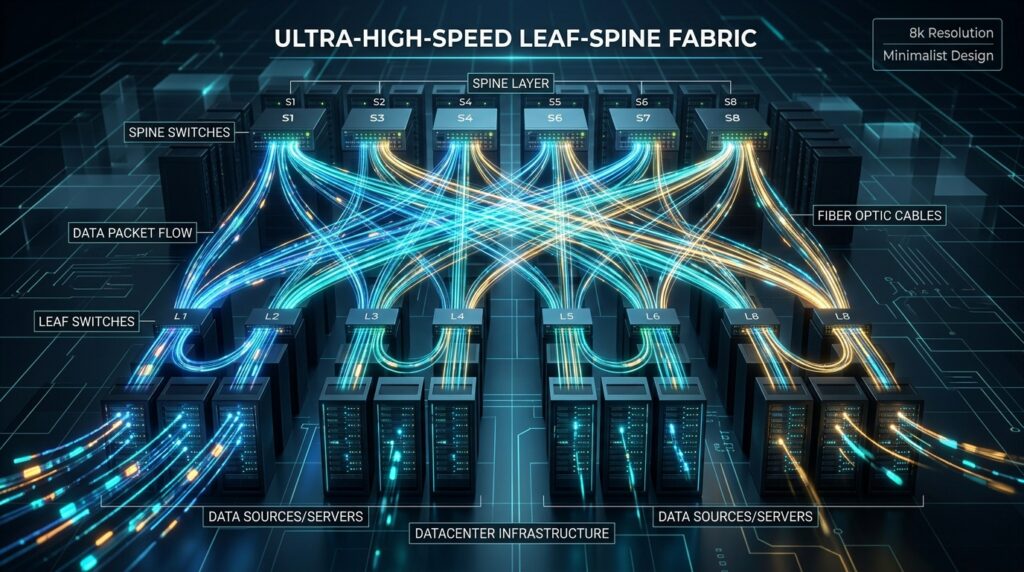
When scaling AI models across multiple physical server racks, data synchronization delays between parallel nodes can degrade training and inference speeds. Standard Ethernet structures often drop data packets or distribute loads unevenly during intense data bursts.
The integration of the NVIDIA Spectrum-X fabric platform, which pairs the high-throughput Spectrum-4 switch framework with BlueField-3 DPUs or ConnectX SuperNICs, addresses this issue through specific mechanisms:
- RDMA over Converged Ethernet (RoCE v2): Grants compute nodes direct access to memory spaces across separate physical servers without passing data through host operating systems, dropping inter-node transit delays down to microsecond levels.
- Hardware-Driven Congestion Mitigation: Uses real-time telemetry to check network queue depths at sub-microsecond increments, dynamically regulating port transmission speeds to remove packet loss.
- Adaptive Routing Paths: Slices large data blocks into smaller packets, routing them dynamically across available paths within a Leaf-Spine network configuration to achieve up to 95% total network bandwidth utility.
- Inband Network Telemetry (INT): Passes continuous network performance health indicators directly back to system monitoring tools, accelerating troubleshooting cycles.
4. The Enterprise Governance Blueprint: Defeating Shadow IT and Preserving Data Sovereignty
For corporate Data Governance Directors, widespread artificial intelligence adoption creates acute security risks. Chief among these is Shadow IT, which occurs when internal teams upload restricted proprietary information to third-party public cloud models, risking intellectual property leakage and compliance violations.
Neutralizing Shadow IT via Internal Workbenches
The platform counters Shadow IT by providing an on-premises development experience that matches public cloud convenience. By making tools like JupyterLab and NVIDIA libraries accessible via single-sign-on (SSO) interfaces, the internal ecosystem removes the friction that drives developers toward unapproved external platforms.
Consolidated Storage: Federated Data Lakehouse
The storage layout centers on the HPE Alletra Storage MP X10000 system, engineered to manage unstructured enterprise data at scale. Using a Federated Data Lakehouse and a Global Namespace architecture, it queries and aggregates data assets from separate repositories—such as SQL engines, Delta Lake tables, Apache Iceberg, or S3-compatible objects—without executing slow physical data copies. This approach preserves a single source of truth, avoiding the creation of unmanaged duplicate datasets during fine-tuning processes.
Automated Infrastructure Monitoring via OpsRamp AI Copilot
The embedded OpsRamp platform monitors the entire stack, tracking metrics from physical hardware states up to individual model performance flows:
- Predictive Hardware Upkeep: Collects continuous system telemetry through HPE Integrated Lights-Out (iLO) systems and automated SNMP validations. The system flags early components anomalies, catching up to 86% of infrastructure faults before they cause system down-time.
- Data Flow Audit Trails: Leverages Prometheus and OpenTelemetry (OTEL) configurations to trace data motion across security zones, providing clear audit trails for security compliance.
- Granular Identity Access Management: Links with Role-Based Access Control (RBAC) layers and manages microservice security profiles via Keycloak and SPIFFE/SPIRE frameworks to secure internal model endpoints.
Strict Data Sovereignty via Air-Gapped Deployments
For highly regulated industries such as banking, healthcare, or government operations, complete data isolation is a core requirement. The Medium and Large production configurations offer fully air-gapped operating profiles. This isolates the entire AI environment from external internet connections, ensuring that updates, training steps, and inferences run entirely within a secure internal network perimeter.
5. Macroeconomic Analysis: Public Cloud APIs vs. On-Premises Turnkey Architecture
Deciding whether to build a dedicated private AI cloud or utilize public cloud API endpoints requires a careful quantitative analysis of long-term transactional costs versus upfront infrastructure investments.
Quantitative Financial Comparison
To analyze the economic shifts that occur when workloads scale up, we evaluate a standardized enterprise operational scenario:
- Concurrent Internal User Base ($U$): 5,000 active employees.
- Daily Interaction Frequency ($S$): 5 chat sessions per user per day.
- Transaction Size ($T$): 8,000 tokens per session (combined prompt input and response generation).
- Annual Operating Window ($D$): 250 business days per year.
The baseline mathematical data volume calculations are structured as follows:
$$\text{Daily Processed Volume} = U \times S \times T = 5,000 \times 5 \times 8,000 = 200,000,000 \text{ tokens/day}$$
$$\text{Annual Processed Volume} = 200,000,000 \times 250 = 50,000,000,000 \text{ tokens/year}$$
The table below contrasts the annual operational costs of public cloud endpoints against an on-premises private cloud alternative running a comparable open-source model (including hardware depreciation, data center colocation hosting fees, power consumption, and cooling allocations over a 3-year amortization window):
| Deployment Architecture | Model Configuration | Annual Operating Expense (USD) | Annual Net Savings vs. GPT-4 (USD) | Relative Cost Reduction (%) |
| Public Cloud API (Classic) | OpenAI GPT-4 | $3,832,500 | Baseline | Baseline |
| Public Cloud API (Optimized) | OpenAI GPT-4o | $912,500 | $2,920,000 | 76.19% |
| Public Cloud API (Entry-Level) | OpenAI GPT-4o mini | $35,587 | N/A (Small Model Size) | N/A |
| HPE Private Cloud AI (Enterprise) | Llama 3 70B (On-Premises IaaS) | $500,802 | $3,331,698 | 86.93% |
| HPE Private Cloud AI (Light) | Llama 3 7B (On-Premises IaaS) | $24,802 | N/A (Small Model Size) | N/A |
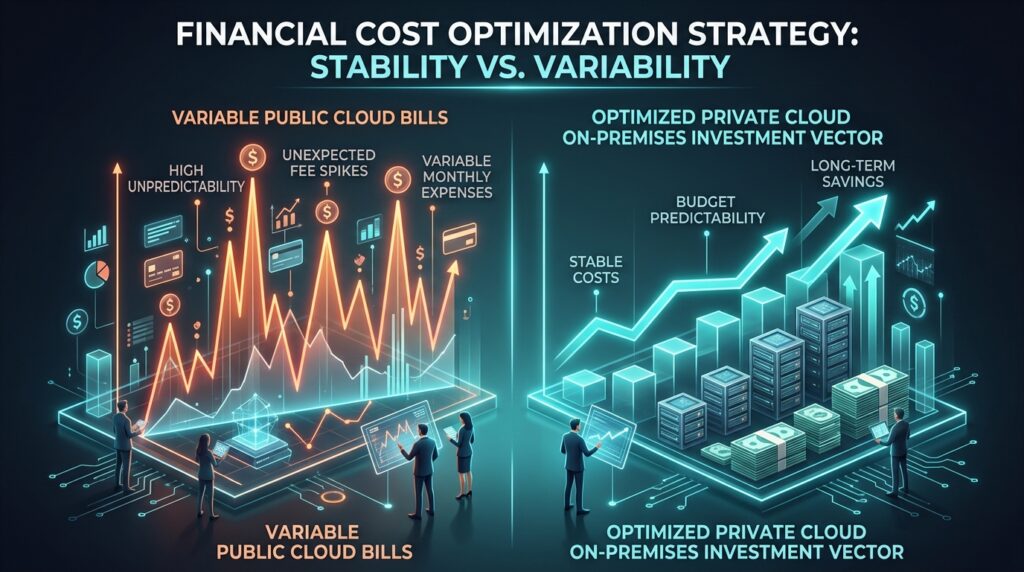
The data indicates that for high-volume, continuous enterprise inference demands, running an open-source model like Llama 3 70B inside an on-premises turnkey infrastructure offers significant cost efficiencies. The private cloud configuration cuts annual operating expenses by 86.93% compared to standard GPT-4 endpoints, and maintains a 45.12% financial advantage over the optimized GPT-4o pricing structure.
Mitigating Hypervisor Licensing Overhead
A secondary cost component in private cloud deployments is hypervisor licensing fees. This platform incorporates HPE Morpheus VM Essentials to control these software expenses.
Morpheus VM Essentials integrates an embedded KVM-based open-source hypervisor alongside standard physical socket-based licensing models. This multi-hypervisor integration provides tangible operational benefits:
- Reduces Hypervisor Costs: Cuts software overhead up to 90% compared to traditional proprietary enterprise virtualization agreements.
- Accelerates Application Deployment: Automated self-service provisioning pathways speed up internal service delivery times across hybrid environments.
- Optimizes Total Cost of Ownership (TCO): Combining Morpheus with hardware-accelerated networking infrastructure can reduce virtualization infrastructure TCO by up to 48%.
Strategic Capital Structuring
To help ease the transition from CapEx to OpEx models, HPE Financial Services structures several deployment support mechanisms:
- Deferred Payment Paths: Offers a 90-day payment deferral window at the start of installation to allow teams to stand up the environment before capital outlays begin.
- Phased Cash-Flow Programs: Structures reduced initial service charges during the first six months of operation to match system maturity phases.
- Asset Trade-In Equity: Allows organizations to trade in legacy compute assets to generate direct capital credits for new AI infrastructure deployments.
6. Strategic Recommendations: Next Action Items for Enterprise Decision-Makers
Deploying the HPE Private Cloud AI platform should be approached as a broader realignment of corporate data assets rather than a routine hardware purchase. To ensure a secure, high-yield deployment, enterprise technology leadership should execute three clear action items:
1. Execute a Strict Data Classification Audit
Before installing any hardware, map internal data assets based on security risk profiles and compliance requirements. Leverage the Federated Data Lakehouse features within the Alletra Storage MP infrastructure to establish secure links to sensitive datasets without creating unmanaged duplicate copies. Configure strict role-based access controls (RBAC) to ensure model training steps run only on authorized data segments.
2. Map the Scalability Matrix Early
Begin pilot programs by sizing initial needs against standard entry points like the Developer System bundle or a Small configuration node. Because the core architecture includes the 400 GbE SN4700M switch infrastructure out of the box, future scale-out expansions via G2 Expansion Racks can be driven via software adjustments, protecting the organization from sudden network redesign expenses.
3. Deploy Automated Telemetry from Day One
Integrate OpsRamp AI Copilot monitoring directly into core corporate IT ticketing pipelines. Moving system maintenance from a reactive posture to a telemetry-driven, predictive framework protects expensive accelerator investments and maintains high uptime across customer-facing and internal corporate AI applications.
Strategic Recommendations: Next Action Items for Enterprise Decision-Makers
Deploying the HPE Private Cloud AI platform should be approached as a broader realignment of corporate data assets rather than a routine hardware purchase. To ensure a secure, high-yield deployment, enterprise technology leadership should execute strict data classification audits, map the scalability matrix early using software-driven resource pooling, and deploy automated telemetry from day one via the OpsRamp AI Copilot infrastructure.
To see how this turnkey architecture measures up against alternative localized server configurations, check out our comprehensive architectural breakdown in the Qualcomm Dragonwing AI Review. For a broader market comparison across multiple on-premises environments, explore our enterprise guide on the Top 5 Zanus AI Alternative options for 2026. If you are tailoring your private infrastructure toward specific industrial sectors, we highly recommend reading our blueprints on Zanus AI Deployment methodologies, Zanus AI for Construction, and Zanus AI for Logistics. To maintain a competitive edge with independent tech valuations, ensure you bookmark our core AI Review Zones hub today.
References
- Hewlett Packard Enterprise: HPE Private Cloud AI QuickSpecs & Solution Architecture Guidelineshttps://www.hpe.com/h20195/v2/GetDocument.aspx?docname=a50007204enw
- NVIDIA Newsroom: Hewlett Packard Enterprise and NVIDIA Announce ‘NVIDIA AI Computing by HPE’ to Accelerate Generative AI Industrial Revolutionhttps://nvidianews.nvidia.com/news/hewlett-packard-enterprise-and-nvidia-announce-nvidia-ai-computing-by-hpe-to-accelerate-generative-ai-industrial-revolution
- HPE Community Portal: Next-Generation HPE Private Cloud AI Drives Enterprise AI Performance and Profitabilityhttps://community.hpe.com/t5/servers-systems-the-right/next-generation-hpe-private-cloud-ai-drives-enterprise-ai/ba-p/7222144
- Principled Technologies: On-Premises AI Approaches: The Advantages of a Turnkey Solution, HPE Private Cloud AIhttps://www.principledtechnologies.com/HPE/Private-Cloud-AI-turnkey-advantages-0924.pdf
- HPE Support Technical Documentation: Overview and System Administration Guide for the HPE Private Cloud AI Engineered Systemhttps://support.hpe.com/hpesc/public/docDisplay?docId=sd00003463en_us