
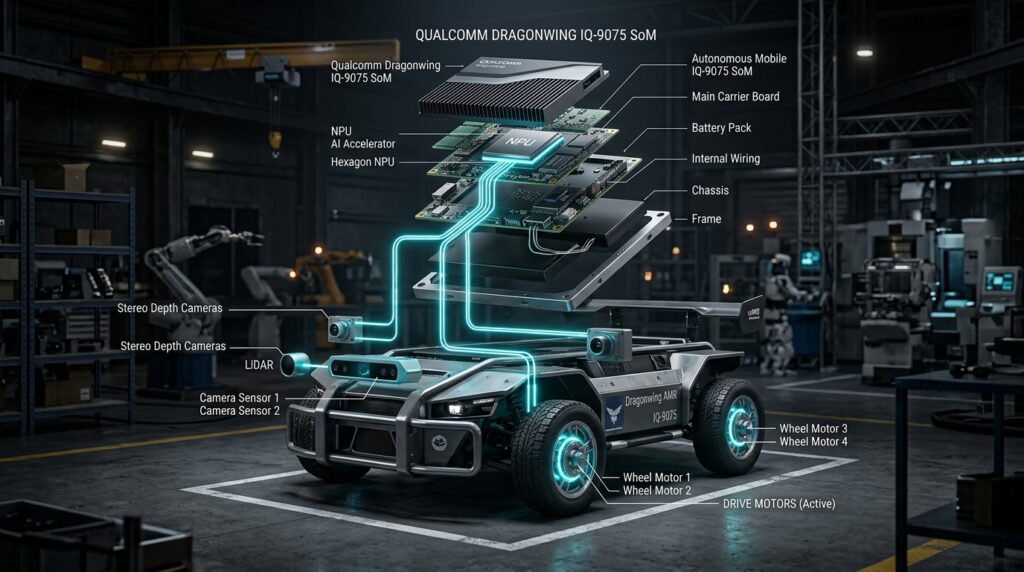
Publishing a comprehensive Qualcomm Dragonwing IQ-9075 review is crucial for robotics system architects, as modern factory floors evaluate if consolidated physical AI is ready to replace the legacy x86+MCU stack. In this article, we analyze its 200 TOPS dual-brain architecture, real-time motor control capabilities, and 3-year TCO impact for next-generation AMRs.
Autonomous Mobile Robots (AMRs) and Automated Guided Vehicles (AGVs) on modern factory floors face a structural computing bottleneck. Real-time perception, localized path generation, and visual dynamic obstacle avoidance require massive parallel compute. At the same time, safety-critical motor control, wheel encoders, and braking loops demand sub-millisecond determinism.
Historically, industrial system architects solved this by building a split-architecture setup: an x86 or GPU-centric System-on-Chip (SoC) for perception paired with a discrete Microcontroller Unit (MCU) over an external bus for low-level motor actuation.
While functional, this split architecture introduces latency jitter, thermal overhead, heavy cabling, and high bill-of-materials (BOM) costs.
The Qualcomm Dragonwing IQ9 series, anchored by the flagship IQ-9075 (QCS9075), directly targets this integration headache. Manufactured on a 5nm Low Power Early (LPE) process, the IQ-9075 consolidates a high-performance application CPU, GPU, a dual Hexagon Tensor Processor (HTP) NPU, and an isolated quad-core real-time subsystem (RTSS) onto a single System-on-Module (SoM).
Here is our independent analysis of the IQ-9075 architecture, its deterministic execution model, physical AI capabilities, and whether it makes commercial sense for your next embedded robotics deployment.
Qualcomm Dragonwing IQ-9075 Review: Executive Summary & Specs
| Hardware Subsystem | Component Architecture | Clock Speed / Max Throughput | Primary Role in AMR / AGV Applications |
| Application CPU | Octa-Core Kryo Gen 6 (Cortex-A78C) | Up to 2.36 GHz (227K DMIPS) | ROS 2 orchestration, vSLAM, global route planning |
| Graphics Engine | Qualcomm Adreno 663 GPU | 800 MHz (1.2 TFLOPS FP32) | Rendering, LiDAR point-cloud processing, Vulkan compute |
| Neural Subsystem | Dual Hexagon Tensor Processor (HTP) | 100 Dense / 200 Sparse INT-8 TOPS | Local Vision-Language Models, multi-camera object detection |
| Real-Time MCU | Quad-Core ARM Cortex-R52 | 1.85 GHz | Hard real-time motor control, kinematic actuation, safety loops |
| System Memory | Up to 36 GB LPDDR5 (96-bit bus) | 6400 MT/s (with Inline/Link ECC) | High-bandwidth unified memory for vision & AI data streams |
| Storage Subsystem | Dual UFS 3.1 Gear 4 / eMMC 5.1 | 2-Lane UFS Interface | OS boot, localized logging, model weight storage |
Architecture Breakdown: The Dual-Brain System-on-Chip
The Dragonwing IQ-9075 SoC is organized around a dual-brain domain topology that decouples compute-heavy edge AI processing from low-latency real-time control.
+-----------------------------------------------------------------------+
|                       QUALCOMM DRAGONWING IQ-9075                     |
|                                                                       |
|  +-----------------------------------------------------------------+  |
|  |                 MICROPROCESSOR DOMAIN (MD)                      |  |
|  |                                                                 |  |
|  |  +-----------------------+     +-----------------------------+  |  |
|  |  |   Octa-Core Kryo      |     |     Qualcomm Adreno 663    |  |  |
|  |  | (ARM Cortex-A78C CPU) |     |       GPU (1.2 TFLOPS)       |  |  |
|  |  |  ROS 2 / vSLAM / Navigation | |  Point Clouds / Pre-Processing |  |
|  |  +-----------------------+     +-----------------------------+  |  |
|  |                              |                                  |  |
|  |  +-----------------------------------------------------------+  |  |
|  |  |     Dual Hexagon Tensor Processor (HTP) NPU Subsystem     |  |  |
|  |  |       100 Dense / 200 Sparse TOPS (INT8) for VLMs/VLA     |  |  |
|  |  +-----------------------------------------------------------+  |  |
|  +-----------------------------------------------------------------+  |
|                                 |                                     |
|                       ZERO-COPY SHARED SRAM                           |
|                       & HARDWARE IPC INTERRUPTS                       |
|                                 |                                     |
|  +-----------------------------------------------------------------+  |
|  |                REAL-TIME SUBSYSTEM (RTSS)                       |  |
|  |                                                                 |  |
|  |  +-----------------------------------------------------------+  |  |
|  |  |          Quad-Core ARM Cortex-R52 Cluster (1.85 GHz)       |  |  |
|  |  |    Split-Lock / Hard Real-Time RTOS / 1-10 kHz Loop        |  |  |
|  |  +-----------------------------------------------------------+  |  |
|  |                              |                                  |  |
|  |  +-----------------------------------------------------------+  |  |
|  |  |       CAN-FD / PWM / Hardware E-Stop Interlocks          |  |  |
|  |  +-----------------------------------------------------------+  |  |
|  +-----------------------------------------------------------------+  |
+-----------------------------------------------------------------------+
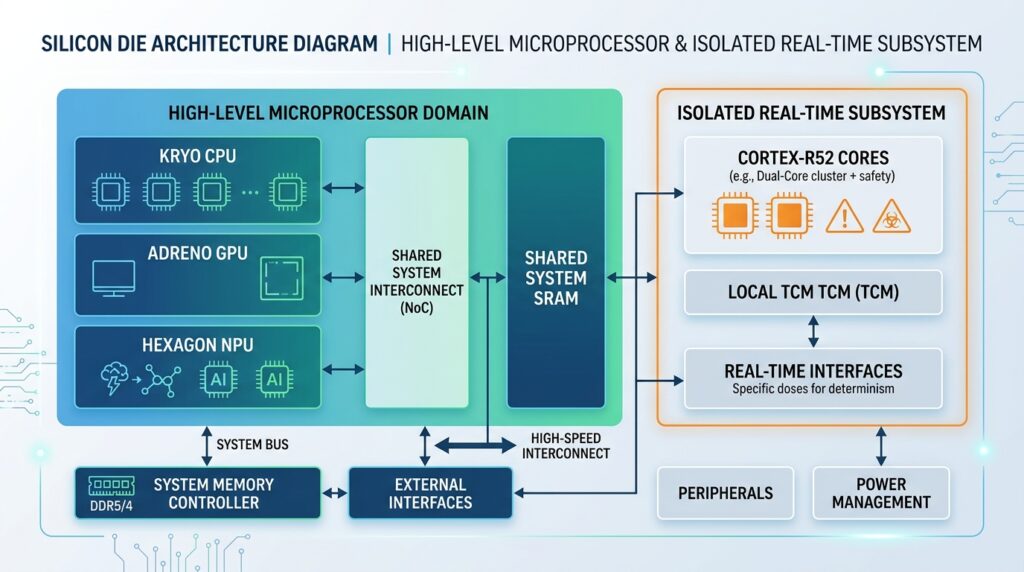
High-Level Microprocessor Domain (MD)
- Application Processing: Driven by an octa-core Qualcomm Kryo Gen 6 cluster (Cortex-A78C cores) running up to 2.36 GHz. Delivering up to 227,000 DMIPS, this cluster easily handles multi-threaded Robot Operating System (ROS 2) nodes, real-time Simultaneous Localization and Mapping (vSLAM), and continuous route optimization without creating OS bottlenecks.
- Spatial and Compute GPU: The integrated Adreno 663 GPU (1.2 TFLOPS FP32) supports Vulkan 1.2, OpenGL ES 3.2, and OpenCL 2.0 FP. Featuring Adreno NN Direct extensions, depth-map generation, LiDAR point-cloud processing, and occupancy grid calculations execute natively without pulling compute from the CPU.
- Dual HTP NPU Subsystem: AI workloads sit on a dual Hexagon Tensor Processor combining a Hexagon DSP, four HVX (Vector) coprocessors, and two HMX (Matrix) coprocessors. Delivering 100 INT-8 dense TOPS and up to 200 INT-8 sparse TOPS, this pipeline is tuned for quantized vision transformers, object detection, and dynamic segmentation models.
Deterministic Real-Time Subsystem (RTSS)
Control functions are offloaded to an embedded MCU-like domain powered by a quad-core ARM Cortex-R52 processor cluster at 1.85 GHz. Featuring hardware isolation and split-lock execution modes, these cores maintain direct access to real-time I/O interfaces.
This hardware separation provides microsecond-level determinism for motor control loops, emergency braking logic, and safety field monitoring. Even if the application CPU experiences an OS kernel panic or high memory contention, the Cortex-R52 safety domain continues to run unimpeded.
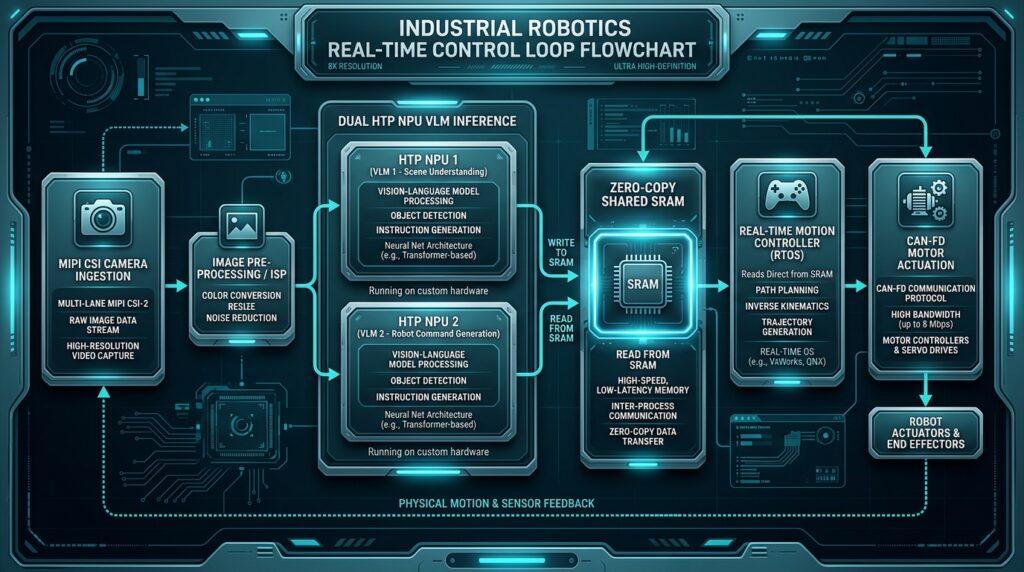
How the Physical AI Closed-Loop Execution Works
Conventional robotics architectures route signals between separate compute boards across PCIe, USB, or UART buses, introducing latency jitter and potential single-point wiring failures.
The IQ-9075 bypasses this by using an internal hardware-enforced Inter-Processor Communication (IPC) topology with zero-copy shared memory regions and hardware semaphores.
MIPI CSI Depth Cameras / Cameras
          │
          ▼
Spectra 690 ISP & HVX (Raw Calibration & Tensors)
          │
          ▼
Dual HTP NPU (VLM / VLA Local Inference Execution)
          │
          ▼
Kryo CPU Cluster (ROS 2 PREEMPT_RT Path Planning)
          │  [Outputs Target Velocity Vectors: vx, vy, ω]
          ▼
ECC-Protected Shared SRAM + Hardware IPC Interrupt
          │
          ▼
Cortex-R52 RTSS Cluster (Calculates Inverse Kinematics)
          │  [Outputs Motor Wheel Commands: w1, w2, w3, w4]
          ▼
CAN-FD / PWM Channels ──► Industrial Servo Drives / Motors (1–10 kHz Loop)
- Ingestion & ISP Calibration: Surround-view vision inputs enter through MIPI CSI connectors. The integrated Spectra 690 ISP and HVX vector units format raw sensor arrays into calibrated point clouds and tensor matrices.
- Inference & Path Planning: The dual HTP NPU evaluates local spatial costmaps and dynamic obstacles. The Kryo CPU cluster running ROS 2 on a PREEMPT_RT Linux kernel computes path trajectory targets $(v_x, v_y, \omega)$.
- Zero-Copy Handshake: The updated trajectory vectors are written into an ECC-protected shared SRAM region accessible by both domains. A hardware IPC interrupt immediately alerts the Cortex-R52 cores.
- Deterministic Actuation: Running an RTOS, the Cortex-R52 cores read the trajectory targets with bounded microsecond latency, running inverse kinematics to output wheel velocity setpoints ($w_1, w_2, w_3, w_4$) over CAN-FD or PWM channels to physical servo drives.
Operational Impact: By keeping high-level perception and hard motor control on the same die with hardware isolation, system engineers eliminate the software-induced motor stutter that happens when high-level CPU loads spike.
Benchmarking Local Vision-Language Model (VLM) Execution
Running generative Vision-Language Models (VLMs) and Vision-Language-Action (VLA) models at the edge lets mobile equipment process natural language instructions and adapt to dynamic environmental changes without relying on cloud connections.
| Model Architecture | Parameter Count | Quantization / Precision | Measured Performance | Primary Robotic Application |
| Meta Llama 2 | 13 Billion | INT-8 / INT-4 Quantized | Up to 12 Tokens / Sec | On-board dialogue & high-level task planning |
| SmolVLA (Unoptimized) | 0.45 Billion | FP16 Baseline | 218 ms / Action Step | Unquantized baseline; too slow for continuous motion |
| SmolVLA (Nota Optimized) | 0.45 Billion | Optimized INT-8 / HMX | 31 ms / Action Step | ~32 Hz closed-loop control; real-time visual navigation |
| Multi-Channel Object Detector | Variable CNNs | INT-8 Dense | Concurrent 16-Camera Stream | Surround vision analytics & obstacle tracking |
When lightweight VLA models like SmolVLA (0.45B parameters) are quantized down to INT8 and compiled for the Hexagon Matrix eXtensions (HMX), execution latency drops from 218 ms to 31 ms per inference step.
A 31 ms execution step delivers an update frequency of ~32 Hz, matching standard depth camera frame rates. For an AMR moving at 2.0 m/s, the vehicle re-evaluates its trajectory every 6.2 cm of movement. Local processing avoids cloud latency, eliminates signal dropouts in isolated warehouse corridors, and removes monthly API subscription overhead.
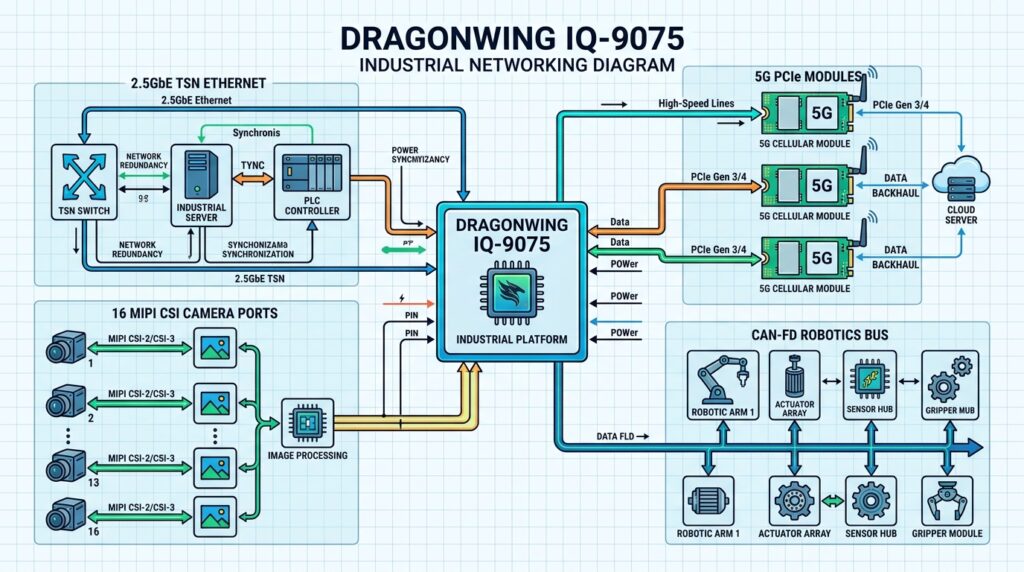
Industrial I/O, Networking, and Peripheral Capabilities
Connecting embedded hardware within automated manufacturing environments requires deterministic networking and broad sensor interfacing.
                               +-------------------------------------+
                               |    Qualcomm Dragonwing IQ-9075      |
                               +-------------------------------------+
                                                  |
       +-----------------------+------------------+-----------------------+
       |                       |                  |                       |
       ▼                       ▼                  ▼                       ▼
+--------------+       +---------------+   +--------------+       +---------------+
| Dual 2.5GbE  |       | 4x 4-Lane     |   |   CAN-FD     |       | PCIe Gen 4.0  |
| Ethernet     |       | MIPI CSI Ports|   | Controller   |       | Interfaces    |
| (Native TSN) |       | (16 Cameras)  |   | (Up to 8Mbps)|       | (5G / NVMe)   |
+--------------+       +---------------+   +--------------+       +---------------+
       |                       |                  |                       |
       ▼                       ▼                  ▼                       ▼
  Deterministic          Surround-View       Servo Drives &          High-Speed
    PLC / Fleet            Perception          Safety BMS           Storage & Cellular
  Synchronization
Time-Sensitive Networking (TSN)
The IQ-9075 includes dual 2.5 Gigabit Ethernet controllers with native hardware support for key IEEE TSN standards:
- IEEE 802.1AS (gPTP): Sub-microsecond clock synchronization across networked systems for time-aligned multi-camera ingestion and multi-robot fleet coordination.
- IEEE 802.1Qbv (Time-Aware Shaper): Segregates network bandwidth into strict time slots, guaranteeing control message delivery alongside regular data traffic.
- IEEE 802.1Qbu (Frame Preemption): Interrupts non-critical Ethernet frames to prioritize time-sensitive safety alerts.
Multi-Camera Processing
Supports up to 16 concurrent camera feeds routed across four 4-lane MIPI CSI ports (D-PHY 1.2 / C-PHY 2.0). Eight dedicated Camera Control Interface (CCI) I2C channels ensure hardware-synchronized exposure across surround-view sensor arrays.
Expansion & Serial Interfaces
Features an integrated CAN-FD controller (up to 8 Mbps) for direct control of servo drives, steering actuators, and Battery Management Systems (BMS). Peripheral flexibility is expanded via 21 configurable Universal Peripheral Serial Engines (QUP_SE) supporting UART, SPI, and I2C modes, alongside 149 GPIO pins and dual PCIe Gen 4 lanes ($1 \times 4$-lane and $1 \times 2$-lane) for 5G cellular modems or NVMe storage expansion.
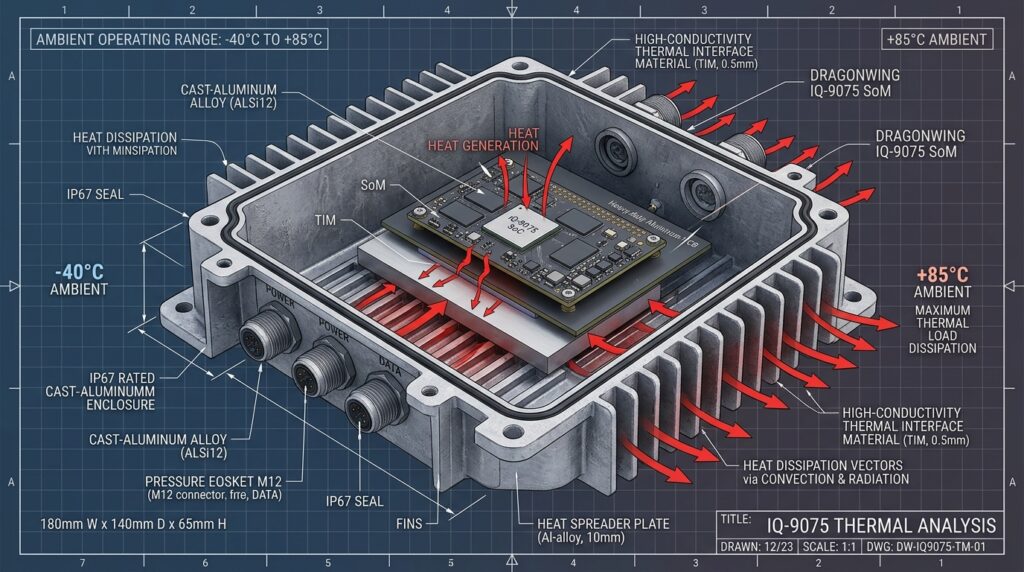
Thermal Engineering and Passive Chassis Design
Industrial mobile hardware must withstand physical vibration, continuous thermal cycles, and dust or liquid contamination.
+--------------------------------------------------------------------+
|                  PASSIVE SEALED CHASSIS (IP65/IP67)                 |
|                                                                    |
|  +--------------------------------------------------------------+  |
|  |           Direct-Contact Thermal Interface Material          |  |
|  +--------------------------------------------------------------+  |
|                                |                                   |
|  +--------------------------------------------------------------+  |
|  |              Qualcomm Dragonwing IQ-9075 SoM                 |  |
|  |                  (1573-Ball BGA / 5nm LPE)                   |  |
|  |                                                              |  |
|  |   Max Junction Temp (Tj): 115°C  |  Ambient Target (Ta): 60°C  |  |
|  |               System Thermal Resistance: 1.8°C/W             |  |
|  |                Calculated Fanless TDP: ~30.55 W                |  |
|  +--------------------------------------------------------------+  |
|                                |                                   |
|  +--------------------------------------------------------------+  |
|  |            Cast-Aluminum Outer Heat Sink Enclosure           |  |
|  +--------------------------------------------------------------+  |
+--------------------------------------------------------------------+
The IQ-9075 uses a 1573-ball Fine-Pitch Ball Grid Array (BGA) package measuring $65 \times 65 \times 4.55\text{ mm}$. The module is AEC-Q100 Grade 3 qualified, built to handle industrial vibration and thermal variation ranging from $-40^\circ\text{C}$ to $+85^\circ\text{C}$ ambient.
| Parameter | Operational Specification | Engineering Significance |
| Ambient Operating Range | $-40^\circ\text{C}$ to $+85^\circ\text{C}$ | Functions reliably in cold storage and unconditioned plants |
| Silicon Junction Temp ($T_j$) | $-40^\circ\text{C}$ to $+115^\circ\text{C}$ | High headroom prevents throttling under heavy AI loads |
| Packaging Pitch | 1573 BGA / 1.27 mm Pitch | Durable interconnect alignment against shock & vibration |
| Long-Term Availability | 10+ Years Supply Life | Protects long-term enterprise machinery designs |
For fanless IP65/IP67 chassis designs, maximum allowable thermal dissipation can be evaluated using standard conduction equations:
$$Q_{\text{max\_fanless}} = \frac{T_j – T_a}{R_{\theta\text{total}}}$$
Assuming a maximum junction temperature $T_j = 115^\circ\text{C}$, an elevated ambient facility temperature $T_a = 60^\circ\text{C}$, and a total system thermal resistance $R_{\theta\text{total}} \approx 1.8^\circ\text{C/W}$:
$$Q_{\text{max\_fanless}} = \frac{115^\circ\text{C} – 60^\circ\text{C}}{1.8^\circ\text{C/W}} = \frac{55^\circ\text{C}}{1.8^\circ\text{C/W}} \approx 30.55\text{ Watts}$$
Because standard workloads on the 5nm IQ-9075 fall comfortably within this ~30.5 W ceiling, hardware engineers can deploy fanless, fully sealed systems that avoid mechanical fan failures while maintaining continuous visual perception.
Editor’s Take & Strategic Decision Guide
Who Should Adopt the IQ-9075?
- Next-Gen AMR & AGV Manufacturers: Engineering teams looking to remove secondary MCU boards, simplify physical wiring harnesses, and run on-board visual AI alongside low-latency motor actuation.
- Heavy Industrial & Outdoor Robotics Teams: Applications operating in harsh, dust-filled, or wet environments that need fanless, IP65/IP67-sealed compute enclosures.
- Logistics & Warehousing Integrators: Fleet operations moving toward multi-camera spatial vision, localized VLA execution, and deterministic TSN network coordination.
Who Should Look Elsewhere?
- Legacy x86/Windows Subsystem Environments: Organizations locked into Windows-based control stacks or x86-only proprietary binaries with no path to compile for ARM64/Linux.
- Ultra-Low-Cost Simple AGVs: Basic line-following or simple magnetic-tape AGVs that only require a $10 microcontroller and have no use for vision processing or NPUs.
- Unconstrained Cloud Compute Workloads: Applications relying entirely on cloud-based server racks for heavy central processing where local real-time execution isn’t required.
Trade-offs and Implementation Risks
While the Dragonwing IQ-9075 is a compelling consolidation platform, enterprise procurement teams should evaluate these trade-offs:
- Vendor & Platform Lock-In: Tightly coupling high-level perception and low-level control into a single ARM SoC increases reliance on Qualcomm’s BSP ecosystem (Qualcomm Linux/Yocto/Ubuntu) and the Qualcomm AI Hub compilation pipeline. Moving to another silicon vendor later requires significant software refactoring.
- Software Transition & Toolchain Rigor: Migrating off a dual-board x86+MCU setup requires cross-domain software engineering. Teams must cleanly separate user-space ROS 2 nodes from RTOS Cortex-R52 firmware, using zero-copy IPC structures correctly to maintain timing guarantees.
- Upfront Development Overhead: While unit hardware costs (BOM) drop when consolidating boards, initial board support package (BSP) customization, safety interlock verification, and model quantization require upfront engineering time.
Final Recommendation
Choose the Qualcomm Dragonwing IQ-9075 if your goal is to consolidate separate x86 and MCU boards into a single, passively cooled, highly integrated platform capable of running local Vision-Language-Action models alongside microsecond-level motor control.
Avoid the IQ-9075 if your software environment depends strictly on legacy x86 architectures or if your mobile units perform simple navigation tasks that do not justify an advanced NPU and multi-camera spatial processing stack.
Final Recommendation
Choose the Qualcomm Dragonwing IQ-9075 if your goal is to consolidate separate x86 and MCU boards into a single, passively cooled, highly integrated platform capable of running local Vision-Language-Action models alongside microsecond-level motor control. For embedded systems engineers exploring hands-on hardware integration, check out our dedicated Qualcomm Dragonwing AI Review.
Avoid the IQ-9075 if your software environment depends strictly on legacy x86 architectures or if your mobile units perform simple navigation tasks that do not justify an advanced NPU and multi-camera spatial processing stack.
To analyze how physical edge AI hardware connects with centralized enterprise infrastructure, explore our flagship report on the Top 5 On-Premise AI Platforms. If your team requires high-throughput data center inference for frontier reasoning models, read our DeepSeek-R1 Hardware Review and core SambaNova SN40L RDU Review. For private cloud AI deployments, see our HPE Private Cloud AI Review, or evaluate agentic workflow orchestration in Dynamiq AI Review. You can also review automated document extraction and cognitive process workflows in our ICR vs Multimodal LLMs Strategy, alongside our platform deep dives on E42.ai Review, ElectroNeek On-Premise Review, and baseline guides like Top 5 Zanus AI Alternative. For vertical deployment blueprints, explore Zanus AI Deployment and Zanus AI for Construction. Keep up with continuous hardware reviews on our central AI Review Zones portal.
References
- Qualcomm Technologies, Inc. Qualcomm Dragonwing IQ-9075 System-on-Module Documentation & Specifications.https://docs.qualcomm.com
- Qualcomm Technologies, Inc. The Qualcomm® IQ-9075 Evaluation Kit for Industrial-Grade IoT.https://www.qualcomm.com
- Radxa Documentation. rCore-Q9075 Product Overview & System Architecture.https://radxa.com
- Lantronix Inc. Qualcomm Dragonwing™ IQ-9075 EVK Compute SOM.https://www.lantronix.com
- Edge Impulse Documentation. Qualcomm Dragonwing IQ-9075 Evaluation Kit Integration Guide.https://docs.edgeimpulse.com
- Advantech Edge AI Solutions. Industrial Edge AI Platform & Robotics Suite Catalog.https://www.advantech.com