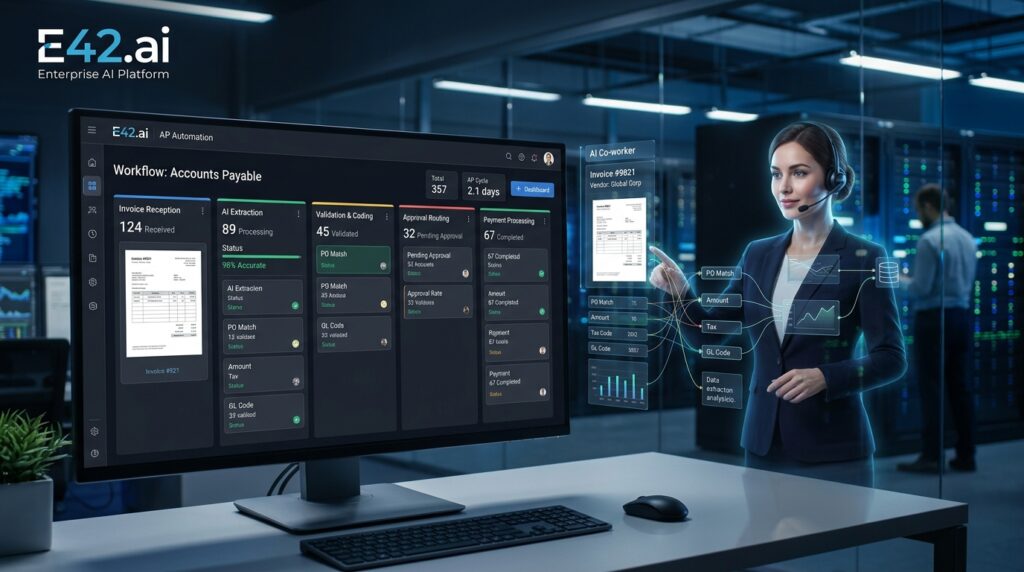
This in-depth E42.ai Review evaluates how the platform’s Cognitive Process Automation (CPA) shifts the paradigm as traditional automation hits a fundamental wall. But when confronted with unstructured data, complex handwriting, or workflows requiring real-world judgment, these brittle systems break down. High exception rates follow, requiring constant, costly human intervention.
Developed by Light Information Systems, E42.ai shifts the paradigm from rote task execution to Cognitive Process Automation (CPA). By deploying “AI Co-workers”—autonomous digital workers engineered to operate alongside human teams—E42.ai simplifies how modern enterprises scale their operations.
E42.ai Review: Product Overview and PaaS Architecture.
E42.ai is a no-code, enterprise-grade Platform as a Service (PaaS) designed to build and deploy specialized AI Co-workers. Rather than acting as a generic conversational chatbot, the platform focuses squarely on automating complex, end-to-end business operations like Accounts Payable (AP), Human Resources, and customer inquiries.
Best For
- Mid-market to Large Enterprises: Organizations dealing with high volumes of unstructured documents, multi-channel vendor communications, and complex ERP environments.
- Operations and Finance Teams: Specifically built for managers seeking to eliminate manual entry errors, reduce invoice processing cycles, and optimize resource allocation without hiring more headcount.
Key Strengths vs. Traditional Automation
1. Fault-Tolerant ICR Over Standard OCR
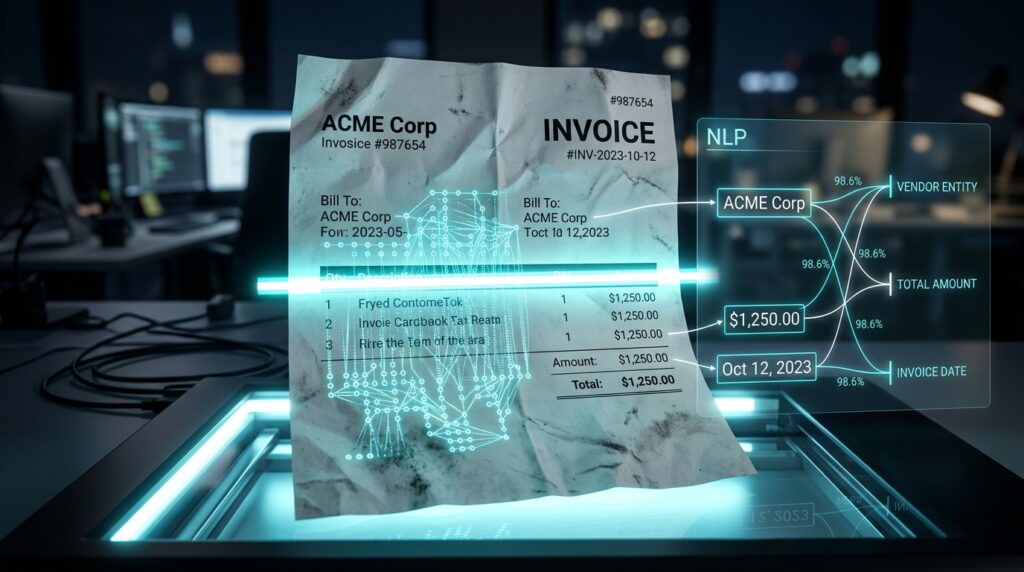
Standard OCR relies on rigid templates. If a vendor changes a layout, or an invoice arrives smudged, crumpled, or handwritten, traditional OCR fails. E42.ai bypasses this via proprietary Intelligent Character Recognition (ICR).
Using Advanced Computer Vision and Deep Learning, the platform maps characters structurally rather than matching static pixels. An integrated Natural Language Processing (NLP) layer contextualizes data fields. For instance, if an ink smudge makes a digit look like either a “0” or an “O,” the system analyzes surrounding financial text to determine the mathematically correct asset value automatically. This achieves verified field extraction accuracy exceeding 95% across 50+ languages.
2. Domain-Specific Guardrails vs. LLM Hallucinations
While general-purpose Large Language Models (LLMs) are notorious for creating plausible-sounding fabrications (“hallucinations”), E42.ai utilizes custom v2 transfer learning. The platform restricts its mathematical weights to the enterprise’s clean internal datasets, vendor portals, and historical records. By anchoring the AI Co-worker’s knowledge base exclusively within the corporate firewall, it guarantees strict compliance and operational reliability.
3. True No-Code Engineering in 7 Days
Building an AI agent traditionally requires a dedicated squad of data scientists and months of custom software development. E42.ai democratizes this via a drag-and-drop orchestration interface, allowing business analysts to design, connect, and launch an AI Co-worker in a week:
- Days 1–2 (Process Mapping): Analysts visually map out logic gates using specialized nodes (e.g., pulling a PDF invoice from an email, running structural verification, executing a 3-way match against PO and GRN data).
- Days 3–4 (Knowledge Ingestion & Integration): Internal FAQs, HR policies, or vendor directories are uploaded. Native APIs connect directly to backend architectures (SAP, Oracle, NetSuite, Workday) without modifying core legacy systems.
- Day 5 (Cognitive & Channel Setup): Intent detection and sentiment parameters are configured, designating communication pathways across Microsoft Teams, Slack, WhatsApp, or interactive web portals.
- Day 6 (Risk Guardrails & Human-in-the-Loop): Threshold configurations ensure that if the ICR extraction confidence falls below a set parameter (e.g., 85%), the transaction routes automatically to a human accountant for review.
- Day 7 (Go-Live): The digital worker runs 24/7, streaming transparent performance logs back to a centralized management dashboard.
Architectural & Hardware Optimization
A primary barrier to enterprise AI adoption is the exorbitant cost of specialized infrastructure. Running heavy open-source models out of the box demands state-of-the-art supercomputers. E42.ai circumvents this hardware bottleneck through aggressive software-level efficiency techniques, allowing models to run effectively on commodity virtual machines (VMs) or legacy corporate GPUs:
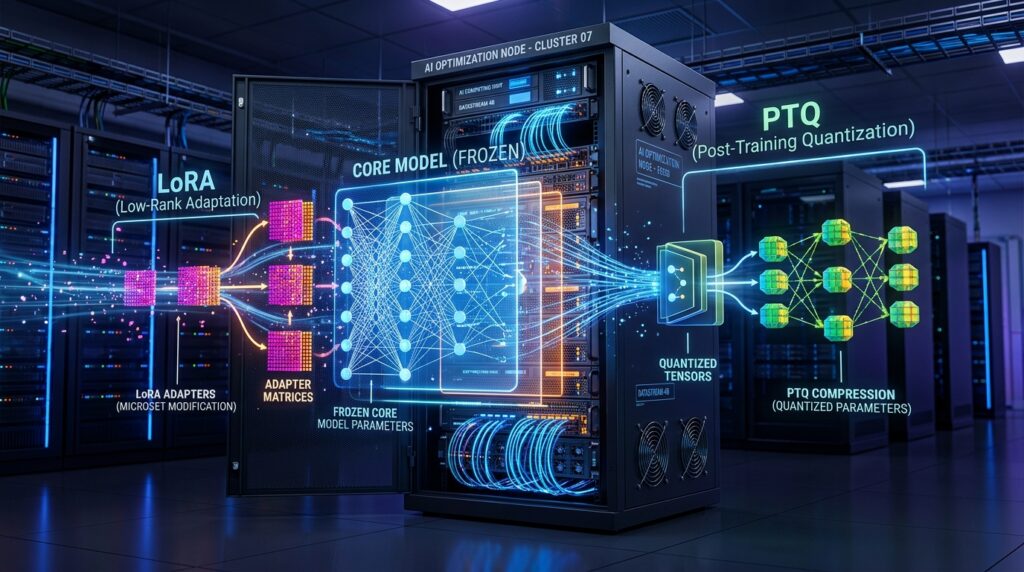
- Low-Rank Adaptation (LoRA): During specialized training, the foundation model’s core parameters are frozen. Only a microscopic subset of low-rank matrices are altered, drastically slashing VRAM usage.
- Post-Training Quantization (PTQ) & Pruning: Structural weights are compressed from standard 16-bit or 32-bit floating points down to INT8 or INT4 integers. Coupled with the pruning of redundant neural connections, model sizes drop threefold with virtually zero degradation in contextual understanding.
- Grouped-Query Attention (GQA) & Sliding Window Attention (SWA): These specialized attention mechanisms optimize query memory traffic and restrict calculation scopes to a sliding contextual window. The result is rapid inference speeds that handle immense text lengths on accessible, cost-effective GPUs like the Nvidia T4.
Commercial Evaluation: The Power of Platform Licensing
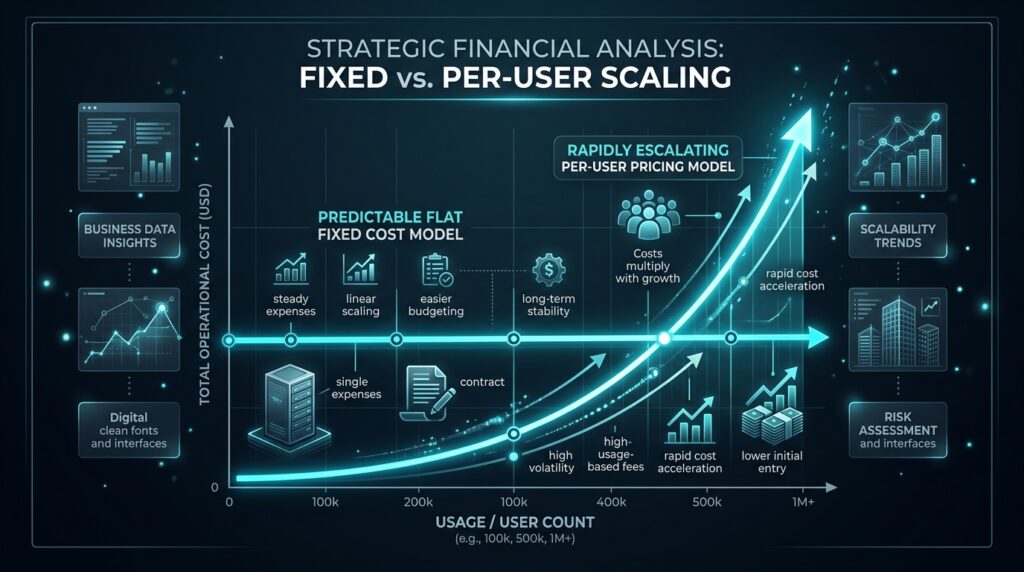
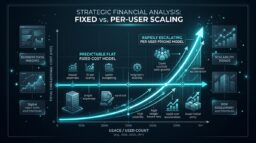
Most modern enterprise software utilizes a per-user pricing model. This paradigm creates a severe friction point: as more employees need access to data, licensing fees balloon linearly, discouraging cross-department deployment.
E42.ai challenges this setup by offering specialized commercial options: an AI Co-worker License (approx. $24,000/year per single digital worker) and an all-inclusive Platform License (approx. $150,000/year).
                                  PER-USER SEAT PRICING
Cost / Scale                      (Costs escalate linearly as team grows)
  ▲                                     /
  │                                    /
  │                                   /
  │                                  /
  │                                 /
  │  ──────────────────────────────/──────────────────────────────
  │  E42.ai PLATFORM LICENSE      /
  │  (Predictable fixed cost)    /
  │                             /
  └────────────────────────────/──────────────────────────────►
                             Volume of Transactions / Users
Strategic Financial Advantages
- Infinite Interaction Scale: Under the flat Platform License, an unlimited number of corporate employees can query, prompt, and interact with the AI Co-workers. The marginal cost of adding a new user effectively drops to zero.
- Compounding Economies of Scale: As transaction volumes scale (e.g., jumping from 2,000 to 20,000 invoices processed monthly), the Total Cost of Ownership (TCO) per transaction plunges. Operating margins widen predictably because software overhead remains static.
- Flexible Cash Flow Integration: To mitigate upfront capital expenditure constraints, E42.ai integrates with financing options like Capchase, allowing organizations to spread licensing costs into monthly or quarterly operational outlays.
The Core Product Showdown
| Evaluation Criterion | Legacy RPA + Standard OCR | E42.ai Cognitive Platform |
| Data Adaptability | Strictly structured text only; breaks on format changes. | Unstructured documents, diverse handwriting, variable templates. |
| Logic & Judgment | Basic, rule-based “if-this-then-that” execution. | Contextual NLP, intent parsing, semantic understanding. |
| Implementation Curve | Requires manual coding, scripts, and lengthy engineering. | No-code visual workspace; typical deployment takes 7 days. |
| Exception Resolution | High manual intervention; halts on unrecognized files. | Automated self-correction backed by built-in Human-in-the-Loop routing. |
| Scalability Cost | Escalates linearly based on user seats or robot licenses. | High ROI via fixed flat-rate platform capability. |
Product Limitations & Trade-Offs
Despite its strengths, E42.ai requires specific operational commitments to deliver maximum value:
- Garbage In, Garbage Out: While the ICR engine corrects contextual inaccuracies, the initial deployment requires accurate data foundations. If an enterprise’s historical master inventory sheets or vendor listings are fundamentally corrupted, the AI Co-worker will struggle to make correct matching decisions.
- Steep Learning Curve for Advanced Logic: While building linear tasks is simple, configuring highly variable edge cases, custom sentiment routing, or intricate multi-layered approval matrices demands rigorous business analysis expertise.
- Infrastructure Strategy Planning: Organizations dealing with strict sovereignty requirements (such as defense or core banking) will need to dedicate engineering resources to configure an on-premises VM stack rather than taking advantage of quick-start cloud deployments.
Editor’s Take
IF your organization is currently burning hundreds of manual hours resolving document discrepancies, handling routine vendor emails, or navigating siloed legacy system entries, THEN E42.ai offers an exceptional pathway to high-ROI automation. BECAUSE its flat platform licensing eliminates scaling penalties, its no-code framework reduces deployment timelines down to a week, and its optimized architecture lets you run highly secure, hallucination-free AI models without forcing a costly overhaul of your hardware infrastructure.
Who Should Adopt E42.ai Immediately
- Finance leaders bogged down by massive manual AP invoicing volumes.
- HR directors looking to automate high-volume CV screening and basic employee policy inquiries.
- Operational teams eager to escape the rigid constraints of traditional RPA.
Who Should Avoid It
- Small startups with low document volumes where standard out-of-the-box SaaS integrations suffice.
- Organizations lacking defined workflow documentation or those with chaotic, unstandardized operational rules.
Final Recommendation
- If your primary goal is maximizing transaction throughput while locking down predictable software expenses… E42.ai’s Platform License is one of the safest structural choices available, accelerating operational velocity without incurring variable fee penalties.
- If you are testing the cognitive automation waters within a single department… Begin with a localized AI Co-worker License (such as their pre-built accounts payable assistant, Neil). Run it against a single high-volume workflow for 30 days, verify that your internal data yields low exception rates, and then scale up to the Platform License as your cross-functional requirements expand.
Final Recommendation
If your primary goal is maximizing transaction throughput while locking down predictable software expenses, especially when dealing with unstructured data or legacy system entries… E42.ai’s Platform License is one of the safest structural choices available, accelerating operational velocity without incurring variable fee penalties. For testing the cognitive automation waters within a single department, begin with a localized AI Co-worker License (such as their pre-built accounts payable assistant, Neil). Run it against a single high-volume workflow for 30 days, verify that your internal data yields low exception rates, and then scale up to the Platform License as your cross-functional requirements expand.
To compare how this software-defined cognitive layer handles legacy system integration versus highly specialized physical hardware appliances at the edge, explore our hands-on architectural evaluation in the Qualcomm Dragonwing AI Review. For enterprises seeking to build a centralized, private “AI Factory” to host these complex models with maximum data sovereignty, we highly recommend reading our deep dive on the HPE Private Cloud AI Review. Additionally, you can review our historical baseline comparison across localized server environments in the Top 5 Zanus AI Alternative guide, or tailer your vertical industrial strategies through our blueprints on Zanus AI Deployment, Zanus AI for Construction, and Zanus AI for Logistics. To stay continually updated on independent enterprise tech valuations, ensure you bookmark our core AI Review Zones portal today.
References
- E42.ai Official Platform Architecture: E42.ai No-Code Cognitive Automation
- Gartner Peer Insights & Ratings: E42 Reviews & Enterprise Evaluation
- Intelligent Document Processing Capabilities: E42.ai ICR Technology Framework
- Model Size and Hardware Optimization Analysis: Techniques to Optimize AI Model Size
- Capchase Financing Integration Details: E42 Pricing and Flexible Financing