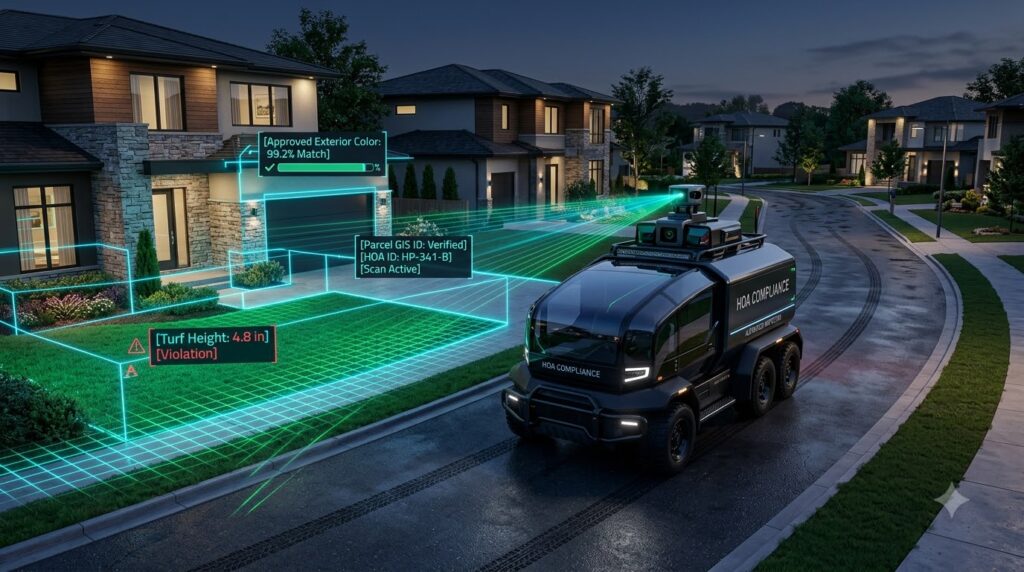
In this 2026 guide to automated HOA violation enforcement, manual drive-by audits are quietly draining operating budgets and exposing associations to avoidable legal battles. Community association managers (CAMs) still spend hours behind the wheel with clipboards or basic mobile apps, missing roughly one out of every four property infractions while exposing their boards to costly selective enforcement lawsuits.
Automating covenant compliance with computer vision (CV) and optical character recognition (OCR) eliminates the guesswork. Instead of subjective drive-by audits, computer vision platforms continuously evaluate street-level video, match infractions directly to recorded Covenants, Conditions, and Restrictions (CC&Rs), and generate verifiable, legally defensible audit trails in minutes.
Quick Summary & Platform Comparison
Before overhauling an inspection workflow, management teams must match platform architecture to operational reality. Standalone point solutions offer fast setup for localized drive-bys, whereas enterprise property management suites require extensive integration to unify accounting, ARC approvals, and field enforcement.
| Platform | Best For | Core AI / Vision Capability | Integration Depth | Pricing / Subscription | Key Trade-off |
| HOALife | Standalone Drive-By Audits | GPS-guided mobile capture & offline rule engine | QuickBooks Online, Zapier, Rent Manager | Starts $199/mo base (~$1.00/unit/mo) | No native enterprise accounting |
| US Tech Automations (USTA) | Custom Legacy Workflows | Custom AI agents; multi-tier auto-tagging | Bi-directional API (Yardi, AppFolio, CINC) | Custom enterprise (~$7,500/yr est.) | High initial onboarding effort |
| SmartProperty | Reserve Asset Management | Atlas™ AI & PRISM predictive structural modeling | AppFolio Stack, Vantaca, Open API | Starts $150/mo base ($1,800–$3,000/yr) | Capital asset focus; not for daily CC&R patrols |
| AppFolio | Full Portfolio Management | Auto-merge notice generation; in-app capture | Native AppFolio Stack™ Ecosystem | Quote-based ($1.40–$3.00/unit/mo) | Lacks real-time drive-by computer vision |
| Yardi Voyager | Large-Scale Enterprise | Enterprise rule engine & violation escalation | Full enterprise API; native Yardi ecosystem | Custom enterprise (~$15,000/yr est.) | Steep learning curve; high setup overhead |
| CINC Systems | Banking-Integrated Portfolios | Automated rule engine & mobile field audit | Native association banking & accounting | Custom enterprise (~$12,000/yr est.) | Rigid configuration requirements |
| IMGING (Loveland) | Roof & Envelope Inspections | Autonomous drone photogrammetry & defect AI | API export; estimating workflows | Custom quote / per-flight tier | Specialized aerial focus; no general violation rules |
The Hidden Costs of Legacy Manual Inspections
Manual visual inspections suffer from an inherent human error rate of 20% to 30%. Fatigue, bad lighting, and visual blind spots mean CAMs routinely overlook infractions on long routes.
Drafting a single Notice of Violation (NOV) by hand takes an average of 22 minutes once photo offloading, homeowner identification, transcription, and CC&R clause mapping are factored in. In a 500-unit master-planned community, this clerical overhead eats up dozens of managerial hours every month.
Automated enforcement systems compress the average violation resolution lifecycle from 21 days down to 6.3 days by running standardized escalation workflows. Unifying digital violation records with accounting ledgers lifts 30-day fine collection rates from 41% to 78%, while automated photo evidence helps resolve 82.6% of infractions at the first-notice stage.
Manual Inspection Benchmark:
[ Drive-by Capture ] ──> [ Manual Sorting (22 min) ] ──> [ Subjective Dispute Risk ] ──> 21-Day Resolution

Automated Computer Vision:
[ 4K GPS Dashcam ] ──> [ Edge AI Match (<2 min) ] ──> [ HITL Verification ] ──> 6.3-Day Resolution
Operational Impact: Manual audits create selective enforcement vulnerabilities. When a homeowner claims their lawn was singled out while a neighbor’s identical yard was ignored, an association relying on manual notes struggles to prove consistent enforcement. Computer vision systems capture an objective record across 100% of lots on every pass, neutralizing selective enforcement claims.
Deep Dive: Automated HOA Violation Enforcement Technical Architecture
Enterprise violation platforms split heavy computational workloads between vehicle hardware and cloud clusters to maintain low processing latency without driving up data ingress costs.
Data Acquisition Layer (4K 60FPS Dashcams, Mobile Telemetry, IMGING Drones)
  │
  ▼
Edge Inference & Pre-Processing (NVIDIA Jetson, INT8 Quantization, Privacy Blurs)
  │
  ▼
Deep Learning & ALPR OCR (Semantic Turf Segmentation, Vehicle Tagging, OCR Disambiguation)
  │
  ▼
Cloud Spatial Mapping (Tax Assessor GIS Shapefiles, Digitized CC&R Engine)
  │
  ▼
Human-in-the-Loop Approval Gate (CAM 1-Click Verification & Postal/Portal Dispatch)
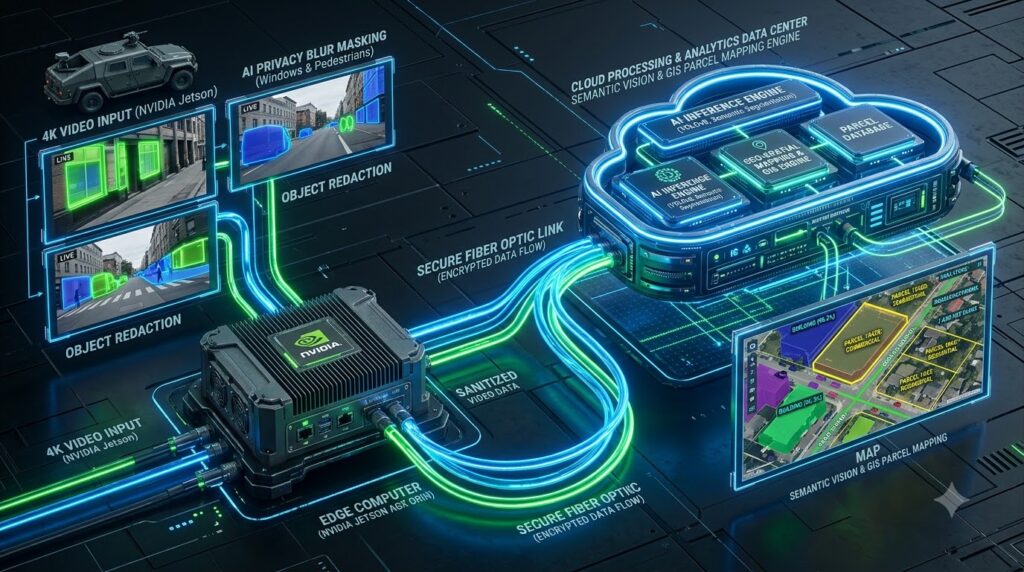
1. Hybrid Edge-Cloud Inference
High-resolution 4K vehicle dashcams, smartphones, and aerial inspection drones capture raw visual feeds paired with sub-meter GPS coordinates and optical telemetry. Embedded edge nodes (such as NVIDIA Jetson platforms) process video in under 50ms per frame using INT8-quantized neural networks. The edge layer removes redundant frames, blurs pedestrian faces for privacy compliance, and sends candidate violation clips to the cloud.
2. Deep Learning Classification & ALPR
Cloud inference engines use convolutional networks and vision transformers trained on millions of residential property images:
- Landscaping & Turf Analysis: Semantic segmentation calculates pixel ratios of healthy turf against dead grass, bare soil, or weed overgrowth.
- Architectural Modifications: Detection models compare exterior paint, trim, and fences against approved association color spaces after normalizing for sunlight and shadow variations.
- Parking Enforcement (ALPR): Optical character recognition extracts license plate text, using disambiguation models to resolve character confusion (e.g., separating ‘0’ from ‘O’ or ‘8’ from ‘B’). Plate data queries internal resident databases to immediately flag unauthorized commercial vehicles or unpermitted overnight street parking.
3. Spatial GIS Boundary Mapping
Candidate images are cross-referenced with municipal tax parcel shapefiles. Once the lot boundary and registered homeowner profile are confirmed, the system evaluates the finding against the association’s digitized CC&R rule thresholds before queuing an enforcement action.
Total Cost of Ownership (TCO) Breakdown
Evaluating a software platform purely on its monthly subscription price ignores the administrative labor required to bridge functional gaps. A complete Total Cost of Ownership (TCO) calculation must account for implementation expenses and loaded CAM labor overhead ($40/hour):
| Platform | Annual Subscription | Setup / Implementation | Annual Labor Overhead | Year 1 Total Cost | Year 2+ Annual Cost |
| HOALife | $6,000 | $2,000 | $1,800 | $9,800 | $7,800 |
| US Tech Automations | $7,500 | $5,000 | $0 | $12,500 | $7,500 |
| Buildium | $1,800 | $1,000 | $8,400 | $11,200 | $10,200 |
| PayHOA | $3,000 | $500 | $9,600 | $13,100 | $12,600 |
| AppFolio | $8,400 | $2,500 | $3,600 | $14,500 | $12,000 |
| CINC Systems | $12,000 | $6,000 | $1,200 | $19,200 | $13,200 |
| Yardi Voyager | $15,000 | $12,000 | $1,200 | $28,200 | $16,200 |
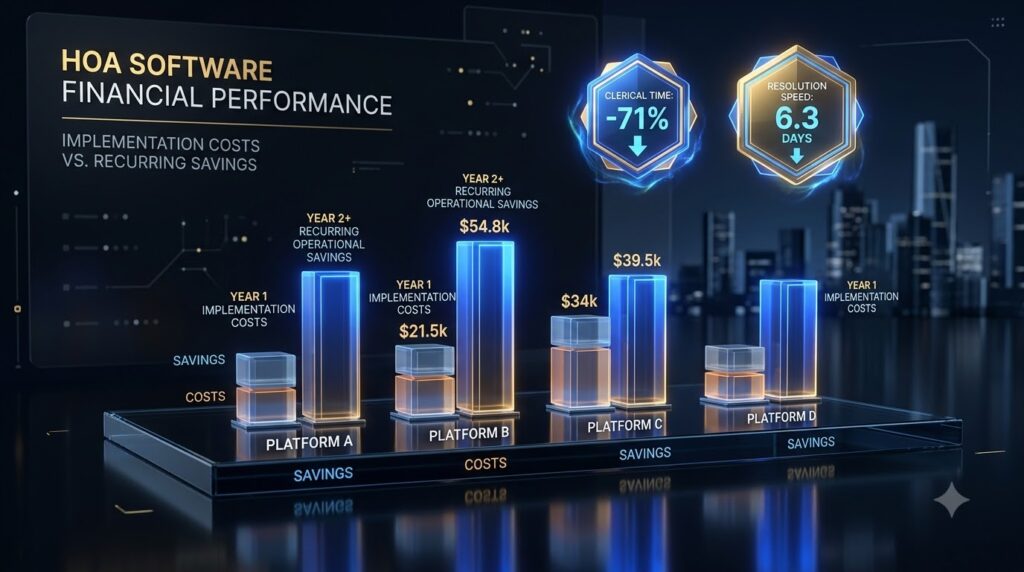
Deployment Insight: Budget-tier platforms with low sticker prices often generate high downstream costs. Platforms lacking automated field recognition force managers to draft notices by hand, creating hidden labor costs that easily outweigh the initial software savings.
Top Platform Deep Dives: Who Should Buy What
HOALife: Best Standalone Drive-By Compliance Engine
HOALife is engineered specifically for fast-paced field audits and architectural committee workflows. Its offline GPS mobile capture auto-populates violation notices as the manager drives through the community, requiring minimal post-inspection data entry.
- Strengths: Dedicated inspection routing, offline caching, and responsive Zapier/QuickBooks sync.
- Limitations: Lacks an integrated general ledger; accounting must be managed via third-party systems.
- Editor’s Take: Choose HOALife if your operational priority is eliminating field inspection bottlenecks without replacing your broader accounting infrastructure.
US Tech Automations (USTA): Best for Custom Enterprise Integrations
USTA acts as an automation bridge over existing property management suites, linking computer vision models directly to core databases like Yardi, AppFolio, and CINC Systems.
- Strengths: Custom-built bi-directional API pipelines that prevent double data entry across enterprise backends.
- Limitations: Requires higher upfront setup investments and tailored onboarding.
- Editor’s Take: Choose USTA if you manage high-volume portfolios across legacy enterprise accounting tools and need automated vision auditing without a platform migration.
SmartProperty: Best for Reserve Studies & Structural Asset Health
Following its acquisition of DecaSIM, SmartProperty combines its PRISM framework with Atlas™ AI to transform standard reserve studies into real-time asset intelligence platforms.
- Strengths: Excellent long-term capital planning, structural defect classification, and predictive replacement modeling.
- Limitations: Not built for daily CC&R enforcement, routine parking patrols, or transient yard violations.
- Editor’s Take: Choose SmartProperty if your board needs to replace static reserve studies with dynamic structural forecasting across large condominium portfolios.
Legal, Privacy, and Statutory Guardrails
Deploying automated enforcement requires strict adherence to state property statutes and resident privacy frameworks.
                  ┌─────────────────────────────────────┐
                  │ AI Vision Flags Candidate Violation │
                  └──────────────────┬──────────────────┘
                                     │
                                     ▼
                  ┌─────────────────────────────────────┐
                  │ State Law Check: Statutory Overrides │
                  │  (e.g., FL HB 1203 24hr Trash Rule) │
                  └──────────────────┬──────────────────┘
                                     │
                                     ▼
                  ┌─────────────────────────────────────┐
                  │  HITL Review Gate: CAM Verification  │
                  └──────────┬────────────────┬─────────┘
                             │                │
                    Approved │                │ Rejected
                             ▼                ▼
     ┌────────────────────────────────┐  ┌─────────────┐
     │ Auto-Dispatch Compliant Notice │  │ Drop Record │
     │  (TX Ch. 209 Certified Mail /  │  └─────────────┘
     │   FL HB 1203 Portal Upload)    │
     └────────────────────────────────┘
1. Florida Statutory Compliance (HB 1203 / Chapter 720)
- Digital Portal Requirement: Associations with 100 or more parcels must post official records, bylaws, and notices to a secure online portal.
- Statutory Fining Locks: Florida law prohibits fining owners for leaving trash cans at the curb within 24 hours of collection windows. Fines for holiday decorations are barred unless left up longer than seven days after written notice. Rule engines must lock these conditions to prevent illegal automated citations.
- Vegetable Gardens & Visibility: Homeowners cannot be cited for backyard vegetable gardens, artificial turf, or parked personal RVs unless visible from the parcel frontage or adjacent parcels. Vision engines must evaluate line-of-sight angles before creating an infraction.
- Statutory Audit Trails: Board members and managers face legal liabilities for altering records to conceal non-compliance. System audit logs must keep immutable, timestamped photo evidence for at least seven years.
2. Texas Property Code Chapter 209 Standards
- Mandatory Certified Mailings: Section 209.006 requires formal violation and fine notices to be sent via Certified Mail alongside standard post. Enforcement pipelines must connect to physical mailroom APIs (such as PostalMethods or Lob) to log tracking numbers directly to the parcel record.
- Statutory Cure Periods: Homeowners have an automatic right to cure violations within a reasonable window before fines can be assessed, superseding conflicting association bylaws.
3. Privacy, Encryption, and Court Defensibility
- ALPR Ethics & Safe Lists: License plate recognition systems must support resident opt-out “Safe Lists” and enforce automated purge windows (typically 7 to 90 days for non-violating data).
- Data Security: Spatial imagery and metadata must be secured using AES-256 encryption at rest and in transit via AWS KMS or GovCloud infrastructure.
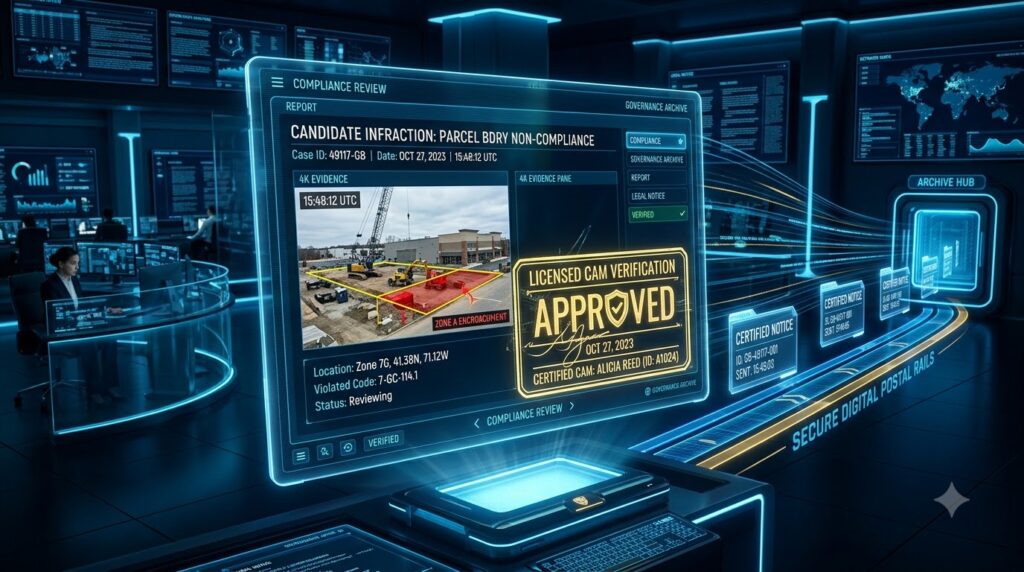
- Human-in-the-Loop (HITL) Defensibility: Automated systems should function as decision-support tools rather than autonomous judges. Having a licensed CAM review and sign off on every flagged violation before a notice goes out defeats claims of arbitrary, algorithmic enforcement.
Step-by-Step Implementation Roadmap
A disciplined rollout ensures board buy-in, resident transparency, and full legal compliance.
Phase 1 (W1-3): Audit & Rule Digitization ──> Phase 2 (W4-6): Technical Procurement
      │
      ▼
Phase 3 (W7-8): Governance & HITL Vetting ──> Phase 4 (W9-12): 30-Day Pilot ──> Phase 5 (W13+): Full Deployment
Phase 1: Compliance Audit & Rule Digitization (Weeks 1–3)
- Review 12 months of historical violation logs to identify your top operational bottlenecks (landscaping, parking, architectural changes).
- Audit governing documents against updated state statutes to strip out invalid rules (such as outdated trash can fines).
- Translate descriptive CC&R guidelines into concrete numeric thresholds for your software engine (e.g., grass height limits in inches, unauthorized parking durations in hours).
Phase 2: Technical Procurement & Vendor Evaluation (Weeks 4–6)
- Evaluate candidate platforms based on detection accuracy, mobile usability, and bi-directional API support for your primary accounting software.
- Verify that the platform uses AES-256 encryption, role-based access control, and automated data retention purges.
- Calculate your 3-year Total Cost of Ownership, weighing software license fees against expected CAM administrative labor savings.
Phase 3: Governance Policy & Legal Vetting (Weeks 7–8)
- Pass a formal Board Resolution establishing camera-assisted inspection as an authorized compliance tool.
- Implement a strict Human-in-the-Loop policy requiring CAM review for every candidate infraction.
- Send an informative policy update to all residents explaining how the technology works, outlining privacy protections, and detailing the vehicle Safe List registration process.
Phase 4: Operational Pilot Execution (Weeks 9–12)
- Run a 30-day pilot across a 100-unit sample section of the community.
- Run manual and automated inspections side-by-side to measure capture accuracy, false positives, and notice drafting speed.
- Calibrate vision sensitivity settings to eliminate false flags caused by regional sun glare, shadow patterns, or seasonal plant dormancy.
Phase 5: Full Portfolio Deployment (Week 13+)
- Roll out automated inspection capture across your entire property portfolio.
- Connect digital print-and-mail APIs to ensure every notice meets state-mandated delivery rules.
- Review quarterly dispute rates and resolution timelines to continuously refine your compliance workflow.
Frequently Asked Questions
Can an HOA issue fines based entirely on AI computer vision without human review?
No. Relying on fully automated citations creates significant legal exposure. Establishing a Human-in-the-Loop (HITL) gate—where a licensed CAM or authorized board member reviews and approves the AI-flagged evidence—ensures discretionary oversight and protects the association against claims of arbitrary enforcement.
How do computer vision models distinguish seasonal lawn dormancy from dead turf?
Modern segmentation models look at spatial texture, plant density, and historical imagery rather than color alone. By normalizing for regional sun angles, seasonal climate variations, and turf consistency, these models accurately separate healthy dormant grass from dying lawns, bare dirt, or weed infestations.
What happens if an automated camera captures images inside a resident’s home?
Enterprise platforms use automated masking algorithms that process visual data directly on the capture device. Any pixels corresponding to window interiors, backyard privacy enclosures, or pedestrian faces are blurred at the edge layer before footage ever syncs to the cloud.
Final Recommendation
- If your primary goal is speeding up drive-by inspections and architectural reviews: Choose HOALife for its mature mobile capture workflows, offline reliability, and fast deployment.
- If you manage large master-planned communities across enterprise ERPs: Choose US Tech Automations to build custom, bi-directional vision workflows on top of Yardi, AppFolio, or CINC Systems without changing your accounting core.
- If your priority is reserve asset intelligence and structural monitoring: Choose SmartProperty to monitor physical building envelopes and long-term capital replacement needs.
Before signing a platform agreement, audit your association’s governing documents to ensure all CC&R rules are digitized into clear, objective numerical thresholds.
🔍 Related PropTech, Building Inspection & Enterprise AI Infrastructure Guides
For HOA board directors, community association managers, and commercial real estate operators optimizing compliance workflows, explore our related technical benchmarks and architectural frameworks:
- Milestone Structural Engineering Compliance: Automate facade and slab crack assessments under Florida building safety mandates in our Florida SB 4-D Compliance Guide: How AI Automates Milestone Property Inspections.
- Autonomous Building Envelope Audits: Discover top UAV photogrammetry and thermal defect platforms in our Best AI Property Inspection Software & Drone Tools (2026 Review).
- Private Community AI & Resident Privacy: Protect association financial ledgers and architectural submissions in Air-Gapped AI for HOA Management & Data Governance.
- Automated Violation Management Systems: Compare enforcement notice workflows in AI HOA Violation Management: From Inspection to Resolution.
- Enterprise On-Premise AI Hardware: Explore private server economics and local LLM appliances in our Top 5 On-Premise AI Platforms for Enterprise Operations.
References
- Florida Senate CS/CS/HB 1203 Summary — Official legislative analysis of Florida statutory reforms governing HOA portals, records retention, and fining restrictions.
- Texas Property Code Chapter 209 (Residential Property Owners Protection Act) — Official Texas statutes outlining mandatory certified mail enforcement and due process notice windows.
- University of Florida IFAS Extension: Key Changes for HOAs Under HB 1203 — Educational guidance on statutory fining limitations and parcel visibility standards.
- SmartProperty Official DecaSIM Acquisition Announcement — Official documentation of Atlas™ AI and PRISM structural predictive intelligence.
- Flock Safety HOA Privacy Standards and Security FAQ — Documented privacy protocols, resident safe listing frameworks, and automated metadata retention policies.
- AppFolio App & Solution Partner Ecosystem — Platform integrations and enterprise property management architecture.