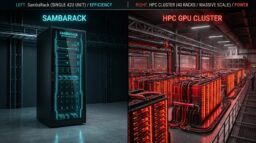
Conducting an intensive DeepSeek-R1 671B hardware review is critical for enterprises, because deploying frontier reasoning models on-premises introduces unprecedented architectural bottlenecks for enterprise data centers. DeepSeek-R1 671B operates on a Mixture-of-Experts (MoE) architecture comprising 671 billion total parameters, with 37 billion active parameters routed per token pass.
Executing this model in its native, unquantized 16-bit precision format (BF16/FP16) requires roughly 1.342 TB solely for weight storage. When accounting for key-value (KV) cache allocations across extended context windows (32K–128K tokens), runtime activation memory, and framework overhead, the total real-time VRAM allocation per inference instance reaches approximately 1.543 TB.
For enterprise decision-makers evaluating on-premises AI infrastructure, the decision is not simply about acquiring raw compute. It comes down to choosing between two fundamentally different engineering paradigms: scale-out general-purpose GPU clusters or specialized spatial dataflow architectures.
DeepSeek-R1 671B Hardware Review: Quick Decision Summary
| Operational Factor | Footprint A: SambaRack SN40L-16 / SN50 (16 RDUs) | Footprint B: Enterprise GPU Cluster (320x H200 SXM5) |
| Best For | High-throughput, native 16-bit MoE inference with zero data center retrofits | Multi-tenant dense training, research environments, and generic GPU workloads |
| Per-User Throughput | 198 – 250 Tokens/sec | 19 – 33 Tokens/sec |
| Time-To-First-Token (TTFT) | 150 – 250 ms (Deterministic Dataflow) | 1,000 – 3,360 ms (Cross-Node Latency) |
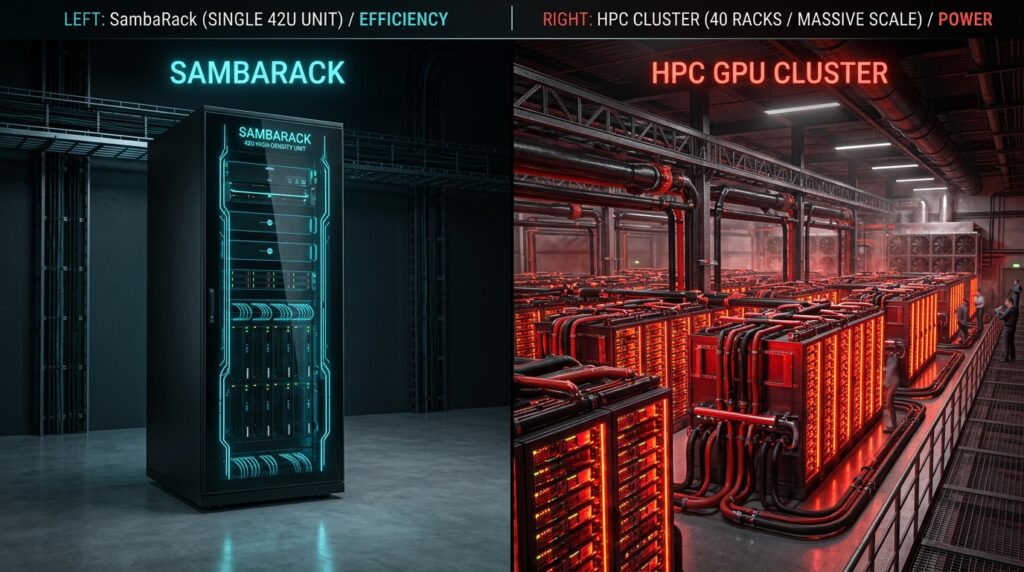
| Physical Footprint | 1 Single Air-Cooled Rack (20 sq. ft.) | 40 Air-Cooled Racks or 5 DLC Liquid Racks |
| Power Consumption | ~18 kW | ~360 kW – 400 kW |
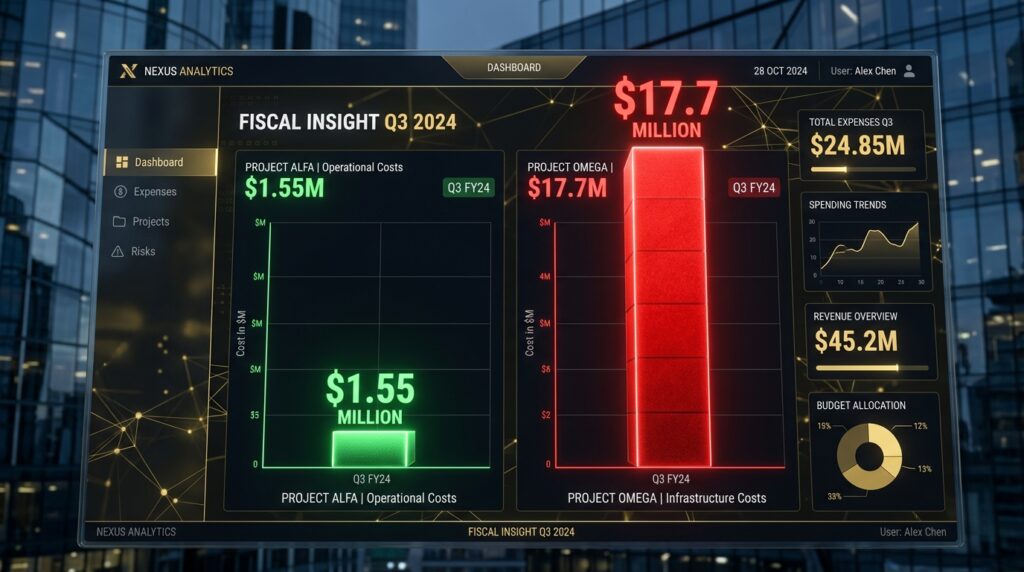
| 3-Year Total TCO | ~$1.55 Million | ~$17.7 Million |
| Primary Limitation | Proprietary software stack; less suited for general training | Massive capital overhead, extreme thermal density, and high network complexity |
The Precision Execution Imperative: Why Unquantized BF16 Matters
In reasoning models like DeepSeek-R1, execution precision directly impacts operational output. Unlike standard autoregressive Large Language Models (LLMs) that output immediate answers, reasoning models rely on extended “chain-of-thought” generation—producing thousands of internal tokens to resolve complex logic, code execution, and mathematical problems.
+-----------------------------------------------------------------------------------+
|                           Unquantized BF16 / FP16 Precision                       |
|  [Input Prompt] ---> [Extended Chain-of-Thought] ---> [Deterministic Reasoning]   |
|                      (Zero Precision Degradation)                                 |
+-----------------------------------------------------------------------------------+
                                         vs.
+-----------------------------------------------------------------------------------+
|                            Post-Training Quantization (FP8/FP4)                   |
|  [Input Prompt] ---> [Accumulated Rounding Drift] ---> [Logic Hallucination / Fail] |
|                      (Compound Error in Long Chains)                              |
+-----------------------------------------------------------------------------------+
Post-training quantization techniques (such as FP8 or FP4 truncation) reduce memory footprints, but they introduce cumulative numerical rounding errors across long generation chains. Over 4,000+ reasoning tokens, these small mathematical discrepancies compound, leading to logic hallucinations, broken code syntax, and degraded accuracy. For enterprise applications in financial modeling, legal compliance, and automated software engineering, maintaining native 16-bit precision is non-negotiable.
The Memory Wall Bottleneck
Serving unquantized DeepSeek-R1 on traditional GPUs encounters a severe capacity barrier. A single NVIDIA H200 node equipped with 8 GPUs provides $8 \times 141\text{ GB} = 1.128\text{ TB}$ of HBM3e—falling short of the ~1.543 TB needed for one inference instance.
To run native 16-bit precision, traditional architectures must distribute the model across multiple nodes using Tensor Parallelism (TP), Pipeline Parallelism (PP), and Expert Parallelism (EP). To maintain reasonable concurrent user access, an enterprise cluster must scale out to 320 GPUs (40 HGX H200 nodes).
Across this 320-GPU fabric, cross-node collective communication protocols—specifically All-to-All expert routing over InfiniBand or RoCEv2—saturate network interconnects. This network overhead throttles per-user output speeds down to 19–33 tokens per second.

Architectural Deep Dive: Dataflow vs. GPU Clusters
The primary cause of this performance divide lies in how memory is structured and how data flows through the silicon.
                              GPU SCALE-OUT PARADIGM
      +---------------------------------------------------------------------+
      | Node 1 (HBM) <---> Node 2 (HBM) <---> ... <---> Node 40 (HBM)       |
      |   ^                                                     ^           |
      +---|-----------------------------------------------------|-----------+
          |========== High-Cost 800G InfiniBand Fabric =========|
          (All-to-All Expert Routing Bottleneck / Network Serialization)

                                      vs.

                            SAMBARACK DATAFLOW PARADIGM
      +---------------------------------------------------------------------+
      | Single Rack Footprint (16 RDU Chips)                                |
      |  +---------------------------------------------------------------+  |
      |  | On-Chip SRAM (PMUs)  <-- Fused Compute Operations             |  |
      |  | Intermediate HBM3    <-- Staging Dense Attention Layers       |  |
      |  | 24 TB DDR5 Host DRAM <-- Pipelined Stream for 671B Weights    |  |
      |  +---------------------------------------------------------------+  |
      +---------------------------------------------------------------------+
             (Zero External Network Hops / Deterministic Execution)
Three-Tier Memory Routing on RDUs
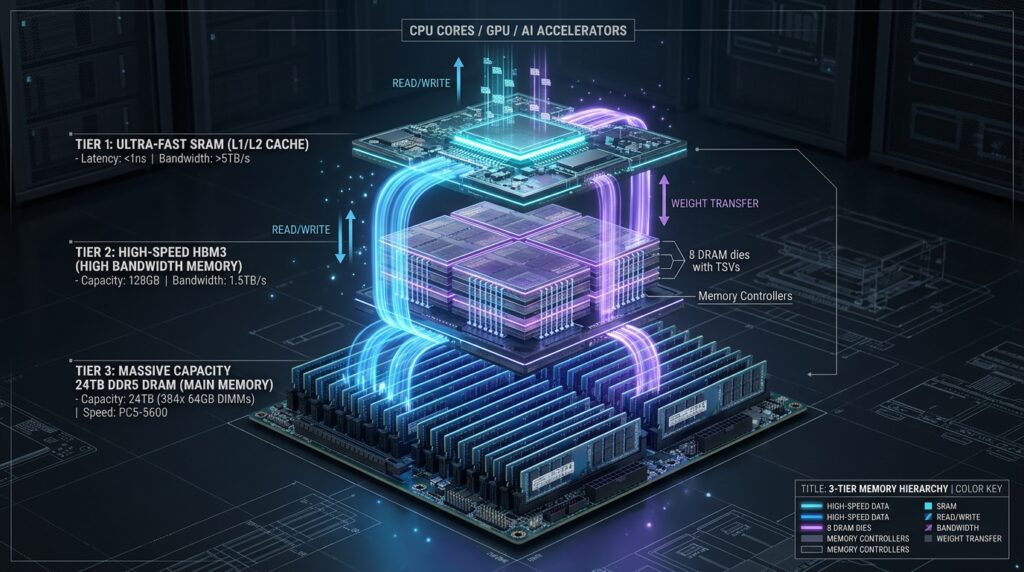
Reconfigurable Dataflow Units (RDUs), such as the SambaNova SN40L, resolve the Memory Wall using a three-tier hardware memory hierarchy managed directly at compile time:
- On-Chip Distributed SRAM (PMUs): Each SN40L chip incorporates 520 MiB of on-chip SRAM linked directly to compute units (PCUs) via an on-chip 2D mesh network. Operating with aggregate internal bandwidth in hundreds of terabytes per second, this tier holds intermediate activations, KV cache blocks, and fused kernel instructions, avoiding off-chip memory trips.
- Intermediate HBM3 Cache: Co-packaged HBM3 provides 64 GiB per socket at ~2.0 TB/s bandwidth. Rather than storing the entire model checkpoint, HBM3 acts as a high-speed staging area for active layer weights and Multi-Head Latent Attention projections.
- Host DDR5 Capacity Base: Up to 1.5 TiB of system DDR5 DRAM connects directly to each RDU socket. Across a 16-RDU system, this delivers 24 TB of addressable memory—comfortably hosting the complete 1.342 TB parameter set in native BF16 within a single rack.
Through predictive compiler-driven DMA pipelining, as attention layers execute in SRAM and HBM3, cold expert weights required for upcoming layers stream asynchronously from DDR5 into HBM3 at over 1 TB/s. Weight transfers overlap completely with active computation, hiding memory latency and enabling 16 RDUs to outperform 320 GPUs in generation throughput.
Facilities & Infrastructure Integration
Deploying high-density compute clusters requires careful evaluation of data center space, power availability, and thermal management.
+------------------------------------------------------------------------------------+
| DATA CENTER FOOTPRINT COMPARISON                                                   |
|                                                                                    |
| [ SambaRack SN40L-16 ]                                                             |
|  [Rack 1]  (18 kW Total Load | Fits Standard Air-Cooled Hot/Cold Aisle)          |
|                                                                                    |
| VS.                                                                                |
|                                                                                    |
| [ 320-GPU Air-Cooled Cluster ]                                                     |
|  [R1] [R2] [R3] [R4] [R5] [R6] [R7] [R8] [R9] [R10]...[R40] (360 kW Total Power)     |
|  (Requires ~800 sq. ft. Raised Floor Space)                                        |
|                                                                                    |
| [ 320-GPU Direct Liquid Cooled (DLC) Cluster ]                                     |
|  [Rack 1] [Rack 2] [Rack 3] [Rack 4] [Rack 5] + [In-Row CDUs + Liquid Loop]        |
|  (Requires 80 kW/rack, Fluid Plumbing, & Facility Upgrades)                       |
+------------------------------------------------------------------------------------+
Physical and Thermal Realities
- SambaRack SN40L-16: Consolidates all compute, memory, and routing into a single standard 42U rack. Drawing ~18 kW total IT load, it runs in standard air-cooled data centers using conventional hot/cold aisle containment—requiring no structural modifications.
- 320-GPU Air-Cooled Cluster: An 8-GPU HGX H200 server draws up to 9.0 kW under load. In legacy data centers limited to 10 kW per rack, 40 servers must be spread across 40 physical racks, occupying roughly 800 square feet of floor space.
- 320-GPU Liquid-Cooled Cluster: Direct Liquid Cooling (DLC) can compress the 320 GPUs into 5 high-density racks (72–80 kW/rack). However, this setup demands retrofits: Coolant Distribution Units (CDUs), dedicated facility water loops, secondary fluid networks, and active leak detection systems.
3-Year Total Cost of Ownership (TCO) Analysis
The financial analysis below reflects enterprise hardware, power, facility, and maintenance costs over a 36-month operational cycle (26,280 hours) at a baseline industrial power rate of $0.10/kWh for a single production deployment of unquantized DeepSeek-R1 671B.
TCO Comparison Table
| Cost Component | Footprint A: SambaRack SN40L-16 (16 RDUs) | Footprint B: 320-GPU Cluster (Air-Cooled) | Footprint B: 320-GPU Cluster (DLC Liquid-Cooled) |
| Server & Compute CapEx | $1,100,000 | $11,200,000 | $11,200,000 |
| Networking Fabric CapEx | $50,000 (Internal RDN) | $1,200,000 (800G InfiniBand) | $1,200,000 (800G InfiniBand) |
| Liquid Cooling Infrastructure | $0 (Air-Cooled Ready) | $0 (Air-Cooled) | $450,000 (CDUs + Plumbing) |
| 3-Year Power & Cooling OpEx | $59,130 (18 kW @ 1.25 PUE) | $1,371,816 (360 kW @ 1.45 PUE) | $1,116,374 (360 kW @ 1.18 PUE) |
| 3-Year Data Center Floor Space | $6,000 (20 sq. ft.) | $240,000 (800 sq. ft.) | $36,000 (120 sq. ft.) |
| 3-Year Hardware Maintenance | $330,000 | $3,720,000 | $3,720,000 |
| Total 3-Year Cost | $1,545,130 | $17,731,816 | $17,722,374 |
| Net Financial Difference | Baseline | +$16,186,686 (+1,047%) | +$16,177,244 (+1,047%) |
Operational Impact Insight
Replacing a 320-GPU scale-out cluster with a single SambaRack system yields over $16.1 million in total expenditure savings over three years—a 91.28% reduction in TCO. On a scale-out GPU fabric, more than $1.2 million is spent on interconnect switches alone simply to bypass local GPU memory limitations. The dataflow architecture resolves this parameter capacity challenge natively within the rack.
Trade-offs and Limitations
No infrastructure architecture fits every operational demand. A balanced technology decision requires understanding the trade-offs:
Where GPU Clusters Win
- Ecosystem Maturity & Portability: NVIDIA’s CUDA ecosystem remains the universal standard for custom software development. Migrating legacy research code or niche custom CUDA kernels to alternative hardware can require refactoring.
- Dense Training Workloads: For multi-tenant environments focused primarily on pre-training large dense models from scratch, scale-out GPU clusters offer broad model support and multi-node software flexibility.
Where Dataflow Architectures Introduce Constraints
- Compiler Lock-in: SambaNova’s execution paradigm relies on its proprietary spatial compiler stack to map PyTorch computational graphs into hardware configuration files.
- Targeted Use Cases: RDU systems are heavily optimized for streaming dataflow and large-scale model inference (particularly MoE models). Organizations needing raw compute for general non-AI high-performance computing (HPC) simulations may find traditional GPUs more adaptable.
Editor’s Perspective: Strategic Deployment Recommendations
Editor’s Take
Choose the SambaRack SN40L-16 / SN50 if your primary objective is serving large reasoning models like DeepSeek-R1 671B in native unquantized precision with high token generation speeds, limited power headroom, and zero data center retrofits.
Choose an Enterprise GPU Cluster if your organization already possesses liquid-cooled data center space, relies heavily on custom uncompiled CUDA kernels, or prioritizes general multi-tenant dense training over inference throughput and cost efficiency.
Practical Next Steps for IT Operations
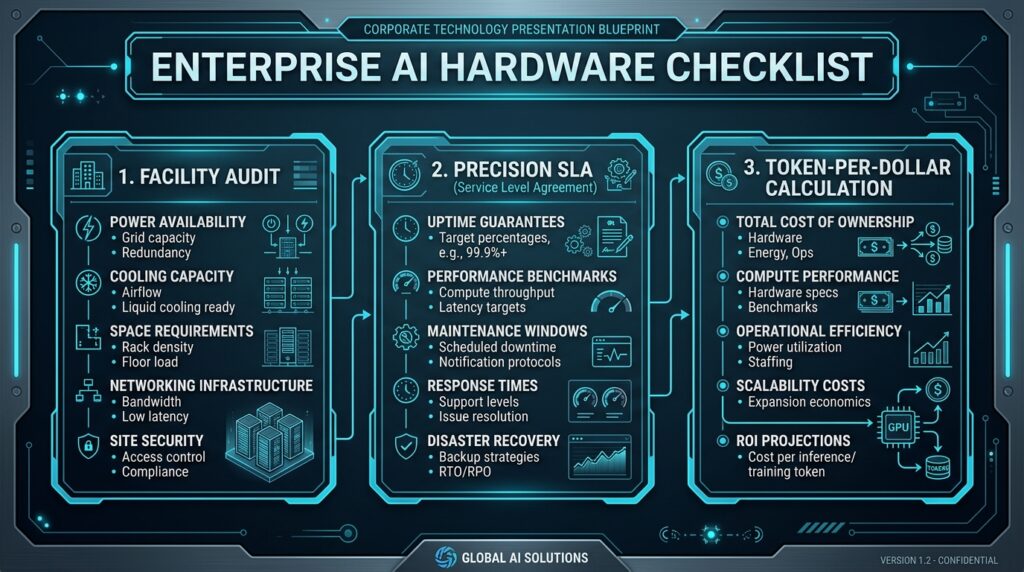
- Audit Facilities First: Determine if your current data center can supply 360 kW and support liquid cooling loops. If power availability is capped below 30 kW per row, a scale-out GPU deployment will require expensive facility upgrades.
- Evaluate Precision SLA Requirements: Test your enterprise reasoning workflows under FP8 quantization versus native BF16. If long reasoning chains suffer from logic degradation, unquantized BF16 execution must be treated as a core system requirement.
- Calculate Token-per-Dollar Metrics: Evaluate infrastructure options based on serving throughput ($ / \text{Tokens per Second}$) rather than simple peak TFLOPS hardware metrics.
Editor’s Take
Choose the SambaRack SN40L-16 / SN50 if your primary objective is serving large reasoning models like DeepSeek-R1 671B in native unquantized precision with high token generation speeds, limited power headroom, and zero data center retrofits.
Choose an Enterprise GPU Cluster if your organization already possesses liquid-cooled data center space, relies heavily on custom uncompiled CUDA kernels, or prioritizes general multi-tenant dense training over inference throughput and cost efficiency.
To analyze how specialized hardware silicon interfaces with containerized software orchestration layers, check out our in-depth Dynamiq AI Review. If your team is evaluating raw Reconfigurable Dataflow Architecture benchmarks, read our core SambaNova SN40L RDU Review. Furthermore, you can explore pre-engineered turnkey private cloud bundles in our HPE Private Cloud AI Review, or evaluate localized industrial processing platforms through the Qualcomm Dragonwing AI Review. For automated document decisioning systems, see the E42.ai Review, alongside our legacy workflow comparisons in the ElectroNeek On-Premise Review and baseline architecture manuals like Top 5 Zanus AI Alternative. To track ongoing enterprise infrastructure evaluations, make sure to visit our central AI Review Zones hub.
References
- SambaNova Systems. SambaNova Launches the Fastest DeepSeek-R1 671B with the Highest Efficiency. Business Wire
- Prabhakar, R., et al. SambaNova SN40L: Scaling the AI Memory Wall with Dataflow and Composition of Experts. arXiv Research Paper
- DeepSeek AI Team. DeepSeek-R1: Incentivizing Reasoning Capability in LLMs via Reinforcement Learning. DeepSeek GitHub
- TRG Datacenters. NVIDIA H200 Power Consumption and Data Center Thermal Planning Guide. TRG Datacenters
- Gigabyte Technology. NVIDIA HGX H200 Direct Liquid Cooling Rack-Scale Infrastructure. Gigabyte Enterprise Solutions