Distributed computing is experiencing a fundamental architectural shift. While the last decade was defined by massive cloud consolidation, the rise of Generative AI and Large Multimodal Models (LMMs) has exposed the limits of centralized infrastructure. In industrial settings, the reality of the factory floor—characterized by strict data privacy mandates, zero-tolerance latency budgets, and the absolute necessity of air-gapped continuity—makes cloud reliance an operational liability.
The Qualcomm Dragonwing AI On-Prem Appliance, paired with the Qualcomm AI Inference Suite, represents a calculated counter-strategy to cloud dependency. It is an industrial-grade edge appliance engineered to bring server-class generative computing directly to the physical edge.
This deep dive evaluates the Dragonwing architecture, its multi-modal execution pipeline, raw hardware performance metrics, and a quantified three-year Total Cost of Ownership (TCO) model to determine where this platform fits within modern enterprise infrastructure.
Core Architecture: Qualcomm Dragonwing AI Review & Silicon Optimization
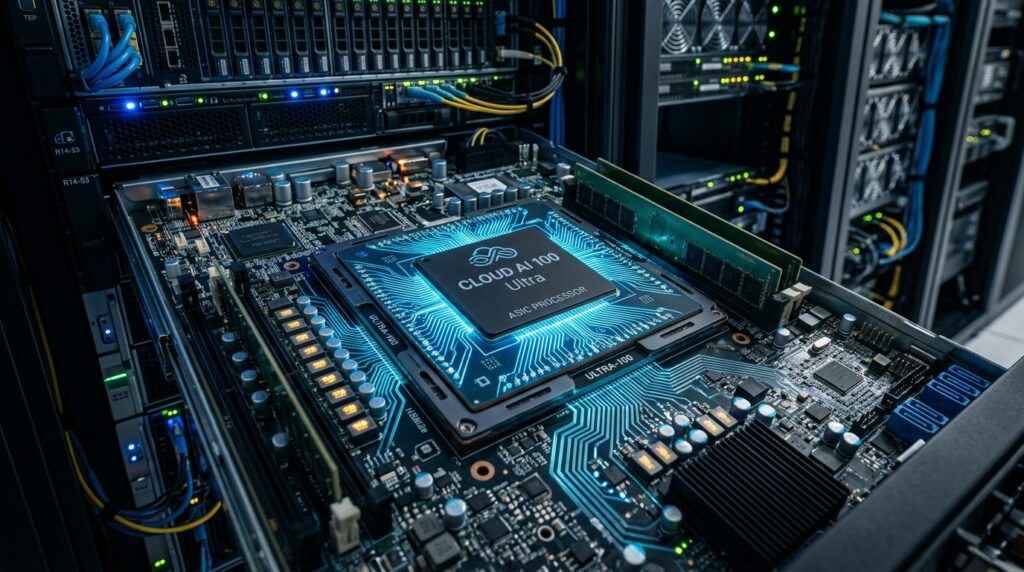
At the center of the Dragonwing appliance is the Qualcomm Cloud AI 100 Ultra acceleration card. Unlike general-purpose GPUs (GPGPUs) that dedicate significant silicon area to FP32/FP64 tensors and cache hierarchies required for model training, the Cloud AI 100 Ultra is an ASIC built exclusively for high-throughput, low-latency inference.
+-----------------------------------------------------------------------+
|                       Host System (PCIe Gen4 x16)                     |
+-----------------------------------------------------------------------+
                                    │
                                    ▼
+-----------------------------------------------------------------------+
|              Qualcomm Cloud AI 100 Ultra Acceleration Card            |
|                                                                       |
|  +-----------------------------------------------------------------+  |
|  |                    On-Board PCIe Gen4 Switch                    |  |
|  +-----------------------------------------------------------------+  |
|            │                  │                  │                  │  |
|        Gen4 x8            Gen4 x8            Gen4 x8            Gen4 x8|
|            ▼                  ▼                  ▼                  ▼  |
|      +-----------+      +-----------+      +-----------+      +-----------+
|      |   SoC 1   |      |   SoC 2   |      |   SoC 3   |      |   SoC 4   |
|      | (144MB SR)|      | (144MB SR)|      | (144MB SR)|      | (144MB SR)|
|      +-----------+      +-----------+      +-----------+      +-----------+
|            ▲                  ▲                  ▲                  ▲  |
|            └──────────────────┴─────────┬────────┴──────────────────┘  |
|                                         ▼                              |
|                         128 GB Shared LPDDR4x Memory                  |
+-----------------------------------------------------------------------+
The Quad-SoC Interconnect Topology
The Cloud AI 100 Ultra utilizes a specialized Quad-SoC design. Rather than relying on a monolithic die, the architecture integrates four individual Cloud AI 100 silicon dies alongside an onboard PCIe switch on a single high-density board. The card interfaces with the host machine via a standard PCIe Gen4 x16 slot, while the internal switch distributes workloads across the four internal SoCs using dedicated PCIe Gen4 x8 links.
This design enables highly parallelized token generation and batch processing. The trade-off is clear: by avoiding the monolithic die approach, Qualcomm improves manufacturing yields and reduces component costs, though developers must rely on the software runtime to handle memory distribution across the four internal domains.
| Architectural Specification | Qualcomm Cloud AI 100 Ultra | Qualcomm AI 100 Pro | Qualcomm AI 100 Standard | Qualcomm AI 100 Edge (Dual M.2) |
| SoC Topology | Quad-SoC (4 Dies) | Monolithic (1 Die) | Monolithic (1 Die) | Dual M.2 Module Config |
| Thermal Design Power (TDP) | 150 Watts | 75 Watts | 75 Watts | 15 Watts – 25 Watts |
| Peak INT8 Performance | Up to 870 TOPS | Up to 375 TOPS | Up to 350 TOPS | 70 to 200 TOPS |
| Peak FP16 Performance | Up to 288 TFLOPS | Up to 125 TFLOPS | Up to 110 TFLOPS | Edge-Stream Optimized |
| On-Chip SRAM Capacity | 576 MB (System Total) | 144 MB | 126 MB | Partitioned Tier |
| Primary DRAM Allocation | 128 GB LPDDR4x | 32 GB LPDDR4x | 16 GB LPDDR4x | Single/Dual Channel |
| Memory Bandwidth | 548 GB/s | 137 GB/s | 137 GB/s | Interface Limited |
| Host Interface Link | PCIe Gen4 x16 | PCIe Gen4 x8 | PCIe Gen4 x8 | PCIe Gen3/4 x4 |
Bypassing the Memory Wall via On-Chip SRAM
The most important architectural differentiator of the Cloud AI 100 Ultra is its 576 MB of ultra-high-speed on-chip SRAM. This allocation provides 9 MB of dedicated static memory directly inside each of the card’s 64 artificial intelligence cores.
In enterprise LLM deployment, standard hardware configurations frequently hit the “memory wall”—an operational bottleneck where execution execution units sit idle waiting for weight matrices and Key-Value (KV) caches to stream from external DRAM.
By embedding 576 MB of SRAM directly onto the silicon substrate, the Cloud AI 100 Ultra can hold critical model weights and intermediate activation layers locally. This approach minimizes cycles spent accessing the 128 GB LPDDR4x system memory, drastically reducing latency and cutting the power consumption typically lost to high-frequency memory bus toggling.
Deployment Insight: Real-World Efficiency vs. NVIDIA Datacenter Hardware
Independent benchmarking conducted by researchers at the University of California, San Diego (UCSD) within the National Research Platform (NRP) framework provides empirical data regarding the efficiency of this hardware. Running large language models through the vLLM engine, researchers evaluated the Cloud AI 100 Ultra directly against NVIDIA’s primary data center infrastructure.
The empirical results reveal distinct architectural characteristics:
- Large-Scale Autoregressive Workloads (e.g., Llama-3-70B): The 128 GB LPDDR4x capacity allows the Cloud AI 100 Ultra to run a quantized 70-billion parameter model on a single card. Conversely, running an unquantized or highly responsive instance on legacy NVIDIA data center hardware (such as the standard 80GB A100 configuration) often requires pooling multiple cards to fit the model and its KV cache. In physical monitoring configurations, the single Qualcomm card maintained an operational draw of 148 Watts, whereas a distributed multinode cluster of older NVIDIA hardware scaling to cover parallel streams can draw significantly higher power under load.
- Small Language Model Throughput (SLMs): When running compact, high-velocity models at the edge, the Qualcomm platform dropped its active consumption down to 36 Watts while maintaining target generation speeds. This highlights the architectural efficiency of an ASIC over a generalized compute platform when the software pipeline matches the hardware execution design.
- Normalized Benchmark Standards: In MLPerf Inference v3.0 audits, the platform achieved high performance-per-watt efficiency metrics. For computer vision benchmarks like ResNet-50 and RetinaNet, the hardware architecture delivered up to 315 inferences per second per watt (315 I/S/W), outperforming general-purpose architectures by avoiding unnecessary graphics pipelines.
Physical Engineering: Defending Against the Industrial Edge
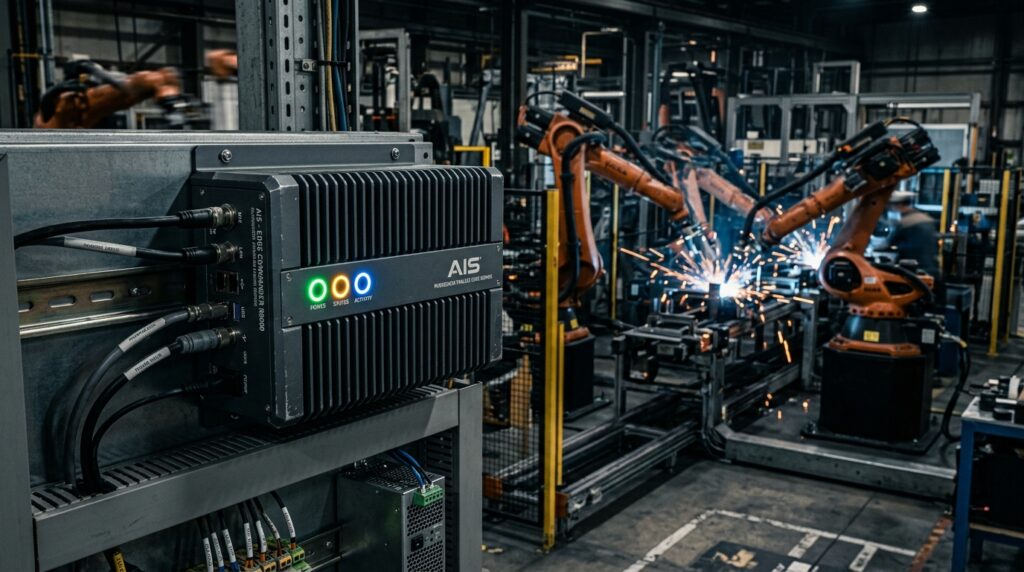
Enterprise software routinely crashes when exposed to the harsh realities of the factory floor. Heavy industrial environments introduce structural vibrations, airborne conductive particulate, oil mists, and unstable thermal zones. The Dragonwing On-Prem Appliance uses specialized physical engineering to survive these environments.
+-----------------------------------------------------------------------+
|                   External Aluminum Heat-Sink Fins                    |
+-----------------------------------------------------------------------+
  │                                                                   │
  ▼───────────────────────── Sealed Enclosure ────────────────────────▼
  ┌───────────────────────────────────────────────────────────────────┐
  │   System-on-Module (SoM) Baseboard                                │
  │                                                                   │
  │  +-------------------------------------------------------------+  │
  │  |   Qualcomm Dragonwing IQ-Series SoC (IQ8/IQ9)               |  │
  │  |   - Extended Diel Temperature Range (-40°C to +125°C)      |  │
  │  +-------------------------------------------------------------+  │
  │                                                                   │
  │  +-------------------------------------------------------------+  │
  │  |   128 GB LPDDR4x Memory with Inline Hardware ECC            |  │
  │  +-------------------------------------------------------------+  │
  │                                                                   │
  │  +-------------------------------------------------------------+  │
  │  |   High-Density 500-Pin Direct-Soldered Connectors           |  │
  │  +-------------------------------------------------------------+  │
  └───────────────────────────────────────────────────────────────────┘
  ▲───────────────────────── Sealed Enclosure ────────────────────────▲
  │                                                                   │
+-----------------------------------------------------------------------+
|                 Ruggedized I/O Ports: CAN-FD, Locking M12             |
+-----------------------------------------------------------------------+
- Extended Die-Temperature Thresholds: The industrial variants of the Dragonwing system—built on the IQ8 (e.g., IQ-8275) and IQ9 (e.g., IQ-9075) processor series—are rated for extreme operating conditions. The silicon architecture is designed to maintain electrical characteristics across broad temperatures: from $-40^\circ\text{C}$ to $+125^\circ\text{C}$ for the IQ8 tier, and $-40^\circ\text{C}$ to $+115^\circ\text{C}$ for the high-performance IQ9 tier. These processors feature integrated real-time microcontrollers built to automotive-grade AEC-Q100 Grade 3 parameters, offering hardware-level self-healing, deterministic execution loops, and emergency safety shutdowns.
- Fanless Thermal Mechanics: Moving parts represent failure points. The thermal efficiency of the Cloud AI 100 Ultra allows infrastructure OEMs (such as Aetina with their MegaEdge AIP-FR68 or Advantech via the AIR-055 chassis) to implement passive, conduction-cooled cooling loops. Eliminating motorized intake fans removes the risk of fan failure due to airborne metal shavings or oil mist. The sealed aluminum casing acts as a direct heat exchanger, isolating the internal motherboard from the surrounding environment.
- High-Density, Vibration-Resistant Interconnects: The structural vibration caused by stamping presses or heavy industrial machinery can cause traditional PCIe expansion cards to shift or shake loose over time. To prevent this, Dragonwing systems use a System-on-Module (SoM) approach. The computing core is directly attached to a rugged carrier board using high-density, low-profile, 500-pin board-to-board connectors. External communication relies on physical locking connectors, including locking M12 Ethernet terminals and secure CAN-FD nodes, preventing physical decoupling under sustained mechanical stress.
- Inline Hardware Error-Correcting Code (ECC): High-power industrial equipment generates strong electromagnetic interference (EMI), which can cause random single-bit errors in system memory. The 128 GB LPDDR4x primary memory engine uses inline hardware ECC. This layer intercepts, checks, and corrects bit-flips inside the memory controller before the corrupted data reaches the execution cores, preventing silent data corruption or sudden kernel panics.
The Air-Gapped Multi-Modal Software Framework
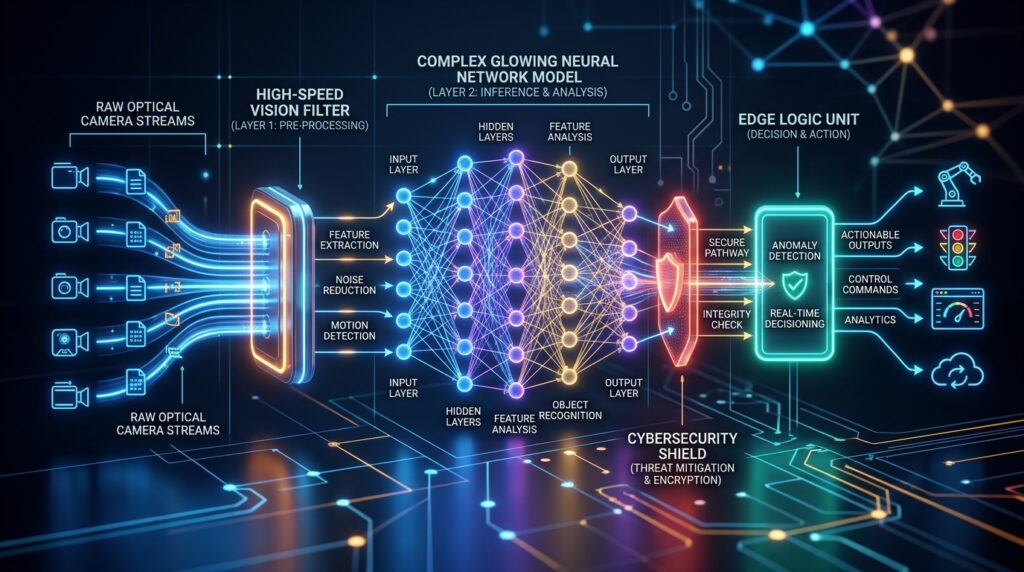
Operating in an air-gapped configuration means the system cannot rely on cloud APIs for processing support. The Dragonwing platform addresses this challenge using a two-tier edge execution model that coordinates fast, lightweight vision models with heavier, highly accurate localized Large Multimodal Models (Local LMMs).
                      Raw Optical Camera Ingestion Stream (up to 16 Cameras)
                                               │
                                               ▼
               +---------------------------------------------------------------+
               |                 REFLEX LAYER (Edge Core / VPU)                |
               |  - Frame Ingestion & H.264/H.265 HW Decoding                  |
               |  - Ultra-low latency computer vision models (YOLOv8)          |
               +---------------------------------------------------------------+
                                               │
                                       [Anomaly Event?]
                                               ├─── No  ──► Discard/Log Locally
                                               │
                                               ▼ Yes
               +---------------------------------------------------------------+
               |                REASONING LAYER (Cloud AI 100 Ultra)           |
               |  - Context-Aware Multi-Modal Assessment                       |
               |  - Real-Time Local Vectors (RAG) Document Lookup              |
               |  - Zero-Cloud Localized Diagnostics & Mitigation Generation   |
               +---------------------------------------------------------------+
                                               │
                                               ▼
                         Automated PLC Controller Intercept Command
Layer 1: The Reflex Layer (Ultra-Low Latency Inference)
The Reflex Layer handles real-time frame evaluation. On an industrial dev kit like the Lantronix IQ-9075 EVK, the integrated Image Signal Processor (ISP) ingests up to 16 concurrent camera feeds via direct MIPI CSI or high-speed GMSL deserializers. The onboard Adreno 675/663 Video Processing Unit (VPU) handles hardware decoding of Full HD (1080p) streams encoded in H.264 or H.265 at speeds up to 4x 4K60 or 1x 4K240.
Once decoded, these frame buffers pass directly to optimized computer vision models (such as an INT8-quantized YOLOv8 configuration) compiled via the Qualcomm Cloud AI SDK. These specialized models operate at frame rates above 30 FPS, maintaining an execution budget under 33 ms per frame. The Reflex Layer serves as a high-speed data filter, analyzing continuous video streams and discarding normal frames to conserve system resources.
Layer 2: The Reasoning Layer (Local LMM Contextual Evaluation)
When the Reflex Layer detects an operational anomaly or an unclassified event, it triggers the Reasoning Layer. The system captures the anomalous frame buffer and aggregates it with current machine metadata—such as real-time operating temperatures read from the CAN-FD bus and historical logs. This complete data package is routed to a local LMM (such as a Llama-3.1-8B instance or an IBM Granite variant) running on the Cloud AI 100 Ultra via a local vLLM or Triton Inference Server instance.
The local LMM analyzes the multi-modal data in context, query-matching the anomalies against mechanical blueprints, internal safety documentation, and maintenance logs stored in a local vector database using Retrieval-Augmented Generation (RAG). The system processes the complete inference sequence locally in under a second, generating text-based diagnostic readouts and sending machine-to-machine control commands directly to factory programmable logic controllers (PLCs).
Production Implementation Scenarios
Scenario A: Real-Time Micro-Defect Inspection on High-Speed PCB Assembly Lines
In electronics manufacturing, defects like micro-fissures in solder joints or misaligned components require immediate detection to prevent material waste.
- Reflex Layer Execution: A high-resolution camera captures the PCB layout immediately after component placement. A localized segmentation model evaluates the board surfaces within 15 ms, identifying an unexpected 0.2 mm surface fracture near a primary power capacitor.
- Reasoning Layer Interception: The system routes the component frame buffer to the onboard LMM, which queries the internal manufacturing database. In less than 500 ms, the system generates an evaluation and localized actionable output:
[Edge Diagnostic Engine Alert – PCB Node 04]
Detectable mechanical fracture isolated at capacitor node C104. Surface deformation profile correlates with the physical alignment fault identified on Pick-and-Place Robot No. 3 during the prior operational shift.
Automated Response: Activating pneumatic gate actuator to divert assembly unit to reclamation tray. Dispatching diagnostic intercept sequence to automated line manager to pause Robot No. 3 for mechanical calibration.
Scenario B: Proactive Hazard Containment in High-Temperature Metallurgical Zones
In metal casting facilities, ensuring staff wear personal protective equipment (PPE) and maintaining safe operating distances around furnaces is a critical safety requirement.
- Reflex Layer Execution: An entry-point camera monitors access to the furnace zone. A pose-estimation model detects an operator approaching the casting platform without a high-temperature heat visor or insulated gloves.
- Reasoning Layer Interception: The local LMM evaluates the danger level against furnace temperatures received via Modbus TCP. Recognizing that the furnace is operating at an active casting temperature of $1200^\circ\text{C}$, the system triggers an emergency protocol:
[Critical Life-Safety Breach – Furnace Zone 02]
Level 5 critical safety violation. Personnel ID 9271 detected inside active radiant boundaries without mandatory class-3 thermal protection equipment. Visual confirmation shows missing facial shield. Retinal exposure risk within 10 seconds.
Automated Response: Routing direct digital trip signal to Relay 04 to cut power to the furnace induction feed system. Activating local acoustic alarms and strobe arrays at the physical station entry.
Quantitative 3-Year Total Cost of Ownership (TCO) Model
To evaluate the financial viability of this edge computing platform compared to cloud-centric architectures, we analyzed a multi-camera monitoring system over a standard three-year enterprise operational lifecycle.
Mathematical Foundation and Common Constraints
- Camera Sensor Matrix ($N$): 100 independent optical camera streams.
- Resolution and Scan Frequency: Full HD (1080p) operating at a uniform 15 FPS.
- Average Video Bitrate ($B$): 2 Mbps per camera using optimized H.264/H.265 compression profiles.
- Operational Cycle: 24 hours per day ($H=24$), 365 days per year ($D=365$), over a 3-year term ($Y=3$).
- Local Power Unit Utility Cost: $0.10 USD per Kilowatt-hour (kWh).
Bandwidth Consumption and Cumulative Data Volume Derivations:
$$\text{Total Continuous Upload Bandwidth Requirement } (T_{\text{total}}) = N \times B = 100 \times 2\text{ Mbps} = 200\text{ Mbps}$$
$$\text{Daily Ingested Data Accumulation Volume } (V_{\text{day}}) = \frac{T_{\text{total}} \times 10^6 \times 3600 \times 24}{8 \times 1024^3} \approx 2,109.38\text{ GB/day}$$
$$\text{Annual Continuous Ingested Volume } (V_{\text{year}}) = \frac{V_{\text{day}} \times D}{1024} \approx 751.88\text{ TB/year}$$
$$\text{Cumulative 3-Year Data Payload Asset } (V_{\text{total\_3y}}) = V_{\text{year}} \times Y \approx 2,255.63\text{ TB}$$
Infrastructure Deployment Options
Option A1: Centralized Cloud Video API (e.g., AWS Rekognition Video Framework)
This approach routes all 100 camera streams directly to a cloud provider’s managed computer vision platform. To optimize costs, the system uses edge-side motion filtering so that only 10% of the raw footage is sent for full cloud API evaluation.
- Cloud Inference API Fees: AWS Rekognition Video charges $0.10 USD per minute of analyzed video.$$\text{Cumulative operating minutes across 3 years} = 100 \text{ cameras} \times 24 \text{ hours} \times 365 \text{ days} \times 3 \text{ years} \times 60 \text{ minutes} = 157,680,000 \text{ minutes}$$$$\text{Inference Cost for 10\% filtered volume} = 15,768,000 \text{ minutes} \times \$0.10 = \$1,576,800.00 \text{ USD}$$
- Network Ingestion Charges (AWS Kinesis Video Streams): Standard ingestion is billed at $0.0085 USD per GB.$$\text{Data Ingestion Financial Allocation} = 2,255.63 \text{ TB} \times 1,024 \times \$0.0085 = \$19,633.01 \text{ USD}$$
- Dedicated High-Speed WAN Infrastructure (Symmetric Leased Line): Supporting a continuous 200 Mbps upload stream requires a dedicated enterprise leased line billed at a flat rate of $1,500 USD per month.$$\text{3-Year Lease Commitment Allocation} = \$1,500 \times 12 \times 3 = \$54,000.00 \text{ USD}$$
- Total Option A1 Financial Cumulative Projection: $1,650,433.01 USD
Option A2: Self-Managed Cloud GPU Cluster instances (e.g., AWS EC2 g6.4xlarge with NVIDIA L4 GPUs)
The enterprise deploys its own custom inference pipeline using managed cloud instances, running a containerized YOLOv8 and LMM stack. Processing 100 concurrent camera feeds requires maintaining a constant cluster of 8 running instances.
- GPU Virtual Instance Fees: Billed at $1.20 USD per hour per instance.$$\text{Cumulative Cluster Compute Fees} = 8 \text{ instances} \times \$1.20 \times 24 \text{ hours} \times 365 \text{ days} \times 3 \text{ years} = \$252,288.00 \text{ USD}$$
- Rolling Cloud Storage Retention (AWS S3 Standard): Maintaining a rolling 30-day buffer of raw video assets for post-event analysis requires roughly 64.8 TB of active storage, billed at $0.023 USD per GB per month.$$\text{Cumulative Storage Financial Fees} = 64.8 \times 1,024 \times \$0.023 \times 12 \times 3 = \$54,942.11 \text{ USD}$$
- Network Ingestion and WAN Infrastructure Leased Line Costs: Matches Option A1, combining data ingestion fees ($19,633.01 USD) and dedicated internet leased line costs ($54,000.00 USD).
- Total Option A2 Financial Cumulative Projection: $380,863.11 USD
Option B: On-Premises Qualcomm Dragonwing AI Appliance
The enterprise deploys a local industrial edge server configured with two Qualcomm Cloud AI 100 Ultra acceleration cards, providing enough local computational capacity to handle the 100 vision streams and run the local LMM diagnostic framework.
- Initial Hardware Acquisition Cost (CAPEX): A one-time purchase of a ruggedized industrial edge server equipped with dual acceleration cards totals $25,000.00 USD.
- Software Licensing and Framework Management Fees: The Qualcomm AI Inference Suite enterprise edge runtime license costs $5,000 USD per year.$$\text{Total Licensing Fees over 3 years} = \$5,000 \times 3 = \$15,000.00 \text{ USD}$$
- System Integration, Setup, and Maintenance: Allocating a one-time deployment fee of $5,000.00 USD and ongoing mechanical maintenance costs of $2,000 USD per year yields a total of $11,000.00 USD.
- On-Site Operational Electrical Utility Cost: The dual-accelerator system maintains an average power draw of 300 Watts (0.30 kW) under full load.$$\text{Cumulative Electrical Energy Usage} = 0.30 \text{ kW} \times 24 \text{ hours} \times 365 \text{ days} \times 3 \text{ years} = 7,884 \text{ kWh}$$$$\text{Total Utility Cost Over 3 Years} = 7,884 \text{ kWh} \times \$0.10 = \$788.40 \text{ USD}$$
- Total Option B Financial Cumulative Projection: $51,788.40 USD
Financial Matrix Summary (All figures in USD)
| Expense Component | Option A1: Cloud Video API | Option A2: Cloud Virtual GPU VMs | Option B: Dragonwing Edge Appliance |
| Capital Expenditures (CAPEX) | $0.00 | $0.00 | $25,000.00 |
| Software Licensing / API Fees | $1,576,800.00 | $252,288.00 | $15,000.00 |
| Data Buffer Storage Allocation | Included in API | $54,942.11 | $0.00 (Local Array) |
| Network Ingestion Data Fees | $19,633.01 | $19,633.01 | $0.00 (Local LAN) |
| Dedicated WAN Leased Line | $54,000.00 | $54,000.00 | $0.00 (Local LAN) |
| System Integration & Maintenance | $0.00 | $0.00 | $11,000.00 |
| Electrical Power Utility Cost | Cloud Overhead | Cloud Overhead | $788.40 |
| Total 3-Year Lifecycle TCO | $1,650,433.01 | $380,863.11 | $51,788.40 |
TCO Comparison Over 3 Years (USD)
===================================================================
Option A1 (Cloud API):   ████████████████████████████████  $1,650,433
Option A2 (Cloud VM):    ███████  $380,863
Option B  (On-Prem):     █  $51,788
===================================================================
Return on Investment (ROI) Analysis
Comparing Option B directly to Option A1 (Cloud Video API) shows a significant reduction in operating expenses. Transitioning the system to the localized Dragonwing Edge Appliance saves $1,598,644.61 USD over the three-year lifecycle, representing an estimated Return on Investment (ROI) of 3086.9%.
When evaluated against Option A2 (the custom cloud GPU cluster approach), the Dragonwing configuration still yields a net savings of $329,074.71 USD, reflecting a calculated ROI of 635.4%.
The primary driver of these cost differences is the compounding nature of cloud consumption fees. Bounding model usage to a continuous, round-the-clock enterprise framework causes monthly operational cloud bills to increase linearly with data volume and processing time.
By utilizing the Qualcomm edge appliance, the enterprise shifts its financial exposure from unpredictable, variable operating expenditures (OPEX) to a predictable, fixed capital investment (CAPEX), allowing organizations to stabilize their long-term infrastructure budgets.
Architectural Compromises and Design Limitations
While the hardware efficiency and cost profiles of the Qualcomm platform are compelling, deploying an enterprise framework onto this architecture requires accepting several distinct engineering trade-offs.
- Complex Compilation Pipelines and Extended Development Velocity: Unlike the mature NVIDIA CUDA ecosystem, which allows developers to run native PyTorch or TensorFlow code directly on a target GPU with minimal friction, the Qualcomm hardware architecture requires a strict compilation pipeline. Engineering teams must export their trained models to an intermediate ONNX representation, then process the graphs through the Qualcomm Cloud AI SDK compiler to generate a proprietary binary package known as a Qualcomm Program Container (QPC). For complex architectures or custom model layers, this graph translation and static quantization process can take hours, creating friction during rapid software development cycles.
- Strictly Inference-Only ASIC Topologies: The Cloud AI 100 Ultra lacks the hardware execution blocks required for backpropagation and gradient calculation loops. Consequently, the hardware cannot perform on-site model training or live parameter fine-tuning. Upgrading or refining models requires maintaining a separate GPU-based development cluster in the cloud or a centralized data center, then pushing the updated, compiled weight configurations out to the edge units.
- Inefficiency with Standard Enterprise IT Workloads: The architectural design of the Hexagon Tensor Cores and processing pipelines in the Dragonwing IQ SoC series is optimized specifically for parallel matrix mathematics. These processors are not designed to handle generalized enterprise compute tasks. They cannot efficiently run legacy relational database engines, standard microservices stacks, or typical office productivity applications, meaning the appliance must remain a dedicated AI accelerator rather than a general-purpose branch server.
Final Assessment & Strategic Recommendations
Editor’s Perspective
The decision to adopt the Qualcomm Dragonwing platform depends on an organization’s existing data center commitments and physical operating constraints.
                  Are you operating in an air-gapped environment?
                                  │
                 ┌────────────────┴────────────────┐
                 ▼ Yes                             ▼ No
    [Deploy Dragonwing Edge]          Are you deeply tied to NVIDIA CUDA?
                                           │
                          ┌────────────────┴────────────────┐
                          ▼ Yes                             ▼ No
             [Retain Cloud/On-Prem GPUs]       [Evaluate Dragonwing for TCO]
IF your organization operates within heavy industrial spaces, requires strict data privacy, or manages multi-camera deployments that run continuous 24/7 inference loops, THEN deploying the Qualcomm Dragonwing On-Prem Appliance combined with the AI Inference Suite is a highly viable strategic option. This choice is justified BECAUSE it removes the ongoing operational costs of cloud scaling, offers a ruggedized physical enclosure that survives harsh factory conditions, and provides the computational efficiency needed to run advanced AI models entirely offline.
Conversely, if your development velocity depends on the flexibility of the NVIDIA CUDA ecosystem, or if your models change frequently throughout the week, the engineering overhead of Qualcomm’s static compilation pipeline may introduce deployment bottlenecks that outweigh the immediate energy savings.
Actionable Infrastructure Implementation Roadmap
For enterprise solutions architects planning to integrate this edge infrastructure into an industrial environment, we recommend the following phased deployment path:
- Establish a Hybrid Development Flow: Continue using flexible GPU-based cloud instances or centralized development nodes to handle initial model training, iterative fine-tuning, and model evaluation. Do not attempt to use edge hardware for primary model development.
- Automate the Qualcomm Compilation Pipeline: Integrate the Qualcomm Cloud AI SDK compiler directly into your centralized CI/CD software pipelines. Automate the conversion of verified model weights into the proprietary QPC container format, removing manual compilation tasks from your core engineering team.
- Deploy Edge Clusters via Kubernetes: Configure the on-premise Dragonwing devices using localized container orchestration layers, such as lightweight Kubernetes distributions (K3s). Use the Qualcomm AI Inference Suite to expose local, OpenAI-compatible REST API endpoints within the factory network, allowing legacy factory applications to query the edge models without modifications.
- Implement an Asynchronous Filtering Pipeline: Design your edge software to use lightweight vision filters at the ingest layer to process continuous video streams. Run heavier contextual language models only when the primary filters detect an operational anomaly, keeping the system optimized for low power consumption and high performance.
References & Further Reading
- Qualcomm Technologies, Inc. – Read the complete hardware blueprint and silicon specifications on the Qualcomm Cloud AI 100 Ultra Documentation.
- University of California, San Diego (UCSD) – Review the full academic study on the NRP LLM HPC Clusters Benchmark comparing Qualcomm ASICs against legacy datacenter GPUs.
- MLCommons Organization – Verify the officially submitted efficiency metrics via the MLPerf Inference v3.0 Verified Submissions dashboard.
- Qualcomm Edge Platforms – Access the deployment guidelines and silicon longevity lifecycles on the official Qualcomm Dragonwing IQ8/IQ9 Industrial Portal.
- Qualcomm Open-Source Ecosystem – Download the graph translation tools and compiler binaries from the Qualcomm Cloud AI SDK & QPC User Guide on GitHub.
Final Assessment & Strategic Recommendations
The decision to adopt the Qualcomm Dragonwing platform depends entirely on your organization’s existing data center commitments and physical operating constraints. If your operations run continuous 24/7 inference loops in harsh factory environments, migrating to this architecture is highly justified because it eliminates ongoing cloud scaling costs and provides complete offline autonomy. However, if your development velocity relies on the flexibility of the NVIDIA CUDA ecosystem, the engineering overhead of Qualcomm’s static compilation pipeline may introduce deployment bottlenecks that outweigh the immediate energy savings.
To see how this platform stacks up against other localized enterprise architectures, read our comprehensive guide on the Top 5 Zanus AI Alternative options for 2026. If you are focused on optimizing deployment protocols across specific industrial sectors, we also recommend checking out our blueprint on Zanus AI Deployment tactics, as well as our deep dives into vertical solutions like Zanus AI for Construction and Zanus AI for Logistics. For more hardware evaluations and unbiased technical breakdowns, bookmark our main AI Review Zones hub today to stay ahead of the technology curve.