Executive Summary: The Architectural Pivot of 2026
Evaluating the Top 5 On-Premise AI Platforms is becoming the primary mandate for enterprise technology leaders as the initial phase of generative AI adoption hits a severe ceiling. Enterprise CTOs, CISOs, and infrastructure architects are running directly into severe regulatory walls, unpredictable WAN latency bottlenecks in complex multi-agent workflows, and staggering monthly cloud usage bills.
Relying solely on external endpoints like OpenAI or AWS Bedrock introduces persistent data residency risks under regulations such as the EU AI Act, HIPAA, and GDPR. Furthermore, variable per-token pricing structures make high-volume agentic loops financially unsustainable at scale.
To regain operational control, lower total cost of ownership (TCO), and maintain absolute data sovereignty, enterprise technology leaders are shifting toward private, sovereign, and fully air-gapped AI environments.
This strategic report provides a comprehensive, independent evaluation of the top five enterprise platforms driving this transition: Dynamiq AI, E42.ai, SambaNova Systems (SN40L/SN50), HPE Private Cloud AI, and Qualcomm Dragonwing IQ-9075.
Architectural Topography & Comparison Matrix
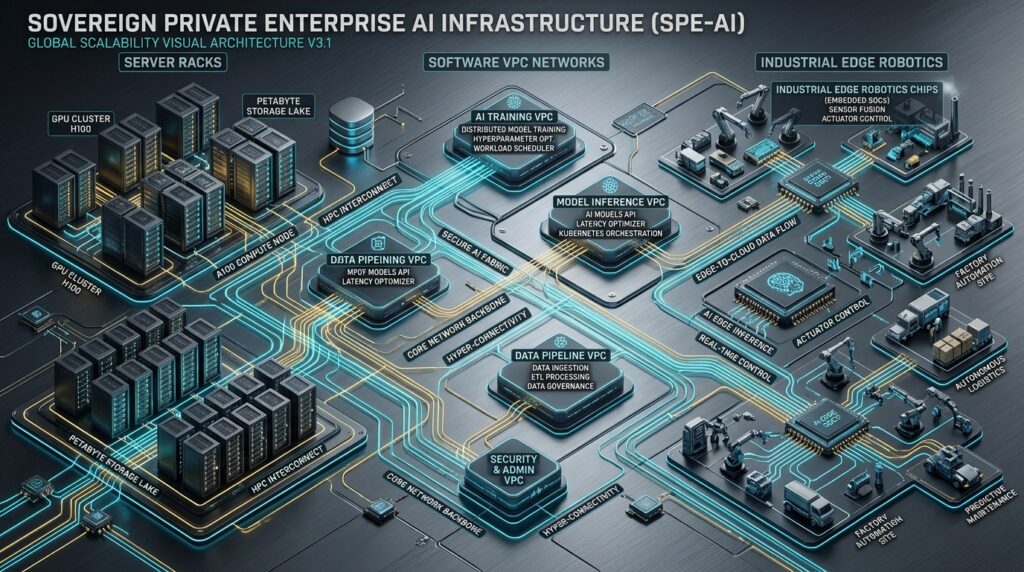
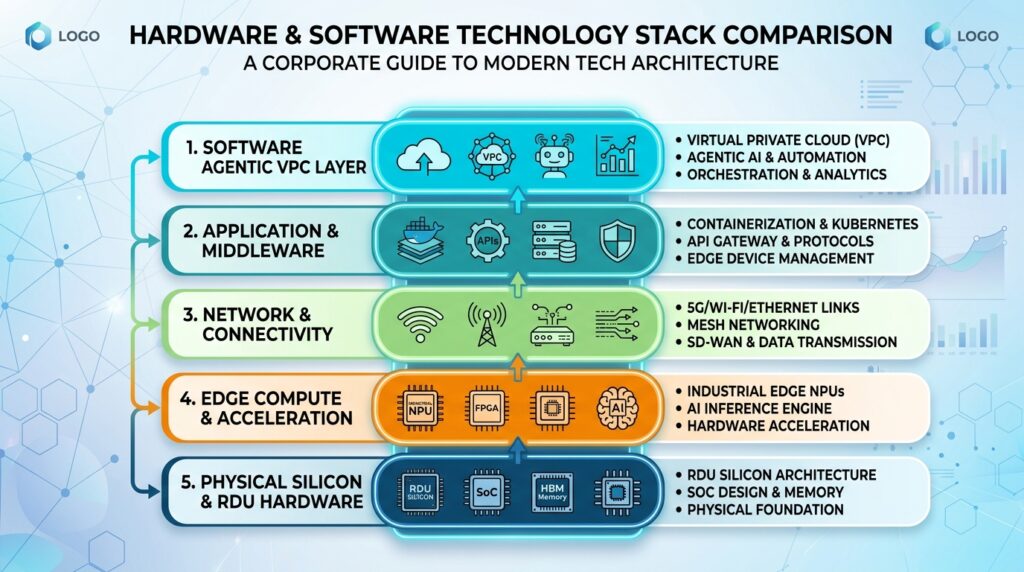
Evaluating private AI infrastructure requires analyzing the entire technology stack—from high-level software orchestration frameworks down to custom hardware chips and industrial edge silicon. Each platform targets a specific operational footprint across the enterprise ecosystem.
Overview of Evaluated Platforms
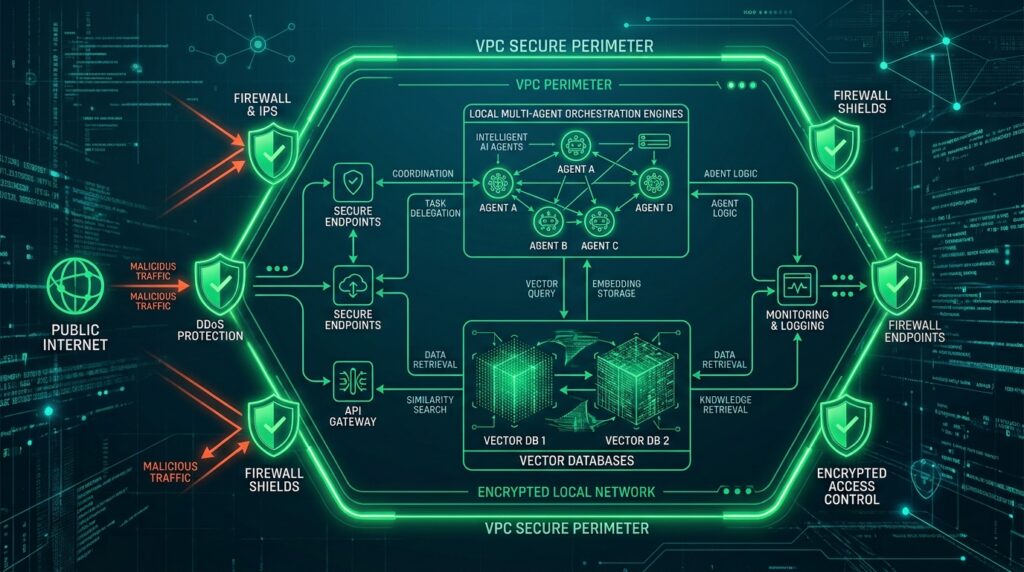
- Dynamiq AI: A software-defined agentic orchestration platform built for deployment inside an enterprise Virtual Private Cloud (VPC) or air-gapped Kubernetes cluster. Delivered via enterprise Helm charts, it provides local retrieval-augmented generation (RAG) pipelines, dynamic agent memory, and prompt safety guardrails within the internal firewall.
- E42.ai: A Cognitive Process Automation (CPA) platform combining Intelligent Character Recognition (ICR) with natural language understanding. Deployed on local servers or private cloud clusters, E42.ai instantiates autonomous “AI co-workers” to process unstructured documents without transmitting sensitive business records outside the network perimeter.
- SambaNova Systems (SN40L / SN50): A hardware-software architecture powered by Reconfigurable Dataflow Units (RDUs). Moving beyond traditional von Neumann GPU paradigms, SambaNova’s non-von Neumann architecture uses dynamic dataflow graphs where compute and memory operate in parallel directly on-chip. Featuring a three-tiered memory structure (SRAM, HBM, and direct DDR DRAM), it supports microsecond model switching and long-context RAG workloads.
- HPE Private Cloud AI: A turnkey, cloud-managed “AI Factory” co-developed with NVIDIA and integrated into the HPE GreenLake control plane. Combining HPE ProLiant Gen12 servers, NVIDIA accelerated computing (RTX Pro 6000, H200, or Blackwell architectures), Spectrum-X Ethernet, and HPE Alletra MP storage, it delivers an out-of-the-box private cloud infrastructure.
- Qualcomm Dragonwing IQ-9075: A high-density Neural Processing Unit (NPU) System-on-Chip (SoC) engineered for mission-critical, air-gapped industrial facilities. It runs multi-modal computer vision, acoustic diagnostics, and local control loops at the physical network edge without requiring cloud backhaul connectivity.
Comparative Platform Matrix
| Platform | Architectural Paradigm | Deployment Footprint | Security & Compliance | Target Enterprise Use Cases |
| Dynamiq AI | Software-Defined Agentic Orchestration | Kubernetes Helm, VPC, On-Prem EKS / OpenShift | SOC 2 Type II, HIPAA, GDPR Sovereign Processing | Multi-agent autonomous workflows, local RAG, enterprise prompt guardrails |
| E42.ai | Cognitive Process Automation (CPA) & Deep ICR | Containerized Microservices on Bare-Metal / VMs | HIPAA, SOC 2, ISO 27001, Financial Audit Standards | Complex document processing, financial ledger audits, back-office automation |
| SambaNova SN40L / SN50 | Reconfigurable Dataflow Unit (RDU) Hardware | SambaRack (16 to 256 RDUs), Standard 42U Rack | FIPS 140-3, Physical Air-Gap Isolation | High-throughput agentic inference, trillion-parameter MoE serving, massive long-context RAG |
| HPE Private Cloud AI | Integrated Hardware & Cloud-Managed Stack | Modular Rack Configurations (1 to 16+ GPUs/node) | FedRAMP High Ready, HIPAA, SOC 2, GDPR | Enterprise-wide LLM hosting, NVIDIA NIM deployment, private cloud AI factories |
| Qualcomm IQ-9075 | Low-Power Industrial Edge NPU SoC | Ruggedized Appliances, DIN-Rail, Passive Cooling | Cyber Resilience Act, IEC 62443 Industrial Security | Real-time computer vision, predictive maintenance, automated industrial edge robotics |
Operational Impact
Editor’s Perspective:
Selecting an AI platform isn’t just about raw TOPS or parameter counts. Software-focused platforms like Dynamiq AI and E42.ai maximize flexibility within your existing computing environment. Conversely, integrated hardware systems like SambaNova and HPE solve deep physical bottlenecks—such as memory bandwidth and hardware integration complexity. Organizations should prioritize solving their primary operational bottleneck before committing capital to hardware upgrades.
TCO & Commercial Economics: The Shift to Fixed-Cost Infrastructure
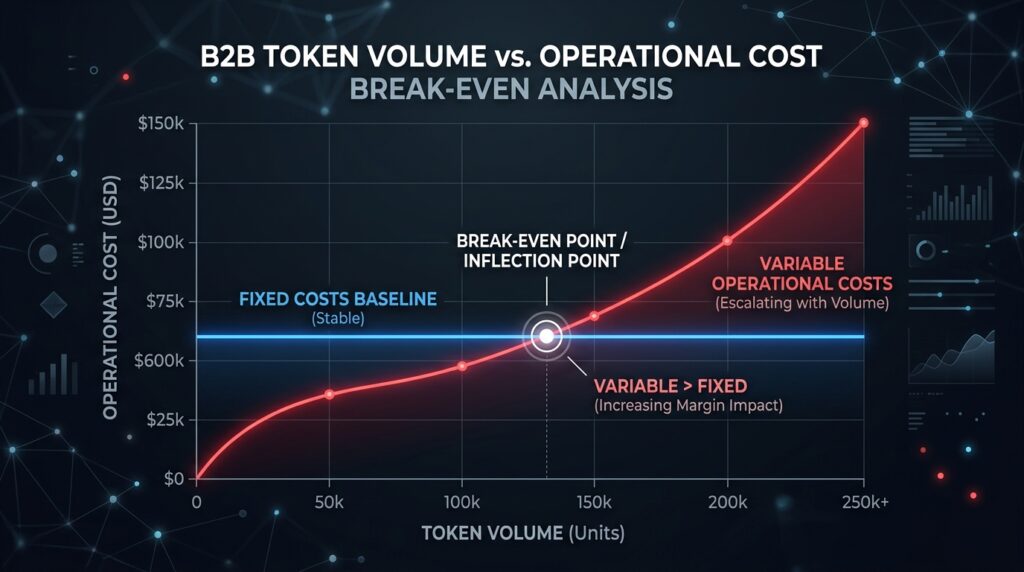
The economic decision to transition from public cloud APIs to on-premise, sovereign private infrastructure centers on the contrast between variable per-token operational expenditures (OpEx) and amortized, fixed-cost capital investments (CapEx).
Public Cloud Unit Economics vs. Fixed Private IaaS
Public cloud models charge based on input and output tokens. While cost-effective during early testing, variable consumption pricing scales unpredictably when deploying multi-agent systems in production. Modern agentic workflows rely on iterative reasoning loops, intermediate tool calls, self-reflection steps, and extensive vector database retrievals—multiplying the token throughput required to complete a single business task.
Public Cloud Total Cost  = Sum(Token Volume x Per-Token Price) + Egress Fees + Gateway Overhead
Private Cloud Total Cost = (Hardware CapEx + License CapEx) / Amortization Period + Power/Cooling + Administration
Quantitative Inflection Point Analysis
Consider an enterprise running 5,000 active AI agents, with each agent completing 20 reasoning loops per day at an average of 10,000 tokens per loop. This setup processes roughly 1 billion tokens daily.
- Public Cloud Cost: At a blended public cloud API rate of $3.00 per million tokens, daily expenses total $3,000, or $1,095,000 annually (excluding data egress fees).
- Private Infrastructure Cost: Deploying a dedicated private hardware stack—such as a SambaNova SambaRack or an HPE Private Cloud AI system—carries an amortized monthly hardware/licensing cost of approximately $12,000 to $18,000. Factoring in annual data center power, cooling, and management costs, total fully loaded expenses average roughly $220,000 annually.
In this operational scenario, moving to dedicated private infrastructure reduces annual token processing costs by over 79%, while eliminating egress fees and maintaining complete data isolation inside the corporate perimeter.
Cost ($)
  |                                   / Public Cloud API Cost (Variable)
  |                                  /
  |                                 /
  |                                /   <-- Inflection Point (~20M Tokens/Day)
  |-------------------------------/---------------------------------------
  |                              /     Private Cloud Fixed-Cost Baseline
  |                             /
  |____________________________/__________________________________________
  0                                                               Token Volume
The economic inflection point where private infrastructure becomes more cost-effective than public cloud APIs typically occurs between 15 million and 30 million tokens processed per day. Beyond this threshold, the marginal cost of generating additional tokens on dedicated hardware drops toward the cost of electricity.
Strategic Deep Dive: Top 5 Sovereign Platforms
1. Dynamiq AI
Best for: Enterprises needing software-level agentic orchestration within an existing VPC.
+-----------------------------------------------------------------------+
| Dynamiq AI VPC Security Perimeter                                     |
|                                                                       |
|  +-----------------------------------------------------------------+  |
|  | Multi-Agent Orchestration Engine (Apache 2.0 Core)             |  |
|  +-----------------------------------------------------------------+  |
|  | Local Memory Stores & RAG Vector Databases                      |  |
|  +-----------------------------------------------------------------+  |
|  | Real-Time Guardrail Validation & Trace Observability Dashboard   |  |
|  +-----------------------------------------------------------------+  |
|                                 ^                                     |
|                                 v (Sub-millisecond Local IPC/EKS Bus) |
|  +-----------------------------------------------------------------+  |
|  | Local Model Inference Runtimes (vLLM / On-Prem Accelerators)     |  |
|  +-----------------------------------------------------------------+  |
+-----------------------------------------------------------------------+
- Problem Solved: Overcomes latency delays and security risks caused by sending multi-agent tool calls and contextual data through public cloud APIs.
- Architectural Differentiator: Operates as a software-defined management fabric directly inside your Kubernetes environment (EKS, OpenShift, or native bare-metal). By co-locating multi-agent orchestration, local vector stores, and prompt guardrails on the same internal network fabric, Dynamiq reduces inter-agent communication latency to sub-millisecond speeds.
- Trade-offs & Limitations: Dynamiq is purely an orchestration and software layer; it does not supply hardware acceleration. You must manage and provision the underlying GPU compute cluster yourself.
- Editor’s Take: Choose Dynamiq AI if you already have dedicated GPU capacity or a mature Kubernetes environment and want to build secure, low-latency multi-agent workflows without sending enterprise telemetry off-site.
2. E42.ai
Best for: Document-heavy enterprise workflows requiring automated cognitive process execution.
- Problem Solved: Resolves low extraction accuracy and data privacy issues when processing complex, unstructured documents (such as invoices, bills of lading, and legal filings) through generic public LLM endpoints.
- Architectural Differentiator: Combines custom Intelligent Character Recognition (ICR) with Cognitive Process Automation (CPA). E42.ai deploys pre-configured “AI co-workers” designed for specific operational roles (e.g., Accounts Payable, Claims Auditing) that run as containerized microservices entirely within your local data center.
- Trade-offs & Limitations: Highly specialized for structured and unstructured document workflows; it is not intended for general-purpose conversational AI or software development tasks.
- Editor’s Take: Choose E42.ai if your primary operational goal is automating document-heavy back-office processes without exposing sensitive corporate records to external APIs.
3. SambaNova Systems (SN40L / SN50)
Best for: High-throughput Mixture-of-Experts (MoE) serving, long-context RAG, and multi-model agent execution.
+-------------------------------------------------------------------------+
| SambaNova Tiered Memory Architecture                                    |
|                                                                         |
|  +-------------------------------------------------------------------+  |
|  | On-Chip SRAM (520MB)    --> Ultra-hot data & immediate compute     |  |
|  +-------------------------------------------------------------------+  |
|  | Co-Packaged HBM (64GB)  --> Active model weights & streaming state|  |
|  +-------------------------------------------------------------------+  |
|  | Attached DDR DRAM (1.5TB)--> Model catalog & massive context cache|  |
+-------------------------------------------------------------------------+
- Problem Solved: Eliminates memory bandwidth bottlenecks in standard GPU architectures when serving large Mixture-of-Experts models or context windows up to 10 million tokens.
- Architectural Differentiator: Powered by Reconfigurable Dataflow Units (RDUs). The SN40L and fifth-generation SN50 RDUs map model compute graphs directly onto a physical grid of Pattern Compute Units (PCUs) and Pattern Memory Units (PMUs). Featuring a three-tiered memory structure (520MB on-chip SRAM, 64GB co-packaged HBM, and up to 1.5TB directly attached DDR DRAM per socket), SambaNova racks can hold multiple large foundation models in memory simultaneously for near-instantaneous model switching.
- Trade-offs & Limitations: Represents a proprietary hardware paradigm. While fully compatible with PyTorch model weights, it requires compilation through SambaNova’s software stack rather than standard CUDA binaries.
- Editor’s Take: Choose SambaNova if your organization needs to serve massive foundation models or run complex agentic reasoning loops that hit severe memory bandwidth walls on standard GPU clusters.
4. HPE Private Cloud AI
Best for: Enterprise IT departments seeking a pre-integrated, vendor-supported “AI Factory” managed like a private cloud.
+-------------------------------------------------------------------------+
| HPE Private Cloud AI Architecture (Managed via HPE GreenLake)            |
|                                                                         |
|  +-------------------------------------------------------------------+  |
|  | Management & AIOps : HPE GreenLake Control Plane / OpsRamp        |  |
|  +-------------------------------------------------------------------+  |
|  | Software Stack     : NVIDIA AI Enterprise / NIM Microservices      |  |
|  +-------------------------------------------------------------------+  |
|  | Compute & GPU      : HPE ProLiant Gen12 / NVIDIA H200/Blackwell    |  |
|  +-------------------------------------------------------------------+  |
|  | Fabric & Storage   : NVIDIA Spectrum-X / HPE Alletra Storage MP    |  |
+-------------------------------------------------------------------------+
- Problem Solved: Eliminates the integration headaches, driver conflicts, and extended deployment timelines associated with building private enterprise AI infrastructure from scratch.
- Architectural Differentiator: A complete hardware-software platform co-developed with NVIDIA. It integrates HPE ProLiant Gen12 servers, NVIDIA accelerated computing (RTX Pro 6000, H200, or Blackwell), Spectrum-X Ethernet/InfiniBand networking, and HPE Alletra MP storage. Managed on-premises via the HPE GreenLake control plane, it includes integrated AIOps (OpsRamp) and NVIDIA AI Enterprise NIM microservices for out-of-the-box model deployment.
- Trade-offs & Limitations: Carries premium enterprise hardware and licensing costs, with less flexibility to swap out core components compared to self-assembled hardware environments.
- Editor’s Take: Choose HPE Private Cloud AI if your IT leadership wants a turnkey, enterprise-grade AI infrastructure backed by strict SLAs and unified cloud-style management.
5. Qualcomm Dragonwing IQ-9075
Best for: Mission-critical, air-gapped industrial manufacturing and edge operations.
- Problem Solved: Removes WAN connectivity requirements, network latency risks, and power/thermal constraints for local real-time visual inspection and computer vision workloads.
- Architectural Differentiator: A high-density, low-power industrial System-on-Chip (SoC) featuring a dedicated Hexagon Neural Processing Unit (NPU). Designed for harsh industrial environments, the IQ-9075 runs multi-modal vision models and acoustic telemetry analytics within passively cooled enclosures mounted directly on industrial DIN rails.
- Trade-offs & Limitations: Built specifically for localized edge inferencing; it is not designed to train enterprise foundation models or run massive LLM clusters.
- Editor’s Take: Choose the Qualcomm Dragonwing IQ-9075 if you need to deploy real-time visual AI or acoustic diagnostics directly inside disconnected or thermally constrained industrial facilities.
Actionable Implementation Roadmap for CTOs
+-----------------------------------------------------------------------+
| Workload Classification & Platform Selection                          |
+-----------------------------------------------------------------------+
| Application-Layer Orchestration & VPC Security                        |
|   ├── Multi-Agent Logic & Local Memory  =======> Dynamiq AI           |
|   └── Unstructured Document Ingestion   =======> E42.ai                 |
+-----------------------------------------------------------------------+
| Hardware Acceleration & Enterprise Infrastructure                     |
|   ├── High-Throughput MoE / Trillion-Param ====> SambaNova SN40L/SN50 |
|   ├── Turnkey Enterprise AI Factory     =======> HPE Private Cloud AI |
|   └── Air-Gapped Industrial Edge        =======> Qualcomm IQ-9075    |
+-----------------------------------------------------------------------+
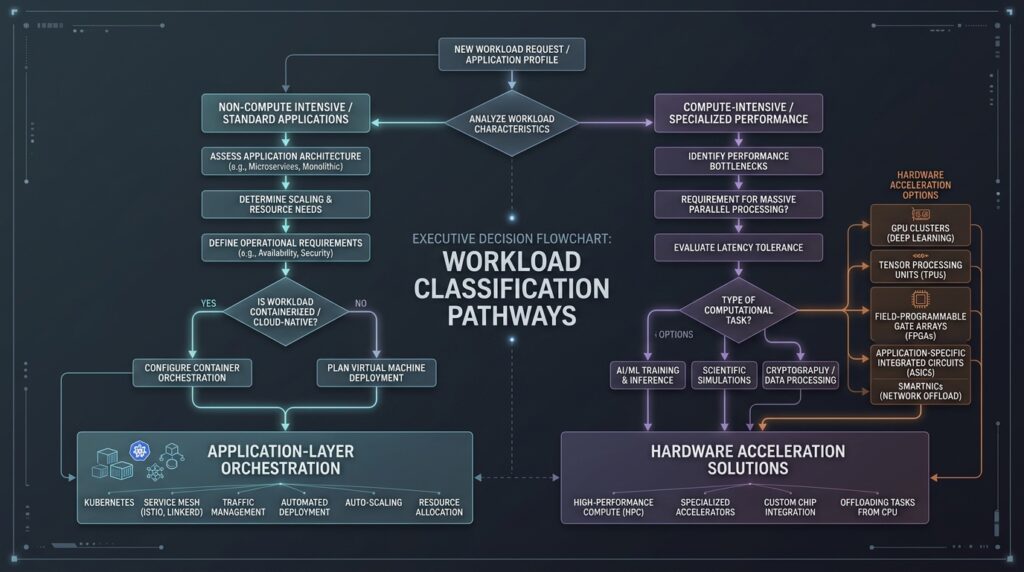
Moving from public cloud APIs to an air-gapped, sovereign AI footprint requires a structured deployment strategy:
- Audit Daily Token Demands: Calculate your organization’s total daily token consumption across all active agentic loops and workflow integrations. If aggregate volume consistently exceeds 20 million tokens per day, initiate a private infrastructure transition plan to protect long-term operating margins.
- Define Security & Compliance Boundaries: Categorize target workloads by regulatory risk. Assign operations processing Protected Health Information (PHI), Personally Identifiable Information (PII), or core financial records to fully air-gapped software or hardware environments.
- Assess Local Data Center Infrastructure: Review your facility’s available power density, cooling infrastructure, and network fabric. For standard data center facilities, air-cooled configurations like SambaNova SambaRacks (10kW typical power footprint) or HPE Private Cloud AI offer clear deployment paths without requiring liquid-cooling retrofits.
- Standardize Management Control Planes: Deploy unified observability and management software (such as HPE GreenLake OpsRamp or Dynamiq Agent Ops) to maintain complete operational control over model performance, system health, and safety guardrails across all on-premise and edge deployments.
Final Recommendation
- Choose Dynamiq AI if you need a software orchestration layer to run multi-agent workflows securely inside your existing Kubernetes VPC.
- Choose E42.ai if your priority is automating complex, unstructured document workflows using pre-configured AI co-workers.
- Choose SambaNova Systems if you serve large Mixture-of-Experts models or long-context RAG pipelines that demand high memory bandwidth and throughput.
- Choose HPE Private Cloud AI if your organization requires an integrated, turnkey private cloud infrastructure supported by enterprise SLAs and cloud-style management.
- Choose Qualcomm Dragonwing IQ-9075 if you must run real-time computer vision or acoustic analytics in rugged, air-gapped industrial environments.
By matching your specific operational priorities to purpose-built private architectures, you can build a resilient AI infrastructure strategy that ensures complete data sovereignty, delivers low operational latency, and provides long-term, predictable cost efficiency.
Strategic Deep Dive: Top 5 Sovereign Platforms
1. Dynamiq AI
Best for: Enterprises needing software-level agentic orchestration within an existing VPC.
Problem Solved: Overcomes latency delays and security risks caused by sending multi-agent tool calls and contextual data through public cloud APIs.
Architectural Differentiator: Operates as a software-defined management fabric directly inside your Kubernetes environment (EKS, OpenShift, or native bare-metal). By co-locating multi-agent orchestration, local vector stores, and prompt guardrails on the same internal network fabric, Dynamiq reduces inter-agent communication latency to sub-millisecond speeds.
Editor’s Take: Choose Dynamiq AI if you already have dedicated GPU capacity or a mature Kubernetes environment and want to build secure, low-latency multi-agent workflows without sending enterprise telemetry off-site.
2. E42.ai
Best for: Document-heavy enterprise workflows requiring automated cognitive process execution.
Problem Solved: Resolves low extraction accuracy and data privacy issues when processing complex, unstructured documents (such as invoices, bills of lading, and legal filings) through generic public LLM endpoints.
Architectural Differentiator: Combines custom Intelligent Character Recognition (ICR) with Cognitive Process Automation (CPA). E42.ai deploys pre-configured “AI co-workers” designed for specific operational roles that run as containerized microservices entirely within your local data center. For a complete deep dive on its platform architecture and flat-rate licensing economics, read our comprehensive E42.ai Review.
3. SambaNova Systems (SN40L / SN50)
Best for: High-throughput Mixture-of-Experts (MoE) serving, long-context RAG, and multi-model agent execution.
Problem Solved: Eliminates memory bandwidth bottlenecks in standard GPU architectures when serving large Mixture-of-Experts models or context windows up to 10 million tokens.
Architectural Differentiator: Powered by Reconfigurable Dataflow Units (RDUs). Featuring a three-tiered memory structure (520MB on-chip SRAM, 64GB co-packaged HBM, and up to 1.5TB directly attached DDR DRAM per socket), SambaNova racks can hold multiple large foundation models in memory simultaneously. Explore how this architecture serves full DeepSeek-R1 workloads inside a single air-cooled rack in our SambaNova SN40L RDU Review.
4. HPE Private Cloud AI
Best for: Enterprise IT departments seeking a pre-integrated, vendor-supported “AI Factory” managed like a private cloud.
Problem Solved: Eliminates integration headaches, driver conflicts, and extended deployment timelines associated with building private enterprise AI infrastructure from scratch.
Architectural Differentiator: A complete hardware-software platform co-developed with NVIDIA integrating HPE ProLiant Gen12 servers, NVIDIA accelerated computing, Spectrum-X networking, and HPE Alletra MP storage. Managed on-premises via HPE GreenLake control plane. To inspect its pre-validated hardware sizing tiers and OpsRamp AIOps governance, check out our in-depth HPE Private Cloud AI Review.
5. Qualcomm Dragonwing IQ-9075
Best for: Mission-critical, air-gapped industrial manufacturing and edge operations.
Problem Solved: Removes WAN connectivity requirements, network latency risks, and power/thermal constraints for local real-time visual inspection and computer vision workloads.
Architectural Differentiator: A high-density, low-power industrial System-on-Chip (SoC) featuring a dedicated Hexagon NPU. Designed for harsh industrial environments, it runs multi-modal vision models within passively cooled enclosures mounted directly on DIN rails. Analyze its dual-brain MCU control and ROS 2 robotics integration in our detailed Qualcomm Dragonwing AI Review.
Final Recommendation & Ecosystem Roadmap
By matching your specific operational priorities to purpose-built private architectures, you can build a resilient AI infrastructure strategy that ensures complete data sovereignty, delivers low operational latency, and provides long-term, predictable cost efficiency. To contrast these modern platforms against legacy setups, explore our foundational ElectroNeek On-Premise Review, reference our baseline Top 5 Zanus AI Alternative manual, or analyze specialized industry frameworks through our vertical blueprints on Zanus AI Deployment, Zanus AI for Construction, and Zanus AI for Logistics. Bookmark our central AI Review Zones portal to stay continuously aligned with high-performance computing shifts.
References
- Amazon Web Services: Dynamiq Gen AI Platform – Enterprise VPC Deployment
- Dynamiq Official Documentation: Enterprise-Ready Custom AI Agent Builder
- E42.ai Platform Portal: No-Code Cognitive Automation Platform for Enterprises
- SambaNova Systems: SN50 RDU: Purpose-Built for Agentic Inference
- arXiv Academic Repository: SambaNova SN40L: Scaling the AI Memory Wall with Dataflow and Composition of Experts
- Hewlett Packard Enterprise: HPE Private Cloud AI Solution Specifications
- NVIDIA Newsroom: Hewlett Packard Enterprise and NVIDIA Announce ‘NVIDIA AI Computing by HPE’
- Qualcomm Technologies: Qualcomm Dragonwing IQ-9075 Industrial Processor Overview