
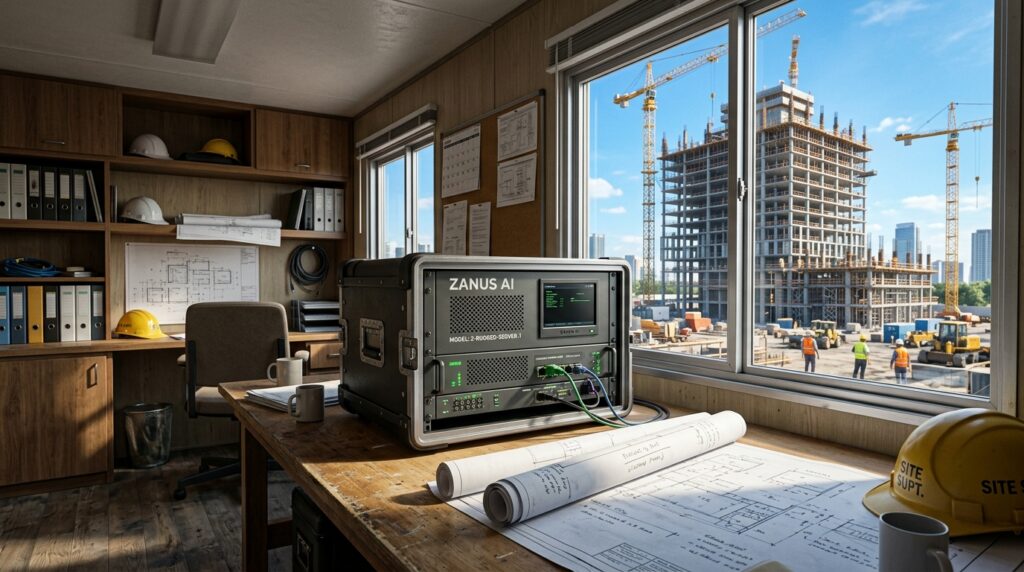
Evaluating zanus ai for construction and AEC operations demonstrates that most commercial firms do not need another abstract AI framework. They need a practical way to resolve operational bottlenecks, protect high-value intellectual property, and secure government contracts without triggering severe compliance penalties.
While cloud-based generative AI and remote computer vision tools promise massive productivity gains, deploying them in the Architecture, Engineering, and Construction (AEC) sector introduces structural data vulnerabilities and unsustainable wide-area network (WAN) costs. For organizations handling sensitive proprietary Building Information Modeling (BIM) files, confidential tender documentation, and defense-related infrastructure projects, the public cloud represents a severe operational risk rather than a solution.
This guide evaluates how on-premises private AI systems—specifically the Zanus AI platform ecosystem (Prime, Quantum, and Enterprise)—compare against custom-built GPU infrastructures to help enterprise IT architects establish secure, sovereign construction intelligence.
Quick Summary
Choosing the right localized AI architecture determines how quickly your organization achieves operational readiness.
- Zanus AI Turnkey Appliances: Best for organizations requiring immediate CMMC 2.0 / NIST SP 800-171 compliance and Day 1 deployment without expanding specialized internal engineering teams.
- Custom GPU Deployments: Best for enterprise environments requiring maximum hardware customization that have the budget to sustain long-term machine learning infrastructure development.
Infrastructure Comparison
| Architectural Metric | Custom-Built Private AI Server | Zanus AI Turnkey Platforms (Prime / Quantum / Enterprise) |
| Best For | Extreme hardware customization | Rapid compliance, secure data enclaves, lower operational overhead |
| Initial Time-to-Value | 6 to 18+ months of engineering development | Pre-configured and operational on Day 1 |
| Initial Expense | Unpredictable hardware sourcing & custom software engineering costs | Predictable, one-time capital investment (CapEx) |
| Software Stack Integration | High complexity; manual integration of models, vector stores, and APIs | Pre-integrated; features localized vector stores and production-ready modules |
| Engineering Staff Demands | Requires 2–5 specialized ML and DevOps engineers | Zero dedicated AI development staff required; managed by standard IT administration |
| Recurring Token Fees | Zero | Zero |
| Sovereign Scaling Paths | Requires manual node configuration and custom load-balancing | Seamless horizontal scaling via pre-configured multi-node clustering |
1. Data Privacy & The Regulatory Traps of Cloud AI
Deploying multi-tenant cloud AI systems (such as OpenAI or AWS Bedrock) to analyze proprietary construction documentation creates immediate legal and compliance exposures.
Intellectual Property Exposure
When an estimator or design engineer uploads proprietary BIM models or project blueprints to a cloud-based Large Language Model (LLM), the data travels across the public internet. This architecture introduces distinct vectors of intellectual property compromise:
- Model Training Ingestion: Many standard enterprise cloud AI platforms utilize customer inputs to refine future model weights. If unique structural engineering designs or patented modular prefabrication techniques are ingested, they can be exposed to competitors through targeted prompt-extraction attacks.
- Shadow AI Proliferation: Driven by production pressures, employees frequently bypass corporate IT policies to utilize unsanctioned, consumer-grade tools. In a construction context, pasting confidential client pricing or supplier agreements into external platforms creates an unmonitored data exposure surface.
- BIM Metadata Aggregation: BIM datasets contain physical security layouts, utility routing, and building access control specifications. Once stored in a cloud environment, these high-value files are vulnerable to hypervisor-level breaches or multi-tenant storage misconfigurations.
The Defense Contract Landscape (CMMC 2.0 & NIST SP 800-171)
For construction firms pursuing government and defense-related tenders, cloud-based data processing is heavily restricted by federal cybersecurity mandates. Under the Defense Federal Acquisition Regulation Supplement (DFARS) clause 252.204-7012, contractors handling Controlled Unclassified Information (CUI) must enforce the 110 security controls outlined in NIST Special Publication 800-171.
Contractors must demonstrate compliance through three tiers under the Cybersecurity Maturity Model Certification (CMMC) 2.0 framework:
- CMMC Level 1 (Foundational): Requires annual self-assessments to protect Federal Contract Information (FCI). No Plans of Action and Milestones (POA&Ms) are permitted to cover security gaps.
- CMMC Level 2 (Advanced): Requires alignment with all 110 practices of NIST SP 800-171 to safeguard CUI. Compliance requires third-party verification from a Certified Third-Party Assessment Organization (C3PAO) for the majority of defense contracts.
- CMMC Level 3 (Expert): Adds 24 selected requirements from NIST SP 800-172 to counter Advanced Persistent Threats (APTs), requiring direct government-led verification.
DFARS 252.204-7012 explicitly dictates that any cloud service provider processing CUI must meet the FedRAMP Moderate (or equivalent) security standard. Commercial cloud AI APIs generally fail this requirement because they lack localized data residency controls and cryptographic isolation.
On-premises appliances like Zanus AI Prime or Quantum resolve this operational bottleneck by processing 100% of data within the physical facility. The server functions as a localized CUI enclave that inherits existing physical protection controls (NIST SP 800-171 Family 3.10) and system communication protections (Family 3.13), allowing IT architects to present verifiable, audit-ready evidence directly to C3PAO inspectors.
Editor’s Perspective: Compliance Risk
Why this matters: The regulatory landscape has shifted from self-attestation to mandatory third-party verification. Relying on commercial cloud AI for defense bidding documents introduces severe legal risks under the False Claims Act (FCA) and can result in immediate contract ineligibility. On-premises architecture turns compliance into an engineering certainty rather than an administrative hurdle.
2. Zanus AI for Construction: Remote Telemetry & WAN Bottleneck
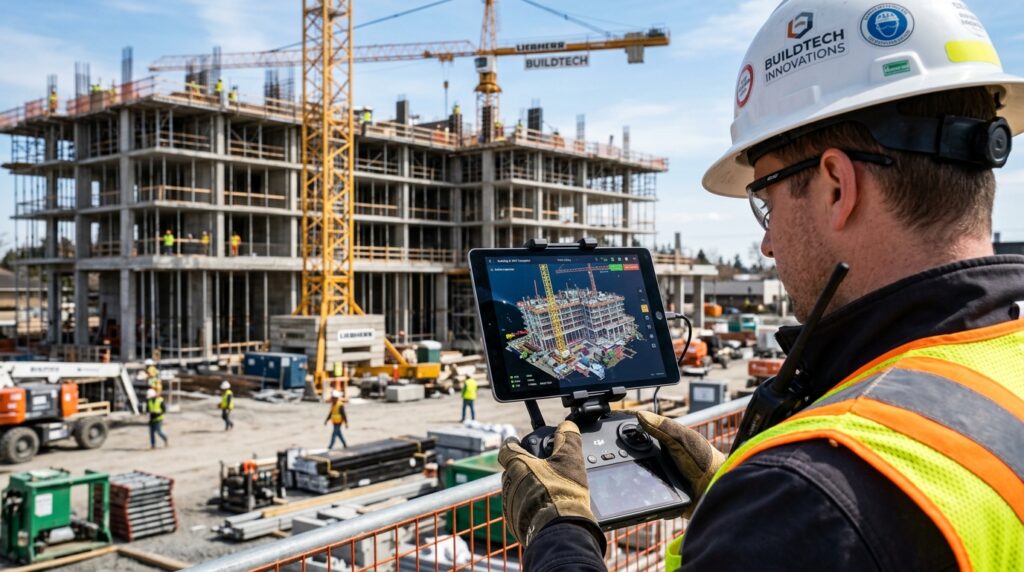
Large-scale construction management depends on high-resolution data payloads, specifically aerial drone photogrammetry and 4K CCTV site security surveillance. Backhauling these massive datasets from geographically isolated or low-bandwidth sites to cloud environments creates severe operational delays.
Drone Photogrammetry Payloads
To generate engineering-grade 2D orthomosaic maps and 3D digital twins, drone flights must maintain strict parameters. Flying at 200 feet above ground level (AGL) generates a Ground Sample Distance (GSD) of 1 to 2 centimeters per pixel, requiring a forward overlap of 75% to 80% and a side overlap of 60% to 70%.
- Small Site (<10 ha): 120 – 400 images | 2 GB – 5 GB raw data
- Medium Site (100 ha): 2,000 – 4,000 images | 15 GB – 30 GB raw data
- Large Site (1,000 ha): 20,000 – 50,000 images | 150 GB – 400 GB raw data
To compute the network transmission time required to upload these raw payloads from a remote site to a cloud processing service, the upload duration
$$T$$
in hours is modeled as:
$$T = \frac{D \times 8 \times 1024^3}{B \times 10^6 \times 3600}$$
Where
$$D$$
represents the raw dataset size in gigabytes (GB) and
$$B$$
represents the effective WAN uplink bandwidth in megabits per second (Mbps).
$$\begin{array}{l|c|c|c} \textbf{Dataset Size (GB)} & \textbf{Cellular LTE (5 Mbps)} & \textbf{LEO Satellite / Starlink (15 Mbps)} & \textbf{Dedicated Fiber (50 Mbps)} \\ \hline \textbf{Small Site (2 GB)} & 0.95 \text{ hours} & 0.32 \text{ hours } (19.2\text{ mins}) & 0.10 \text{ hours } (6.0\text{ mins}) \\ \textbf{Medium Site (30 GB)} & 14.32 \text{ hours} & 4.77 \text{ hours} & 1.43 \text{ hours} \\ \textbf{Large Site (150 GB)} & 71.58 \text{ hours} & 23.86 \text{ hours} & 7.16 \text{ hours} \\ \end{array}$$
On remote sites characterized by network jitter and packet loss, uploading a 150 GB payload via a standard LEO satellite connection consumes nearly an entire day of continuous uplink capacity, risking data corruption and costly re-upload cycles.
4K CCTV Feeds and Bandwidth Starvation
The data transfer bottleneck is compounded by continuous safety and surveillance monitoring. The daily data volume
$$E_{\text{daily}}$$
in gigabytes generated by
$$N$$
active cameras can be modeled using the following equation:
$$E_{\text{daily}} = \frac{N \times R \times 10^6 \times 86400}{8 \times 1024^3}$$
Where
$$R$$
is the constant stream bitrate in Mbps, and 86400 is the number of seconds in a 24-hour cycle.
- H.264 Codec (12 Mbps per 4K stream): 20 cameras require 240 Mbps of dedicated upload bandwidth, generating 2.36 TB of daily data egress.
- H.265 Codec (6 Mbps per 4K stream): 20 cameras require 120 Mbps of dedicated upload bandwidth, generating 1.18 TB of daily data egress.
The Localized AI Alternative
Deploying a private AI server directly on the local site network completely bypasses the WAN bottleneck. Raw photogrammetry images are processed locally over high-speed local area networks (LAN) using enterprise GPUs. The system executes spatial alignment algorithms locally:
- Scale-Invariant Feature Transform (SIFT): Extracts scale- and rotation-invariant feature points across overlapping images, ensuring reliable matching despite changing light conditions or varying drone flight angles.
- Fast Library for Approximate Nearest Neighbors (FLANN): Optimizes nearest-neighbor searches across massive high-dimensional datasets to accelerate feature matching.
- Random Sample Consensus (RANSAC): Iteratively models spatial transformation while identifying and removing geometric outliers and mismatched keypoints.
For CCTV feeds, edge-deployed servers process the raw 4K video streams locally via built-in computer vision models to evaluate safety compliance (e.g., proper personal protective equipment utilization) or perimeter breaches. The system only transmits low-bandwidth metadata alerts and highly compressed event clips to corporate headquarters, reducing WAN requirements from hundreds of megabits per second to a few kilobytes while eliminating public cloud storage costs.
Operational Impact: Bandwidth Liberation
Why this matters: In remote construction environments, bandwidth is a scarce physical asset. Processing high-resolution telemetry at the edge replaces expensive, fragile cloud upload dependencies with predictable, deterministic local compute performance.
3. Cyber Security Threats & Air-Gapped Mitigation Mechanics
The commercial construction sector remains a high-priority target for ransomware and state-sponsored corporate espionage due to its massive financial flows and distributed joint-venture networks.
The AEC Cyber Threat Landscape
- Ransomware Infrastructure Overhaul: Attackers encrypt project directories, active scheduling databases, and BIM models to freeze physical site operations and trigger liquidated contract damages.
- Bid Data Breaches: Infiltrating internal procurement directories allows threat actors to extract confidential bid estimations, subcontractor cost breakdowns, and margin models, allowing competitors to underbid the firm precisely.
- Corporate Espionage: Threat actors target proprietary structural engineering models and prefabricated component blueprints to extract valuable design insights.
Physical Air-Gapping and ISO 19650-5 Compliance
A physical air-gapped architecture (such as Zanus AI Quantum) mitigates these external vulnerabilities by operating with zero internet-facing interfaces. The server remains physically and logically isolated from the public internet, preventing external remote code execution or command-and-control (C2) callbacks.
This deployment model directly aligns with the international information management standard ISO 19650-5:2020, which mandates a security-minded approach to managing sensitive built-asset data across the four states of a Common Data Environment (CDE):
                 PHYSICAL PERIMETER (ON-PREMISES NETWORKS)
+-------------------------------------------------------------------------+
|                                                                         |
|  +--------------------+                   +--------------------------+  |
|  |     Local CDE      |                   |    Private AI Server     |  |
|  |  (ISO 19650-5)     |                   |  (Zanus AI Quantum/Prime)|  |
|  +--------------------+                   +--------------------------+  |
|            |                                            |               |
|            | (WIP / Shared / Published / Archive)       |               |
|            v                                            v               |
|  +-------------------------------------------------------------------+  |
|  |             Secure Local Area Network (No WAN Uplink)             |  |
|  +-------------------------------------------------------------------+  |
|                                                                         |
+-------------------------------------------------------------------------+
                                     X
                                     X  [ PHYSICAL AIR-GAP ]
                                     X
                        +--------------------------+
                        |  Public Cloud Network    |
                        |  (Ransomware / Hijack)   |
                        +--------------------------+
- Work in Progress (WIP): Localized task-team modeling and development.
- Shared: Coordinated data released for cross-disciplinary review.
- Published: Authorized, authoritative information approved for construction.
- Archived: Read-only historical transaction logs and data histories.
The private AI server indexes data from these CDE states locally using a localized Precision Vector Store, enabling deep semantic searches across active WIP models and historical archives without data leaving the internal network.
To prevent lateral threat movement if a local endpoint is compromised, the system implements strict hardware and access controls:
- Granular Role-Based Access Control (RBAC): Restricts user permissions on a “need-to-know” basis, mapping directly to specific project roles and document classifications.
- RAID 10 NVMe Storage Arrays: Writes are striped and mirrored across a local NVMe flash array. If a drive experiences a hardware fault, the system maintains continuous availability with zero downtime and supports hot-swapping.
- Offline LTO Tape Archiving: Automated robotic LTO tape systems create a physical air-gap that remote ransomware cannot bridge, providing a reliable data recovery path.
- Immutable Local Transaction Logging: Cryptographically chains all read, write, query, and configuration changes to provide verifiable documentation for NIST SP 800-171 audits.
Real-World Consideration: Security Sovereignty
Why this matters: The primary risk to enterprise AI adoption is not choosing the wrong model; it is trying to run automated intelligence on top of open, exposed networks. An air-gapped system stops external perimeter attacks before they reach your data assets.
If you are scaling your enterprise AI deployment and need robust, high-bandwidth bare-metal hosting without exorbitant cloud egress fees, check out our in-depth NovoServe Review and our NovoServe vs Hetzner Comparison to find the right server specs for your budget. Additionally, if your team manages multi-language workflows or cross-border project documentation, read our hands-on Palabra AI Review and Palabra AI vs Lokalise Breakdown to learn how automated AI localization can streamline your content pipeline.
4. Deep-Dive Product Reviews: Turnkey Solutions vs. Custom Build
Zanus AI Prime / Quantum / Enterprise
The Zanus AI ecosystem provides a series of turnkey, rack-mountable private AI appliances designed to integrate hardware, software, and localized model stacks into a single secure platform.
- Best For: Turnkey enterprise deployments, rapid regulatory compliance (CMMC Level 2 / NIST SP 800-171), and low operational maintenance overhead.
- Key Strengths: Pre-configured with a proprietary AI Operating System and over 15 built-in business modules (including private chat, document intelligence, and edge computer vision analysis tools). Connects to existing enterprise resource planning (ERP) platforms, customer relationship management (CRM) systems, and local directory services via built-in, local APIs.
- Limitations: Higher initial hardware capital expenditure (CapEx) compared to standard cloud subscriptions; requires physical rack space and power allocation within local data centers.
- Pricing: Custom enterprise pricing; structured as a one-time hardware and software licensing acquisition with zero recurring token consumption fees.
Custom-Built Private GPU Infrastructure
A custom-built private AI infrastructure involves sourcing enterprise-grade GPUs (such as NVIDIA H100 or L40S hardware clusters) and assembling a bespoke machine learning compute stack internally.
- Best For: Highly specialized enterprise environments requiring custom-engineered hardware topologies and proprietary model architectures.
- Key Strengths: Provides complete control over hardware component selection, memory allocation configurations, and specific model quantization choices.
- Limitations: High implementation risk and extended time-to-value (typically requiring 12 to 24 months of development). Demands continuous engineering support from specialized internal machine learning and DevOps teams to handle software updates, driver tuning, and RAG pipeline maintenance.
- Pricing: Variable capital and operational costs, including high specialized engineering salaries and variable hardware procurement expenses.
Final Recommendation & Buying Advice
What decision should you make next?
- If your primary objective is to achieve rapid CMMC 2.0 Level 2 compliance and protect high-value bid estimations without expanding your internal engineering headcount: Choose a turnkey appliance like Zanus AI Quantum or Zanus AI Prime. This architecture allows you to establish a secure, localized CUI enclave immediately, leveraging built-in modules to extract value from day one.
- If your firm operates a dedicated, mature AI research division and requires extreme customization over hardware topologies or internal chip architectures: Invest in building a Custom GPU Infrastructure. Be prepared to absorb significant initial development timelines (12 to 24 months) and sustained operational engineering costs to maintain the underlying software and integration layer.
Buying AI infrastructure before resolving data privacy and remote network limitations simply automates your architectural vulnerabilities. For the modern AEC enterprise, establishing operational sovereignty through localized, on-premises compute represents the safest path toward long-term security, compliance, and operational efficiency.
Your Next Step
Establishing absolute control over your project data is the only way to safeguard your competitive advantage and clear federal verification hurdles. To successfully implement this sovereign compute strategy within your organization, we recommend exploring our complete technical evaluation hub:
- Hardware Spec Comparison: Determine which localized hardware deployment fits your operational footprint by checking out Zanus AI Prime vs Quantum.
- Architectural Deep Dive: Review the exact processing capabilities and built-in database layers via our Zanus AI Hardware Infrastructure analysis.
- Security Validation: See how a true physical air-gap protects active workflows from ransomware by studying the Zanus AI Security Review.
- Property Application: For an operational look at how automated visual computing secures physical assets under strict regional statutes, read our manual on minimizing the Florida SB-4D inspection cost.
If you are scaling your enterprise AI deployment and need robust, high-bandwidth bare-metal hosting without exorbitant cloud egress fees, check out our in-depth NovoServe Review and our NovoServe vs Hetzner Comparison to find the right server specs for your budget. Additionally, if your team manages multi-language workflows or cross-border project documentation, read our hands-on Palabra AI Review and Palabra AI vs Lokalise Breakdown to learn how automated AI localization can streamline your content pipeline.
Don’t let unpredictable cloud processing fees or strict regulatory updates compromise your business assets—secure your construction intelligence and deploy your localized enclave today.
References
- Zanus AI Official Portal: Private On-Premises Enterprise AI Hardware & Operating System Platforms. https://zanusai.com
- International Organization for Standardization (ISO): ISO 19650-5:2020: Organization and digitization of information about buildings and civil engineering works, including building information modelling (BIM) — Part 5: Security-minded approach to information management. https://www.iso.org/standard/74773.html
- National Institute of Standards and Technology (NIST): NIST Special Publication 800-171 Revision 2: Protecting Controlled Unclassified Information in Nonfederal Systems and Organizations. https://csrc.nist.gov/publications/detail/sp/800-171/rev-2/final
- Office of the Federal Register (32 CFR Part 170): Cybersecurity Maturity Model Certification (CMMC) Program Final Rule. https://www.federalregister.gov/documents/2024/10/15/2024-22905/cybersecurity-maturity-model-certification-cmmc-program
- EngBIM Security Systems: CyberSecurity in BIM: Structural Threats, Technical Risks, and Security Standards Explained. https://engbim.com
- Preprints.org Academic Repository: Real-Time 2D Orthomosaic Mapping from Drone-Captured Images Using Feature-Based Sequential Image Registration. https://www.preprints.org