

Conducting an objective HubSpot Enterprise AI review is essential for revenue leaders evaluating whether the Breeze ecosystem can outperform alternatives like Salesforce Agentforce in 2026.
Most revenue teams do not fail because they lack technology. They fail because their technology operates in silos, leaving sales, marketing, and support teams with fragmented customer data and manual administrative drag.
When enterprise decision-makers evaluate generative AI and modern RevOps infrastructure, they are rarely looking for “fancy chat interfaces.” They want to remove operational bottlenecks, compress sales cycles, and reduce customer acquisition costs (CAC).
Choosing between HubSpot Enterprise AI (powered by the Breeze ecosystem) and alternatives like Salesforce Agentforce is a high-stakes decision. This guide breaks down the architectural realities, unit economics, and practical tradeoffs you must consider to make the right long-term platform choice for your enterprise.
HubSpot Enterprise AI Review: Quick Summary & Platform Snapshot
| Feature / Criteria | HubSpot Enterprise AI (Breeze Platform) | Salesforce Agentforce Platform |
|---|---|---|
| Core Database Architecture | Native, single-schema Smart CRM | Multi-cloud abstraction reliant on Data Cloud / Data 360 |
| Primary Pricing Mechanism | Pooled HubSpot Credits + Outcome-based pricing | Flex Credits ($500 per 100k) OR $2.00 per Conversation |
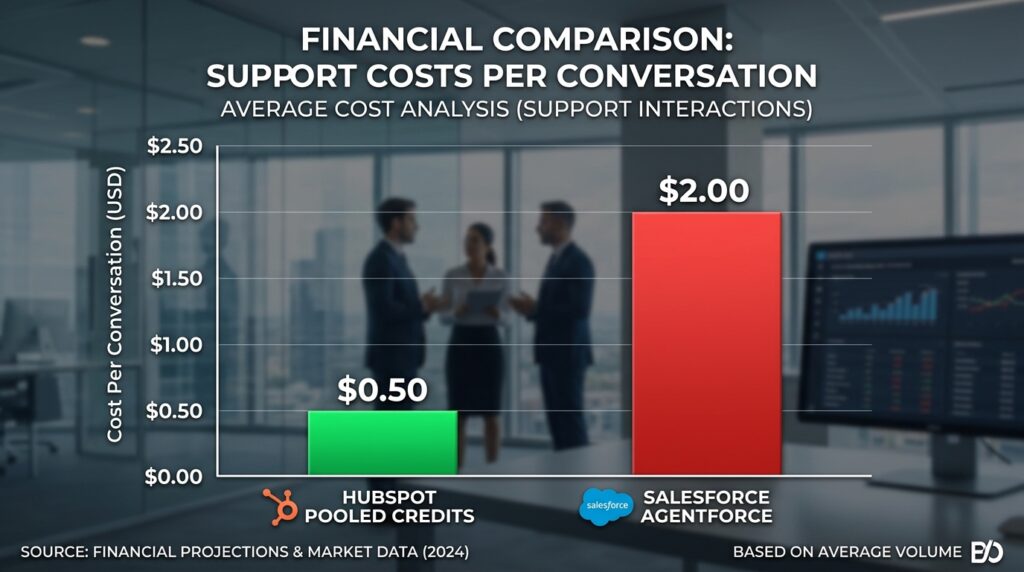
| Support Agent Cost | $0.50 per resolved conversation (or 100 credits) | $2.00 per conversation |
| Data Enrichment | Native via Breeze Intelligence (10 credits/record) | Data Cloud consumption fees + third-party APIs |
| Setup & Implementation | Low-to-moderate; low-code configuration | High; requires custom Flow orchestration & SI support |
| Typical Time-to-Value | 1 to 4 Weeks | 3 to 9 Months |
| Best For | Scaling mid-market to enterprise RevOps looking for unified economics | Deeply customized, legacy multi-cloud enterprise setups |
1. Architectural Anatomy: Unified Data vs. Data Abstraction
When evaluating modern CRM architectures, the most important technical decision is where the data lives and how AI agents access it.
                               ┌────────────────────────────────────────┐
                               │       Enterprise RevOps Context        │
                               └───────────────────┬────────────────────┘
                                                   │
                         ┌─────────────────────────┴─────────────────────────┐
                         ▼                                                   ▼
       ┌───────────────────────────────────┐               ┌───────────────────────────────────┐
       │     HubSpot Smart CRM Schema      │               │     Salesforce Multi-Cloud        │
       │   (Single Unified Data Layer)     │               │   (Sales, Service, Marketing)     │
       └─────────────────┬─────────────────┘               └─────────────────┬─────────────────┘
                         │                                                   │
                         ├─► Breeze Assistant (Co-Pilot)                     ├─► Data Cloud / Data 360 Layer
                         ├─► Breeze Agents (Autonomous Workflows)            │    (Vectorization & Ingestion)
                         └─► Breeze Intelligence (200M+ Profiles)            └─► Agentforce Platform Engines
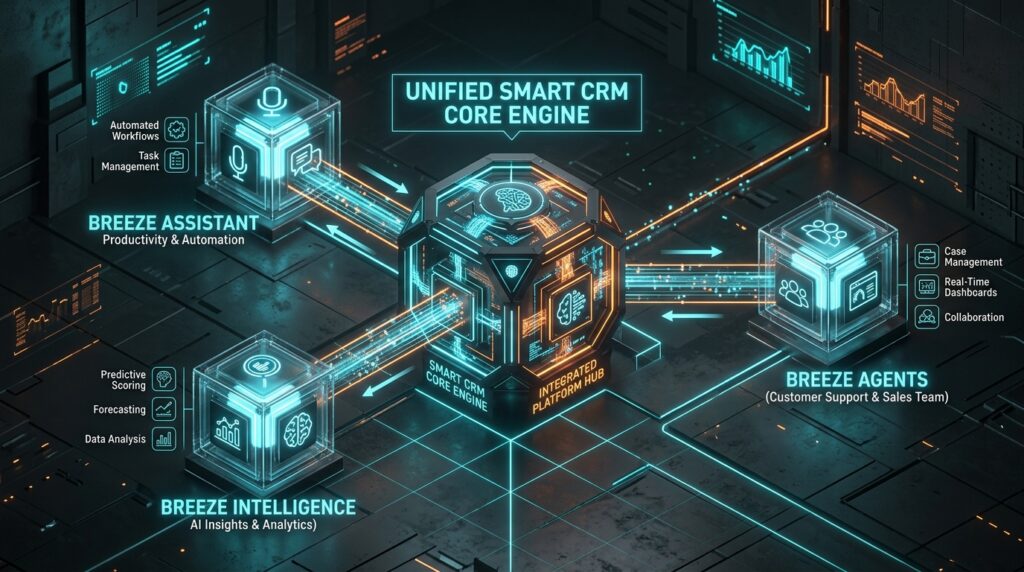
The Tri-Partite Core Engine of HubSpot Breeze
HubSpot engineered its 2026 AI ecosystem around three distinct operational layers that run directly on top of its core database:
- Breeze Assistant: A contextual co-pilot embedded across all Hubs. It handles real-time user requests—such as summarizing contact history, drafting emails, or preparing pre-call briefings—without forcing users to leave their standard workspace.
- Breeze Agents: Autonomous digital workers that operate asynchronously. Unlike passive co-pilots waiting for prompts, agents monitor CRM triggers (e.g., deal stage changes, form fills, support ticket spikes) and execute end-to-end task chains. Native agents include Customer, Prospecting, Content, and Data Agents.
- Breeze Intelligence: The foundational enrichment engine built following HubSpot’s acquisition of Clearbit. Grounded in a global database of over 200 million contact profiles and 20 million company records, it hydrates CRM properties with firmographic, technographic, and buyer-intent signals in real time.
Context Layer, Data Provenance, and Governance
Autonomous AI is only as good as its context layer. To prevent hallucinations and enforce operational guardrails:
- Knowledge Vaults: Centralized repositories that aggregate static documentation, internal knowledge base articles, dynamic list segments, and web URLs into domain-specific contexts (e.g., Technical Support Vault). Updating a document in a vault instantly updates every agent connected to it.
- Action Tiering & Governance: System tools are divided into Get Data, Generate, and Take Action. Any tool classified as “Take Action” (e.g., updating deal stages, publishing web pages) retains human-in-the-loop review by default, backed by transparent audit logs.
Editor’s Perspective:
The fundamental advantage of HubSpot’s architecture is its native database unity. Salesforce Agentforce is exceptionally capable, but because Salesforce grew through acquisitions (ExactTarget, Demandware, etc.), it relies on Data Cloud as an abstraction layer to vectorize and unify data across disparate clouds. If your goal is to minimize middleware costs and technical debt, native database unity is a massive operational win.
2. Top High-ROI Enterprise AI Workflows
Automation should never be deployed for its own sake. It must target specific business pain points. Here are five automated workflows delivering proven enterprise ROI:
┌────────────────────────────────────────────────────────────────────────────────────────┐
│                          HIGH-ROI ENTERPRISE AI WORKFLOWS                              │
└────────────────────────────────────────────────────────────────────────────────────────┘

 1. CONTINUOUS ENRICHMENT ──► Inbound Form Fill ──► Auto-Hydrate 100+ Attributes ──► Progressive Forms
 2. PREDICTIVE FORECASTING──► Pipeline Stages + Sentiment + Buyer Signals ──► Algorithmic Close %
 3. SUPPORT ROUTING      ──► 9 Channel Ingest ──► Knowledge Vault Triage  ──► 65% Autonomous Containment
 4. CONTENT REPURPOSING   ──► Core Asset Upload ──► Brand Voice Grounding  ──► Multi-Channel Campaigns
 5. DEAL & LEAD SCORING   ──► Behavioral Signals ──► ML Close Probability ──► High-Touch Rep Alert
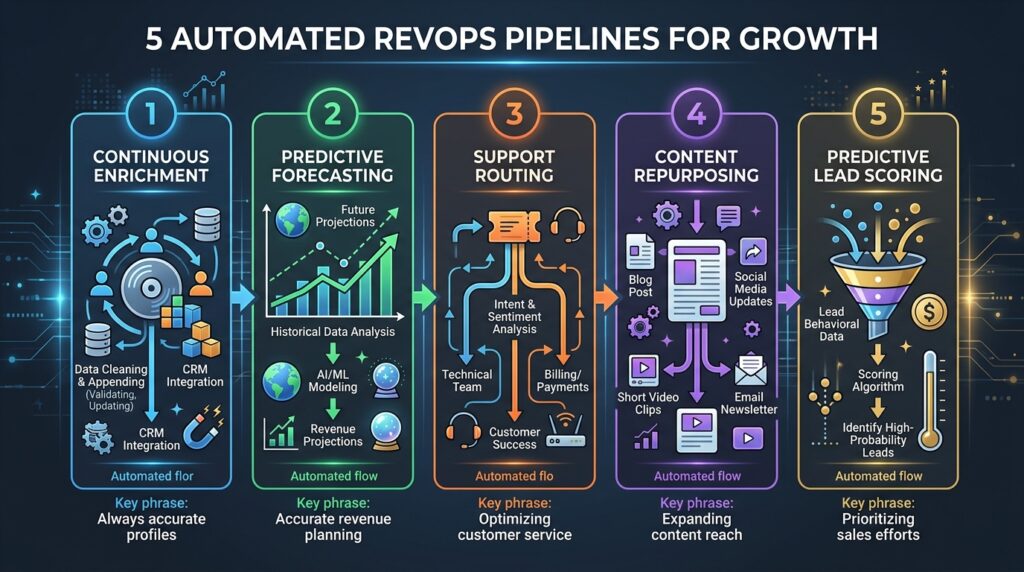
1. Continuous Automated Lead Enrichment and Progressive Form Shortening
- The Problem: Incomplete inbound forms and manual SDR research waste hours and slow response times.
- The Workflow: When a prospect submits an inbound form, Breeze Intelligence matches the domain or email against its 200M+ profile graph, automatically appending firmographic data (revenue, employee counts, tech stack) directly into CRM fields. Progressive forms dynamically suppress fields that are already known, asking for only the bare minimum (e.g., just business email).
- Impact: Higher landing page conversion rates without compromising database depth. Cost is governed at 10 credits per enriched record.
2. Algorithmic Predictive Pipeline Forecasting
- The Problem: Sales reps are notoriously bad at forecasting deals, leading to pipeline inflation.
- The Workflow: Machine learning models continuously evaluate closed-won historical data against active pipeline properties, call sentiment from Conversation Intelligence, and buyer engagement metrics (email opens, document views).
- Impact: Outputs an objective “Likelihood to Close” percentage across commit, most likely, and best-case categories, removing subjective sales rep bias.
3. Omnichannel Support Routing and Autonomous Containment
- The Problem: High tier-1 support ticket volumes drive up customer service headcount.
- The Workflow: The Breeze Customer Agent ingests inquiries across nine channels (Email, Live Chat, WhatsApp, SMS, etc.). Grounded in Knowledge Vaults, it resolves inquiries, executes API calls (e.g., checking order status), and routes complex, high-negative-sentiment tickets to human specialists alongside automated summaries.
- Impact: Average autonomous containment rates of 65% (up to 90% in optimized setups) and a 39% reduction in Mean Time to Resolution (MTTR).
4. Multi-Modal Content Repurposing (Content Remix)
- The Problem: Creating customized marketing collateral for multiple channels requires significant editorial bandwidth.
- The Workflow: Marketers upload a core foundational asset (whitepaper, case study, webinar transcript). Grounded in your enterprise Brand Voice settings, Content Remix automatically converts it into blog posts, tailored email sequences, social posts, and ad variations.
- Impact: Scales marketing output without increasing creative headcount.
5. Predictive Lead Scoring & Real-Time Prioritization
- The Problem: Legacy point-based lead scoring models (e.g., +10 points for downloading a PDF) result in poor-quality SQLs.
- The Workflow: Predictive models evaluate hundreds of historical contact parameters to score prospects on a dynamic scale (0–100%) and assign priority tiers (Very High, High, Medium, Low).
- Impact: High-priority status automatically alerts sales reps via Slack or triggers high-touch outbound sequences, ensuring immediate engagement.
3. Commercial Unit Economics & Pricing Model Comparison
Deploying enterprise AI changes your operational financial model. However, choosing the wrong commercial structure can result in painful overage charges.
HubSpot’s Unified Credit Model
HubSpot operates on a shared credit pool across its entire AI suite.
- Enrichment & Intelligence: 10 credits per enriched contact or company record.
- Customer Support Agent: Billed on an outcome-based metric of $0.50 per resolved conversation (or 100 credits).
- Credit Packs: Extra capacity can be added in pooled packs (e.g., $150/month for 1,000 credits up to $600–$1,000/month for 10,000 credits).
- The Catch: HubSpot credits operate on a 30-day billing cycle with no monthly rollover. Unused credits expire, making accurate capacity planning essential.
Salesforce Agentforce Pricing Architecture
Salesforce uses a usage-based structure that moves away from standard user seats:
- Conversations Model: Billed at $2.00 per conversation for external customer-facing agents under pre-purchased contracts.
- Flex Credits Model: Priced at $500 per 100,000 credits ($0.005 per credit). Internal employee-facing agents and complex workflows consume between 20 to 60 Flex Credits ($0.10 to $0.30) per action step.
- The Catch: You cannot mix the Conversations model and Flex Credits model in the same Salesforce organization. Additionally, enterprise deployments frequently incur high third-party System Integrator (SI) fees ranging from $50,000 to over $250,000.
┌────────────────────────────────────────────────────────────────────────────────────────┐
│                         COMMERCIAL & FINANCIAL COMPARISON                              │
└────────────────────────────────────────────────────────────────────────────────────────┘

  HUBSPOT ENTERPRISE AI
  ├── Support Cost: $0.50 per resolved conversation (or 100 pooled credits)
  ├── Credit Pool: Unified across enrichment, intelligence, and agents
  └── Implementation Spend: Low setup overhead; 1 to 4 week deployment window

  SALESFORCE AGENTFORCE
  ├── Support Cost: $2.00 per conversation OR Flex Credit action metering
  ├── Credit Pool: Segmented models (Conversations vs. Flex Credits cannot mix)
  └── Implementation Spend: $50k to $250k+ in consulting fees; 3 to 9 month rollout
4. Who Should Choose Which Platform?
Choose HubSpot Enterprise AI if:
- You prioritize rapid Time-to-Value (TTV): You need functional, autonomous agents and predictive models deployed in weeks, not quarters.
- You want predictable unit economics: You prefer a single, unified credit pool where support interactions cost $0.50 rather than $2.00 per conversation.
- You value low-code management: Your RevOps team wants to build and maintain agents, knowledge vaults, and workflows without hiring specialized enterprise developers or software integrators.
- Your team uses the Smart CRM natively: You want sales, marketing, and support executing from one unified database without data pipeline friction.
Choose Salesforce Agentforce if:
- You have deep multi-cloud legacy architecture: Your enterprise already relies on heavily customized instances of Sales Cloud, Service Cloud, and Marketing Cloud tied together via Data Cloud.
- You require complex custom developer orchestrations: You have dedicated Salesforce developers and budget allocated for specialized consulting partners.
- Your operational workflows are highly bespoke: You need granular programmatic flow controls that extend far beyond standard GTM practices.
5. Strategic Implementation Roadmap
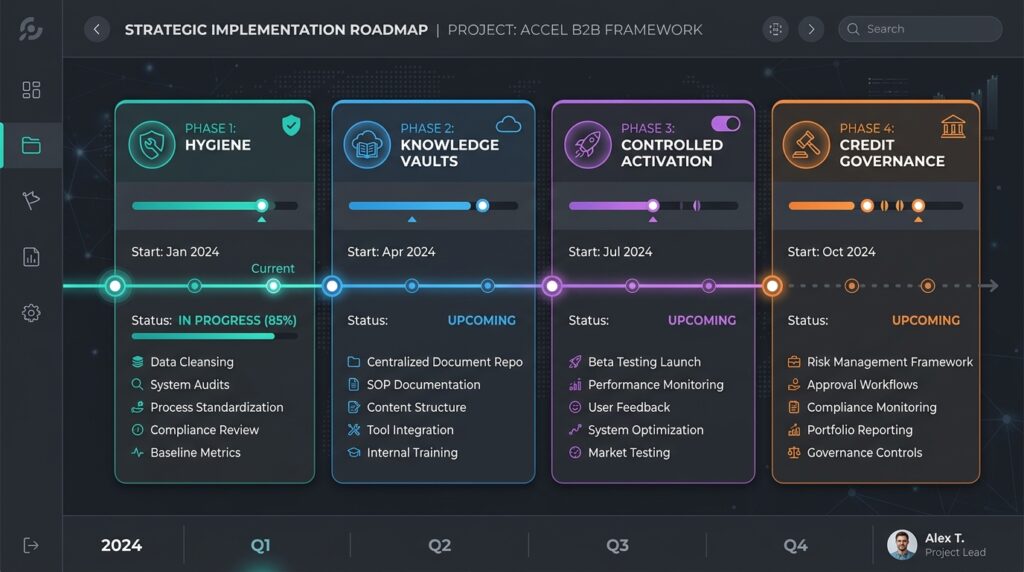
To maximize ROI and minimize operational disruption, deploy your enterprise AI platform in four structured phases:
┌────────────────────────────────────────────────────────────────────────────────────────┐
│                        4-PHASE IMPLEMENTATION ROADMAP                                  │
└────────────────────────────────────────────────────────────────────────────────────────┘

  [Phase 1: Baseline Architecture] ──► Audit property schema & execute data enrichment backfill
                │
                ▼
  [Phase 2: Context Layer]        ──► Build Knowledge Vaults & configure Brand Voice controls
                │
                ▼
  [Phase 3: Controlled Rollout]   ──► Deploy Support Agent on primary channels & enable scoring
                │
                ▼
  [Phase 4: Credit Governance]    ──► Audit execution logs & actively manage 30-day credit limits
- Phase 1: Data Preparation & HygieneClean duplicate records, standardize lifecycle stage definitions, and run a baseline data enrichment sweep using Breeze Intelligence to hydrate missing properties across contact and company databases.
- Phase 2: Context Vault Construction & GuardrailsBuild functional Knowledge Vaults by organizing technical documentation, product guides, and dynamic list segments. Connect brand assets to the Brand Voice engine, and ensure all high-impact agent tools retain mandatory human-in-the-loop approval.
- Phase 3: Controlled Agent ActivationRoll out the Customer Support Agent on primary communication channels (e.g., website chat) with safety thresholds. Enable predictive lead scoring and train sales reps on using Breeze Assistant for meeting preparation.
- Phase 4: Optimization & Credit GovernanceSet up RevOps monitoring dashboards to track monthly credit consumption across enrichment and agent tasks. Because credits do not roll over month-to-month, actively adjust credit pack purchases to avoid capacity expiration or unexpected overages.
Final Editor’s Verdict
Editor’s Take:
If your enterprise is already invested in a deeply customized Salesforce ecosystem and has the engineering budget to manage complex Data Cloud implementations, Salesforce Agentforce remains a powerful platform.
However, for mid-market and scaling enterprise organizations ($10M to $500M ARR) looking to compress customer acquisition costs and drive immediate revenue velocity, HubSpot Enterprise AI offers a clearly superior time-to-value. Its native database architecture, lower support costs ($0.50 vs. $2.00 per conversation), and unified credit model deliver a faster, more accessible path to scalable revenue operating leverage.
Final Editor’s Verdict
Editor’s Take: If your enterprise is already invested in a deeply customized Salesforce ecosystem and has the engineering budget to manage complex Data Cloud implementations, Salesforce Agentforce remains a powerful platform.
However, for mid-market and scaling enterprise organizations looking to compress customer acquisition costs and drive immediate revenue velocity, HubSpot Enterprise AI offers a clearly superior time-to-value. Its native database architecture, lower support costs ($0.50 vs. $2.00 per conversation), and unified credit model deliver a faster, more accessible path to scalable revenue operating leverage.
To evaluate how front-office AI CRM engines align with back-office cognitive document automation, check out our comparative analysis on ICR vs Multimodal LLMs Strategy and our platform deep dive in the E42.ai Review. For orchestrating custom agentic workflows across private clouds, read our Dynamiq AI Review. If your team is evaluating the broader infrastructure hardware required to host private enterprise LLMs and RAG pipelines, explore our flagship report on the Top 5 On-Premise AI Platforms, alongside turnkey benchmarks like the HPE Private Cloud AI Review and DeepSeek-R1 Hardware Review. For specialized hardware stacks, see our SambaNova SN40L RDU Review and physical AI analyses in the Qualcomm Dragonwing IQ-9075 Review and Qualcomm Dragonwing AI Review. You can also contrast modern AI platforms against legacy software tools in our ElectroNeek On-Premise Review, Top 5 Zanus AI Alternative, Zanus AI Deployment, and Zanus AI for Construction. Make sure to bookmark AI Review Zones for ongoing enterprise software and RevOps strategy updates.
References
- CX Today: What Is HubSpot Breeze, and How Does It Work?https://www.cxtoday.com/crm/what-is-hubspot-breeze-and-how-does-it-work/
- HubSpot Official Documentation: Breeze Intelligence & Lead Scoring Mechanicshttps://blog.hubspot.com/marketing/predictive-lead-scoring
- Derrick App: Breeze Intelligence Review: Pricing, Pros & Cons (2026)https://www.derrick-app.com/blog/breeze-intelligence-review
- Ekfrazo Technologies: Salesforce Agentforce Pricing 2026: Tiers, Flex Credits & Real Costshttps://ekfrazo.com/salesforce-agentforce-pricing-2026/
- Synebo: What Is the Agentforce Implementation Cost in 2026?https://www.synebo.io/blog/agentforce-implementation-cost/