

Evaluating the top 5 enterprise AI coding platforms in 2026 is critical for engineering leaders balancing developer productivity against code sovereignty and rising SaaS costs…
The software development lifecycle (SDLC) in 2026 has undergone a fundamental shift. Enterprise engineering organizations have moved past basic inline autocomplete utilities toward multi-agent, autonomous coding systems. As generative models assume responsibility for codebase refactoring, pull request auditing, and multi-file architecture execution, engineering leaders face a direct trade-off: how do you maximize developer speed without exposing corporate intellectual property to unacceptable security and regulatory risks?
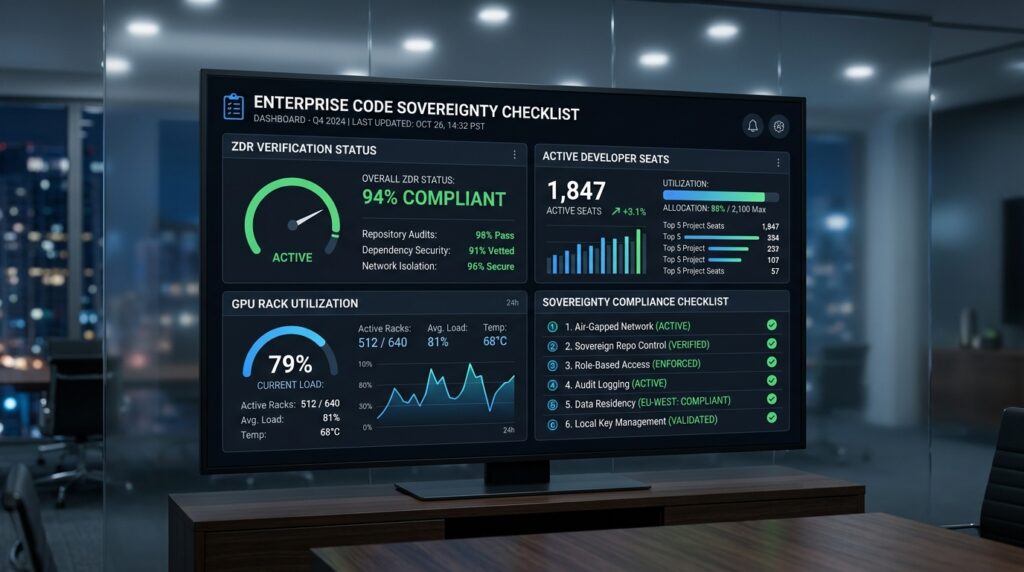
Central to this challenge is the mandate for Code Sovereignty—the guarantee that source code, corporate IP, and diagnostic telemetry remain isolated from public model training loops, untrusted multi-tenant clouds, and foreign regulatory jurisdictions. For enterprises operating in defense, healthcare, financial services, and critical infrastructure, standard SaaS terms are rarely enough.
This guide delivers an independent evaluation of the top enterprise AI coding options in 2026: Cursor Enterprise, GitHub Copilot (Business/Enterprise), Augment Code, Qodo, and a Self-Hosted Llama-Based Internal Stack.
Top 5 Enterprise AI Coding Platforms in 2026: Quick Decision Matrix
If you need a fast answer for an upcoming architecture or procurement review, start with this decision framework:
| Platform | Deployment Paradigm | Zero Data Retention (ZDR) | Air-Gapped Option | Primary Ideal Scenario |
| Cursor Enterprise | Multi-Tenant / Hybrid Cloud Agent | Yes (Enforced Privacy Mode) | No | Teams seeking maximum developer productivity, multi-file refactoring, and agentic workflows. |
| GitHub Copilot | Multi-Tenant Cloud SaaS | Yes | No | Organizations embedded in Microsoft/GitHub environments that prioritize IP indemnity. |
| Augment Code | Multi-Tenant / Private Cloud VPC | Yes (CMEK Supported) | No | Large engineering organizations with massive, highly interconnected multi-repository codebases. |
| Qodo | Multi-Tenant / VPC / On-Prem | Yes | Yes | Regulated enterprises that require quality-first automated PR auditing and full on-premise execution. |
| Self-Hosted Stack | Bare-Metal / Local Kubernetes | Complete (Air-Gapped) | Yes | Defense, intelligence, or heavily regulated sectors with strict sovereign data requirements. |
Top Enterprise AI Coding Solutions Reviewed
1. Cursor Enterprise (Anysphere)
Overview:
Cursor, developed by Anysphere as an AI-native fork of Visual Studio Code, is built around deep codebase indexing and interactive multi-file editing through its native Composer engine.
┌─────────────────────────────────────────────────────────────┐
│                      Cursor Enterprise                      │
└──────────────────────────────┬──────────────────────────────┘
                               │
               ┌───────────────┴───────────────┐
               ▼                               ▼
    ┌────────────────────┐          ┌────────────────────┐
    │    Privacy Mode    │          │ Self-Hosted Cloud  │
    │                    │          │       Agents       │
    │  ZDR enforced for  │          │  Agentic tools &   │
    │   prompts & code   │          │ shell commands run │
    │    via frontier    │          │  inside customer   │
    │     LLM models     │          │    VPC/network     │
    └────────────────────┘          └────────────────────┘
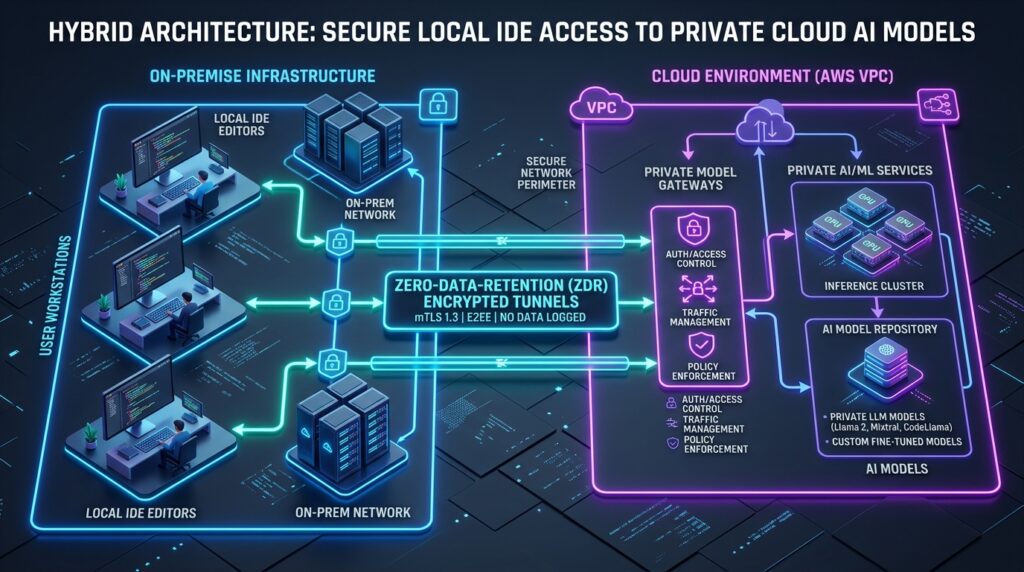
- Code Sovereignty & Data Retention: Cursor Enterprise automatically enforces Privacy Mode across the organization, preventing developer overrides. Legacy Privacy Mode ensures zero customer code touches intermediate servers, routing requests straight to underlying frontier models under zero-data-retention (ZDR) agreements. Standard Privacy Mode allows encrypted, ephemeral code storage to support features like codebase “Memories” and asynchronous Background Agents.
- Deployment Models: Cursor operates as a multi-tenant cloud service and does not offer a fully air-gapped on-premise installation. However, it offers self-hosted cloud agents, allowing tool execution, shell commands, and code edits to run inside the customer’s private VPC while routing model inference through Cursor’s cloud gateway.
- Pros:
- Market-leading multi-file editing and agentic workflows via Composer.
- Deep local and repository-wide context indexing.
- Seamless migration path for Visual Studio Code users.
- Cons:
- Lacks a true air-gapped on-premise deployment option.
- Usage-based model credit overages can increase running costs.
Editor’s Take: Choose Cursor Enterprise if your primary objective is developer output and your security team allows ZDR-backed multi-tenant SaaS. Avoid it if your regulatory framework demands complete air-gapped hardware isolation.
2. GitHub Copilot (Business & Enterprise)
Overview:
GitHub Copilot remains a widely adopted default in enterprise environments, heavily integrated into the Microsoft and GitHub DevSecOps ecosystems.
- Code Sovereignty & Data Retention: Copilot Business and Enterprise enforce strict data exclusion rules. Customer prompts, code snippets, and telemetry are excluded from public LLM training datasets. Transient context is processed inside isolated Azure production tenants over TLS 1.2+ and purged within standard operational audit windows.
- Deployment Models: Copilot is entirely cloud-native SaaS. Microsoft does not provide an on-premise or air-gapped version for local datacenters. Sovereign compliance is established logically using Azure regional boundaries (such as the EU Data Boundary) rather than dedicated physical hardware.
- Pros:
- Backed by Microsoft’s Copilot Copyright Commitment for third-party IP defense.
- Native integration with GitHub Enterprise, Enterprise Managed Users (EMU), and Azure AD.
- Lower base seat pricing for the Business tier.
- Cons:
- No self-hosted or air-gapped deployment path.
- Agentic multi-file capabilities lag behind dedicated AI-native IDEs like Cursor.
Editor’s Take: If your organization relies on GitHub Enterprise and Azure Entra ID, Copilot offers the lowest administrative friction and strongest legal indemnification. However, engineering teams looking for multi-file generation may find its agentic feature set conservative.
3. Augment Code
Overview:
Augment Code is designed specifically for large-scale enterprise environments, focusing on real-time dependency mapping across complex multi-repository codebases.
- Code Sovereignty & Data Retention: Augment enforces ZDR across its enterprise tiers and supports Customer-Managed Encryption Keys (CMEK). Stored embeddings and context graphs remain under the customer’s cryptographic control, and customer code is never ingested into foundation training sets.
- Deployment Models: Augment provides multi-tenant SaaS alongside single-tenant Private Cloud / VPC options. While it supports dedicated cloud boundaries, it does not market an air-gapped bare-metal package.
- Pros:
- Exceptional performance on massive, multi-gigabyte codebases with complex dependency trees.
- CMEK provides strong cryptographic control over indexing databases.
- Deep context recovery across multiple distinct repositories.
- Cons:
- High entry pricing compared to standard entry-level copilots.
- Lacks an air-gapped on-premise option.
Editor’s Take: Augment Code is built for large enterprises whose codebases are too complex for standard window-indexing models. Choose it if developer productivity is bottlenecked by cross-repository dependency tracing.
4. Qodo (Formerly CodiumAI)
Overview:
Qodo focuses on code quality, automated testing, and governance, offering coverage from IDE completions (Qodo Gen) to pull request reviews (Qodo Merge) and terminal assistance.
┌─────────────────────────────────────────────────────────────┐
│                       Qodo Enterprise                       │
└──────────────────────────────┬──────────────────────────────┘
                               │
       ┌───────────────────────┼───────────────────────┐
       ▼                       ▼                       ▼
┌──────────────┐       ┌──────────────┐       ┌──────────────┐
       │ Multi-Tenant │       │ Single-Tenant│       │ Full Air-    │
       │     SaaS     │       │  VPC Cloud   │       │ Gapped On-Prem│
       └──────────────┘       └──────────────┘       └──────────────┘
- Code Sovereignty & Data Retention: Qodo transiently processes code snippets through its multi-agent engine, discarding them under strict ZDR guarantees. Under enterprise contracts, data is purged immediately upon completion of the request cycle.
- Deployment Models: Qodo offers flexible deployment options among commercial vendors. It supports multi-tenant SaaS, single-tenant VPCs, and fully air-gapped on-premise deployments inside customer-controlled Kubernetes clusters or bare-metal setups.
- Pros:
- Offers a true air-gapped enterprise installation option.
- Strong emphasis on quality gates, automated test generation, and PR auditing.
- Deterministic rule enforcement allows teams to align AI suggestions with internal coding standards.
- Cons:
- The interface requires setting up governance policies to maximize value.
- Requires dedicated Kubernetes administration for on-premise deployments.
Editor’s Take: Qodo is one of the top commercial choices for regulated organizations that want both automated code quality enforcement and a fully air-gapped deployment option.
5. Self-Hosted Llama-Based Internal Stack
Overview:
For organizations where sending code outside the building is a dealbreaker—such as defense contractors, intelligence agencies, or classified engineering units—building an internal AI stack is the standard route to total code sovereignty.
- Code Sovereignty & Data Retention: Sovereign control remains entirely internal. Open-weights models (such as Llama 3.1 70B/405B or DeepSeek-Coder-V2) run locally on internal hardware. Zero telemetry or source code leaves the corporate network.
- Deployment Models: Fully air-gapped on-premise datacenters or isolated sovereign clouds. The stack usually pairs high-density GPU servers (e.g., NVIDIA H100 or L40S) running optimized inference engines (vLLM, TensorRT-LLM) with open-source IDE extensions like Continue.dev or Tabnine.
- Pros:
- Complete operational, data, and legal isolation.
- Fixed long-term operating costs that are immune to vendor price adjustments or SaaS changes.
- Total control over model fine-tuning, system prompts, and context rules.
- Cons:
- High upfront capital costs and continuous infrastructure management requirements.
- Requires dedicated MLOps and infrastructure engineering resources.
- Lacks native legal IP indemnification compared to Microsoft Copilot.
Editor’s Take: Build a self-hosted stack only if air-gapped security mandates prevent commercial cloud usage, or if your engineering headcount is large enough to amortize fixed GPU and MLOps expenses.
Day-2 Operations, Governance & Security
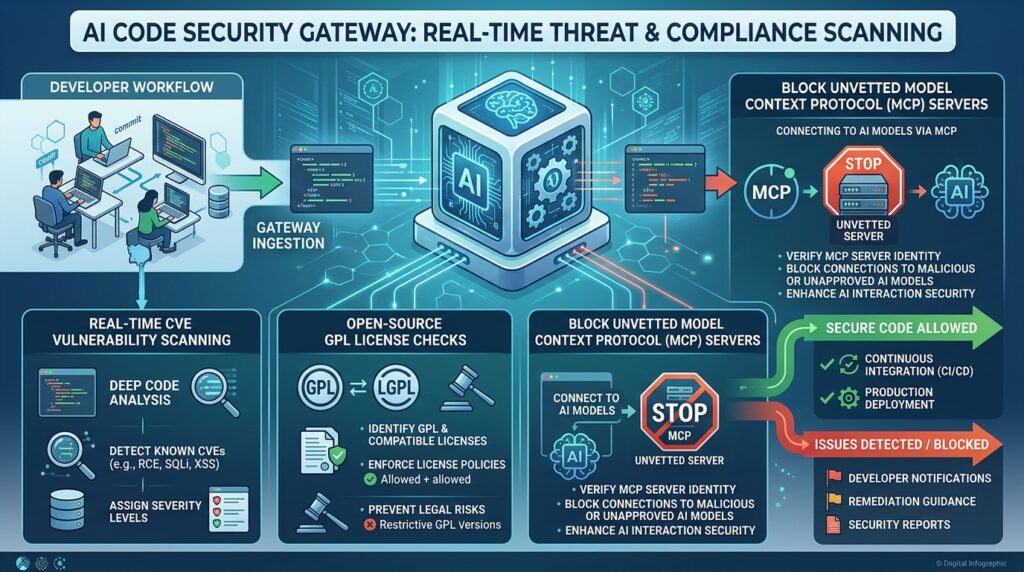
Deploying AI coding tools across thousands of developers introduces operational challenges, including prompt injection risks via Model Context Protocol (MCP) servers, license compliance concerns, and code quality maintenance.
               ┌──────────────────────────────────────┐
               │    Developer Submits Code / PR       │
               └──────────────────┬───────────────────┘
                                  │
                                  ▼
               ┌──────────────────────────────────────┐
               │     Security Gateways & Auditing     │
               └──────────────────┬───────────────────┘
                                  │
        ┌─────────────────────────┴─────────────────────────┐
        ▼                                                   ▼
┌───────────────────────────────┐   ┌───────────────────────────────┐
│     Static & IP Checks        │   │    Context & Policy Rules     │
│  • Vulnerability Scan (CVE)   │   │  • Deterministic Rules        │
│  • License Compliance (GPL)   │   │  • Block unvetted MCP servers │
└───────────────────────────────┘   └───────────────────────────────┘
Risk Comparison Breakdown
- Legal IP Indemnity: Microsoft’s Copilot Copyright Commitment provides legal defense against copyright claims on generated code, provided default content filters remain enabled. Self-hosted open-source models carry no vendor indemnity, leaving the enterprise liable if a model outputs memorized open-source code under restrictive licenses (e.g., GPL).
- Model Context Protocol (MCP) Risks: Emerging attack vectors target client-side AI editors using unvetted third-party MCP servers or altered workspace files (
.cursorrules). Security administrators must restrict unverified MCP servers to prevent prompt injection and remote code execution vulnerabilities. - Quality Enforcement: Solutions like Qodo allow teams to commit deterministic guidelines directly into repositories (
best_practices.md). This creates automated quality checks that prevent AI assistants from generating code that violates internal architectural patterns.
3-Year Total Cost of Ownership (TCO) & Financial Crossover Analysis
To evaluate the financial impact of enterprise AI coding platforms, CapEx and OpEx must be calculated across varying engineering team sizes.
Financial Baseline Assumptions
- Standard SaaS (Cursor Enterprise, Augment Code): $40.00/user/month ($480/user/year).
- GitHub Copilot Enterprise: $39.00/user/month ($468/user/year).
- GitHub Copilot Business: $19.00/user/month ($228/user/year).
- Qodo On-Premise Enterprise: Estimated $45.00/user/month ($540/user/year) license fee.
- Self-Hosted Llama Stack Infrastructure:
- High-density inference server rack (8x NVIDIA L40S/H100 GPUs supporting ~200-300 concurrent developers): $120,000/year/rack (amortized).
- Power, cooling, and colocation: $30,000/year/rack.
- MLOps & platform engineering labor: Fixed $150,000/year.
3-Year Cumulative TCO Modeling
| Active Developers | Copilot Business ($19/mo) | Standard SaaS ($40/mo) | Qodo On-Prem ($45/mo) | Self-Hosted Stack (CapEx + Labor) | Racks Required (Self-Hosted) |
| 100 Devs | $68,400 | $144,000 | $162,000 | $900,000 | 1 Rack |
| 250 Devs | $171,000 | $360,000 | $405,000 | $1,350,000 | 2 Racks |
| 500 Devs | $342,000 | $720,000 | $810,000 | $1,800,000 | 3 Racks |
| 1,000 Devs | $684,000 | $1,440,000 | $1,620,000 | $2,700,000 | 5 Racks |
The Crossover Point: Cloud SaaS vs. Self-Hosted Infrastructure
When does moving from commercial SaaS to a self-hosted private stack make financial sense?
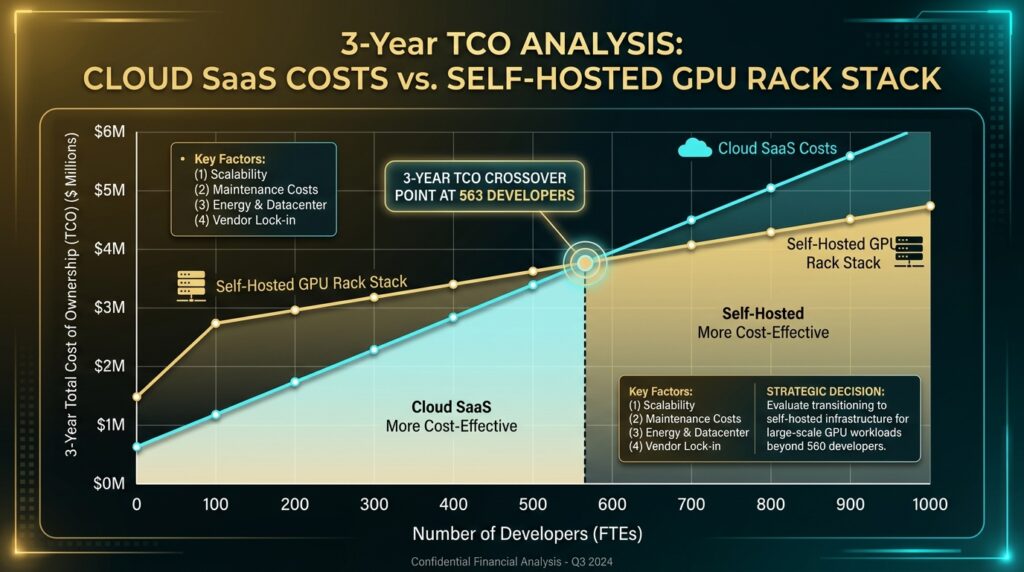
Using standard cost assumptions—a $120,000/year fixed MLOps labor overhead, $150,000/year per operational GPU rack, and an average capacity of 300 developers per rack:
$$\text{Cost}_{\text{SaaS}}(N) = N \cdot P_{\text{SaaS}}$$
$$\text{Cost}_{\text{Private}}(N) = \text{Cost}_{\text{Ops}} + \left\lceil \frac{N}{K} \right\rceil \cdot \text{Cost}_{\text{Rack}}$$
Equating these two expressions reveals the crossover point ($N^*$):
$$N^* \cdot \$480 = \$120,000 + (1 \cdot \$150,000)$$
$$N^* = \frac{\$270,000}{\$480} \approx \mathbf{563\text{ developers}}$$
Cost ($)
  |
  |                                   / Cloud SaaS ($40/mo)
  |                                  /
  |                                 /
  |                                /   CROSSOVER POINT
  |                               /    (~563 Developers)
  |                              /  x
  |                             / x
  |                            / x   Self-Hosted Infrastructure
  |                           /x
  |                          x
  |                         /|
  |                        / |
  |                       /  |
  +----------------------/---+---------------------------------- Headcount (N)
                        0   563
- Below 563 developers: Cloud SaaS (Cursor, Augment, or Copilot) is significantly more cost-effective. Building an internal stack for small teams results in high fixed costs due to unamortized hardware and dedicated engineering overhead.
- Above 563 developers: Self-hosted infrastructure delivers a positive financial return, with marginal seat costs dropping below commercial SaaS pricing.
Operational Warning: If developer usage leans heavily on complex multi-file agentic loops using unquantized 70B+ models, rack capacity drops from 300 to roughly 200 developers. This shifts the financial crossover point upward to 800–1,000 active developers.
Actionable Next Steps for Engineering Leadership
- Verify Contractual ZDR Terms: Do not rely on marketing materials. Ensure Zero Data Retention clauses and Data Protection Addendums (DPAs) are explicitly written into binding Master Services Agreements (MSAs).
- Implement Model Context Protocol (MCP) Boundaries: Configure administrative policies to restrict unvetted third-party MCP servers and prevent local prompt injection exploits.
- Establish Spending Controls: Set hard usage caps within admin dashboards for consumption-billed tools like Cursor Enterprise to prevent cost overages from high-frequency queries to frontier models.
- Prepare for Scale Thresholds: If your engineering organization is approaching 500 active developers, evaluate dedicated private cloud or sovereign on-premise infrastructure. Capturing savings at the 563-developer threshold requires advance planning for GPU leases, datacenter capacity, and internal MLOps staffing.
Operational Takeaway
For most mid-sized engineering teams, Cursor Enterprise or GitHub Copilot Enterprise offers the fastest time-to-value while keeping risk low through ZDR contracts. For strictly regulated environments where code cannot leave the perimeter, Qodo On-Premise provides a packaged path to sovereign deployment. Finally, organizations scaling past 500+ active developers should begin calculating the trade-offs of an internal, self-hosted open-weights stack to secure long-term code sovereignty and cost efficiencies.
Actionable Next Steps for Engineering Leadership
- Verify Contractual ZDR Terms: Do not rely on marketing materials. Ensure Zero Data Retention clauses and Data Protection Addendums (DPAs) are explicitly written into binding Master Services Agreements (MSAs).
- Implement Model Context Protocol (MCP) Boundaries: Configure administrative policies to restrict unvetted third-party MCP servers and prevent local prompt injection exploits.
- Establish Spending Controls: Set hard usage caps within admin dashboards for consumption-billed tools like Cursor Enterprise to prevent cost overages from high-frequency queries to frontier models.
- Prepare for Scale Thresholds: If your engineering organization is approaching 500 active developers, evaluate dedicated private cloud or sovereign on-premise infrastructure. Capturing savings at the 563-developer threshold requires advance planning for GPU leases, datacenter capacity, and internal MLOps staffing.
To evaluate how private self-hosted AI coding models fit into broader enterprise infrastructure, explore our overarching benchmark on the Top 5 On-Premise AI Platforms. For hardware selection required to host local LLM inference engines with low latency, analyze our DeepSeek-R1 Hardware Review, SambaNova SN40L RDU Review, and turnkey appliances in the HPE Private Cloud AI Review. For edge-based AI deployments, see our Qualcomm Dragonwing IQ-9075 Review and Qualcomm Dragonwing AI Review. You can also evaluate front-office AI CRM automation in our HubSpot Enterprise AI Review and workflow orchestration in Dynamiq AI Review, alongside cognitive document extraction in ICR vs Multimodal LLMs Strategy and E42.ai Review. For legacy RPA benchmarks, check ElectroNeek On-Premise Review, Top 5 Zanus AI Alternative, Zanus AI Deployment, and Zanus AI for Construction. Bookmark AI Review Zones for continuous developer tooling and AI infrastructure coverage.
References
- Anysphere / Cursor Enterprise Docs: https://docs.cursor.com/enterprise
- GitHub Copilot Plans & Security Overview: https://github.com/features/copilot/plans
- Microsoft Copilot Copyright Commitment Details: https://learn.microsoft.com/en-us/copilot/copyright-commitment
- Augment Code Enterprise Security & CMEK: https://www.augmentcode.com/security
- Qodo (CodiumAI) Deployment Options & Pricing: https://docs.qodo.ai/pricing-and-plans
- vLLM High-Performance LLM Inference Setup Guide: https://docs.vllm.ai/en/latest/