The Sovereign AI Challenge in 2026
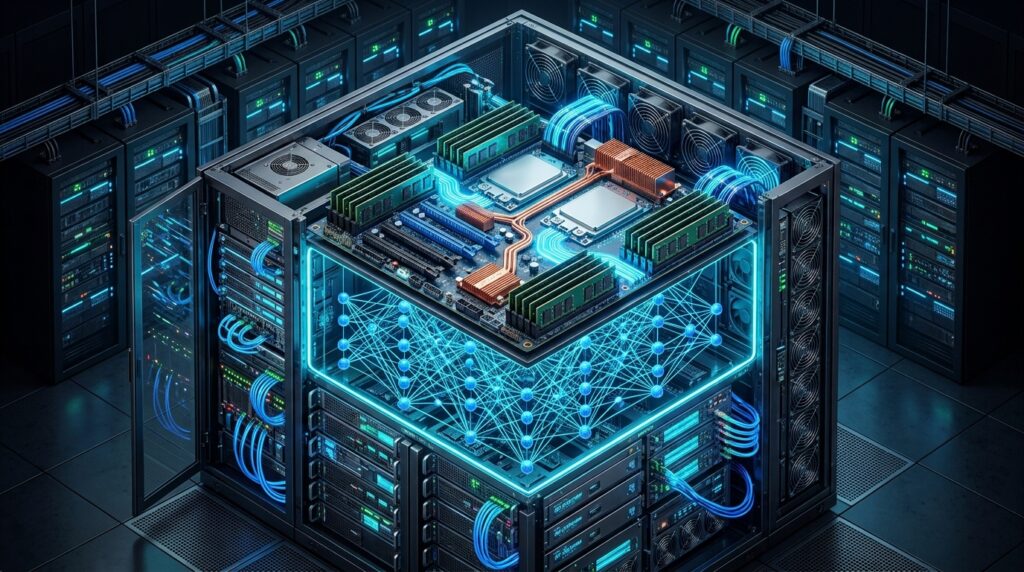
When evaluating options for Deploying DeepSeek-R1 on NovoServe Bare-Metal infrastructure in 2026, enterprise artificial intelligence architecture has reached a pivotal transition point. As large language models (LLMs) shift from experimental interface tools to core operational backbones, reliance on multi-tenant managed cloud APIs—such as Amazon Bedrock, Azure OpenAI, and Google Vertex AI—presents severe strategic, financial, and regulatory challenges. Enterprise engineering teams face an imperative to construct sovereign, private AI inference pipelines that guarantee absolute data isolation, deterministic tail latencies, and predictable operational expenditure.
Data privacy and regulatory compliance represent the primary catalysts driving enterprise workloads away from shared cloud API infrastructure. Under stringent global frameworks, including the European Union Artificial Intelligence Act and updated General Data Protection Regulation (GDPR) mandates, processing proprietary enterprise IP, corporate telemetry, or personally identifiable information (PII) through multi-tenant cloud proxies introduces significant compliance risks. Proprietary cloud API agreements often reserve ambiguous rights regarding data ingestion, telemetry monitoring, or secondary logging. Furthermore, multi-tenant cloud architectures cannot offer physical memory boundary isolation, leaving sensitive embedding vectors and prompt context exposed to cross-tenant side-channel vulnerabilities or legal subpoenas issued to cloud aggregators.
Operational unpredictability further undermines the viability of managed cloud APIs for high-throughput enterprise pipelines. Managed API endpoints enforce dynamic rate limits—measured in Tokens Per Minute (TPM) and Requests Per Minute (RPM)—that arbitrarily throttle application traffic during peak demand periods. Multi-tenant infrastructure introduces the “noisy neighbor” phenomenon, where concurrent resource utilization by unrelated tenants degrades inference latency. Time to First Token (TTFT) in multi-tenant environments fluctuates wildly, with P99 tail latencies frequently exceeding several seconds. For real-time applications, financial algorithmic processing, or agentic automation, such latency variance breaks system functionality.
Explore NovoServe High-Performance Compute Nodes
Provision dedicated bare-metal infrastructure tailored for sovereign DeepSeek-R1 and open-source LLM inference with unmetered 10G/100G networking pipelines.
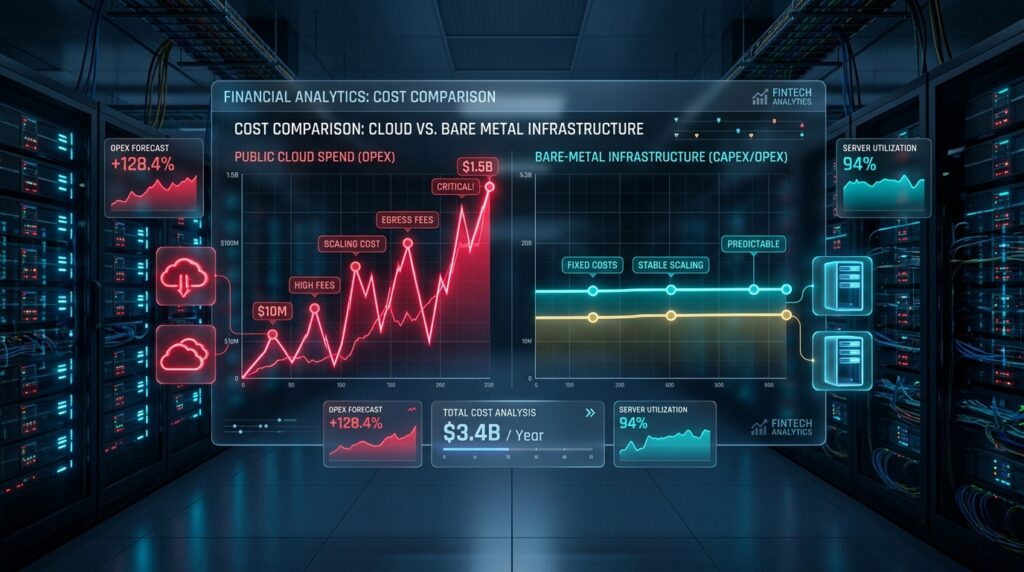
Financial unpredictability constitutes the third major challenge of hyperscaler managed AI services. While multi-tenant APIs advertise deceptively low per-million-token entry rates, production workloads expose enterprise budgets to exponential bill amplification. Hyperscalers surround model endpoints with required supporting infrastructure that carries substantial hidden minimum costs. For example, Amazon Bedrock Knowledge Bases default to Amazon OpenSearch Serverless vector clusters, incurring fixed floor charges of $345 to $700 per month even with zero query traffic. Additional surcharges—such as $0.15 per 1,000 text units for content guardrails, 10% premiums for regional data residency guarantees, network egress fees, and multi-call token expansion in agentic loops—frequently cause actual cloud invoices to exceed initial projections by 150% to 200%.
Migrating to dedicated bare-metal infrastructure on providers like NovoServe eliminates these variables. Single-tenant bare-metal compute guarantees full hardware isolation, complete root access for kernel-level optimization, unmetered network pipelines without egress fees, and flat-rate monthly budgeting that decouples operational cost from token throughput.
Operational Impact
The migration from managed cloud APIs to dedicated bare-metal servers isn’t just an infrastructure shift—it’s a control mechanism. By removing multi-tenant proxies and variable token billing, engineering teams regain full command over system latency, security boundaries, and monthly operating costs.
Deploying DeepSeek-R1 on NovoServe: Hardware & Memory Provisioning
Memory Footprint and Quantization Dynamics
Deploying state-of-the-art open-weight models—including the DeepSeek-R1 reasoning family and Meta’s Llama 3 generation—requires rigorous mathematical modeling of hardware memory allocation. Large language model inference requires hosting active parameter weights within high-speed memory while reserving sufficient overhead for the Key-Value (KV) cache, activation tensors, and system execution runtime.
The baseline memory requirement for loading model weights is governed by total parameter count ($P$) and numerical precision bit-width ($B$), expressed as:
$$\text{VRAM}_{\text{weights}} = \frac{P \times B}{8} \text{ Bytes}$$
In addition to static model weights, dynamic inference execution requires memory allocation for the KV cache, which scales linearly with context window length ($N_{\text{ctx}}$), batch size ($B_s$), layer count ($L$), hidden dimension size ($H$), and attention head count ($A$):
$$\text{VRAM}_{\text{KV}} = 2 \times B_s \times N_{\text{ctx}} \times L \times H \times \left(\frac{B}{8}\right)$$
To calculate total required system memory ($\text{VRAM}_{\text{total}}$), MLOps architects must include a safety margin factor ($\approx 1.2$) to account for runtime activation buffers, CUDA/ROCm context allocations, and framework overhead:
$$\text{VRAM}_{\text{total}} = \left(\text{VRAM}_{\text{weights}} + \text{VRAM}_{\text{KV}}\right) \times 1.2$$
Quantization alters this equation by reducing bit-width ($B$) from full FP16 (16 bits / 2 bytes) down to FP8/INT8 (8 bits / 1 byte) or INT4/Q4 (4 bits / 0.5 bytes). While quantization drastically reduces memory footprints, it introduces measurable trade-offs in reasoning accuracy and task performance. Benchmarks indicate that INT8/FP8 quantization yields an optimal balance for enterprise production, reducing memory demands by approximately 50% while preserving model accuracy within ~3% of native FP16 baselines. INT4 quantization slashes memory footprints by 75% relative to FP16, enabling large models to run on smaller hardware footprints, but introduces accuracy degradation of up to ~12% on complex coding, mathematical, and multi-step reasoning benchmarks.
The full non-distilled DeepSeek-R1 model utilizes a Mixture-of-Experts (MoE) architecture comprising 671 billion total parameters with 37 billion active parameters per token across a 128K context window. Running full DeepSeek-R1 at uncompressed FP16 precision requires over 1,340 GB of ultra-high-speed memory, demanding multi-GPU or clustered bare-metal server nodes. However, quantized FP8/INT8 variants reduce this footprint to ~670 GB, and distilled variants (ranging from 1.5B to 70B parameters) enable flexible deployment across diverse single-node hardware configurations.
| Model Variant | Parameter Count (P) | FP16 Memory Footprint | INT8 (Q8) Memory Footprint | INT4 (Q4) Memory Footprint | Recommended Minimum Hardware Baseline |
| DeepSeek-R1 Distill 1.5B | 1.54 Billion | ~4.04 GB | ~2.53 GB | ~1.50 GB | Single CPU / 8GB RAM (CPU-only capable) |
| DeepSeek-R1 Distill 8B | 8.0 Billion | ~16.0 GB | ~9.0 GB | ~5.0 GB | 1x 16GB VRAM / 32GB RAM |
| DeepSeek-R1 Distill 14B | 14.8 Billion | ~30.0 GB | ~16.0 GB | ~9.0 GB | 1x 24GB VRAM / 64GB RAM |
| DeepSeek-R1 Distill 32B | 32.8 Billion | ~71.0 GB | ~36.0 GB | ~18.0 GB | 1x 48GB VRAM or Dual AMD EPYC DDR5 |
| DeepSeek-R1 Distill 70B | 70.6 Billion | ~145.0 GB | ~75.0 GB | ~40.0 GB | 2x 48GB VRAM / 128GB RAM |
| Llama 3.3 70B / Llama 4 Scout | 70B – 109B (MoE) | ~140.0 – 220.0 GB | ~70.0 – 110.0 GB | ~38.0 – 60.0 GB | Dual AMD EPYC / Multi-GPU Node |
| DeepSeek-R1 (Full MoE) | 671B (37B active) | ~1,340.0 GB | ~670.0 GB | ~335.0 – 480.0 GB | High-Density Bare-Metal Multi-Socket/GPU Cluster |
Memory Bandwidth Constraints & Dual AMD EPYC Architecture
Large language model inference operates in two distinct execution phases: the Prefill phase and the Decoding phase.
- The Prefill Phase: Processes incoming prompt tokens concurrently. This phase is heavily compute-bound, executing dense General Matrix Multiply (GEMM) operations that saturate GPU Tensor Cores or CPU AVX-512/AMX vector units.
- The Decoding Phase: Generates output tokens autoregressively, one token at a time. This phase is heavily memory-bandwidth-bound, executing General Matrix-Vector (GEMV) operations. For every generated token, the inference engine must sweep the entire parameter weight set through the processor’s memory buses.
The theoretical maximum output generation speed—measured in Tokens Per Second ($\text{T/s}$) per sequence stream—is strictly constrained by system memory bandwidth:
$$\text{T/s}_{\text{max}} = \frac{\text{System Memory Bandwidth (GB/s)}}{\text{Active Model Weight Footprint (GB)}}$$
In conventional virtualized cloud environments, multi-tenant CPU sockets share memory channels across multiple guest virtual machines, causing memory bus contention and severe bandwidth degradation. Dual-socket AMD EPYC bare-metal server platforms available through NovoServe resolve this memory bottleneck.
NovoServe’s dual AMD EPYC bare-metal configurations feature dual-socket architectures supporting up to 24 DDR5 memory channels operating at 4800MHz to 6400MHz. This architecture delivers aggregate memory throughput exceeding 1.2 TB/s to 1.5 TB/s. High memory throughput allows dual AMD EPYC systems to execute autoregressive decoding for distilled DeepSeek-R1 variants (1.5B through 32B) directly on host system CPU memory at production speeds, bypassing the capital expenditure of dedicated accelerator cards for moderate-concurrency endpoints.
To support high-concurrency model swapping, rapid context loading, and disk-spilled KV cache extension during ultra-long context windows (up to 128K tokens), storage bandwidth must not introduce system stalls. NovoServe bare-metal architectures integrate enterprise PCIe Gen5 NVMe storage arrays operating directly on the CPU’s native PCIe lanes. With sequential read throughput exceeding 5,000 MB/s to 12,000 MB/s per drive, these NVMe arrays eliminate storage I/O bottlenecks during model weight loading, checkpoint swapping, and vector index disk operations.
NUMA Topology and Host Orchestration Config
Dual-socket AMD EPYC architectures utilize Non-Uniform Memory Access (NUMA) topologies. Each CPU socket governs its own discrete memory channels and PCIe buses. If an inference execution thread on Socket 0 attempts to access model weights or KV cache memory addresses located in memory banks attached to Socket 1, the request must traverse the inter-socket interconnect, introducing high memory access latency and destroying execution throughput.

To maximize inference throughput on bare-metal dual AMD EPYC systems, MLOps engineers must enforce strict NUMA node binding, process pinning, and CPU affinity. Below is a shell deployment script demonstrating how to orchestrate dual-instance isolated vLLM engines across NUMA boundaries on a NovoServe bare-metal compute node running DeepSeek-R1 Distill 32B:
Bash
#!/usr/bin/env bash
# Hardware Orchestration Script: NUMA-Aware Dual-Instance vLLM Deployment
# Target Architecture: Dual AMD EPYC Bare-Metal Server (2x Sockets, 24-Channel DDR5)
# Model Target: DeepSeek-R1-Distill-Qwen-32B

set -euo pipefail

# 1. Environment Variable Configuration for ZenDNN and OpenMP Optimizations
export OMP_NUM_THREADS=48
export OMP_PROC_BIND=CLOSE
export OMP_PLACES=CORES
export ZENDNN_GEMM_ALGO=3
export VLLM_CPU_KVCACHE_SPACE=64
export VLLM_ENGINE_ITERATION_TIMEOUT_S=60

# 2. Isolate NUMA Node 0 and Launch Primary Serving Engine (Socket 0)
echo "Starting vLLM Engine Instance 0 on NUMA Node 0 (Port 8000)..."
numactl --cpunodebind=0 --membind=0 \
  python3 -m vllm.entrypoints.openai.api_server \
    --model deepseek-ai/DeepSeek-R1-Distill-Qwen-32B \
    --tensor-parallel-size 1 \
    --dtype float16 \
    --max-model-len 8192 \
    --block-size 16 \
    --cpu-offload-gb 0 \
    --host 127.0.0.1 \
    --port 8000 &

# 3. Isolate NUMA Node 1 and Launch Secondary Serving Engine (Socket 1)
echo "Starting vLLM Engine Instance 1 on NUMA Node 1 (Port 8001)..."
numactl --cpunodebind=1 --membind=1 \
  python3 -m vllm.entrypoints.openai.api_server \
    --model deepseek-ai/DeepSeek-R1-Distill-Qwen-32B \
    --tensor-parallel-size 1 \
    --dtype float16 \
    --max-model-len 8192 \
    --block-size 16 \
    --cpu-offload-gb 0 \
    --host 127.0.0.1 \
    --port 8001 &

# 4. Wait for Background Processes
wait
Deployment Insight
When deploying on multi-socket CPU systems, hardware configuration is only half the battle. Without explicit process pinning via
numactland NUMA-aware memory allocation, inter-socket memory transfers can degrade inference throughput by up to 40%. Direct socket-to-memory alignment is non-negotiable for low-latency execution.
Network Pipeline Optimization
Token Delivery Latency: TTFT vs. Inter-Token Latency
In production AI applications—such as interactive chat interfaces, customer support systems, and agentic workflows—user-perceived latency is governed by two critical metrics:
- Time to First Token (TTFT): The total time elapsed between a client issuing an HTTP/gRPC request and receiving the first generated token back over the network stream. TTFT includes network propagation delay, TCP handshakes, TLS setup, API gateway routing, prompt parsing, prefill execution, and initial token generation.
- Inter-Token Latency (ITL): The time delta between subsequent generated tokens during the decoding phase. ITL determines the visual fluidness of streamed responses.
Multi-tenant hyperscaler AI endpoints introduce significant network latency overhead into TTFT. When a client calls a cloud managed API, the payload passes through multi-tier proxy layers, API gateway authentication controllers, rate-limit evaluation filters, dynamic cross-region network routing, and multi-tenant task queues before ever hitting compute hardware. In peak conditions, these software proxy layers add 300ms to over 1,200ms of non-compute latency to TTFT.
Single-tenant bare-metal deployments eliminate proxy overhead entirely. Clients connect directly to bare-metal inference endpoints running vLLM, TGI (Text Generation Inference), or TensorRT-LLM, establishing raw HTTP/2 or gRPC streaming sockets. This direct access slashes TTFT down to physical hardware prefill limits, achieving sub-100ms TTFT performance.
NovoServe High-Capacity Network Fabric
Network pipeline architecture must handle high concurrency without packet queuing or socket starvation. NovoServe addresses this by provisioning bare-metal compute nodes with dedicated 10 Gbps and 100 Gbps unmetered network interfaces directly connected to core routing fabrics.
NovoServe’s network architecture relies on direct peering relationships at major global Internet Exchanges, including AMS-IX (Amsterdam Internet Exchange). Data center footprints located in strategic core connectivity hubs—such as the Netherlands, Germany, and key North American locations—ensure physical network paths between enterprise client infrastructure and bare-metal inference nodes take minimum geographic hops.
Furthermore, hyperscalers charge punitive network egress rates (typically ranging from $0.08 to $0.12 per GB) when streaming generated data or transferring vector embeddings out of their cloud environments. NovoServe’s unmetered bandwidth model completely eliminates egress costs, allowing enterprise pipelines to stream terabytes of context logs, generated text, and fine-tuning checkpoints without incurring financial penalties.
Kernel-Level Network Tuning
Because bare-metal deployments grant MLOps engineers full administrative root privileges, the underlying Linux operating system kernel can be customized to support high-frequency token-streaming connections. Under default Linux kernel configurations, handling thousands of concurrent HTTP/2 Server-Sent Events (SSE) or gRPC streaming connections results in socket memory exhaustion, packet drops, and socket allocation stalls.
The following production /etc/sysctl.conf configuration file optimizes the Linux network stack for ultra-low latency, high-concurrency LLM streaming endpoints on NovoServe bare-metal infrastructure:
Ini, TOML
# Production Linux Kernel Network Stack Tuning for LLM Inference
# Path: /etc/sysctl.conf
# Target Workload: High-Concurrency Low-Latency HTTP/2 & gRPC Token Streaming

# 1. Maximum Socket Backlog and Connection Queue Parameters
net.core.somaxconn = 65535
net.ipv4.tcp_max_syn_backlog = 65535
net.core.netdev_max_backlog = 100000

# 2. Network Memory Allocation Limits (Read/Write Buffers in Bytes)
net.core.rmem_default = 262144
net.core.wmem_default = 262144
net.core.rmem_max = 16777216
net.core.wmem_max = 16777216

# 3. TCP Buffer Auto-Tuning Vectors (Min, Default, Max Bytes)
net.ipv4.tcp_rmem = 4096 87380 16777216
net.ipv4.tcp_wmem = 4096 65536 16777216

# 4. Fast Connection Reuse and Timeout Optimization
net.ipv4.tcp_tw_reuse = 1
net.ipv4.tcp_fin_timeout = 15
net.ipv4.ip_local_port_range = 1024 65535

# 5. Disable Slow-Start on Idle Connections to Maintain Low ITL Latency
net.ipv4.tcp_slow_start_after_idle = 0

# 6. Enable TCP BBR Congestion Control Algorithm
net.core.default_qdisc = fq
net.ipv4.tcp_congestion_control = bbr
TCO Comparison: Self-Hosted NovoServe vs. Hyperscaler Managed AI Services
Evaluating the Total Cost of Ownership (TCO) between self-hosted bare-metal infrastructure and managed hyperscaler services requires accounting for base token usage alongside secondary infrastructure costs, hidden fees, and scale pricing.
Hyperscaler Managed API Cost Structure
Managed APIs bill users per million input and output tokens. Standard model families carry the following baseline profiles:
- DeepSeek V3.2 / Llama 3.3 70B Class: ~$0.62–$0.72 per 1M input tokens / $0.72–$1.85 per 1M output tokens.
- Frontier Standard Class: ~$3.00 per 1M input tokens / $15.00 per 1M output tokens.
- High-Reasoning Frontier Class: ~$5.00 per 1M input tokens / $25.00 per 1M output tokens.
While these per-token numbers appear manageable on small workloads, production enterprise workloads expose severe cost multipliers:
- Vector Indexing Floor Costs: Managed RAG pipelines utilizing cloud knowledge bases deploy serverless vector clusters, incurring mandatory floor charges of $345 to $700 per month even with zero query volume.
- Guardrail Assessments: Managed content moderation guardrails incur per-evaluation charges of $0.15 per 1,000 text units on input and output streams, compounding billing by $1,000 to $5,000 per month under sustained query volumes.
- Agent Token Expansion: Agentic workflows that execute automated tool-calling loops chain multiple model invocations per user task, expanding actual processed token volume by 3x to 5x over base prompt estimates.
- Data Residency Surcharges: Guaranteeing data residency within specific regions incurs a ~10% premium over default global endpoint routing.
- Data Transfer Fees: Standard network egress fees apply to outbound streaming tokens and embeddings.
Self-Hosted NovoServe Bare-Metal Cost Structure
Self-hosting open-source LLMs on dedicated NovoServe bare-metal servers converts variable operational expenditure into a fixed, predictable line item:
- Fixed Server Hardware Rental: High-spec dual AMD EPYC bare-metal node (e.g., 2x AMD EPYC CPUs, 256GB–512GB DDR5 RAM, PCIe Gen5 NVMe, unmetered 10G/100G bandwidth connection) costs a flat ~$550 to $1,100 per month.
- Zero Variable Token Fees: Unlimited inference requests can be processed up to the maximum physical compute capacity of the server without additional token charges.
- Zero Network Egress Charges: NovoServe’s unmetered bandwidth model completely eliminates bandwidth usage billing.
- Zero Infrastructure Floor Charges: Vector databases (e.g., Qdrant, Milvus, or pgvector) run directly on local NVMe storage within the bare-metal environment at zero incremental cost.
12-Month Financial TCO Comparison Benchmark
The following benchmark scenario models an enterprise processing a continuous daily throughput of 50 Million Tokens/Day (35 Million Input Tokens, 15 Million Output Tokens) over a 12-month period:
| Financial Metric / Cost Component | Hyperscaler Managed API (DeepSeek/Llama Class) | Hyperscaler Managed API (Frontier Standard) | NovoServe Bare-Metal (Dual AMD EPYC Host) |
| Monthly Base Input Token Cost | $651.00 / mo ($0.62 / 1M) | $3,150.00 / mo ($3.00 / 1M) | $0.00 (Flat-rate server rental) |
| Monthly Base Output Token Cost | $832.50 / mo ($1.85 / 1M) | $6,750.00 / mo ($15.00 / 1M) | $0.00 (Flat-rate server rental) |
| Annual Raw Token Subtotal | $17,802.00 | $118,800.00 | $0.00 |
| Knowledge Base / Vector Floor Cost | $4,140.00 / yr ($345 / mo min) | $4,140.00 / yr ($345 / mo min) | $0.00 (Self-hosted on NVMe array) |
| Guardrails & Safety Fees | $3,600.00 / yr ($300 / mo) | $6,000.00 / yr ($500 / mo) | $0.00 (Self-hosted open-source guardrails) |
| Network Egress / Data Transfer | $1,296.00 / yr ($108 / mo) | $1,296.00 / yr ($108 / mo) | $0.00 (Unmetered 10G/100G pipeline) |
| Dedicated Compute Hardware Rental | $0.00 (Multi-tenant API) | $0.00 (Multi-tenant API) | $10,200.00 / yr ($850 / mo flat rate) |
| Total 12-Month Operating Expenditure | ~$26,838.00 | ~$130,236.00 | ~$10,200.00 |
| 12-Month Enterprise Cost Savings | Baseline | +385% Higher Cost | 61.9% to 92.1% Cost Reduction |
At a daily volume of 50 million tokens, self-hosting open-weight models on a dedicated NovoServe bare-metal server reduces annual operational spend by 61.9% compared to commodity open-model API endpoints, and by 92.1% compared to frontier proprietary endpoints. The breakeven point occurs rapidly; for workloads exceeding 10 million tokens per day, migrating off hyperscaler APIs onto bare-metal compute repays hardware operational costs within the first 60 days of deployment.
Real-World Consideration
Cost savings from bare-metal deployments extend beyond token prices. Eliminating secondary managed charges—such as serverless vector clusters, per-request guardrails, and egress bandwidth—often accounts for up to 35% of total annual savings.
Final Architecture Recommendation
To establish a resilient, high-throughput, and cost-effective private AI inference engine, enterprise engineering teams should deploy the following unified architecture:
- Compute Layer: Single-tenant dual AMD EPYC bare-metal server nodes equipped with 24-channel DDR5 memory controllers and PCIe Gen5 enterprise NVMe storage arrays. This hardware configuration provides the memory bandwidth required to run distilled DeepSeek-R1 variants (1.5B through 32B) and Llama models at native speeds with deterministic tail latencies.
- Execution Framework: Deploy vLLM or ZenDNN inference servers bound strictly to NUMA socket boundaries using explicit process pinning (
numactl). Quantize mid-to-large parameters to INT8/FP8 precision to maximize memory density while maintaining high accuracy retention on complex reasoning tasks. - Network Pipeline: Utilize high-capacity, unmetered 10G or 100G network connections backed by direct AMS-IX internet exchange peering. Apply low-level Linux kernel network stack tuning (
/etc/sysctl.conf) to optimize TCP window parameters and connection backlog queues, achieving sub-100ms Time to First Token (TTFT) metrics while eliminating network egress fees. - Governance & Cost Control: Replace cloud-managed vector databases and proprietary guardrails with local high-performance engines (e.g., Qdrant or Milvus) running on native NVMe arrays. This design secures enterprise intellectual property within physical memory boundaries while capping operational expenses to a predictable, flat-rate monthly baseline.
Provision Your Private AI Server on NovoServe
Take total control of your AI infrastructure. Deploy bare-metal EPYC servers with unmetered bandwidth, root access, and zero hyperscaler markups.
To evaluate how single-tenant bare-metal dedicated servers fit into broader enterprise AI infrastructure, explore our technical benchmarks and ecosystem reviews across AI compute, on-premise platforms, and edge automation:
- AI Compute & Private Platforms: For hardware selection required to host local LLM inference engines with low latency and predictable costs, analyze our benchmark on the Top 5 On-Premise AI Platforms, alongside deep-dives into DeepSeek-R1 Hardware Review, SambaNova SN40L RDU Review, and turnkey enterprise appliances in the HPE Private Cloud AI Review.
- Edge Deployments & Orchestration: For edge-based AI architectures, see our hands-on analysis of Qualcomm Dragonwing IQ-9075 Review and Qualcomm Dragonwing AI Review. You can also evaluate workflow orchestration in Dynamiq AI Review, cognitive document extraction strategies in ICR vs Multimodal LLMs Strategy, and enterprise automation platforms like E42.ai Review.
- Enterprise Infrastructure & Hosting Comparisons: Compare bare-metal unmetered bandwidth economics in our comprehensive guide NovoServe vs Hetzner vs DigitalOcean Review. For front-office CRM automation and legacy RPA benchmarks, read our HubSpot Enterprise AI Review and ElectroNeek On-Premise Review. Bookmark AI Review Zones for continuous developer tooling and AI infrastructure coverage.
References
- AMD Developer Documentation: ZenDNN Library for Deep Learning Inference Acceleration on AMD EPYC Processorshttps://www.amd.com/en/developer/zendnn.html
- vLLM Project Documentation: Distributed Inference and Host Memory Offloading Architectureshttps://docs.vllm.ai/en/latest/
- NovoServe Bare-Metal Infrastructure: High-Performance Bare-Metal Compute Nodes and Network Specshttps://www.novoserve.com/bare-metal-servers
- DeepSeek AI Technical Report: DeepSeek-R1: Incentivizing Reasoning Capability in LLMs via Reinforcement Learninghttps://github.com/deepseek-ai/DeepSeek-R1
- Linux System Kernel Tuning: Linux Network Performance Parameters and TCP/IP Stack Optimization Guidehttps://www.kernel.org/doc/Documentation/sysctl/net.txt