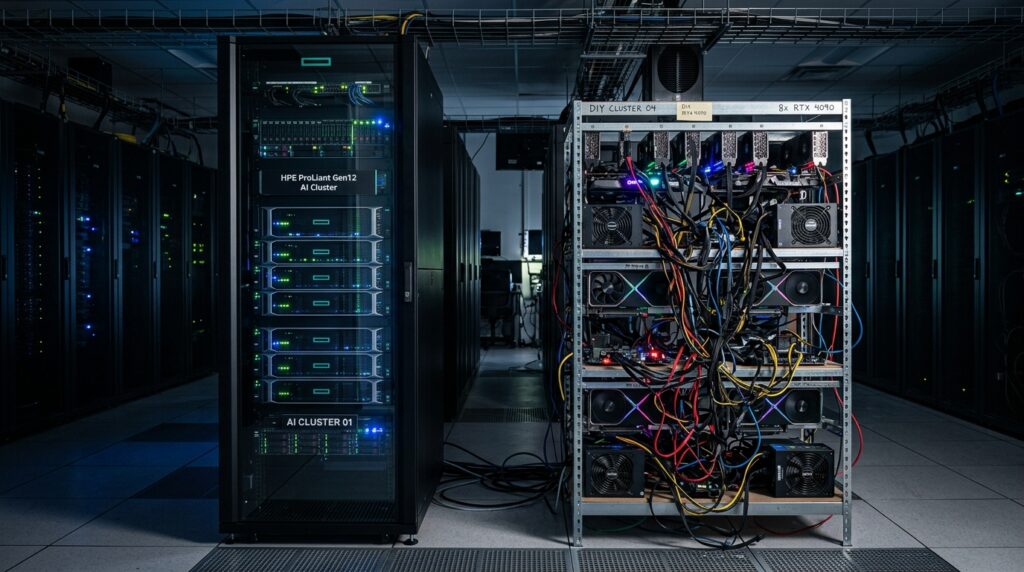
Conducting a thorough HPE Private Cloud AI review is essential for enterprise CIOs and Infrastructure Architects deciding between pre-engineered turnkey AI factories and custom modular DIY GPU stacks. In this strategic guide, we analyze system integration, software-firmware matrix friction, and 3-year TCO economics for 2026 deployments.
As enterprise IT transitions from experimental generative AI pilots to production-grade agentic workflows, real-time Retrieval-Augmented Generation (RAG), and physical AI, Chief Information Officers (CIOs) and Infrastructure Architects face a defining strategic choice: Should you deploy a pre-engineered, vertically integrated turnkey “AI Factory”—such as HPE Private Cloud AI co-developed with NVIDIA—or build a custom, modular do-it-yourself (DIY) GPU stack from scratch?
While custom modular builds promise maximum component flexibility, late-2026 operational realities show they frequently introduce crippling software-firmware matrix friction, multi-month deployment delays, and severe Day-2 operational overhead. Turnkey private clouds address these risks through standardized, pre-validated appliances, unified software-defined architectures, pay-per-use consumption frameworks, and automated AIOps observability across both connected and air-gapped environments.
HPE Private Cloud AI Review: Quick Summary & Comparison
| Evaluation Criteria | Turnkey AI Factory (e.g., HPE Private Cloud AI) | Custom Modular DIY GPU Stack |
| Primary Advantage | Rapid time-to-value; zero integration friction; single-point support | Complete hardware component flexibility; granular stack customization |
| Deployment Timeline | Operational in under 8 hours; production-ready in 2 to 4 weeks | 120 to 180 days required for hardware, fabric, and software alignment |
| Integration Overhead | Included white-glove deployment; zero internal assembly labor | ~800 hours of internal enterprise IT engineering labor |
| Maintenance Model | Single-click full-stack upstream updates validated by OEM | Manual Git-tracked version matrices; mandatory 48-hour canary testing |
| Financial Model | Flexible OpEx pay-per-use with on-site unbilled capacity buffer | High upfront CapEx; risk of stranded/idle hardware assets |
| Day-2 Observability | Native cross-domain AIOps (copilot tracking GPU thermals, IOPS, tokens) | Fragmented monitoring (custom Prometheus/Grafana) requiring ongoing upkeep |
| Best For | Enterprise teams needing predictable ROI, fast execution, and turnkey security | Hyperscalers, specialized research facilities, or custom hardware labs |
1. System Integration & Architectural Blueprint
The core architectural distinction between a turnkey AI Factory and a DIY stack lies in full-stack co-engineering versus post-purchase component integration. Turnkey solutions abstract physical and logical infrastructure complexity by unifying server hardware, specialized GPU accelerators, disaggregated scale-out storage, and AI orchestration software into pre-validated SKUs.
Compute Acceleration Topology
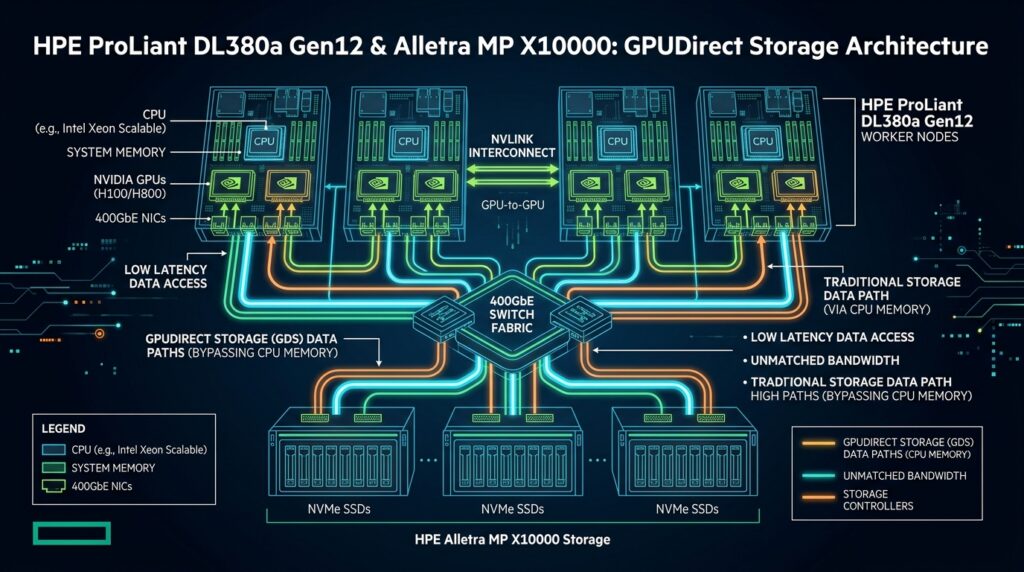
At the compute layer, worker nodes in platforms like HPE Private Cloud AI utilize purpose-built architectures like the 4U HPE ProLiant Compute DL380a Gen12, supporting high-density PCIe 5.0 bandwidth and dual Intel Xeon 6 processors (up to 144 cores per socket). Isolated 1U control nodes (such as high-availability clusters of HPE ProLiant DL325 Gen11 systems) separate cluster orchestration overhead from heavy GPU matrix calculations.
For multi-modal inference and large-scale fine-tuning, worker nodes leverage up to eight NVIDIA H200 GPUs interconnected via high-bandwidth NVLink bridges, or NVIDIA RTX Pro 6000 Blackwell Server Edition GPUs for agentic and visual computing workloads. The underlying network fabric operates over NVIDIA SN4700M 400GbE switches paired with Aruba 6300M switches dedicated to Out-of-Band Management (OOBM).
Disaggregated Storage Architecture
AI workloads frequently stall due to storage I/O bottlenecks. Modern turnkey factories resolve this by integrating disaggregated scale-out storage, such as the all-flash HPE Alletra Storage MP X10000.
By utilizing S3 over Remote Direct Memory Access (RDMA) and GPUDirect Storage (GDS) capabilities, data transfers move directly between NVMe drives and GPU memory, bypassing host CPU bottlenecks. When offloading Key-Value (KV) cache during multi-tenant LLM inference, this disaggregated architecture achieves up to a 20x improvement in time-to-first-token (TTFT) and up to a 17x increase in effective throughput. Native vector database integrations (e.g., Milvus) further accelerate inline metadata indexing during real-time data ingestion pipelines.
+-----------------------------------------------------------------------+
|                   GreenLake / Software Control Plane                   |
+-----------------------------------------------------------------------+
|  NVIDIA AI Enterprise (NIM, Agent Toolkit) | HPE AI Essentials Stack  |
+-----------------------------------------------------------------------+
        |                                                 |
        v                                                 v
+-------------------------------+               +-----------------------+
| Worker Compute Nodes          |               | Disaggregated Storage |
| - HPE ProLiant DL380a Gen12   |               | - HPE Alletra MP      |
| - NVIDIA H200 / Blackwell     |   GPUDirect   |   X10000              |
| - High-Bandwidth NVLink       | <===========> | - S3 over RDMA        |
+-------------------------------+     Storage   | - Low-Latency NVMe    |
        ^                                       +-----------------------+
        | 400GbE Switch Fabric (NVIDIA SN4700M)
+-----------------------------------------------------------------------+
| Control Nodes (3x HPE ProLiant DL325 Gen11) & Aruba OOBM Management    |
+-----------------------------------------------------------------------+
Pre-Validated SKU T-Shirt Sizes
To eliminate guesswork, turnkey solutions consolidate these technologies into pre-validated size configurations:
- Developer System (Sandbox / Proofs-of-Concept): 1x Worker Node (2x RTX Pro 6000 Blackwell or H100 NVL GPUs), 1x Control Node, integrated internal storage, standalone enclosure. Designed for fast prototyping without dedicated Top-of-Rack networking switches.
- Small (Production Inference & Visual Computing): 3x Control Nodes, 1–2x Worker Nodes (4x or 8x RTX Pro 6000 Blackwell GPUs), 62 TB HPE Alletra MP X10000 Storage, 400GbE fabric in a single 42U rack.
- Medium (Enterprise AI Inference & Agentic RAG): 3x Control Nodes, 2x Worker Nodes (8x NVIDIA H200 GPUs), 62 TB (109 TB for air-gapped) Alletra MP X10000 Storage, full 400GbE networking fabric.
- Large (Multi-Modal Fine-Tuning & Physical AI): 3x Control Nodes, 2+ Worker Nodes (16x NVIDIA H200 or RTX Pro 6000 Blackwell GPUs), 124 TB Alletra MP X10000 Storage, expandable across multiple 42U racks up to 64 GPUs.
2. Time-to-Value & Integration Friction
Building a custom DIY GPU stack requires navigating complex physical and logical dependency chains. Enterprise telemetry indicates that a DIY private build consumes approximately 800 IT engineering hours solely to establish foundational infrastructure.
The Hidden Trap of Software-Firmware Version Coupling
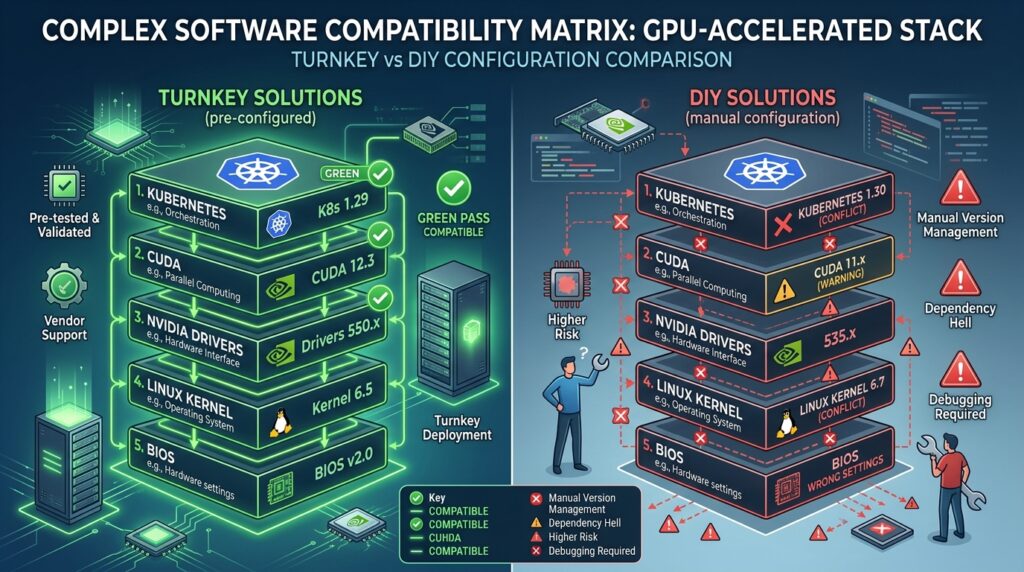
In a DIY environment, the primary operational hazard stems from tight version coupling across interdependent operational layers:
- Host Operating System & Kernel Version
- Container Orchestration Engine (e.g., Kubernetes / OpenShift)
- NVIDIA GPU Operator & Display Drivers
- CUDA Acceleration Toolkit & Runtime Libraries
- NVIDIA Network Operator / MOFED Driver Set
- Mellanox ConnectX NIC Firmware
- Host Server System BIOS & PCIe Controller Firmware
Updating the container orchestrator in a custom build can alter the underlying Linux kernel. If that kernel is incompatible with the deployed MOFED driver, RDMA communication fails, dropping GPUDirect Storage down to standard TCP fallback speeds. DIY operators must maintain custom Git-tracked compatibility matrices and execute mandatory 48-hour canary tests before every patch.
The Turnkey Deployment Model
In contrast, a turnkey system arrives pre-integrated and factory-tested. Hardware setup is streamlined via pre-configured 3-phase PDUs and pre-cabled 42U racks. Software initialization occurs via an automated onboarding routine, bringing the Kubernetes engine, storage subsystems, and NVIDIA AI Enterprise software to operational status within 8 hours. Supported by white-glove onboarding services, enterprises move from power-on to production workloads in two to four weeks, compared to 3 to 6 months (120–180 days) for DIY builds.
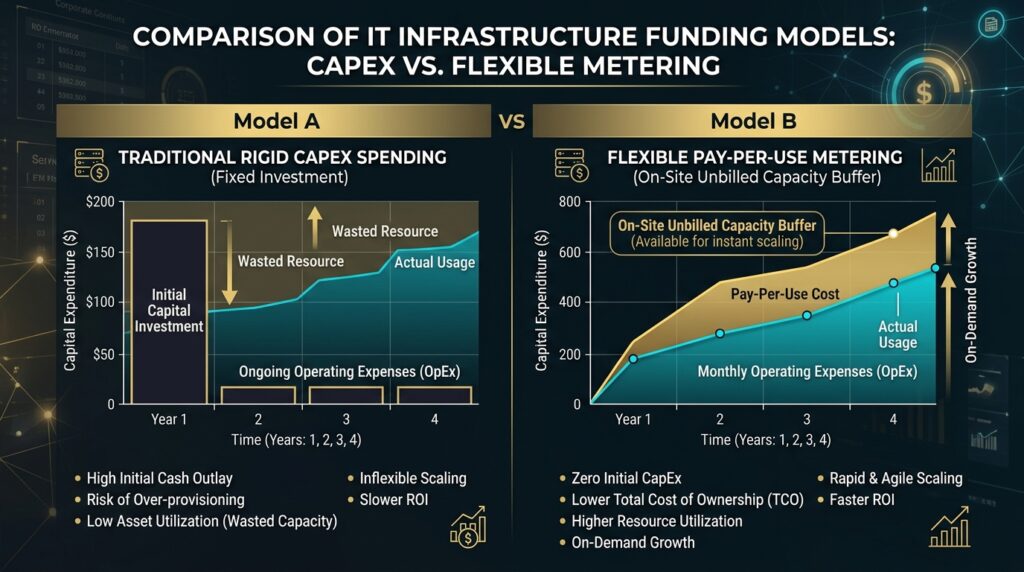
3. Financial Framework: Eliminating the CapEx Overprovisioning Penalty
Traditional hardware procurement forces organizations to project compute requirements 3 to 5 years in advance. In volatile AI cycles, this creates two distinct failure modes:
- The Overprovisioning Trap: Overbuying hardware to accommodate future demand spikes leads to stranded capital, with up to 40% of installed compute sitting idle during initial development phases.
- The Underprovisioning Bottleneck: Underestimating capacity forces development teams into 12 to 24-week procurement delays when expansion is required.
Pay-Per-Use On-Premises Consumption
Consumption models like HPE GreenLake replace upfront CapEx purchases with a pay-per-use operational model while keeping physical hardware secure inside your private data center. Metering tracks actual usage—such as active compute hours, allocated GPU runtime, and terabytes written to storage.
Infrastucture Capacity Utilization
+-----------------------------------------------------------------+
|                                 [On-Site Unbilled Buffer]       |
|  Actual Compute Demand  ~~~~~>  -------------------------       |
|                                 [Base Committed Capacity]       |
+-----------------------------------------------------------------+
To support sudden processing spikes without requiring emergency CapEx allocations, an on-site unbilled buffer (typically 10% extra installed capacity) remains connected and powered in your data center. When a large fine-tuning job or agentic burst occurs, your team utilizes this buffer instantly, with billing scaling automatically based on actual usage. This flexible structure can yield up to 45% savings in total infrastructure TCO and up to 65% savings in routine operational labor.
4. Operational Risk Management & AIOps Observability
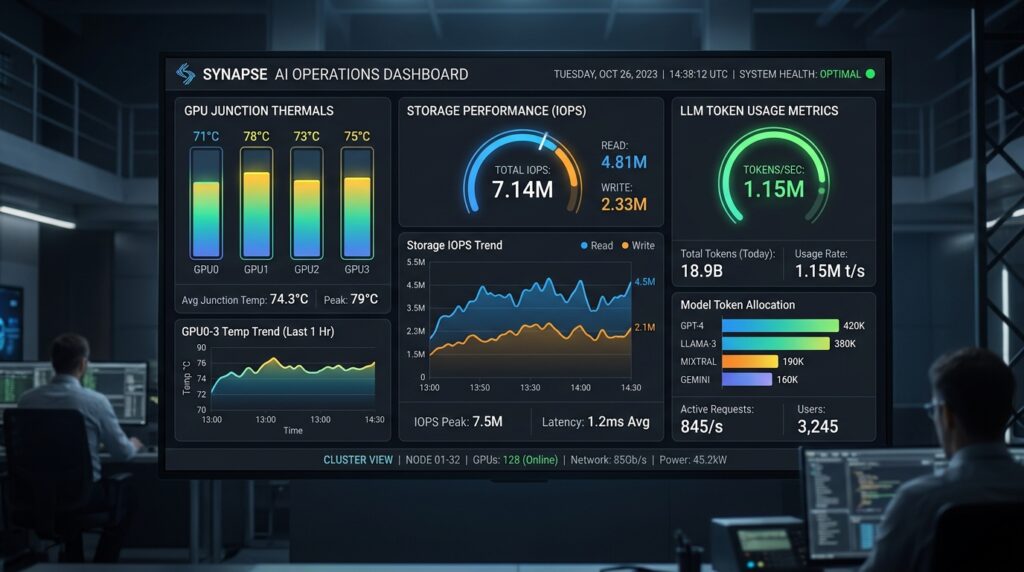
Day-2 operations present significant long-term risks in enterprise deployments. Maintaining high GPU utilization requires proactive monitoring of power consumption, thermal envelopes, storage IOPS, and multi-tenant token metrics.
                +---------------------------------+
                |   OpsRamp Operations Copilot   |
                +---------------------------------+
                 /               |               \
                /                |                \
               v                 v                 v
     +-----------------+ +---------------+ +------------------+
     | GPU Thermals &  | | Storage IOPS  | | Token & API      |
     | Power Dynamic   | | & Network     | | Usage            |
     | Load Balancing  | | Congestion    | | Governance       |
     +-----------------+ +---------------+ +------------------+
Full-Stack Observability via OpsRamp
Modern turnkey management planes integrate AIOps tools like the OpsRamp Operations Copilot to correlate telemetry across all physical and virtual layers:
- Thermal and Power Mitigation: Monitors junction temperatures and power draw per card under matrix-multiplication loads, proactively re-routing compute jobs before thermal throttling degrades performance.
- I/O Storage Bottleneck Prevention: Correlates real-time storage latency against GPU demand, flagging queue congestion before it starves compute nodes.
- Token Observability and Governance: Tracks token usage and API call rates across individual business units to maintain strict cost governance across hybrid environments.
- Cyber Resilience and Rollback: Tools like HPE Zerto enable point-in-time state recovery. If an autonomous agent alters system states, corrupts vector datastores, or breaches execution parameters, operational teams can restore corrupted datasets to a clean snapshot within seconds.
Air-Gapped and Sovereign Deployments
For defense, public sector, healthcare, and finance sectors, public cloud connectivity introduces compliance and data exposure risks. Dedicated Air-Gapped Configurations (available in Medium and Large SKUs) operate without external WAN connections. Localized collectors process telemetry within the private enclave, adhering to strict security standards (such as DoD IL4 readiness) while maintaining complete API parity with standard connected platforms.
5. Editor’s Perspective & Deployment Insight
Why This Matters
Building infrastructure is not the primary objective of enterprise digital transformation; accelerating business outcomes is. When engineering teams spend months manually aligning host kernels, CUDA libraries, and network switch drivers, high-value AI projects stall before delivering business value.
Editor’s Take
If your goal is to launch production-grade agentic AI or high-throughput RAG within the next month with predictable financing and single-call support, choose a turnkey AI Factory like HPE Private Cloud AI.
Choose a Custom DIY GPU Stack only if you are a hyperscaler, a specialized hardware research institute, or possess a dedicated internal infrastructure team willing to absorb ongoing software-firmware matrix integration risks.
Final Recommendation: Who Should Use What?
Choose a Turnkey AI Factory If:
- You need to move from delivery to active production in under 30 days.
- Your enterprise prioritizes strict data governance, local sovereign compliance, or fully air-gapped security.
- You prefer an operational pay-per-use financial structure to avoid stranded capital assets.
- You want a single point of operational accountability covering server hardware, GPUs, storage arrays, networking fabrics, and container software.
Consider a DIY GPU Stack Only If:
- You require non-standard hardware topologies or unvalidated experimental ASIC accelerators.
- You maintain a dedicated full-time engineering team to manage Git-tracked driver compatibility matrices and execute manual update cycles.
- You operate at hyperscale volumes where custom component sourcing outweighs the cost of internal integration labor.
Final Recommendation: Who Should Use What?
Choose a Turnkey AI Factory If:
- You need to move from delivery to active production in under 30 days.
- Your enterprise prioritizes strict data governance, local sovereign compliance, or fully air-gapped security.
- You prefer an operational pay-per-use financial structure to avoid stranded capital assets.
- You want a single point of operational accountability covering server hardware, GPUs, storage arrays, networking fabrics, and container software.
Consider a DIY GPU Stack Only If:
- You require non-standard hardware topologies or unvalidated experimental ASIC accelerators.
- You maintain a dedicated full-time engineering team to manage Git-tracked driver compatibility matrices and execute manual update cycles.
- You operate at hyperscale volumes where custom component sourcing outweighs the cost of internal integration labor.
To see how turnkey private clouds fit into broader infrastructure strategies, read our overarching guide on the Top 5 On-Premise AI Platforms. If your enterprise is benchmarking specialized silicon for frontier reasoning models, explore our DeepSeek-R1 Hardware Review and SambaNova SN40L RDU Review. For physical AI and industrial robotics edge deployment, analyze our Qualcomm Dragonwing IQ-9075 Review and Qualcomm Dragonwing AI Review. You can also evaluate software-level agentic orchestration in Dynamiq AI Review, or unstructured document extraction in our ICR vs Multimodal LLMs Strategy and E42.ai Review. For legacy automation benchmarks, check out ElectroNeek On-Premise Review, alongside our manual on Top 5 Zanus AI Alternative, Zanus AI Deployment, and Zanus AI for Construction. Bookmark AI Review Zones for continuous enterprise hardware coverage.
References
- Hewlett Packard Enterprise. HPE Private Cloud AI System Architecture & QuickSpecs. Available at: https://www.hpe.com
- NVIDIA Corporation. NVIDIA AI Enterprise & NIM Deployment Guides. Available at: https://www.nvidia.com
- HyperFRAME Research. Evaluating Enterprise AI Infrastructure: Turnkey Appliances vs. DIY Custom Stacks. Available at: https://hyperframeresearch.com
- Kubernetes Recipe Standards. GPU Cluster Upgrade Version Matrix and Driver Dependencies. Available at: https://kubernetes.recipes
- Recovery Monkey. HPE Alletra Storage MP X10000 Deep Dive: GPUDirect Storage and Unstructured Data Performance. Available at: https://recoverymonkey.org
- Network World. HPE GreenLake Intelligence and Unified Operations for Hybrid Cloud AI. Available at: https://www.networkworld.com