
Enterprise infrastructure architectures face a severe structural challenge driven by the operational economics of large language model (LLM) inference, real-time data processing, and massive data transport requirements.
Hyper-scalable public cloud platforms such as Amazon Web Services (AWS), Google Cloud Platform (GCP), and Microsoft Azure remain effective for elastic, ephemeral compute. However, they introduce severe financial and technical friction when handling sustained, high-concurrency, and bandwidth-heavy enterprise workloads. The primary drivers of this friction include volatile usage-based pricing models, aggressive data egress tariffs, network virtualization overhead, and resource contention inherent to multi-tenant hypervisor environments.
NovoServe has established itself as an enterprise-grade alternative by specializing in high-performance bare-metal dedicated servers, unmetered high-capacity network pipelines, and fully customizable hardware configurations. Operating a global footprint anchored in Tier-III, ISO-certified data centers across Europe and North America, NovoServe provides enterprise technology leaders with raw physical compute access, non-blocking network throughput, and transparent fixed-cost operational models.
Executive Summary & Key Highlights
| Evaluation Criteria | Technical Assessment & Operational Specs |
| Ideal Use Cases | Private AI/LLM inference hosting (e.g., DeepSeek-R1, Llama 3), high-concurrency SaaS backend infrastructure, real-time video streaming, high-frequency AdTech, and hybrid private cloud foundations. |
| Standout Features | Dedicated hardware isolation, raw non-virtualized AMD EPYC and Intel Xeon Scalable processors up to 128 physical cores per node, NVMe-over-Fabrics support, in-house multi-terabit anti-DDoS edge mitigation platform, and 24/7 direct access to senior network engineers. |
| Bandwidth Options | Unmetered network pipelines ranging from 10Gbps to 100Gbps per server node, backed by an 18+ Tbps global network capacity with Tier-1 transit and 800+ direct peering partners. |
| TCO Rating | 9.4 / 10 — Delivers an estimated 40% to 60%+ total cost of ownership reduction compared to public cloud hyperscalers by eliminating per-gigabyte data egress fees and hypervisor management surcharges. |
NovoServe Review: Deep-Dive Hardware & Network Infrastructure Analysis
Compute Performance & Hardware Customization
Modern compute-intensive workloads—specifically private AI inference pipelines and high-concurrency analytical databases—require direct physical hardware execution without virtualized hypervisor abstraction. Virtualized instances in public clouds introduce thread contention, non-uniform memory access (NUMA) node misalignment, and unpredictable latency spikes caused by co-tenant “noisy neighbors.”
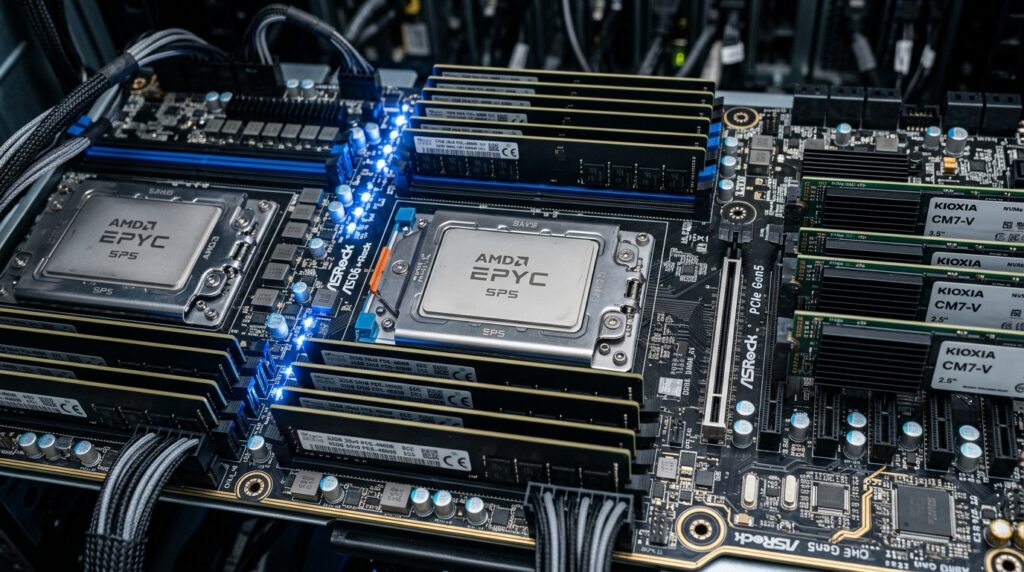
NovoServe addresses these architectural limitations by offering bare-metal infrastructure built entirely on enterprise-grade server platforms powered by AMD EPYC and Intel Xeon Scalable processors. Hardware deployments scale up to 128 physical cores (256 threads) per node, utilizing high-frequency, multi-core topology to process parallelized data streams efficiently.
+-----------------------------------------------------------------------+
|                         NOVE SERVE BARE-METAL                         |
|  [ Physical CPU ] ---> [ Direct RAM Access ] ---> [ Direct NVMe IO ]   |
|  (Zero Hypervisor Overhead / Pure Kernel Isolation / Native Performance)|
+-----------------------------------------------------------------------+
                                  VS.
+-----------------------------------------------------------------------+
|                       PUBLIC CLOUD VIRTUALIZED                        |
|  [ vCPU ] -> [ Hypervisor Scheduler ] -> [ Shared RAM ] -> [ Virtual IO ]|
|  (Resource Contention / Jitter / Variable Noisy-Neighbor Latency)     |
+-----------------------------------------------------------------------+
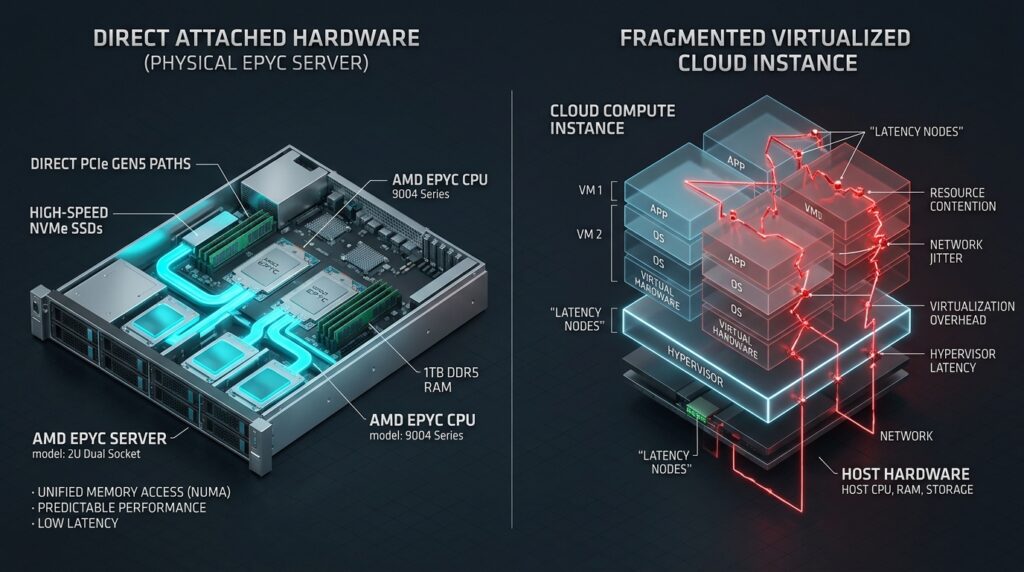
To support memory-intensive workloads such as enterprise LLM context windows and high-capacity key-value (KV) caches, server configurations support over 1TB of registered ECC DDR4 or DDR5 system memory. On the storage layer, system architectures leverage high-throughput PCIe Gen4 and Gen5 enterprise NVMe SSD arrays, supplemented by advanced deployment capabilities like NVMe-over-Fabrics (NVMe-oF) for disaggregated, low-latency storage scaling. Custom deployments can also integrate field-programmable gate array (FPGA) accelerators, specialized high-frequency trading CPU variants, and enterprise AI GPU accelerators to meet precise algorithmic requirements.
Every server node is provisioned with 100% dedicated physical resources and complete root access. This hardware-level isolation allows engineering teams to optimize software stacks from the operating system kernel upward, customizing CPU governor parameters, memory page allocation, and custom network drivers without public cloud abstraction barriers.
Network Architecture & Bandwidth Dominance
Network throughput and packet routing performance represent critical operational metrics for distributed enterprise systems. NovoServe operates a multi-homed global network infrastructure built with a total network capacity exceeding 18 Tbps.
The transit layer integrates multiple Tier-1 network carriers, ensuring path redundancy and optimal global routing:
- Arelion: 2.0 Tbps provisioned capacity
- Cogent Communications: 1.8 Tbps provisioned capacity
- NTT Communications: 1.6 Tbps provisioned capacity

Beyond upstream transit, the infrastructure incorporates direct peering relationships with over 800 network partners, including hyper-scale content networks, global ISPs, and major internet exchange points such as the Amsterdam Internet Exchange (AMS-IX). This peering topology minimizes autonomous system (AS) hop counts, drastically reduces packet jitter, and maintains predictable latency profiles for real-time transatlantic and intra-European data transfers.
A core technical differentiator is the provisioning of unmetered bandwidth pipelines operating at native 10Gbps to 100Gbps port speeds per physical server. Unlike public cloud environments that throttle port throughput or impose heavy variable egress tariffs, NovoServe unmetered ports permit continuous, non-blocking data ingestion and egress at full line rates. All deployments are backed by formal Service Level Agreements (SLAs) guaranteed by Tier-III data center infrastructure with redundant N+1 power generators, uninterruptible power supply (UPS) systems, and precision cooling architectures.
Security, Protection & Regulatory Compliance
Physical and network security controls are essential requirements for enterprise infrastructure migration. NovoServe operates data center facilities across key strategic regions, including three sites in the Netherlands (Amsterdam and Rotterdam), one in Denmark (Copenhagen), and one in the United States (New York).
To defend against volumetric and application-layer cyberattacks, NovoServe deploys an in-house, multi-terabit edge Distributed Denial of Service (DDoS) mitigation system. Operating directly at the network perimeter, this platform performs real-time automated packet inspection and scrubbing. By filtering malicious volumetric flows at the edge prior to reaching the host network interface card (NIC), legitimate operational traffic maintains unimpeded access without added latency or packet loss.
From a governance and regulatory perspective, NovoServe infrastructure maintains Tier-III design compliance and ISO 27001 data center certifications. The availability of dedicated physical nodes within explicit geographic locations allows enterprise compliance teams to satisfy strict data sovereignty and regulatory mandates:
- GDPR (General Data Protection Regulation): Guarantees European data resides entirely within sovereign EU boundaries (Netherlands and Denmark data centers) under direct physical control.
- HIPAA (Health Insurance Portability and Accountability Act): Provides isolated physical compute environments required for processing sensitive protected health information (PHI) without shared tenant access risks.
- PCI-DSS (Payment Card Industry Data Security Standard): Offers physical hardware segregation, dedicated network interfaces, and audited access controls necessary for level-1 payment gateway processing.
Operational Impact: The Engineering Reality of Bare-Metal
Modern hypervisor architectures absorb between 3% and 8% of raw hardware capabilities simply managing virtual machine states and CPU cycle allocation. When running deep learning inference routines across multi-socket systems, hypervisor thread switching creates micro-stutters that degrade real-time processing capabilities. By deploying on dedicated bare-metal, engineering teams trade cloud-native API abstraction for deterministic, predictable hardware execution—a trade-off that pays massive dividends in performance consistency and system transparency.
TCO & Cost Comparison: NovoServe Bare-Metal vs. Hyperscalers (AWS / GCP)
Structural Flaws in Hyperscaler Network Pricing
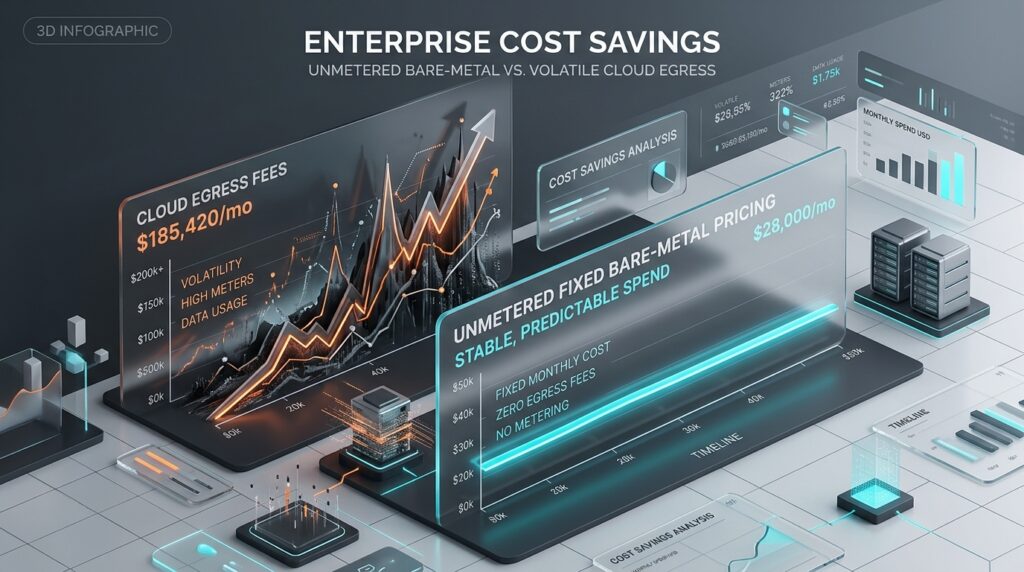
The public cloud economic model is built around elastic compute pricing paired with aggressively tier-monetized network egress fees. While initial compute instances may appear cost-effective on an hourly basis, high-throughput applications encounter substantial, unpredictable financial escalations due to network egress metering.
In major public cloud ecosystems like AWS and GCP, inbound data transfer is unbilled, but outbound data transfer crossing network boundaries incurs per-gigabyte charges. On AWS EC2, after a baseline 100 GB monthly free allowance, internet egress pricing follows a tiered charge structure starting at $0.09 per GB for the first 10 TB, $0.085 per GB for the next 40 TB, $0.07 per GB for the next 100 TB, and $0.05 per GB for volumes exceeding 150 TB.
Beyond baseline internet egress tariffs, cloud architectures frequently accumulate hidden networking surcharges:
- NAT Gateway Processing Surcharges: Outbound traffic routed through a managed NAT Gateway incurs an additional processing fee of $0.045 per GB, plus hourly gateway provisioning fees ($0.045/hour per AZ). Outbound internet traffic via a NAT Gateway effectively costs $0.135 per GB for the initial 10 TB tier ($0.09 egress + $0.045 NAT processing).
- Cross-Availability Zone (Cross-AZ) Transfer: Data moving between instances across different AZs within the same AWS region carries a charge of $0.01 per GB in each direction ($0.02 per GB per round-trip). For high-availability multi-AZ microservice architectures, inter-service traffic can add thousands of dollars to monthly invoices.
- Load Balancer Data Processing Fees: Application Load Balancers (ALB) and Network Load Balancers (NLB) charge data processing fees averaging $0.008 per GB.
In contrast, NovoServe eliminates variable network pricing entirely by bundling dedicated physical hardware with predictable unmetered bandwidth pipelines. Enterprise buyers pay a fixed monthly recurring charge (MRC) for the physical server and network interface port (e.g., 10Gbps or 100Gbps unmetered), enabling unlimited data transfer without usage-based billing volatility.
Comprehensive TCO Comparison Matrix
| Infrastructure Parameter | NovoServe Bare-Metal Dedicated Server | AWS EC2 (Equivalent Cluster Config) | GCP Compute Engine (Equivalent Config) |
| Compute Topology | Dedicated Bare-Metal Node (AMD EPYC 7713, 64-Core / 128-Th) | Multi-Tenant Virtual Instances (e.g., c6i.16xlarge / c7g.16xlarge) | Multi-Tenant Virtual Instances (e.g., c2d-standard-56 / c3-standard-88) |
| System Memory | 1,024 GB (1 TB) ECC DDR4/DDR5 RAM | 1,024 GB RAM (Aggregated across instance pool) | 1,024 GB RAM (Aggregated across instance pool) |
| Storage Subsystem | 2.0 TB Enterprise NVMe SSD Array (PCIe Gen4) | EBS Provisioned IOPS SSD (gp3 / io2) attached volume | Persistent Disk SSD (pd-ssd / pd-extreme) attached volume |
| Hypervisor Overhead | 0% (Direct physical hardware access) | ~3%–8% (Virtualization, vCPU scheduling jitter) | ~3%–8% (Virtualization, vCPU scheduling jitter) |
| Network Port Speed | Dedicated 100Gbps Non-Blocking Pipeline | Variable Network Bandwidth (Up to 25–50 Gbps burst) | Variable Network Bandwidth (Up to 32–50 Gbps burst) |
| Monthly Egress Model | Unmetered Flat-Rate (Fixed Port Price) | Tiered Metered Tariff ($0.09 to $0.05 per GB) | Tiered Metered Tariff ($0.12 to $0.08 per GB) |
| Base Hardware / Compute MRC | ~$1,800 – $2,500 / month (Hardware + 100G Port) | ~$2,800 – $3,400 / month (On-Demand Compute) | ~$2,900 – $3,500 / month (On-Demand Compute) |
| Egress Cost (50 TB/mo Transfer) | $0.00 (Included in unmetered plan) | ~$4,394.70 (Base internet egress) | ~$4,500.00 (Base internet egress) |
| Egress Cost (100 TB/mo Transfer) | $0.00 (Included in unmetered plan) | ~$7,980.20 (Base internet egress) | ~$8,200.00 (Base internet egress) |
| Estimated Total Monthly TCO (100 TB Egress) | ~$2,500 / month | ~$10,780+ / month | ~$11,100+ / month |
Quantitative Financial Simulation & Savings Modeling
To illustrate the financial impact of network egress and compute infrastructure costs, consider an enterprise operating a high-concurrency SaaS or private AI inference platform generating sustained outbound data volumes of 10 TB, 50 TB, and 100 TB per month.
The mathematical formulation for standard AWS networking egress costs ($C_{\text{AWS\_Egress}}$) given a monthly transfer volume $V$ (in GB) is expressed as:
$$C_{\text{AWS\_Egress}}(V) = \sum_{i=1}^{n} (V_i \times R_i) + C_{\text{NAT}} + C_{\text{Cross-AZ}} + C_{\text{ALB}}$$
Where:
- $V_i$ represents the volume allocated within pricing tier $i$.
- $R_i$ represents the marginal per-gigabyte rate for tier $i$ ($0.09, $0.085, $0.07, $0.05).
- $C_{\text{NAT}}$ represents NAT Gateway processing ($V_{\text{NAT}} \times \$0.045$).
- $C_{\text{Cross-AZ}}$ represents inter-zone traffic ($V_{\text{Cross-AZ}} \times \$0.02$).
- $C_{\text{ALB}}$ represents load balancing processing fees ($V_{\text{ALB}} \times \$0.008$).
Financial Modeling Scenarios:
10 TB Outbound Monthly Egress:
- AWS Base Egress: $(10,240 \text{ GB} – 100 \text{ GB free}) \times \$0.09 = \$912.60$.
- AWS Real-World Surcharges (Assuming 5 TB via NAT Gateway & 3 TB Cross-AZ): $\$912.60 + (5,000 \times \$0.045) + (3,000 \times \$0.02) = \$1,197.60 \text{ / month}$.
- NovoServe Cost: Included in baseline unmetered server MRC. Total Egress Cost = $0.00.
50 TB Outbound Monthly Egress:
- AWS Base Egress: $(10,140 \text{ GB} \times \$0.09) + (41,060 \text{ GB} \times \$0.085) = \$4,394.70$.
- AWS Real-World Surcharges (Full workload through NAT Gateway, Cross-AZ, and ALB): Combined charges routinely reach $\$7,522.55 \text{ / month}$.
- NovoServe Cost: Included in baseline unmetered server MRC. Total Egress Cost = $0.00.
100 TB Outbound Monthly Egress:
- AWS Base Egress: $(10,140 \text{ GB} \times \$0.09) + (40,960 \text{ GB} \times \$0.085) + (51,200 \text{ GB} \times \$0.07) = \$7,980.20$.
- AWS Real-World Surcharges: Combined overall egress bill reaches ~$\$11,500+ \text{ / month}$.
- NovoServe Cost: Included in baseline unmetered server MRC. Total Egress Cost = $0.00.
Across an annual operational cycle, transitioning high-throughput workloads from public hyperscalers to NovoServe dedicated servers yields an overall Total Cost of Ownership reduction between 40% and 60% on baseline compute, expanding to >80% financial savings on network egress intensive architectures.
Related Hardware & Infrastructure Coverage
To evaluate how bare-metal dedicated servers fit into broader enterprise infrastructure, explore our technical benchmarks and ecosystem reviews across AI compute, on-premise platforms, and edge automation: