
The Core Decision for Today’s Enterprise
The biggest bottleneck in HR AI adoption isn’t model performance. It is data custody. When a Chief Human Resources Officer (CHRO) routes candidate profiles to public cloud APIs, they aren’t just transferring data—they are transferring their organization’s legal liability and brand reputation to a third party.
For large enterprise recruitment functions and global IT outsourcing firms, deploying Zanus AI for staffing (or equivalent on-premises architectures) has evolved from a tech experiment into an operational survival imperative. Mass ingestion of Personally Identifiable Information (PII), compensation histories, and background checks into multi-tenant cloud ecosystems introduces severe, structural statutory liabilities.
The only viable path to capitalize on automated workforce management while retaining airtight compliance is to build a Sovereign Local RAG Pipeline running entirely behind the corporate firewall.
The Legal Reality: Navigating the Cloud “Joint Controller” Trap
Many enterprise technology architects mistakenly assume that standard Data Processing Agreements (DPAs) protect them from upstream data liabilities. In automated workforce management, the architectural reality tells a different story:
[Enterprise Sends Candidate PII] ──> [Public Multi-Tenant Cloud AI Endpoint]
                                                     │
               (Vendor retains data for optimization or caches inference layers)
                                                     ▼
                                [Legal Shift to Joint Controller (GDPR Art. 26)]
                                                     │
                                                     ▼
                                [Risk: Model Memorization & Data Leakage]
1. The Shift from Processor to Joint Controller
Under GDPR Article 26, if a cloud AI provider utilizes client-submitted resumes or performance data to optimize, fine-tune, or train its underlying foundation models, its legal classification shifts. The provider ceases to operate as a pure Data Processor and legally transforms into a Joint Controller.
This triggers joint and several liability under GDPR Article 82, exposing the enterprise to regulatory enforcement and class-action litigation stemming from data leaks or model memorization failures anywhere within the vendor’s ecosystem.
2. Critical Blind Spots in Global Compliance Frameworks
- GDPR (Europe): Routing candidate payloads across dynamic cloud server nodes to optimize compute loads frequently violates the core principles of purpose limitation, storage limitation, and cross-border data transfer mandates.
- DPDPA (India): Featuring far-reaching extraterritorial enforcement, the Digital Personal Data Protection Act requires explicit consent notices in scheduled regional languages and imposes massive penalties (up to INR 250 crore) for failing to secure personal data at rest.
- EU AI Act: Automated recruitment, resume ranking, and worker evaluation systems are explicitly designated as High-Risk AI Systems under Annex III. This imposes strict, non-transferable Article 26 deployer obligations—including human oversight, technical logging, and demographic bias monitoring—enforceable by severe global turnover fines.
Operational Impact
Why this matters: Relying on public cloud infrastructure for workforce management transforms an enterprise into a legal proxy for the cloud vendor’s architectural changes. Mitigating this compliance risk demands an immediate shift away from multi-tenant remote inference toward sovereign data containment strategies.
Architectural Blueprint: Sovereign Local RAG Pipeline for HR Systems
To eliminate external WAN dependencies and completely mitigate data custody leaks, the sovereign local RAG pipeline executes data ingestion, vectorization, and inference within an air-gapped network substrate:
[Candidate Records (PDF, DOCX, Scanned Images)]
                       │
                       ▼
       [Local Layout Parser: Docling] (Containerized)
                       │
                       ▼
    [Text Chunks + Rich Metadata Extraction]
                       │
                       ▼
    [Hybrid Embeddings Generation: BGE-M3]
                       │
        ┌──────────────┴──────────────┐
        ▼                             ▼
 [Dense Vectors]               [Sparse Tokens]
        └──────────────┬──────────────┘
                       ▼
         [On-Premises Vector Database]
      (Qdrant or PostgreSQL + pgvector)
                       │
                       ▼
 [Sovereign Local Inference: Llama 3.3 70B via vLLM]
                       │
                       ▼
 [Legal Alignment Layer (Pydantic & Local Regex)]
                       │
                       ▼
 [Human-in-the-Loop Approval Queue] ──> [Validated Contract / Match Output]
Core Architecture Breakdown:
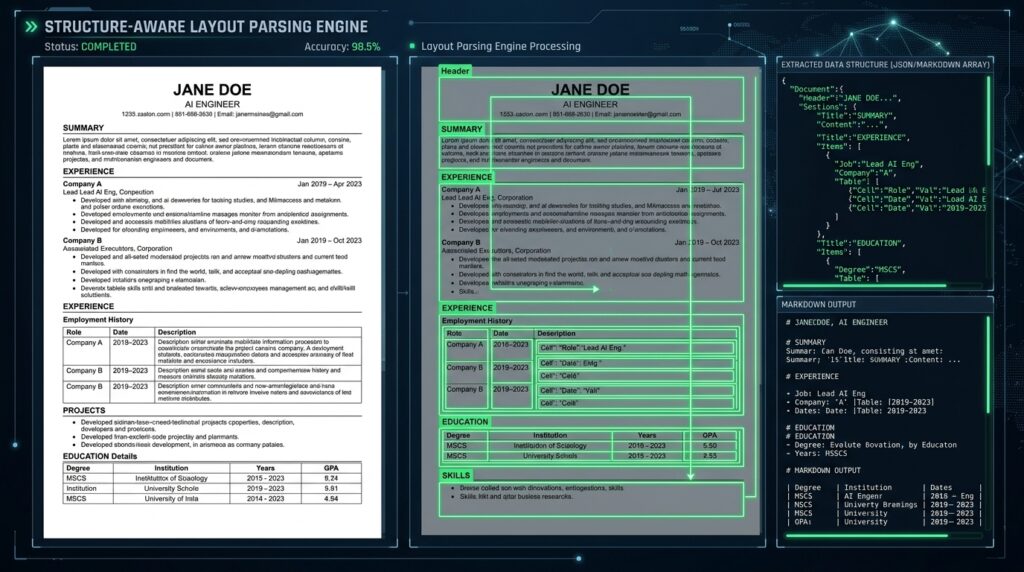
- Local Layout Engine: Containerized engines parse applications locally, extracting structured text and metadata while preserving the physical reading order of complex, multi-column CVs.
- Hybrid Embeddings (BGE-M3): Generates dense vector representations for abstract semantic matching alongside sparse tokens for precise keyword matching (e.g., certifications, exact job codes).
- Local Inference Engine: Serves open-weights models like Llama 3.3 70B on internal GPU nodes via vLLM, ensuring no candidate data leaves the private network perimeter.
Infrastructure Sizing: VRAM Requirements for Local HR AI Deployments
Deploying enterprise-grade models like Llama 3.3 70B with long context capabilities requires careful calculation of model weight memory and active Key-Value (KV) cache allocation. Processing high-volume talent pipelines at a concurrent batch size of 16 ($B=16$) across a 32,768-token context window ($S=32,768$) requires explicit physical resource allocation.
To compute the precise memory footprint of the KV cache under the model’s Grouped-Query Attention (GQA) architecture, we apply the following calculation:
$$KV_{\text{bytes}} = 2 \times L \times H_{kv} \times D \times S \times B \times \text{BytesPerElement}$$
Architectural constants for Llama 3.3 70B:
- $L$ (Transformer Layers) = $80$
- $H_{kv}$ (Key-Value Heads) = $8$ (reflecting an 8:1 query-to-KV head ratio under GQA)
- $D$ (Head Dimension) = $128$
VRAM Allocation & Hardware Configuration Matrix
| Precision Configuration | Base Weight Memory | KV Cache Memory (Batch 16, 32k Context) | Total Required VRAM | Recommended Physical Hardware |
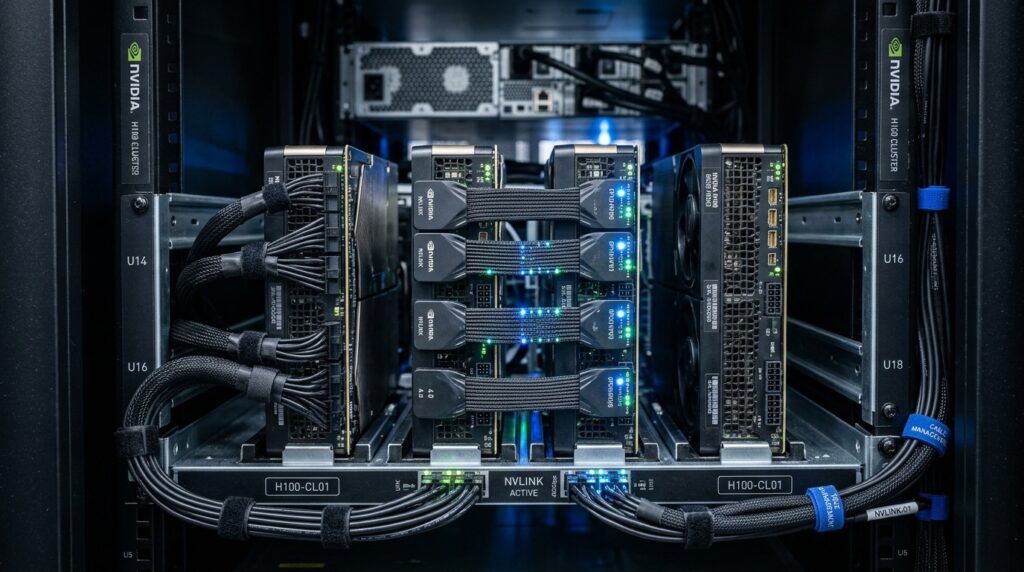
| FP16 Weights + FP16 KV Cache | ~130.39 GB | 160.00 GB | 290.39 GB | 4x NVIDIA H100 (80GB) configured with Tensor Parallelism (TP=4) over local NVLink interfaces. |
| INT8 Weights + FP8 KV Cache | ~65.19 GB | 80.00 GB | 145.19 GB | 2x NVIDIA A100 (80GB) utilizing vLLM PagedAttention to eliminate memory fragmentation. |
| INT4 Weights + FP8 KV Cache | ~32.60 GB | 80.00 GB | 112.60 GB | 2x NVIDIA L40S (48GB) or 2x NVIDIA A100 (80GB). Highly cost-effective setup for mid-market deployment. |
Deployment Insight
Editor’s Take: Organizations that minimize infrastructural footprint by leveraging INT4 quantization combined with FP8 KV caches can drastically decrease initial hardware acquisitions while preserving the processing accuracy required for high-volume CV evaluations.
Eliminating Data Degradation: Layout-Aware Parsing to Prevent Algorithmic Bias
In automated talent matching pipelines, the principle of “Garbage In, Garbage Out” manifests during document ingestion. Resumes are highly heterogeneous documents characterized by multi-column profiles, floating text callouts, and nested employment tables.
Standard programmatic text extractors and basic OCR utilities parse documents line-by-line horizontally. This scrambles the semantic integrity of multi-column layouts: an applicant’s employment tenure dates in the left column get mixed with unrelated technical skills in the right column.
When this scrambled text is vectorized via the embedding layer (BGE-M3), it generates corrupted semantic tokens. Consequently, the vector database yields low-relevance records, causing the downstream LLM to generate biased screenings that violate Article 26(4) of the EU AI Act regarding input data quality.
To safeguard against this, the pipeline must implement structure-aware document parsing locally. The table below outlines how top local-capable parsers stack up:
Local Document Ingestion Engine Comparison
| Parser | Hosting & Licensing Model | Format Coverage | Architectural Capabilities | Key Enterprise Selection Factor |
| Docling | Apache-2.0 / Fully Cục bộ (Local) Execution. | PDF, DOCX, PPTX, XLSX, Images, Markdown. | Extracts explicit reading order, bounding layout boxes, and complex tables natively. | Top Pick for RAG: Natively optimized for token chunking pipelines and supports local GPU acceleration out of the box. |
| MinerU | Open-Source / Self-Hosted Infrastructure. | PDF, Technical Papers, Complex Images. | Advanced layout segmentation; converts dense nested tables into clean Markdown arrays. | Free from cloud page-limit constraints, making it highly effective for unstructured resumes. |
| LLMWhisperer | Proprietary / Containerized On-Premise. | Scanned PDFs, Images, Legacy Paper Forms. | Heavy image preprocessing; handles low-quality, skewed, or faded paper applications. | Best for Legacy Systems: Maximizes extraction clarity for historical paper records and low-contrast scans. |
| PyMuPDF4LLM | Open-Source / CPU-Bound Python Library. | Born-digital PDFs only. | Rapid textual streaming without native layout segmentation. | Processes hundreds of pages per second on standard CPUs, but lacks OCR capabilities for image assets. |
Real-world Consideration
Why This Matters: Implementing a structure-aware document utility like Docling directly mitigates algorithmic bias liabilities by preserving data syntax. Systems relying on unverified text dumping introduce high downstream verification overhead and skew candidate compliance profiles.
If you are scaling your enterprise AI deployment and need robust, high-bandwidth bare-metal hosting without exorbitant cloud egress fees, check out our in-depth NovoServe Review and our NovoServe vs Hetzner Comparison to find the right server specs for your budget. Additionally, if your team manages multi-language workflows or cross-border project documentation, read our hands-on Palabra AI Review and Palabra AI vs Lokalise Breakdown to learn how automated AI localization can streamline your content pipeline.
Actionable Strategy for CHROs and Technology Architects
To execute a secure, fully compliant AI workforce integration roadmap, enterprise leadership must immediately adopt a four-step remediation track:
- Conduct an Active Shadow AI Audit: Scan and catalog all automated text utilities and AI extensions currently used by internal recruiters to stop unencrypted candidate PII from leaking to external cloud endpoints.
- Provision Sovereign Hardware Foundations: Secure on-premises multi-GPU server infrastructure optimized for tensor parallelism to run high-capacity, open-weights models (like Llama 3.3 70B served via Zanus AI deployments) within the internal network perimeter.
- Standardize on Layout-Aware Ingestion Engines: Integrate advanced document layout engines like Docling into your data ETL pipeline to ensure high-fidelity semantic parsing and prevent downstream algorithm bias.
- Enforce Programmatic Legal Guardrails: Deploy strict Pydantic JSON schema constraints and local regex redaction scripts, backed by a mandatory Human-in-the-Loop review portal, to audit all automated employment contract drafts before final dispatch.

Your Next Step
Eliminating multi-tenant cloud data exposures and shielding your talent pipeline from heavy regulatory penalties requires a foundational transition toward hardware-level server containment. To successfully blueprint your secure recruitment infrastructure and pitch a clear CapEx deployment strategy to your executive board, we recommend leveraging our comprehensive technical network resources:
- Deployment Scale Analysis: Determine the optimal hardware tier and memory limits required for your portfolio query velocity at Zanus AI Prime vs Quantum.
- Structural Component Mapping: Audit your physical server room configurations, cooling needs, and electrical loads via the Zanus AI Hardware Infrastructure.
- Platform Capability Review: Explore how the proprietary local OS orchestrates built-in document intelligence and visual computing tools in the Zanus AI Deep Review.
- Engineering Use Cases: For a practical deep dive into how edge-deployed networks automate real-time multi-stream drone telemetry under regional statutes, check out our tactical blueprint on minimizing the Florida SB-4D inspection cost.
Don’t let variable cloud API transaction pricing or strict global data residency penalties stall your operational timeline—audit your internal HR data streams and deploy your turnkey sovereign network today.
If you are scaling your enterprise AI deployment and need robust, high-bandwidth bare-metal hosting without exorbitant cloud egress fees, check out our in-depth NovoServe Review and our NovoServe vs Hetzner Comparison to find the right server specs for your budget. Additionally, if your team manages multi-language workflows or cross-border project documentation, read our hands-on Palabra AI Review and Palabra AI vs Lokalise Breakdown to learn how automated AI localization can streamline your content pipeline.
References
- European Parliament, Artificial Intelligence Act (Regulation EU 2024/1689), Official Journal of the European Union. https://www.artificialintelligenceact.eu/
- Ministry of Electronics and Information Technology (MeitY), The Digital Personal Data Protection Act, 2023 (DPDP Act), Gazette of India. https://www.meity.gov.in/
- IBM Research, Docling: An Efficient Open-Source Toolkit for AI-driven Document Conversion, arXiv technical report. https://arxiv.org/abs/2408.09869
- vLLM Project Team, PagedAttention: Memory Management for Large Language Model Serving, vLLM Documentation. https://docs.vllm.ai/
- Meta AI, Llama 3.3 Model Architecture and Grouped-Query Attention Implementation, Meta Resources. https://ai.meta.com/llama/