The tragic collapse of Champlain Towers South in 2021 reshaped the legal landscape, heavily driving up the florida sb-4d inspection cost and financial liabilities of multi-family property management.. With the enforcement of Florida Senate Bill 4-D (SB-4D) and subsequent updates through 2026, condominium associations face strict timelines for mandatory structural compliance. For Homeowner Association (HOA) boards, managing the high costs of physical engineering inspections alongside newly non-waivable reserve mandates has become a critical operational challenge.
This guide evaluates how localized, drone-assisted artificial intelligence platforms—specifically Zanus AI—compare against legacy inspection methods and cloud infrastructure to help boards minimize compliance costs while meeting strict state mandates.
The Florida Legislative Pressure: Milestones and Mandates
Under Florida Statute 553.899, condominium and cooperative buildings three stories or taller must complete periodic Milestone Inspections.
- Phase 1 Inspection: A mandatory visual assessment of load-bearing structures by a licensed engineer or architect once a building reaches 30 years of age (or 25 years if within three miles of the coastline), recurring every 10 years.
- Phase 2 Inspection: Triggered only if Phase 1 uncovers substantial structural decay, requiring destructive or non-destructive testing.
- Structural Integrity Reserve Study (SIRS): A mandatory financial and physical study of core structural systems (roof, envelope, foundation) to ensure long-term repair funding. As of 2026, associations are legally prohibited from waiving or reducing these reserve contributions.
The Cost of Non-Compliance
Failing to secure these reports or fund reserves introduces immediate financial and legal risks:
- Municipal Fines: Local enforcement agencies can levy civil fines reaching $10,000 or more per month for outstanding milestone compliance violations.
- DBPR Penalties: Failing to host mandatory inspection and financial records online (required for communities with 25+ units) triggers a Department of Business and Professional Regulation (DBPR) fine of $1,000 per day (capped at $10,000 per violation) after a 10-day cure window.
- Personal Liability: Board directors face personal fiduciary breach claims and potential criminal charges for deliberate failures to maintain structural records.
- Insurance Non-Renewals: Carriers routinely deny coverage or spike premiums for buildings lacking compliant Milestone and SIRS documentation.
The Florida SB-4D Inspection Cost Crisis: Scaffolding vs. Drones
Meeting Phase 1 visual standard requirements traditionally meant deploying heavy physical access systems. The table below outlines how manual engineering setups compare to automated drone visual mapping.
| Evaluation Factor | Traditional Scaffolding & Swing Stages | Automated Drone-Assisted Surveys |
| Mobilization & Setup Cost | $15,000 to $50,000+ per building | Included in standard survey fee ($4,000–$12,000) |
| Typical Phase 1 Data Cost | $15,000 to $40,000+ | $4,000 to $12,000 |
| Field Collection Duration | 2 to 6 weeks | 1 to 2 days |
| Visual Facade Coverage | 10% to 15% coverage per physical setup | 90% to 100% continuous digital mapping |
| Resident Disruption | High (long-term noise, balcony closures) | Low (brief visual flyovers) |
| Liability Risk Profile | High (personnel working at extreme heights) | Negligible (ground-based remote operations) |
| Data Consistency | Subjective, handwritten field notes | Standardized high-resolution digital maps |
Editor’s Perspective: The Real Bottleneck
While switching from scaffolding to drones slashes field costs by up to 75%, an aerial survey produces thousands of 50-megapixel (MP) visual and thermal images. If an engineering firm manually reviews these images back at the office, the field savings are entirely swallowed by billable engineering hours. True cost reduction requires automating the data analysis.
Evaluating Zanus AI: Localized Edge Analysis for Property Management
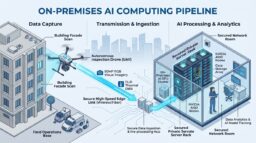
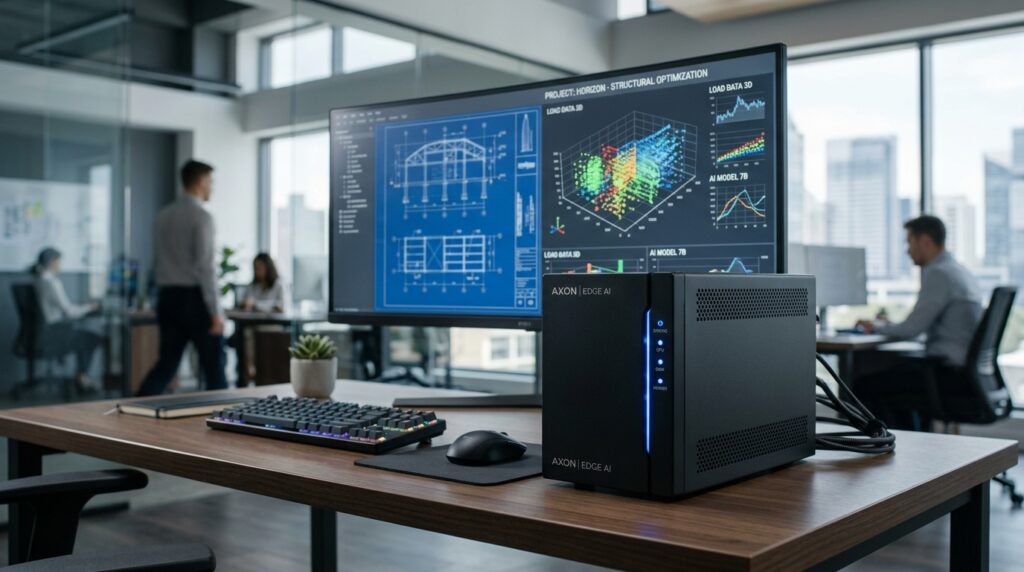
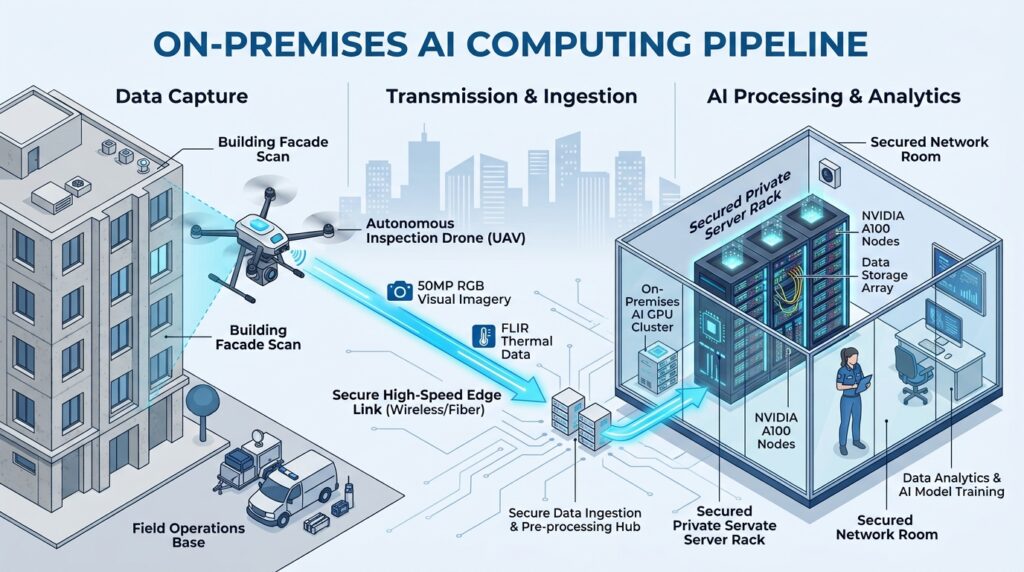
The Zanus AI platform addresses the data analysis bottleneck by deploying an on-premises private AI server (such as the Zanus AI Prime or Quantum systems) directly within the association’s office or data closet. Rather than processing sensitive building blueprints and imagery via public cloud models, it operates entirely inside the local firewall.
[Drone Imagery Payload]
       │
       ├──► 50MP RGB (Visual Spectrum Camera)
       └──► FLIR Radiometric Thermal (Infrared Data)
             │
             ▼
┌──────────────────────────────────────────────────────────┐
│ ZANUS AI ON-PREMISES SECURE SERVER                       │
│   ├──► CNN, Swin Transformer & ConvNeXt Engines          │
│   │     └───► Surface & Subsurface Crack Segmentation   │
│   └──► Vector Database & Local RAG System                │
│         └───► Georeferenced Structural Health Logs       │
└──────────────────────────────────────────────────────────┘
The Zanus AI platform addresses the data analysis bottleneck by deploying an on-premises private AI server directly within the association’s office. Crucially, while the core Zanus hardware operates as an enterprise LLM and document vector database, these specialized computer vision pipelines—including CNN, Swin Transformer, and U-Net crack segmentation—are deployed as an industry-specific property inspection inference module hosted directly on the local Zanus infrastructure.
The Physics of Subsurface Degradation
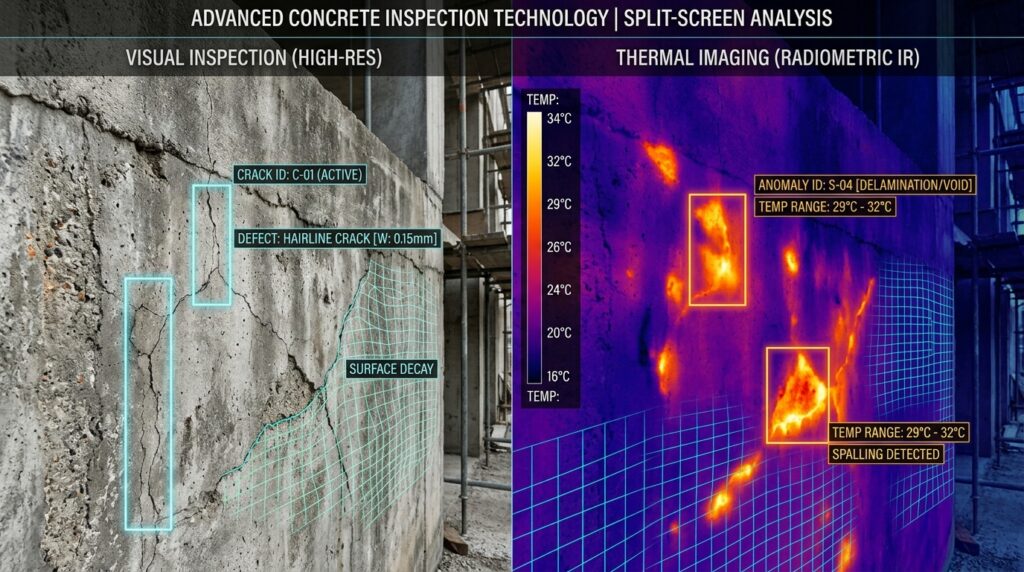
Concrete spalling is heavily driven by internal steel rebar corrosion. When saltwater and oxygen breach the envelope, the steel oxidizes and expands, exerting internal tensile pressure that causes subsurface delamination (internal air pockets parallel to the surface).
Zanus AI utilizes passive infrared thermography (IRT) to isolate these hidden anomalies. Solid concrete has a thermal conductivity ($k_{\text{concrete}}$) of approximately $1.6 \text{ W/mK}$, while air ($k_{\text{air}}$) is highly insulative at $0.024 \text{ W/mK}$.
$$\Delta k = k_{\text{concrete}} – k_{\text{air}} \approx 1.576 \text{ W/mK}$$
Because of this thermal delta, internal air voids trap heat at the surface during daytime solar cycles, appearing as “hot spots” on radiometric drone sensors. At night, these zones cool much quicker than the dense concrete core, appearing as “cold spots.”
Zanus AI coordinates specialized neural networks to interpret this data:
- Swin Transformer & ConvNeXt: Differentiates real structural cracks and subsurface delaminations from superficial surface stains, dirt, or shadows.
- YOLO Frameworks: Scans massive visual arrays to apply georeferenced bounding boxes over rust blooms, exposed rebar, and failing joints.
- U-Net & K-Net Segmentation: Executes pixel-level evaluation of fine structural cracks, mapping width and propagation history so engineers can track deterioration over time.
5-Year Financial Comparison: On-Premises AI vs. Cloud vs. DIY
Property managers must justify capital allocations to highly analytical HOA boards. The table below analyzes the five-year Total Cost of Ownership (TCO) for data processing strategies.
| TCO Cost Parameter (5-Year Cycle) | Zanus AI Prime Server (Turnkey) | Public Cloud AI (AWS + OpenAI APIs) | DIY Server (Consumer GPUs + Ollama) |
| Initial Capital Expenditure | $19,900 (Hardware + Core Software) | $0 (Subscription infrastructure model) | $12,000 (Consumer hardware assembly) |
| Token Surcharges & API Fees | $0 (Unlimited local execution) | $50,000 to $200,000+ (Based on data volume) | $0 |
| User Seat Licensing | $0 (Unlimited local accounts) | $36,000+ (Scale dependent) | $0 |
| Pipeline Setup & Dev Costs | $0 (Pre-built structural modules) | $100,000 to $500,000+ | $50,000 to $200,000+ |
| DevOps & IT Support | Included managed firmware updates | Continuous cloud maintenance | $8,000+ annually in consulting fees |
| 5-Year Cumulative TCO | Low, predictable one-time investment | $135,000 to $200,000+ | $35,000+ (High maintenance/failure risk) |
Operational Impact
- The Turnkey Advantage: Public cloud models charge variable fees for every gigabyte of 50MP imagery processed. Zanus AI operates as a flat-rate depreciable asset sitting on the association’s balance sheet, removing data processing caps and recurring overhead.
- The Privacy Barrier: Using public cloud models exposes highly sensitive structural data and resident layout imagery to third-party servers. Keeping the compute localized ensures total data sovereignty and eliminates recurring cloud subscriptions.
- DIY Risk: Assembling custom consumer graphics cards requires expensive specialized DevOps consultants, lacks error-correcting code (ECC) memory, and risks system downtime during critical compliance windows.

Final Recommendation: What to Do Next
Choose a manual scaffolding survey if: Your building is under three stories, lacks complex concrete envelopes, or your association currently lacks the initial five-figure capital reserves required to clear the $19,900 hardware CapEx threshold.
Choose an on-premises AI deployment (like Zanus AI) if: You manage mid-rise or high-rise communities, face immediate SB-4D or SIRS deadlines, want to eliminate recurring cloud processing fees, and need to build a permanent, secure digital log of structural health to avoid catastrophic insurance hikes.
Your Next Step
To move forward with board approval, property operations teams should request an engineered asset evaluation, download a 5-year TCO budgeting template, or evaluate hardware specifications through the official Zanus AI Pricing Catalog.
Your Next Step
Navigating the complexities of Florida SB-4D doesn’t have to break your association’s balance sheet. To move forward with board approval, your operations team needs accurate, un-hyped data.
For a complete breakdown of configuration models and lifetime commercial licensing options, explore the official Zanus AI Pricing & ROI Analysis. If you are still evaluating whether an on-premises physical server fits your property’s existing IT layout, check out our comprehensive Zanus AI Deep Review and our technical breakdown of the Zanus AI Hardware Infrastructure to see how an air-gapped system functions within a localized firewall.
Don’t let unexpected cloud token fees or compounding scaffolding costs drain your reserves—plan your transition to secure, automated structural intelligence today.
References
- Florida Legislature: Florida Statute 553.899 – Mandatory Building Milestone Inspections
- Zanus AI official site: Zanus AI Prime On-Premises Server Capabilities
- Building Mavens: Florida Milestone Inspection Guide: Deadlines and Costs
- MDPI Infrastructure Research: A Review of Infrared Thermography for Delamination Detection on Buildings
- Florida Department of Business and Professional Regulation (DBPR): Condominium and Cooperative Statutory Compliance Guidelines
- Taylor Forensics & Engineering: Structural Integrity Reserve Study (SIRS) 2026 Mandates