
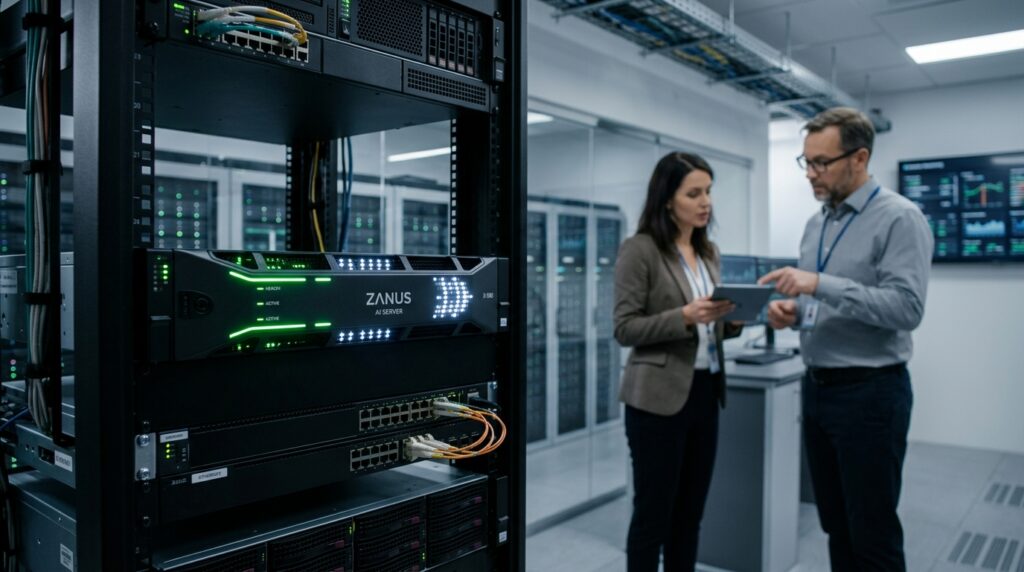
Evaluating zanus ai for business applications demonstrates that mid-market enterprises (MMEs) face a critical inflection point as they transition generative artificial intelligence (AI) initiatives from experimental pilots to production-level operational workflows. While cloud-hosted options offer rapid initial deployment, they introduce escalating financial unpredictability, severe operational dependencies, and systemic data sovereignty risks. This analysis evaluates the mathematical progression of cloud-tier AI cost scaling, details the technical risks of “API drift” and provider-enforced model deprecations, and formulates a capital-asset alternative using on-premises physical private AI systems.
The SaaS Seat Minimum Floor and Seat License Inflation
Enterprise generative AI procurement typically begins with SaaS-based conversational seat licensing, such as ChatGPT Enterprise or Claude Enterprise. For modern mid-market enterprises with precisely 100 active users, these models introduce immediate financial friction due to provider-enforced minimum seat caps and pricing tiers.
While a business-tier seat plan might cost $\$20$ to $\$25$ per user per month, it lacks critical enterprise-grade security protocols, single sign-on (SSO/SAML 2.0), automated user provisioning (SCIM), data residency controls, compliance logging, and administrative oversight. To secure data processing agreements and implement standard corporate identity and access management, the enterprise must transition to the Enterprise plan tier.
Cloud enterprise plans do not have public price lists, requiring custom negotiation. Across the procurement landscape, the standard cost of ChatGPT Enterprise or Claude Enterprise ranges from $\$60$ to $\$100$ per user per month, with two non-negotiable constraints: a 150-seat licensing minimum and a prepaid annual contract. Consequently, an MME with 100 users is forced to buy 150 seats to access the compliance, security, and administrative features required by internal governance policies. This mismatch generates “shelfware”—50 completely unallocated licenses representing a structural premium.
The baseline seat license calculation is defined as:
$$Cost_{Seats, annual} = L_{min} \times P_{seat} \times 12$$
Where:
- $L_{min}$ is the minimum seat requirement ($L_{min}=150$).
- $P_{seat}$ is the negotiated monthly price per seat ($P_{seat}=\$60$).
$$Cost_{Seats, annual} = 150 \times \$60 \times 12 = \$108,000 \text{ per year}$$
For a 100-user workforce, the effective per-user cost rises from the nominal $\$60$ rate to $\$90$ per month due to the 150-seat floor:
$$P_{effective} = \frac{\$108,000}{100 \times 12} = \$90 \text{ per user per month}$$
Furthermore, cloud vendors historically implement annual pricing inflation, often modeled at a conservative 10% year-over-year increment to account for model capability expansion (such as the transition from legacy reasoning models to frontier agentic architectures).
| Operational Year | Minimum Seat Cap | Monthly Price per Seat | Total Annual Seat Cost | Effective Per-User Monthly Rate (100 Users) |
| Year 1 | 150 | $60.00 | $108,000.00 | $90.00 |
| Year 2 (10% Inflation) | 150 | $66.00 | $118,800.00 | $99.00 |
| Year 3 (10% Inflation) | 150 | $72.60 | $130,680.00 | $108.90 |

This structured SaaS seat expense is purely administrative; it grants users access to the conversational interface but does not fund programmatic background automation, batch database processing, or external software integration, which are billed separately under consumption-based API token frameworks.
Mathematical Progression of Cloud AI Cost Scaling
To evaluate the operational financial profile of cloud-native AI, one must separate conversational chat interfaces from autonomous workflow automation. The latter relies on continuous API calls linked to customer relationship management (CRM) systems, enterprise resource planning (ERP) platforms, and custom vector search systems.
Multi-Turn Agentic Volume Projections
Consider a 100-user enterprise executing heavy internal workflow automation. The organization operates multiple agentic workflows handling automated operations (such as document ingestion, customer email triage, CRM cross-referencing, and automated contract drafting). This operational profile averages 2,000 completed runs per business day.
Because these systems are agentic rather than linear, each run does not consist of a single prompt. Instead, the autonomous agent executes a multi-turn reasoning loop, averaging 3 separate LLM API calls (steps) per workflow invocation to complete its sub-tasks.
- Input Context Density: Each step requires the model to ingest system instructions, conversation history, and high-density Retrieval-Augmented Generation (RAG) context retrieved from internal file shares. The average input payload is 8,000 tokens per step.
- Output Generation Density: The agent’s generated responses, structured data payloads (such as JSON objects for database writes), or draft documents average 800 tokens per step.
The enterprise utilizes a frontier model (such as the GPT-4o or Claude 3.5 Sonnet class) with a baseline price of $C_{in}=\$3.00$ per million input tokens and $C_{out}=\$15.00$ per million output tokens. While cloud providers offer prompt caching to reduce input costs on highly repetitive system instructions, real-world multi-tenant contexts with dynamic document retrieval limit the practical caching discount to an average of 30% off the total input token bill.
The mathematical formulation for standard daily token volume and operational API expenditure is as follows:
$$T_{in, daily} = W \times S \times T_{in}$$
$$T_{out, daily} = W \times S \times T_{out}$$
Where:
- $W=2,000$ (workflows per day).
- $S=3$ (agentic steps per workflow).
- $T_{in}=8,000$ (input tokens per step).
- $T_{out}=800$ (output tokens per step).
$$T_{in, daily} = 2,000 \times 3 \times 8,000 = 48,000,000 \text{ tokens per day}$$
$$T_{out, daily} = 2,000 \times 3 \times 800 = 4,800,000 \text{ tokens per day}$$
Applying the 30% prompt caching discount ($c=0.30$) to the input tokens, the daily cost ($Cost_{API, daily}$) is computed as:
$$Cost_{API, daily} = \left[\frac{T_{in, daily} \times (1-c)}{1,000,000} \times C_{in}\right] + \left[\frac{T_{out, daily}}{1,000,000} \times C_{out}\right]$$
$$Cost_{API, daily} = \left[\frac{48,000,000 \times 0.70}{1,000,000} \times \$3.00\right] + \left[\frac{4,800,000}{1,000,000} \times \$15.00\right]$$
$$Cost_{API, daily} = [33.6 \times \$3.00] + [4.8 \times \$15.00] = \$100.80 + \$72.00 = \$172.80 \text{ per business day}$$
Across a standard business month containing 22 business days, the baseline API operational cost is:
$$Cost_{API, monthly} = \$172.80 \times 22 = \$3,801.60 \text{ per month}$$
Over an annualized cycle of 250 business days:
$$Cost_{API, annual} = \$172.80 \times 250 = \$43,200.00 \text{ per year}$$
Unpredictable Monthly Billing and Token Runaway Analysis
The baseline API cost assumes nominal, error-free execution. However, autonomous agentic architectures introduce severe financial volatility due to “token runaway” events. A token runaway occurs when an autonomous agent enters an infinite, self-referential recursive loop (e.g., an agentic logic error where Tool A calls Tool B, which fails and invokes Tool A, or when a parsing error prevents the agent from recognizing a termination token).
In a cloud-hosted setup, these loops run unchecked over weekends or overnight, executing thousands of high-context API calls per minute until they hit hard platform spending limits.
The simulation models one standard token runaway incident per month. On average, this incident processes 12,000,000 input tokens and generates 3,000,000 verbose output tokens before administrative thresholds or timeouts terminate the process.
The monthly runaway cost premium ($Cost_{runaway, monthly}$) under baseline pricing is calculated as:
$$Cost_{runaway, monthly} = \left(\frac{12,000,000}{1,000,000} \times \$3.00\right) + \left(\frac{3,000,000}{1,000,000} \times \$15.00\right)$$
$$Cost_{runaway, monthly} = \$36.00 + \$45.00 = \$81.00 \text{ per incident}$$
Forced Model Migration and Generational Token Inflation
Cloud AI providers enforce short, rigid deprecation lifecycles on API endpoints. Older models are retired to consolidate infrastructure, forcing enterprises to migrate downstream codebases to newer, larger-scale foundation models.
In this simulation, the provider retires the baseline model in Month 13, forcing an unscheduled migration to a high-tier reasoning framework (such as the GPT-5.5 class). This transition changes the financial profile of the API operations:
- Forced Input Cost Inflation: Input token rates increase from $\$3.00$ to $\$5.00$ per million tokens.
- Forced Output Cost Inflation: Output token rates increase from $\$15.00$ to $\$30.00$ per million tokens.
The post-migration daily API cost ($Cost_{API, daily, post}$) is computed using these inflated rates:
$$Cost_{API, daily, post} = \left[\frac{48,000,000 \times 0.70}{1,000,000} \times \$5.00\right] + \left[\frac{4,800,000}{1,000,000} \times \$30.00\right]$$
$$Cost_{API, daily, post} = [33.6 \times \$5.00] + [4.8 \times \$30.00] = \$168.00 + \$144.00 = \$312.00 \text{ per business day}$$
This increases the monthly API run rate to:
$$Cost_{API, monthly, post} = \$312.00 \times 22 = \$6,864.00 \text{ per month}$$
Additionally, the token runaway premium scales under the inflated rates:
$$Cost_{runaway, monthly, post} = \left(\frac{12,000,000}{1,000,000} \times \$5.00\right) + \left(\frac{3,000,000}{1,000,000} \times \$30.00\right) = \$60.00 + \$90.00 = \$150.00 \text{ per incident}$$
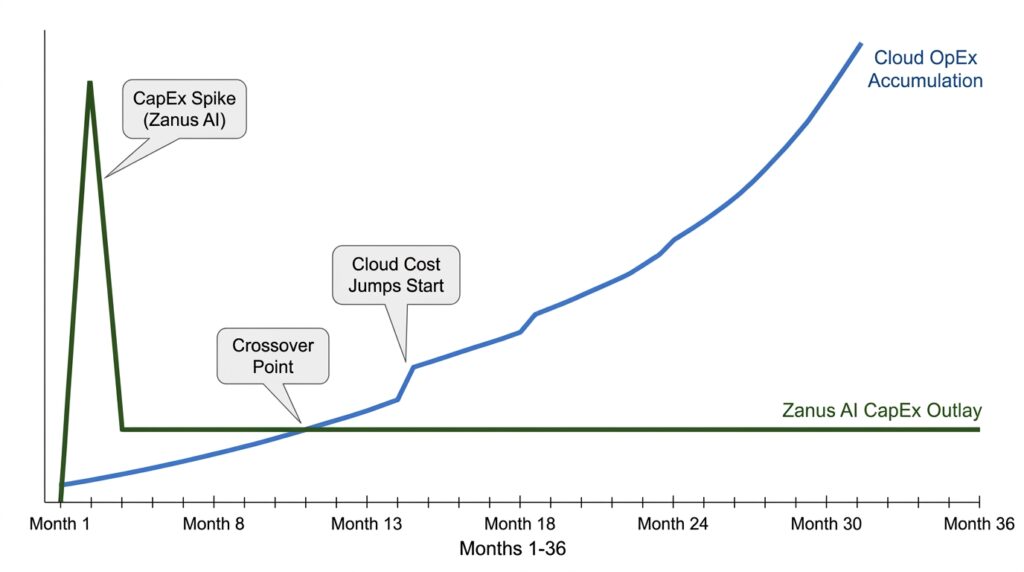
The table below tracks the cumulative financial profile of cloud-native AI across a 36-month horizon, mapping the combination of seat license inflation, standard API usage, and token runaway events.
| Month Range | Monthly Seat Cost | Monthly Standard API Cost | Monthly Runaway Cost | Total Monthly Cloud OpEx | Cumulative Cloud Cash Outlay |
| Month 1 | $6,000.00 | $3,801.60 | $81.00 | $9,882.60 | $9,882.60 |
| Month 6 | $6,000.00 | $3,801.60 | $81.00 | $9,882.60 | $59,295.60 |
| Month 12 | $6,000.00 | $3,801.60 | $81.00 | $9,882.60 | $118,591.20 |
| Month 13 (Forced Migration) | $6,600.00 | $6,864.00 | $150.00 | $13,614.00 | $132,205.20 |
| Month 18 | $6,600.00 | $6,864.00 | $150.00 | $13,614.00 | $200,275.20 |
| Month 24 | $6,600.00 | $6,864.00 | $150.00 | $13,614.00 | $281,959.20 |
| Month 36 | $7,260.00 | $6,864.00 | $150.00 | $14,274.00 | $453,247.20 |
Technical Risks of API Drift and Provider-Enforced Model Deprecations
Beyond direct token costs, cloud-based models introduce substantial engineering risks. These stem from “API drift” and unscheduled model updates enforced by external cloud providers.
The Lifecycle of Provider-Enforced Sunsets
Cloud-hosted AI models do not remain static. Providers operate on a rigid lifecycle model:
[ Active ] ---> [ Legacy ] ---> [ Deprecated ] ---> [ Retired ]
                                 (Shutdown Date)     (Returns 410 Gone)
- Active: Fully supported, receiving optimization and performance patches.
- Legacy: Runs standard inference but does not receive behavioral or security optimizations.
- Deprecated: Handed an official shutdown date, typically 6 months out for generally available (GA) models, 3 months for specialized variants, and as short as 2 weeks for preview models.
- Retired: The endpoint is physically shut down. Any application call to the endpoint returns an HTTP 410 Gone error, immediately breaking downstream operations.

Throughout 2026, major cloud providers have executed aggressive deprecation cycles. For example, in early 2026, multiple preview and flagship models were retired on short notice, converting optional software updates into mandatory, time-critical engineering tasks.
| Model Group / Endpoint | Deprecation Announcement | Hard Shutdown Date | Mandatory Replacement Path |
| gpt-4o-latest (legacy) | Late January 2026 | February 16, 2026 | gpt-4o-2024-08-06 |
| gpt-4-0314 / gpt-4-turbo-preview | Late 2025 | March 26, 2026 | gpt-4.1 |
| gpt-4.5 / o3 (ChatGPT Interface) | May 28, 2026 | June 27, 2026 (GPT-4.5) / August 26, 2026 (o3) | gpt-5.6-sol |
| gpt-4o-mini-audio-preview / gpt-5-chat-latest | Early 2026 | July 23, 2026 | gpt-realtime / o4-mini variants |
| gpt-3.5-turbo-0125 / o1-2024-12-17 | Mid 2026 | October 23, 2026 | o4-mini-2025-04-16 / gpt-4.1-nano |
| gpt-image-1-mini | Late 2026 | December 1, 2026 | gpt-image-2 |
Downstream Schema and Prompt Engineering Degradation
When a cloud provider deprecates an API endpoint, automated workflows are routed to the designated replacement model (e.g., fallback routing from a deprecated preview model to a newer production engine). This dynamic introduces “API drift”—behavioral changes in how the model interprets system prompts and structured data schemas, even when the code-level API signature remains identical.
These structural behavior shifts impact enterprise integrations in several key areas:
- JSON Schema Violations: Internal applications often parse LLM outputs into strictly typed JSON databases. When a model is updated, its tendency to output markdown block formatting (e.g., prefixing code blocks with “`json), altering field names, or incorrectly escaping characters can break downstream parsers, causing database transaction failures.
- Prompt Engineering Debt: Prompts optimized for one model do not transfer cleanly to next-generation architectures. A prompt engineered for precise structured classification on a legacy model may produce overly verbose responses on a newer model, leading to truncation, logic failures, or increased output token costs.
- System Trace Leakage: Updated models can bypass prompt-based guardrails. System instructions designed to keep responses strictly within organizational boundaries or prevent trace leakage can fail on updated weights, requiring comprehensive re-tuning.
To manage these frequent model updates, enterprise IT departments must run continuous regression testing, validation pipelines, and manual prompt re-tuning, which can consume significant engineering time for each model event.
Case Study: The Spring 2026 Claude Code Infrastructure Regression
The risks of product-layer and system-prompt adjustments by cloud vendors were illustrated during the March–April 2026 Claude Code infrastructure regression. Over a six-week period, enterprises utilizing the developer toolkit experienced a drop in reasoning capabilities, code-completion accuracy, and multi-file editing performance.
An official post-mortem traced the issues to three distinct, overlapping modifications made in the provider’s application and orchestration layers:
Total Quality Regression = Downgraded Reasoning Effort + Thinking History Clearing Bug + Verbosity Limit Injection

[ March 4 ]                       [ March 26 ]                       [ April 16 ]
Default Reasoning Effort Drops     Caching Bug Wipes History          Verbosity Cap Injected
(High -> Medium)                  (Cleared on every turn)            (≤25 and ≤100 words)
     |                                  |                                  |
     +----------------------------------+----------------------------------+---> [ Cumulative Quality Drop ]
- Reasoning Effort Downgrade (March 4 – April 7): To reduce latency and manage server load, the provider adjusted the default thinking budget for the model (Sonnet and Opus variants) from high to medium. This reduced the model’s analytical depth on complex, multi-file codebases.
- Thinking History Clearing Bug (March 26 – April 10): The provider introduced a performance optimization to clear older thinking history from sessions that had been idle for more than an hour. A bug in the implementation caused the session to clear this history on every turn. As a result, the model lost track of previous context within active, ongoing workflows, leading to repetitive or incorrect outputs.
- Verbosity Cap Injection (April 16 – April 20): To address high output token volume in verbose models, the provider’s orchestration layer injected strict instructions into the system prompt: “keep text between tool calls to ≤ 25 words; final responses ≤ 100 words unless more detail is required”. This restriction directly impacted the model’s ability to explain its reasoning step-by-step.
This case study demonstrates that even when the underlying model weights are stable, provider-controlled infrastructure, orchestration harnesses, and default parameters can introduce unexpected regressions into production environments.
Transforming OpEx into Depreciable CapEx: The Zanus AI Alternative
For mid-market enterprises looking to avoid the escalating costs, billing volatility, and operational dependencies of cloud-hosted systems, Zanus AI for business offers a highly secure, high-performance alternative. Rather than viewing enterprise AI as an endless operational expense, deploying an on-premises physical private AI server converts the technology stack into a stable, depreciable capital asset.
+---------------------------------------------------------------------------------+
|                                 ZANUS AI SERVER                                 |
|                                                                                 |
|  +-----------------------+  +-----------------------+  +---------------------+  |
|  |    Hardware Layer     |  |  Intelligence Layer   |  |   Software Layer    |  |
|  | * Enterprise GPUs     |  | * Pre-loaded LLMs     |  | * Zanus AI OS       |  |
|  | * RAID 10 NVMe        |  | * Deep Reasoning      |  | * 15+ Modules       |  |
|  | * Redundant Power     |  | * Local Vector Store  |  | * Integration APIs  |  |
|  +-----------------------+  +-----------------------+  +---------------------+  |
+---------------------------------------------------------------------------------+
                                         |
                               [ Local Network LAN ]
                                         |
                      +------------------+------------------+
                      |                                     |
             [ Unlimited Users ]                   [ Air-Gapped Operations ]
            (Zero Per-Seat Fees)                    (No Cloud Dependency)
By retaining all computation within the local area network, the enterprise gains the ability to run unlimited queries and process millions of dynamic files without incurring seat licensing adjustments, token transaction fees, or third-party performance risks.
Sizing and Physical Requirements of Enterprise-Grade Local AI
A common barrier to on-premises private AI adoption is the assumption that it requires industrial data center space, dedicated liquid cooling configurations, or high-voltage three-phase electricity. The Zanus AI server family solves this infrastructure bottleneck by remaining fully compatible with standard corporate environments.
| Infrastructure Spec | Zanus AI Prime (Deep Reasoning) | Zanus AI Quantum (Extended Deep Reasoning) |
| Form Factor | Rack-mount or desktop chassis | Rack-mount or desktop chassis |
| GPU Architecture | Integrated Enterprise GPUs | Enhanced Enterprise GPUs |
| Document Storage Capacity | 2M+ docs on NVMe RAID 10 (mirrored) | 5M+ docs on NVMe RAID 10 (mirrored) |
| Power Infrastructure | Auto-ranging 90–240V, 50/60 Hz | Auto-ranging 90–240V, 50/60 Hz |
| Circuits Required | 4× Standard AC circuits (NEMA 5-15/5-20) | 4× Standard AC circuits (NEMA 5-15/5-20) |
| Power Consumption | Peak: 6 kW / Idle: ~1 kW | Peak: 6 kW / Idle: ~1 kW |
| Cooling Architecture | Patented Air-Cooled system (no liquid) | Patented Air-Cooled system (no liquid) |
| Environmental Target | Standard office closet / climate control | Standard office closet / climate control |
| Acoustic Profile | Whisper-Quiet | Whisper-Quiet |
These turn-key appliances plug directly into standard commercial wall outlets without requiring costly facility re-wiring, rendering them immediately deployable within a typical IT storage room, server closet, or administrative back office.
Regulatory and Accounting Frameworks (US GAAP & Corporate Finance)
Transitioning to an on-premises physical appliance reshapes the balance sheet by establishing complete structural control over AI spending under standard accounting frameworks:
- US GAAP ASC 360 (Property, Plant, and Equipment): The physical server housing the enterprise hardware assets is capitalized at cost and depreciated over its estimated useful life (typically 3 to 5 years) using standard straight-line methods to ensure linear expenses.
- US GAAP ASC 350-40 (Internal-Use Software): Core software modules, pre-installed language models, and local operating systems acquired alongside a turnkey appliance are capitalized as integrated intangible assets, eliminating variable recurring software fees.
- Tax Optimization & Shielding: Depending on localized corporate tax incentives for advanced digital infrastructure, enterprises deploying physical private systems can leverage accelerated or immediate first-year equipment depreciation write-offs. This mechanism lowers the effective net cost of the hardware in Year 1, strengthening cash position and accelerating return on investment.
Financial Sizing and Break-Even Formulation
To evaluate the financial trade-offs, we can model an on-premises deployment using a Zanus AI Quantum-class system:
- Initial CapEx: $\$65,000.00$ hardware/software purchase price plus a $\$5,000.00$ one-time professional services fee for network configuration and API integrations, totaling $\$70,000.00$.
- Continuous Power Expense: The system consumes a continuous average load of 2.5 kW. At a commercial electricity rate of $\$0.15$ per kWh:$$\text{Monthly Power Cost} = 2.5 \text{ kW} \times 24 \text{ hours} \times 30 \text{ days} \times \$0.15/\text{kWh} = \$270.00 \text{ per month}$$
- Maintenance & Support Expense: Year 1 is fully covered under the manufacturer’s warranty. Years 2 and 3 include an annual maintenance contract priced at 15% of the original server CapEx, which translates to:$$\text{Monthly Maintenance (Y2-Y3)} = \frac{\$65,000.00 \times 0.15}{12} = \$812.50 \text{ per month}$$
- Accounting Book Expense (Income Statement Impact): Using straight-line depreciation over a 36-month useful life, the monthly book depreciation is $\$1,944.44$ ($\$70,000.00 / 36$). Combined with monthly operational costs, the GAAP book expense hitting the income statement is:
- Months 1–12: $\$1,944.44 \text{ (Depreciation)} + \$270.00 \text{ (Power)} = \$2,214.44 \text{ per month}$
- Months 13–36: $\$1,944.44 \text{ (Depr.)} + \$270.00 \text{ (Power)} + \$812.50 \text{ (Maint.)} = \$3,026.94 \text{ per month}$
The table below compares the cash flow dynamics of Cloud AI and On-Premises deployment across key monthly milestones over a 3-year period.
| Month | Cloud Monthly OpEx | Cumulative Cloud Cash | On-Prem CapEx Outflow | On-Prem Monthly OpEx | Cumulative On-Prem Cash | Cumulative On-Prem Book Expense |
| Month 1 | $9,882.60 | $9,882.60 | $70,000.00 | $270.00 | $70,270.00 | $2,214.44 |
| Month 6 | $9,882.60 | $59,295.60 | $0.00 | $270.00 | $71,620.00 | $13,286.67 |
| Month 8 (Break-Even) | $9,882.60 | $79,060.80 | $0.00 | $270.00 | $72,160.00 | $17,715.56 |
| Month 12 | $9,882.60 | $118,591.20 | $0.00 | $270.00 | $73,240.00 | $26,573.33 |
| Month 13 | $13,614.00 | $132,205.20 | $0.00 | $1,082.50 | $74,322.50 | $29,600.28 |
| Month 24 | $13,614.00 | $281,959.20 | $0.00 | $1,082.50 | $86,230.00 | $62,896.67 |
| Month 36 | $14,274.00 | $453,247.20 | $0.00 | $1,082.50 | $99,220.00 | $99,220.00 |
Breakdown of Financial Indicators
- Cash Break-Even Horizon: On a cash basis, the on-premises private system achieves break-even in Month 8. At this point, cumulative cloud spend ($\$79,060.80$) surpasses cumulative on-premises cash outflow ($\$72,160.00$), offering rapid investment validation for corporate finance stakeholders.
- Three-Year Net Cash Savings: Over 36 months, the total cloud cash outlay is $\$453,247.20$ compared to $\$99,220.00$ for the on-premises alternative, yielding massive cash retention:$$\text{Net Cash Savings} = \$453,247.20 – \$99,220.00 = \$354,027.20$$
- Tax Shield Benefits: Capitalizing on first-year accelerated tech depreciation provides immediate asset deductions, which drastically mitigates the initial capital outlays and shortens the real-world operational return timeline.
Editor’s Strategic Recommendations
The financial and operational data reveals that while cloud-tier generative AI provides a low barrier to entry for early testing, it introduces systemic scaling friction for enterprises looking to expand automation. The constant cycle of API deprecations, paired with the structural premium of forced seat mínimo plans, converts cloud architecture into an ongoing engineering maintenance burden.
For mid-market enterprises looking to solidify production workflows, deploying Zanus AI for business offers a highly predictable, sovereign path forward. It successfully transforms volatile operational expenses into a stable capital asset, protects against external API updates, and preserves total data autonomy.
Enterprise decision-makers should adopt the following implementation strategies:
- Prioritize Turnkey Deployments Over DIY Custom Builds: Avoid allocating excessive internal engineering resources, driver debugging time, and maintenance overhead toward building custom GPU servers. Opting for an integrated appliance ensures rapid time-to-value with zero internal IT development strain.
- Migrate High-Volume Base Workloads Cautiously to Local Private Infrastructure: Keep core, high-frequency automations (such as continuous CRM synchronization, high-density document processing, and background email triaging) on local private hardware to structurally eliminate token consumption billing.
- Engage Financial Teams to Leverage Technology Capitalization: Utilize ASC 350-40 guidelines and localized first-year tax write-offs to optimize equipment purchases on the corporate balance sheet, unlocking immediate cash flow advantages.
- Insulate Mission-Critical Prompts and Logic from API Drift: Relying on private open-weights models running under local parameters guarantees that workflow execution remains stable, immune to forced deprecation timelines and sudden performance adjustments by cloud vendors.
Your Next Step
Eliminating unpredictable token usage bills and stabilizing your downstream agentic schemas requires an intentional shift toward hardware-level software control. To successfully draft your enterprise procurement framework and present a clear capital asset allocation plan to your executive board, we recommend leveraging our complete technical cluster:
- Technical Capacity Evaluation: Contrast the processing density and memory thresholds of the server tiers by exploring Zanus AI Prime vs Quantum.
- Infrastructure Component Map: Read our comprehensive deep-dive into physical server room engineering requirements at the Zanus AI Hardware Infrastructure.
- Operational Systems Review: Discover how the pre-loaded software engine drives automated internal parsing tools via the Zanus AI Deep Review.
- Spatial Data Applications: For a detailed structural look at how edge-AI infrastructure handles heavy multi-stream telemetry under regional statutes, see our manual on minimizing the Florida SB-4D inspection cost.
Don’t let forced model deprecation deadlines or inflation-driven cloud seat minimum floors drain your corporate cash reserves—audit your internal token pipelines and deploy your turnkey sovereign server today.
If you are scaling your enterprise AI deployment and need robust, high-bandwidth bare-metal hosting without exorbitant cloud egress fees, check out our in-depth NovoServe Review and our NovoServe vs Hetzner Comparison to find the right server specs for your budget. Additionally, if your team manages multi-language workflows or cross-border project documentation, read our hands-on Palabra AI Review and Palabra AI vs Lokalise Breakdown to learn how automated AI localization can streamline your content pipeline.
References
- Zanus AI. “Private AI Servers & On-Premise GPU Systems – Zanus AI Overview.” https://zanusai.com
- OpenAI API Reference. “Deprecations and Upcoming Model Shutdowns Protocol (2026).” https://developers.openai.com
- Anthropic Claude Platform Documentation. “API Pricing, Prompt Caching Token Rates, and Architecture Specifications.” https://platform.claude.com
- Financial Accounting Standards Board (FASB). “ASC 350-40: Internal-Use Software Cost Capitalization and Software Development Cloud Guidelines.” https://kpmg.com
- Section 179 Org. “2026 Section 179 Tax Deduction Limits, Technology Equipment Qualifications, and Phase-Out Rules.” https://section179.org
- Cornell University arXiv. “From Prompts to Contracts: Harness Engineering for Auditable Enterprise LLM Agents.” https://arxiv.org