
1. Introduction: The 2026 SaaS Globalization Imperative
Welcome to our comprehensive Palabra.ai Review. If your SaaS product has reached stable Product-Market Fit (PMF) domestically, but your Monthly Recurring Revenue (MRR) growth is hitting a plateau, the problem likely isn’t your features—it’s your language barrier.
Entering 2026, software localization has transitioned from a “nice-to-have” marketing tactic to a fundamental core growth lever. Expanding into non-English markets yields undeniable economic returns: fully localized platforms achieve a 25% to 65% improvement in trial-to-paid conversion rates, a 20% to 45% increase in customer lifetime value (LTV), and up to a 40% reduction in churn within international cohorts.
However, capturing these returns through legacy frameworks presents severe obstacles. This post provides a strategic executive review of Palabra.ai, a next-generation AI-powered dynamic localization platform, and compares it against traditional file-based Translation Management Systems (TMS) and human agencies.
2. Architectural Bottlenecks and The Hidden “i18n Debt”
Most SaaS teams treat localization as a reactive, post-onboarding task. This approach creates compounding technical neglect known as Internationalization (i18n) decay.
Before choosing a tool, leadership must understand the three architectural bottlenecks that tank international rollouts:
Engineering Debt and i18n Decoupling
High-velocity engineering teams routinely hardcode text strings directly into frontend components. When global expansion is retroactively introduced, it triggers substantial technical debt. Developers must manually scan codebases, isolate source strings into structured resource files (JSON, YAML), and maintain divergent feature branches during translation cycles. Delaying i18n inflates ongoing localization expenses by 60% to 80% due to extensive code refactoring.
User Interface Breakage and Spatial Dynamics
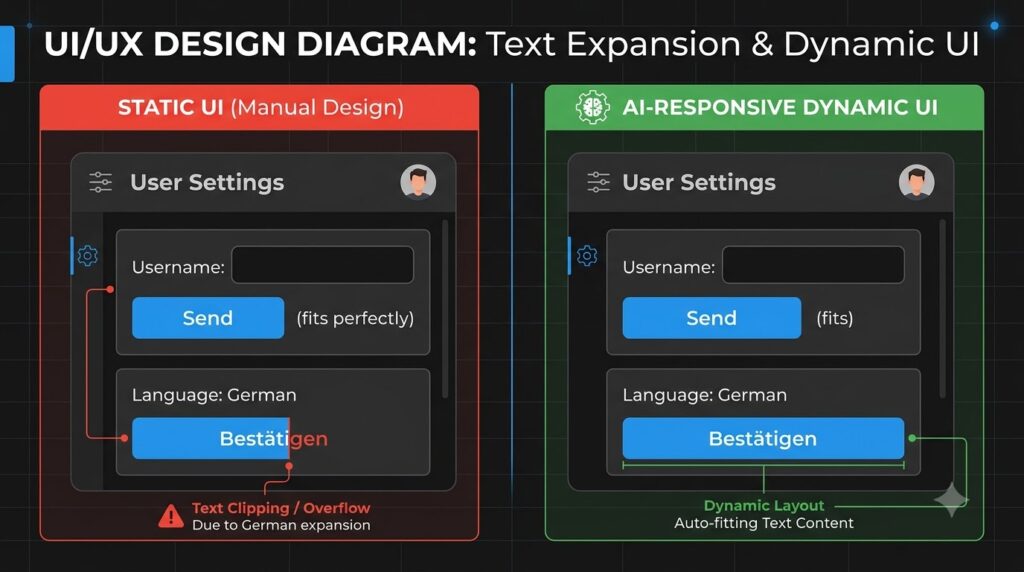
Moving from concise source English into languages such as German or Finnish causes text expansion of 30% to 40%. Without responsive, context-aware design, string expansion results in truncated text, broken flexbox arrangements, and overlapping UI controls. Furthermore, expanding into Right-to-Left (RTL) scripts like Arabic or Hebrew requires complete layout mirroring—a process that regularly fails in legacy architectures.
Operational Friction and Query Latency
External human translators working on isolated string keys lack visual understanding. Resolving ambiguities requires constant back-and-forth context queries. Enterprise tracking shows that resolving a single contextual query takes an average of 45 minutes of combined staff time. Across hundreds of new strings per release, this consumes engineering capacity and delays global software rollouts by weeks.
[ 🚀 Try Palabra.ai for Free ]
3. Paradigm Shift: Traditional TMS vs. AI-Powered Dynamic Platforms
The software localization technology stack is undergoing a structural shift. Legacy TMS platforms—including Lokalise, Crowdin, and Phrase—were designed as static database hubs to manage string-file synchronization between code repositories and human linguists. While useful, they remain bound to file-based workflows and batched pull requests.
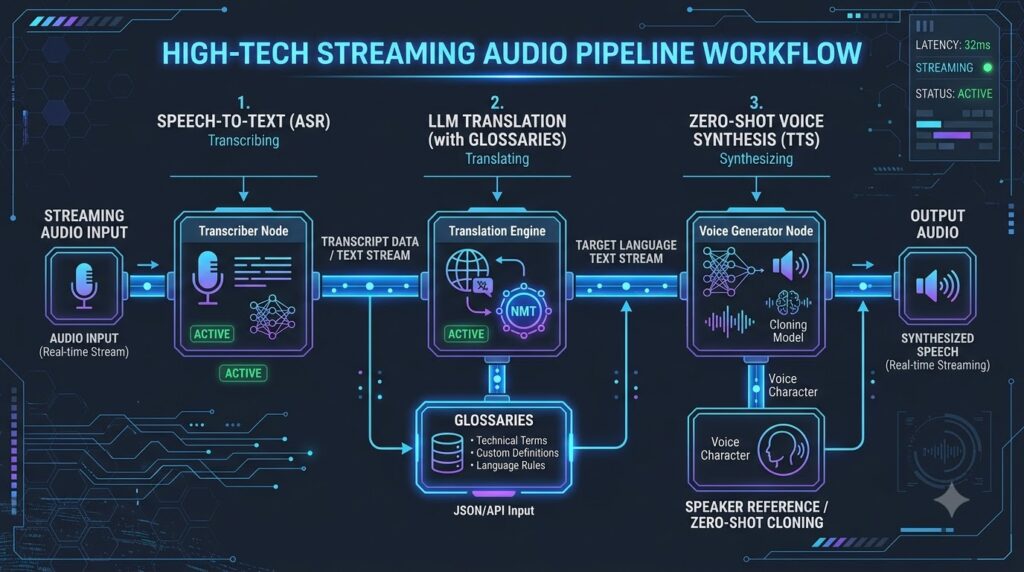
In contrast, Palabra.ai represents an AI-native shift to dynamic stream processing. Built on artificial intelligence models, it unites automated speech recognition (ASR), context-aware machine translation (MT), zero-shot neural voice synthesis, and real-time streaming protocols (WebSockets and WebRTC) into a single processing pipeline.
| Architectural Dimension | Traditional TMS (Lokalise, Crowdin, Phrase) | AI-Powered Dynamic Platform (Palabra.ai) | Strategic Impact on SaaS Operations |
| Core Architecture | File-based string management via repository sync connectors. | Real-time AI streaming pipeline utilizing WebSockets and WebRTC. | Eliminates manual file transfers, branch management, and pull requests. |
| Turnaround Velocity | 2 to 3 weeks for full agency translation and post-editing. | Sub-second real-time global translation (<1000 ms). | Aligns localization directly with daily agile release cycles (CI/CD). |
| Contextual Intelligence | Static Translation Memory (TM) and glossaries. | Predictive AI context engine with dynamic glossary injection. | Eliminates context queries; prevents terminology errors. |
| Multimodal Support | Text-only string resource file processing. | Unified Speech-to-Speech (S2S), Speech-to-Text (STT), and voice cloning. | Supports voice, video, and software translation within one API. |
| Data Security | Persistent database storage of strings. | Zero Data Retention (ZDR); memory-only stream processing. | Complies with GDPR without storing sensitive user data. |
[ 💰 Calculate Your SaaS Savings with Palabra.ai ]
4. Comprehensive Review Breakdown of Palabra.ai
Palabra.ai is an enterprise-grade AI speech and audio localization platform built for application developers, virtual meeting ecosystems, media broadcasters, and global contact centers. It consolidates the full localization stack into a unified, streaming API pipeline.
Technical Architecture and Security
Instead of chaining independent third-party providers (which increases cumulative latency), Palabra.ai operates dedicated, proprietary translation models specifically for live interaction.
- Low-Latency Infrastructure: Leverages WebSockets and WebRTC to maintain end-to-end voice translation latency below 1 second.
- Zero Data Retention (ZDR): Under a strict ZDR policy, audio streams and transcripts are processed entirely in volatile memory and discarded immediately post-session, complying with GDPR and ISO 27001 requirements.
- Deployment Flexibility: Supports public cloud clusters, private server deployment in target regions to minimize network latency, and self-hosted on-premises installations for regulated industries.
Functional Capabilities
- 60+ Language Engine: Coverage across major global languages and regional variants (e.g., Mexican vs. European Spanish).
- Zero-Shot Voice Cloning: Replicates a speaker’s voice profile, tone, and delivery cadence in target languages without prior model training.
- Automated QA & Layout Protection: AI automatically calculates character dynamics to prevent UI layout truncation or overflow while protecting source code variables.
- Multi-Speaker Diarization: Automatically isolates multiple voices in meeting environments and handles mid-sentence language switching.
5. Performance Metrics: Quantifying Manual vs. Palabra.ai Workflows
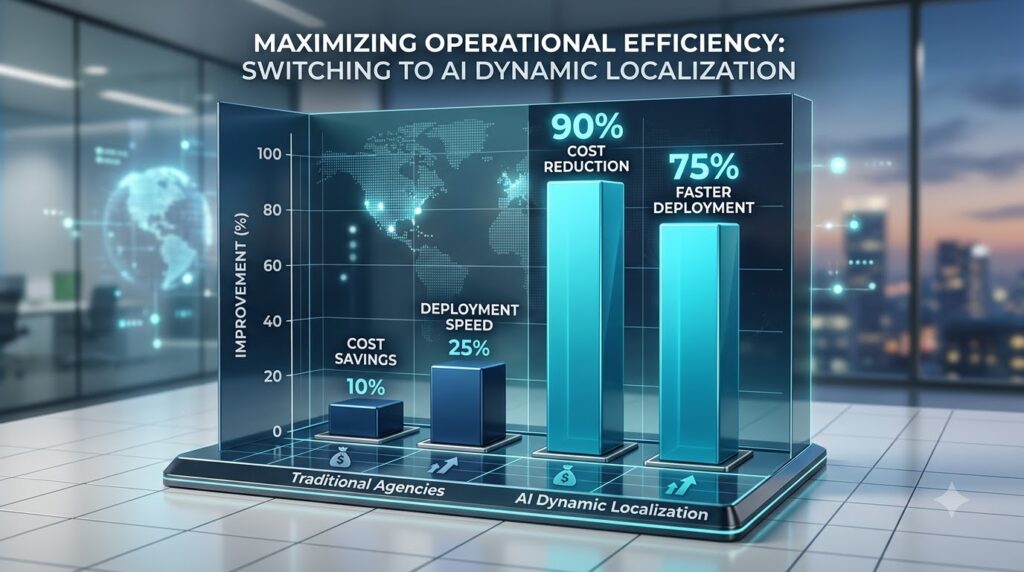
Replacing manual engineering effort and asynchronous human agencies with AI automation delivers undeniable operational returns. Automated continuous localization reduces time-to-market by 75%.
While human linguists cost between $0.12 and $0.25 per word, AI API primitives drive unit costs down significantly. When applied to live audio streams and contact centers, AI systems yield up to 90% cost savings compared to traditional human interpreter services.
| Performance Metric | Legacy Human Agency Model | Hybrid TMS Model (e.g., Crowdin/Lokalise) | AI-Automated Platform (e.g., Palabra.ai) | Business Impact |
| Time-to-Market | 14 to 21 days per release cycle. | 3 to 5 days per feature release. | Real-time / Instantaneous deployment. | 75% faster velocity; keeps international releases synchronized. |
| Unit Cost | $0.12 – $0.25 per word. | TMS License + ~$0.07/word post-editing. | $0.04 / min (S2S) or $0.03 / 1k chars (TTS). | 40% to 60% savings (text); up to 90% savings (voice/live). |
| Engineering Overhead | 15–20 developer hours/month. | 3–5 developer hours/month maintaining connectors. | Near-zero developer maintenance. | 90% reduction in dev overhead, redirecting capacity to features. |
| Conversion Uplift | Baseline. | +15% to +30% lift. | +25% to +65% trial-to-paid lift. | Maximizes top-of-funnel customer acquisition efficiency. |
[ 🌍 Start Localizing Your SaaS globally for Free with Palabra.ai ]
6. Quickstart Guide: Integrating Palabra.ai in 3 Steps
Under a modern API-driven model, technical integration is minimal. Palabra.ai offers client SDKs for JavaScript and Python.
Step 1: Initialize the SDK
New accounts receive $50 in API testing credits. Retrieve your API key from the dashboard.
Bash
npm install @palabra-ai/translator
Step 2: Configure Business Context
Upload your Custom Business Glossaries and terminology term lists. This is critical to ensure AI translation engines handle proprietary brand names, technical jargon, and feature terminology correctly without needing human review.
Step 3: Start Real-Time Streaming
Leverage WebSockets for sub-second text or speech processing.
Python
# Real-Time Speech-to-Speech Translation with Python
from palabra_api import PalabraClient

client = PalabraClient(api_key="YOUR_API_KEY")

# Start audio stream with predictive context engine active
stream = client.s2s.stream(source_lang="en", target_lang="es")

for audio_chunk in mic_input:
    stream.send(audio_chunk)
    translated_audio = stream.receive() # Sub-second latency output
7. Final Recommendation
SaaS leadership teams planning 2026 international expansion must adjust their operational approach to capitalize on modern AI infrastructure:
- Choose Human Agencies if: You require heavily regulated legal documentation, contracts with legal certification, or content that rarely changes and has massive budget tolerance.
- Choose Hybrid TMS (Lokalise/Crowdin) if: Your organization already possesses a heavily human-dependent translation pipeline with a large team of in-house translators and rigid internal processes that prohibit automation.
- Choose Palabra.ai if: You are a B2B SaaS Founder, Tech Lead, or Product Manager looking to scale globally at maximum velocity, automate your entire i18n pipeline, eliminate unnecessary engineering overhead, and maximize international MRR conversion rates.
Trì hoãn việc bản địa hóa hoặc tiếp tục chi trả cho từng từ dịch thuật thủ công đồng nghĩa với việc doanh nghiệp đang tự làm chậm tốc độ tăng trưởng trên thị trường toàn cầu.
[ 🚀 Try Palabra.ai for Free & Claim $50 API Credit ]
💡 Related Reading: If you are currently evaluating legacy localization tools or considering switching from traditional management systems, check out our in-depth comparison: Palabra.ai vs. Lokalise: Which Localization Tool is Right for Your SaaS in 2026?
References
- Phrase Official Documentation. The Complete Guide to Software Localization
- Crowdin Blog. SaaS Localization: How to Translate Software in 2026
- Lokalise Official Portal. Lokalise Pricing & Feature Comparison
- Palabra.ai Documentation. Real-Time AI Translator for Software & Live Audio Integration
- Capterra Software Reviews. Palabra.ai Profile, Features & Enterprise Pricing Overview