
Deploying zanus ai for real estate and property management operations demonstrates that most large-scale enterprises do not need another software-as-a-service (SaaS) cloud application.. What they require is a secure mechanism to automate core operational workflows without exposing sensitive tenant financial records, commercial lease covenants, or asset underwriting reports to the public internet.
Zanus AI enters the market to address this specific infrastructure challenge. Rather than offering a typical cloud-based application, it delivers an all-in-one private AI system that runs entirely on-premises. The architecture combines dedicated physical hardware, localized large language models (local LLMs), and a self-contained internal database infrastructure. By processing data behind the corporate firewall instead of routing it through third-party cloud APIs like ChatGPT or Microsoft Copilot, the platform targets enterprise owners, Chief Operating Officers (COOs), and Chief Technology Officers (CTOs) in real estate who demand artificial intelligence capabilities but cannot accept cloud-related security liabilities.
Product Overview
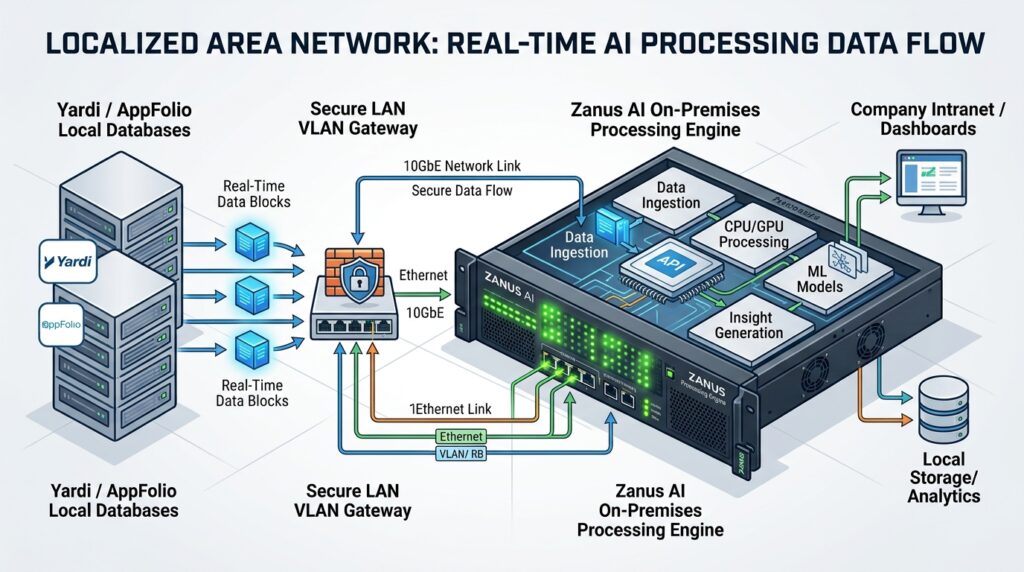
Zanus AI bypasses the traditional SaaS framework entirely, deploying as a physical, localized infrastructure stack pre-integrated with over 15 functional machine learning models. Within a national corporate property management ecosystem, this system functions as a centralized on-premises processing engine, connecting directly to legacy Enterprise Resource Planning (ERP) and Customer Relationship Management (CRM) databases—such as Yardi Voyager, AppFolio, or SAP—via secure virtual local area networks (vLANs).
When deployed within property management operations, the system automates three baseline workflows:
- Structured Lease Abstraction: Automatically parses thousands of dense commercial lease agreements to extract penalty clauses, renewal options, and indexation parameters without requiring external network connectivity.
- Localized Maintenance & Operations Routing: Processes tenant maintenance tickets, automates technician dispatch scheduling, and categorizes resident communication through local network gateways.
- Underwriting & Cash Flow Synthesis: Assists acquisitions and financial modeling teams by scanning raw operating statements to extract unstructured financial parameters, minimizing manual data entry into Excel or Argus models.
Editorial Observation: The system shifts the focus away from theoretical machine learning parameters toward direct operational yield, converting multi-page unstructured documents into verifiable data structures that can be written back to core databases.
Best For
- Large-Scale Commercial and Residential Real Estate Enterprises: Organizations managing portfolios spanning thousands of units where tenant financial data and corporate underwriting records are subject to strict data privacy compliance standards.
- Operations Teams Seeking Long-Term ROI Predictability: Enterprises looking to eliminate recurring per-user licensing fees or escalating cloud consumption costs as their operational headcount expands.
- Infrastructure Teams Hindered by Network Latency: Technology divisions requiring high-throughput document processing and automated scheduling without relying on the availability or latency of external internet pipelines.
Zanus AI for Real Estate & Property Management: Architecture Metrics
To evaluate how an on-premises deployment restructures technology infrastructure compared to standard cloud-based alternatives, consider the functional metrics below:
| Evaluation Metric | Cloud-Based AI Platforms | Zanus AI On-Premises Architecture |
| Cost Infrastructure | Recurring monthly subscription + Per-user scaling fees | Predictable upfront capital expenditure; $0 ongoing licensing fees |
| Data Governance | Dependent on third-party cloud multi-tenancy and API data policies | Absolute local data sovereignty over all vector databases and model weights |
| Data Leakage Risk | Moderate to High (Data traverses public internet gateways) | Zero network leakage (Operates entirely behind localized corporate firewalls) |
| ERP Integration Path | Cloud API Gateways (Requires opening external firewall inbound ports) | Direct read-only database replication (SQL Change Data Capture via LAN) |
| Processing Latency | Variable (Dependent on public web bandwidth and cloud queue congestion) | Sub-millisecond prefill and decode processing via localized GPU memory bus |
| Scalability Overhead | Scales linearly based on prompt token volume and seat count | Fixed operational footprint regardless of user volume or query density |
Key Strengths
1. Absolute Data Sovereignty and Localized Network Protection
The core architectural advantage of this platform is the complete elimination of regulatory compliance liabilities. When processing sensitive resident credit files or confidential commercial financial covenants, routing data to external cloud clusters introduces severe legal exposure. Localized processing removes this vulnerability by ensuring that every query vector and source PDF remains within the physical server memory infrastructure.
2. Predictable Cost Structure for High-Volume Pipelines
The platform avoids the compounding cost structures typical of enterprise SaaS models. By requiring only an initial infrastructure deployment expenditure, a corporation can expand its property portfolio from 1,000 to 10,000 units or increase active user endpoints without incurring escalating subscription or API token fees.
3. Structural Accuracy via Layout-Aware RAG Pipelines
Standard token-sliced chunking methods often destroy the structural context of complex legal documents by breaking paragraphs apart arbitrarily. The platform implements layout-aware parsing algorithms that preserve document geometry. When scanning enterprise lease documents containing nested financial tables and complex legal sections, the architecture retains document hierarchies, driving up retrieval accuracy for specialized legal queries.

Technical Limitations & Infrastructure Trade-offs
No enterprise architecture is free of engineering trade-offs. Deploying an on-premises stack introduces specific physical and operational requirements that enterprise technology leaders must assess:
- High Initial Capital Expenditure (CapEx): Bypassing monthly cloud software bills requires a substantial upfront investment in specialized enterprise hardware, including high-performance GPU nodes such as the NVIDIA H100 or RTX 6000 Ada architectures.
- Internal Hardware Lifecycle Management: Because the system lives within the enterprise data center or local corporate office, internal IT personnel must manage physical server health, cooling capacity, power delivery redundancies, and on-site physical security.
- Rigid Upstream Data Prerequisites: The inference engine relies heavily on the quality of the source data. The platform requires a structured data engineering phase to establish clean Change Data Capture (CDC) replication pipelines from primary ERP systems like Yardi or AppFolio into a read-only local PostgreSQL instance.
Implementation Pricing Models
Zanus AI does not utilize a public, fixed-rate pricing sheet and rejects traditional monthly software subscription fees. Total cost of ownership is calculated on a custom basis depending on corporate infrastructure scale:
- Cost Composition: Quotes are bundled to reflect specialized GPU server hardware provisioning, perpetual core software licensing, and specialized data engineering services required to build the initial local ERP integrations.
- Editor’s Note: Determining an accurate budget requires an internal audit of overall data volume and average daily document processing requirements. Technical architects map this compute load to specific hardware configurations to determine the exact GPU count required to sustain targeted token throughput.
Editor’s Take
If an enterprise manages a high-value real estate portfolio, routinely evaluates complex commercial lease structures, and operates under strict security or regulatory parameters, then migrating toward an on-premises framework like Zanus AI represents a viable long-term infrastructure strategy, because it fully isolates proprietary business operations from external web vulnerabilities while insulating the enterprise from the volatile subscription pricing models of mainstream cloud providers.

Enterprise Alternatives
Infrastructure architects evaluating their automation roadmaps should consider alternative deployment strategies:
- V7 Labs (AI Real Estate Agents): A strong alternative for acquisitions and investment analysis teams that require specialized cloud-based agents to parse rent rolls and push financial indicators directly into Argus or Excel models, provided their corporate risk profile permits highly secure cloud processing.
- In-House Sovereign RAG Development (PostgreSQL + pgvector + vLLM): A viable path for organizations with established data science divisions. Enterprises can procure bare-metal GPU nodes directly, implement pgvector 0.8.0 iterative index scanning to manage overfiltering, and configure database-level Row-Level Security (RLS) to restrict access between regional managers and front-desk personnel without buying a prepackaged platform.
Final Verdict
Zanus AI is not designed for small-scale real estate operations. For property management firms handling localized portfolios of a few dozen units, the capital expenditure and physical infrastructure management required by an on-premises GPU stack will outweigh the operational advantages.
However, for national real estate corporations prioritizing absolute data privacy, zero internet reliance, and high-volume document automation without variable computing costs, an on-premises system represents a robust deployment model.
The most practical next step for operational leaders is to conduct an internal audit of monthly document processing volume and arrange a localized Proof of Concept (PoC) using an isolated segment of their active lease database.
Your Next Step
Securing your portfolio’s underlying intelligence and safeguarding commercial lease structures from multi-tenant data harvesting requires a deliberate shift toward hardware-level isolation. To successfully map your enterprise deployment strategy and draft a precise asset procurement presentation for your executive board, we recommend leveraging our comprehensive technical cluster:
- Computation Scale Analysis: Evaluate the exact memory limits and GPU processing thresholds required for your document ingestion volumes by reading Zanus AI Prime vs Quantum.
- Hardware Component Matrix: Audit your local data center infrastructure specs, electrical draw, and office closet thermal allocations via the Zanus AI Hardware Infrastructure.
- Platform Core Review: Discover how the integrated local operating system orchestrates pre-loaded automation tools by diving into the Zanus AI Deep Review.
- Civilian Asset Applications: For a detailed engineering blueprint on how localized visual compute layers handle complex multi-stream inspection profiles under regional statutes, see our technical breakdown on minimizing the Florida SB-4D inspection cost.
Don’t let variable public cloud subscription inflation or unmonitored WAN data leaks compromise your corporate assets—audit your pipeline dependencies and deploy your turnkey sovereign network today.
References
- Zanus AI Official Platform: Private On-Premise AI Solutions for Business Operations, URL: https://zanusai.com
- Yardi Systems Infrastructure: Cloud Services & Voyager SaaS / Private Cloud Deployments, URL: https://www.yardi.com
- AppFolio Developer Ecosystem: AppFolio Stack™ Marketplace & Partner API Connectivity, URL: https://www.appfolio.com
- V7 Labs Real Estate Automation: AI Real Estate Cash Flow Modeling & Rent Roll Abstraction Agent, URL: https://www.v7labs.com
- PostgreSQL Extension Documentation: pgvector 0.8.0 Resource Management and Iterative Index Scans, URL: https://github.com/pgvector/pgvector