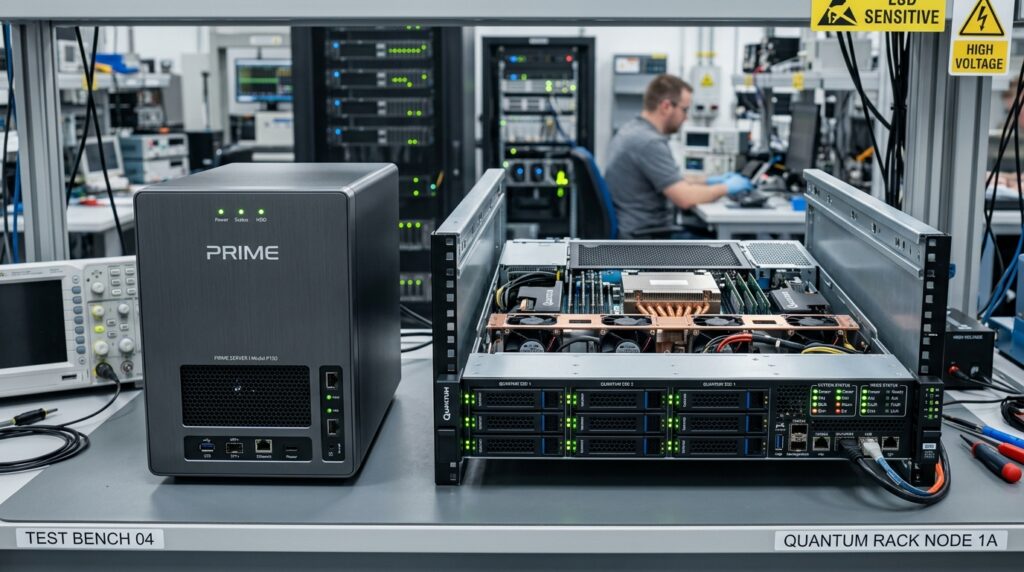
This zanus ai prime vs quantum architectural comparison demonstrates that most businesses don’t need another generic AI platform.
Modern real estate enterprises, large-scale property management corporations, and Homeowners Associations (HOAs) operate in an information-heavy, highly regulated landscape. Property portfolios generate massive amounts of unstructured data, ranging from lease agreements and deed restrictions to standard operating procedures (SOPs) and financial audits. Concurrently, the proliferation of physical security infrastructure, local closed-circuit television (CCTV) networks, and aerial drone-based structural inspections introduces demanding, high-throughput media-processing workloads.
While public cloud-based artificial intelligence services present severe risks regarding data sovereignty, compliance breaches, and unpredictable operational costs, on-premises sovereign AI systems present a reliable alternative. Zanus AI addresses this paradigm by delivering an all-in-one private AI appliance combining enterprise-grade graphics processing units (GPUs), locally compiled Large Language Models (LLMs), a high-precision vector database, and an integrated enterprise AI Operating System.
When evaluating localized physical hardware, real estate executives and asset managers frequently compare the two core enterprise tiers: Zanus AI Prime and Zanus AI Quantum. This independent evaluation provides a technical and financial comparison of these platforms to assist decision-makers in determining the optimal hardware architecture for their operational scale.
The Verdict: Which System Wins?
For large-scale enterprise portfolios and high-density portfolios managing real-time media feeds, Zanus AI Quantum is the winner due to its superior processing capacity and extended context handling. However, for regional offices or localized Homeowners Associations handling standard text-based document automation, Zanus AI Prime serves as the more cost-effective deployment path without introducing unnecessary hardware overhead.
Zanus AI Prime
- Strengths: Lower infrastructure footprints, lower initial capital requirements, native integration with standard building IT setups, and plug-and-play local automation.
- Weaknesses: Inability to handle ultra-high-resolution video analytics simultaneously; sequential document processing slows down during massive batch uploads.
- Best For: Local HOA operations, regional real estate offices, and mid-sized document repositories.
Zanus AI Quantum
- Strengths: Extended context processing engine, high-density concurrent operations, and continuous processing capability for ultra-high-definition multi-site media data.
- Weaknesses: Higher initial capital investment; requires dedicated 19-inch rack enclosures and carries strict power infrastructure considerations.
- Best For: National property chains, enterprise real estate developers, and operations running continuous 50MP drone and high-throughput vector analysis.
Zanus AI Prime vs Quantum: Technical Specifications
The structural utility of an on-premises AI server is governed by its compute density, memory bandwidth, thermal thresholds, and localized storage capacity. Zanus AI servers are engineered as turnkey appliances, eliminating the need for custom driver installation, database orchestration, or cloud API key integrations.
| Feature | Zanus AI Prime | Zanus AI Quantum |
| Best For | Local HOA operations & regional offices | National portfolios & high-density property chains |
| Pricing | Custom enterprise pricing (One-time CapEx) | Custom enterprise pricing (Higher hardware tier) |
| Deployment | 8U Rackmount or standard standalone space | Standard 19″ rack-mountable or desktop option |
| Learning Curve | Low (Turnkey OS with 15+ built-in modules) | Low (Same software environment, advanced back-end) |
| Standout Feature | Standard local Deep Reasoning engine | Extended Deep Reasoning with wider context windows |
| Free Trial | Not available (On-prem hardware installation) | Not available (On-prem hardware installation) |
Operational Impact
The hardware variance directly determines your daily ingestion capability. While the Prime configuration safely handles 2,000,000+ business documents, the Quantum model expands baseline capacity to over 5,000,000 documents and integrates with automated LTO tape archival libraries. This expansion allows larger entities to process historical legal archives across decades without risking system lag.
Editor’s Take: If your organization focuses primarily on standard textual processing—such as auditing vendor compliance or comparing blueprints with architectural design guidelines—the Prime model prevents overspending on high-tier GPU memory that your daily workflows will rarely saturate.
Operational Capacity and Workload Profiling
The selection between Zanus AI Prime and Zanus AI Quantum is primarily dictated by data density, processing latency requirements, and physical operational complexity.
Zanus AI Prime: Localized Operations and Regional Portfolios
The Prime server is optimized for single-location or regional deployments, providing complete data processing for operations managing mid-sized properties and standard Homeowners Associations. Equipped with enterprise-grade inference GPUs, the Prime handles structured document retrieval and basic media analysis.
+------------------------------------------------------------------------+
|                          ZANUS AI PRIME SERVER                         |
|                                                                        |
|  +-------------------+  +--------------------+  +-------------------+  |
|  |  CCTV FEED INPUT  |  |   HOA REGULATORY   |  |   DRONE PATROL    |  |
|  | (Local 1080p/4K)  |  |     DOCUMENTS      |  |  (Periodic MP4)   |  |
|  +---------+---------+  +---------+----------+  +---------+---------+  |
|            |                      |                       |            |
|            v                      v                       v            |
|  +------------------------------------------------------------------+  |
|  |              ZANUS AI OPERATING SYSTEM (15+ MODULES)             |  |
|  |  - Automated Violation Tracking    - Document Parser & RAG Renders  |  |
|  |  - Localized Asset Monitoring      - Secure Internal Messaging      |  |
|  +--------------------------------+---------------------------------+  |
|                                   |                                    |
|                                   v                                    |
|  +------------------------------------------------------------------+  |
|  |            NVMe RAID 10 REAL-TIME STORAGE ENGINE                  |  |
|  |        (Capacity: 2M+ Documents / 50K+ Hours of Local Video)       |  |
|  +------------------------------------------------------------------+  |
+------------------------------------------------------------------------+
In standard local HOA operations, the Prime server processes historical board minutes, physical deed restrictions, architectural design guidelines, and vendor contracts. When community managers receive architectural variance applications, the local LLM compares the incoming blueprints and structural narratives with localized rules, completing in seconds assessments that typically take several days of human review.
Zanus AI Quantum: Extended Deep Reasoning and High-Density Real Estate Assets
The Quantum server is designed for enterprise property networks, national portfolios, or high-security commercial spaces. Its primary hardware advantage is its enhanced enterprise-grade GPU array, which scales available Video RAM (VRAM) to support broader context windows. This capability powers Zanus AI’s Extended Deep Reasoning engine, allowing the platform to analyze vast, multi-layered relational data pools simultaneously.
+------------------------------------------------------------------------+
|                         ZANUS AI QUANTUM SERVER                        |
|                                                                        |
|  +-------------------+  +--------------------+  +-------------------+  |
|  | CONTINUOUS 50MP   |  | NATIONWIDE YARDI/  |  |  MULTI-SITE LTO   |  |
|  | DRONE VIDEO FEED  |  | APPFOLIO DATABASES |  |   TAPE ARCHIVE    |  |
|  +---------+---------+  +---------+----------+  +---------+---------+  |
|            |                      |                       |            |
|            v                      v                       v            |
|  +------------------------------------------------------------------+  |
|  |        EXTENDED DEEP REASONING SYSTEM (ZANUS AI OS ENGINE)        |  |
|  |  - Multi-Document Contract Synthesis   - 24/7 Automated Lead Gen   |  |
|  |  - High-Density Asset Analytics        - Enterprise RBAC Systems   |  |
|  +--------------------------------+---------------------------------+  |
|                                   |                                    |
|                                   v                                    |  |  +------------------------------------------------------------------+  |
|  |               ULTRA-SPEED NVMe RAID 10 INFRASTRUCTURE             |  |
|  |      (Capacity: 5M+ Documents / 100K+ Hours of High-Res Video)      |  |
|  +------------------------------------------------------------------+  |
+------------------------------------------------------------------------+
For enterprises operating chains of hundreds of properties, document processing is complex and interconnected. A regional lease modification or local municipal code change may impact hundreds of active lease agreements. The Quantum server digests thousands of active leases, financial records, and vendor agreements in a single analytical sweep. It identifies termination liabilities, tracks payment escalations, and extracts maintenance obligations across entire regional portfolios.
Continuous structural monitoring of modern real estate assets involves high-resolution sensor telemetry and ultra-high-definition visual feeds. When managing high-density real estate, operators deploy drones equipped with 50-megapixel (50MP) cameras to inspect building facades, roofs, and utility lines. High-resolution 50MP frame feeds create data streams that overwhelm standard GPU memory pools. The Quantum’s enhanced GPU hardware handles these intensive visual workloads by continuously parsing multiple 50MP drone feeds, performing real-time image degradation analysis to identify hairline structural fractures, thermal insulation leaks, or moisture intrusions.
Operational Trade-offs
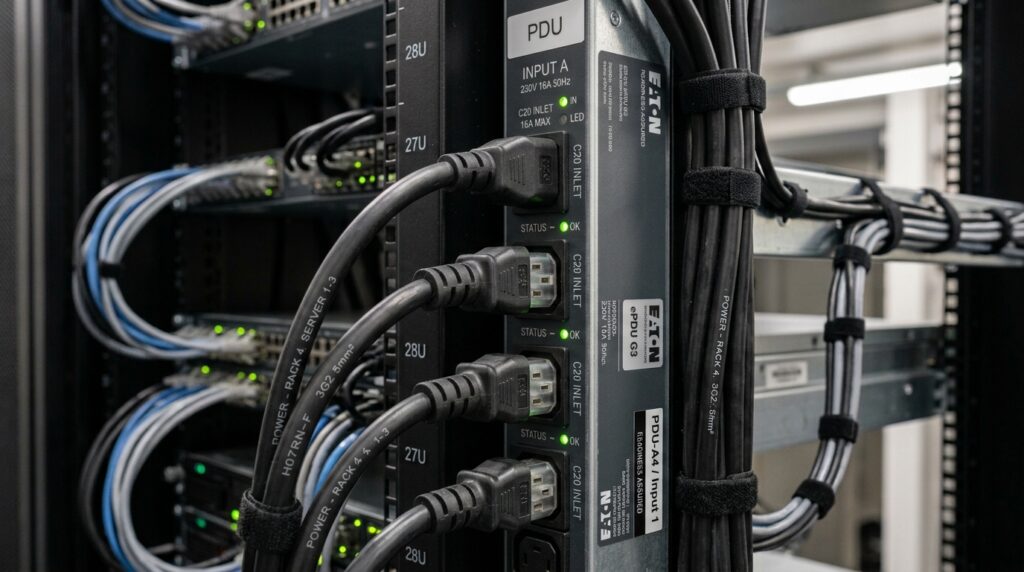
Introducing these physical appliances brings infrastructural requirements. The Prime system draws up to 6 kW peak power, utilizing four IEC 60320 C20 inlets, meaning your facility must be pre-wired to support high-density draw. The Quantum, while deployment-flexible, generates higher localized acoustic and thermal signatures due to intense GPU operation, necessitating isolated IT utility rooms rather than open office environments.
Why This Matters: The biggest challenge in AI deployment isn’t choosing software; it’s choosing the right infrastructure for the workload. Buying high-tier hardware to run basic text search is like installing a jet engine in a delivery van—it increases upfront expenditure without yielding actual business results.
Financial Engineering: Eliminating the SaaS Trap
To evaluate the acquisition of either server, organizations must analyze the financial differences between on-premises capital investments and cloud-based Software-as-a-Service (SaaS) subscription models.
The Realities of Cloud AI (The OPEX Money Pit)
SaaS AI platforms operate on a metered, consumption-driven pricing model, charging businesses per token, per API transaction, and per user seat. While initial testing costs appear minimal, operationalizing cloud-based AI across a 50-person property management enterprise quickly triggers escalating recurring expenses.
The mathematical progression of cloud AI costs over a given time horizon can be modeled as:
$$C_{\text{cloud}}(t) = t \times \left( N \times S_{\text{seat}} + D_{\text{doc}} \times \left( T_{\text{in}} \times P_{\text{in}} + T_{\text{out}} \times P_{\text{out}} \right) \right) + E_{\text{eng}} + S_{\text{SaaS}}$$
Where:
- $t$ is the operational duration in months.
- $N$ is the active workforce count.
- $S_{\text{seat}}$ is the monthly license fee per user seat.
- $D_{\text{doc}}$ is the monthly document volume parsed.
- $T_{\text{in}}, T_{\text{out}}$ represent average input/output token counts per document.
- $P_{\text{in}}, P_{\text{out}}$ represent token pricing charged by cloud vendors.
- $E_{\text{eng}}$ represents custom engineering costs for building RAG pipelines ($100,000 to $500,000 upfront).
- $S_{\text{SaaS}}$ represents secondary software subscriptions.
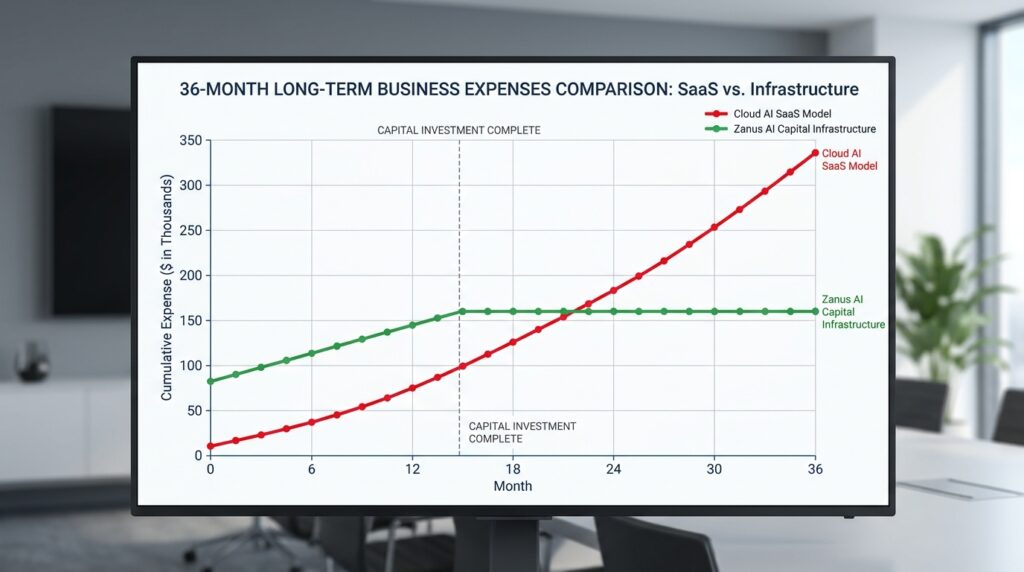
When running 50 users who process typical real estate documents (leases, maintenance reports, HOA rules), cloud token fees and seat licenses regularly reach $3,000 to $5,000 per month. Over three years, this results in direct costs of $135,000 to $200,000. If the organization integrates continuous high-resolution video analytics into cloud models, the bandwidth, storage, and API costs rise exponentially.
Cumulative Cost (USD)
  |                                                  / [Cloud AI: $135K - $200K+]
  |                                                 /
  |                                                /
  |                                               /
  |                                              /
  |---------------------------------------------/-----------------------
  |                                            /  [DIY Server: $35K - $45K]
  |                                           /
  |------------------------------------------/--------------------------
  |                                         /     [Zanus AI: One-Time CapEx]
  |                                        /      (Zero Subscription Fees)
  |                                       /
  +-------------------------------------+--------------------------------
  0                                    14                              36
                                 Time (Months)
The Turnkey Private AI Server Advantage
Zanus AI replaces variable operational expenses with a single, depreciable capital investment. Once a Prime or Quantum server is purchased, the ongoing software operating cost drops to zero:
$$C_{\text{Zanus}}(t) = I_{\text{cap}} + t \times P_{\text{elec}}$$
Where:
- $I_{\text{cap}}$ is the one-time upfront turnkey acquisition cost.
- $P_{\text{elec}}$ is the localized cost of electrical power.
With Zanus AI, there are zero token costs, zero per-seat subscription charges, and zero custom development expenses, since the software ecosystem arrives configured. Most commercial real estate operations report full capital amortization and return on investment (ROI) within 14 months compared to metered cloud configurations.
Deployment Insight: One pattern appears repeatedly across enterprise deployments: organizations that move to a CapEx infrastructure model protect themselves from software price inflation while unlocking unlimited data usage. When processing millions of items, financial predictability matters more than initial convenience.
Compliance, Cybersecurity, and Operational Integration
For enterprise property managers, data security and system compliance are critical operational requirements. Real estate transactions, financial underwriting records, and guest registries contain highly sensitive data, including Social Security Numbers (SSNs), corporate bank routing details, and credit card numbers.
Regulatory Alignment by Architecture
Cloud-based AI models introduce transmission risks. Uploading lease records or tenant data to external cloud APIs distributes private information across multiple third-party servers, complicating regulatory compliance. Zanus AI’s on-premises architecture contains all data processing within the building’s physical firewall.
- PCI DSS Compliance: Property managers and hospitality operators routinely process reservation fees and security deposits. Zanus AI ensures that guest credit card data and personally identifiable information (PII) never leave the local environment.
- GDPR & CCPA Compliance: Under strict privacy frameworks, tenants reserve the right to audit where their personal data is stored and request its deletion. An on-premises system allows compliance officers to verify, audit, and wipe localized storage pools directly.
- Fair Housing & RESPA Compliance: The Zanus AI OS operates on local audit trails. The system logs every user query, generation, and operational transaction, creating an immutable log to demonstrate compliance in housing or financial audits.
Cybersecurity and System Interconnections
Zanus AI platforms are air-gap capable, allowing them to run entirely isolated from the external internet. Even during localized ISP outages or regional telecom failures, the property’s AI assistant, violation tracker, and document processing systems remain online.
                      +-----------------------------+
                      |     SECURE NETWORK MOAT     |
                      |  (Air-Gapped Local Network) |
                      +--------------+--------------+
                                     |
              +----------------------+----------------------+
              |                                             |
              v                                             v
+---------------------------+                 +---------------------------+
|    PROPERTY DATABASES     |                 |   OPERATIONAL ECOSYSTEM   |
|   - Real Estate ERPs      |                 |   - Microsoft Office 365  |
|   - PMS (Yardi/AppFolio)  |                 |   - Local Document Pools  |
|   - Financial Accounting  |                 |   - Local Security CCTV   |
+-------------+-------------+                 +-------------+-------------+
              |                                             |
              +----------------------+----------------------+
                                     |
                                     v
                      +-----------------------------+
                      |     ZANUS AI CONNECTOR      |
                      |      (On-Premises API)      |
                      +--------------+--------------+
                                     |
                                     v
                      +-----------------------------+
                      |   LOCAL PROCESSING NODE     |
                      |   (Prime / Quantum Server)  |
                      +-----------------------------+
To maintain workflow continuity, Zanus AI connects directly to existing real estate software stacks. Through secure on-premises API integrations, the system interfaces with property management systems (PMS) like Yardi, AppFolio, and Cloudbeds, as well as accounting platforms like QuickBooks or Sage Intacct. This allows organizations to layer intelligent automation over existing workflows without replacing their primary software platforms.
Through Role-Based Access Control (RBAC), system administrators can define granular permission policies. For example, front-desk staff can access guest reservation records and local operations manuals, property managers can review maintenance queues, and corporate executives retain exclusive access to financial records and underwritten lease models.
Real-World Consideration: Buying AI hardware before auditing your internal user access controls is an operational hazard. An unconfigured AI appliance exposed to an open internal network can allow lower-tier staff access to sensitive executive documentation. Implementing a strict RBAC policy must be your first step.
Strategic Procurement Framework: Buying Advice
To select the appropriate hardware configuration, procurement officers and property executives should evaluate their requirements using the following situational decision tree.
Choose Zanus AI Prime if:
- The asset footprint is regional or localized: The community portfolio contains fewer than 50 distinct HOA properties or localized multi-family projects.
- Document libraries are within baseline limits: The historical database of records, rules, and contracts is under 2,000,000 documents.
- Media inspection is periodic or standard-resolution: Video analysis is focused on localized, standard-definition CCTV cameras or scheduled, lower-resolution drone scans.
- Operations require standard processing: Document synthesis and query execution can be processed efficiently within standard sequential computing pipelines.
Choose Zanus AI Quantum if:
- The asset footprint is expansive or national: The enterprise manages a nationwide portfolio of properties with complex, overlapping compliance requirements.
- Document libraries are large and growing: The active database exceeds 2,000,000 documents or requires a continuous tape-archiving system for long-term document retention.
- The site deploys high-resolution drone inspections: Structural analysis relies on continuous, high-density 50MP drone imagery for real-time asset degradation modeling.
- Operations require multi-document synthesis: Legal and financial teams frequently run complex analyses that cross-reference hundreds of active leases, localized regulations, and contract histories simultaneously under an Extended Deep Reasoning framework.
Final Recommendation & Next Steps
If your primary operational goal is automating regional property documentation or optimizing localized HOA enforcement without scaling up your hardware management complexity, Zanus AI Prime provides the clearest implementation track. If your priority changes and you must process heavy multi-stream high-definition video data and cross-analyze multi-layered nationwide portfolios, select Zanus AI Quantum.
What to do next:
- Audit your data footprint: Measure your total active document repository size and determine if your media feeds require high-density context windows.
- Verify local facility infrastructure: Ensure your server space meets the 6 kW peak power and thermal dissipation thresholds required by on-premises hardware.
- Map your software interconnections: Document your internal Yardi, AppFolio, or custom accounting software deployment models to prepare for on-premises API integration.
Your Next Step
Choosing the right infrastructure is the ultimate determining factor behind your organization’s digital transformation. To successfully draft your corporate procurement framework and secure immediate board-level approval, we recommend reviewing our complete architectural cluster:
- Deep Evaluation: For a hands-on breakdown of the core processing features and model workflows, read our comprehensive Zanus AI Deep Review.
- Infrastructure Details: Explore the precise physical component maps and thermal dissipation requirements via the Zanus AI Hardware Infrastructure.
- Operational Case Study: If your portfolio requires drone deployment and visual defect parsing under current state laws, see our tactical guide on automating Florida SB-4D inspection cost management.
- Security Framework: Review how an air-gapped environment complies with corporate network isolation standards by analyzing our Zanus AI Security Review.
Don’t let predictable cloud SaaS price inflation or security leaks stall your operational scaling—audit your data footprint and deploy your turnkey sovereign network today.
References
- Zanus AI Official Product Documentation: Zanus AI Software Packages
- Zanus AI Industry Application Guide: Real Estate & Property Management AI Systems
- Zanus AI Infrastructure Overview: Private AI Server Architecture vs Cloud AI vs DIY
- Zanus AI Technical Tier Comparison: Zanus AI Prime Private Server
- Zanus AI Hardware Specification Sheet: Zanus AI Quantum Deep Reasoning System