
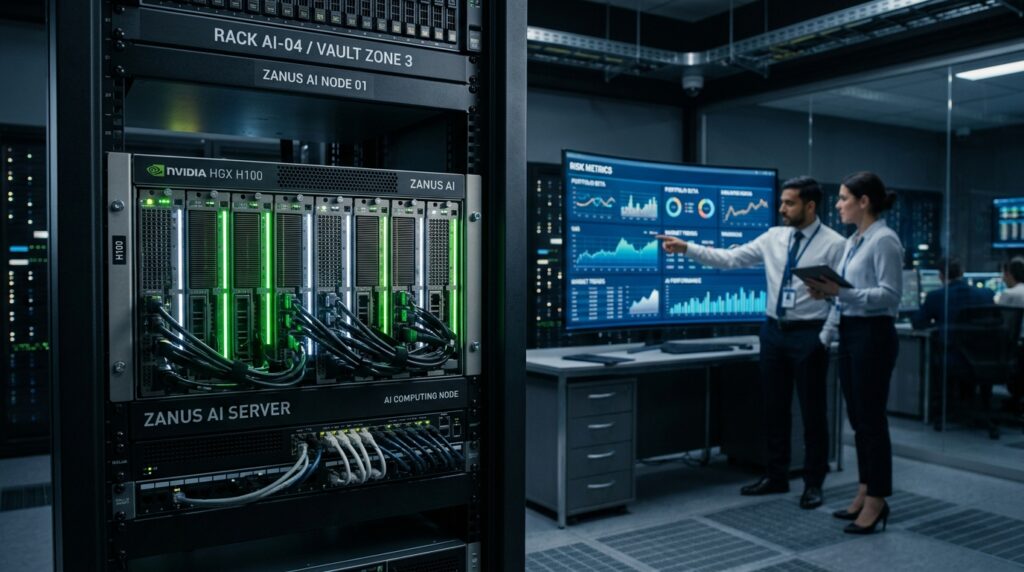
Most Tier-1 financial institutions do not lack capable AI models. What they lack is a secure, isolated infrastructure to deploy them without leaking proprietary valuation data or violating stringent regulatory recordkeeping mandates. Routing non-public personal information (NPPI), black-box underwriting algorithms, or high-value M&A financial models through public cloud APIs introduces an operational risk that can cost a firm its regulatory license.
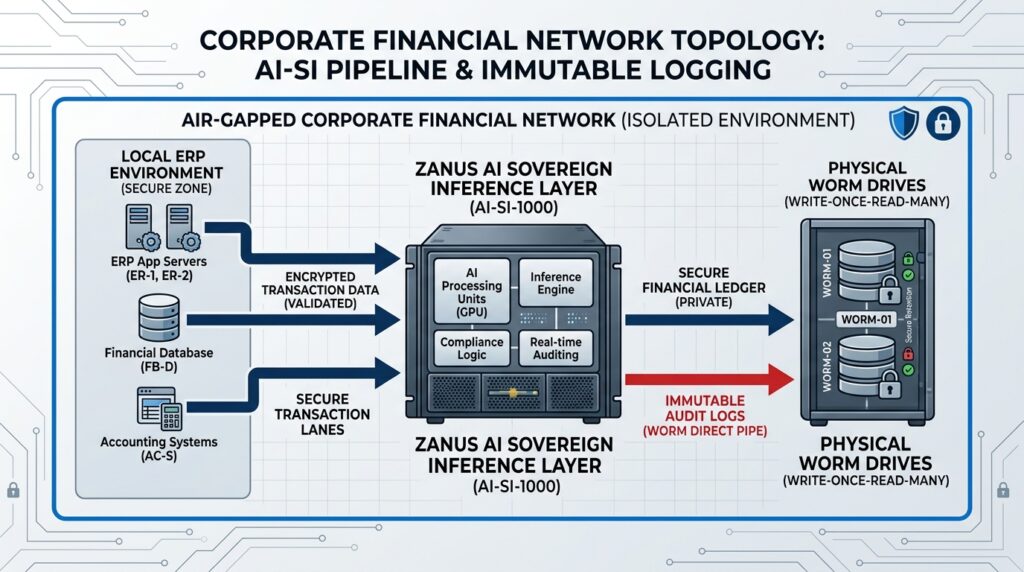
Zanus AI for Finance directly solves this architectural isolation dilemma. It is a specialized hardware-and-software stack designed to let financial institutions run large language models (LLMs) and Retrieval-Augmented Generation (RAG) frameworks entirely behind a physical, air-gapped firewall.
Product Overview: What is Zanus AI for Finance?
Zanus AI for Finance is a proprietary, on-premises AI platform engineered to run locally on high-density compute clusters, such as the NVIDIA HGX H100 architecture. The system completely isolates the data pipeline—from raw ingestion and vector embedding to local inference and immutable log tracing.
The primary objective of this platform is not to deliver a model that outscores commercial alternatives on generic benchmarks; instead, it establishes a Zero-Trust execution environment. By eliminating the multi-tenant architecture inherent to public cloud infrastructure, Zanus eliminates the risk of side-channel attacks, cache-exploitation vulnerabilities, or vector database leaks to market competitors.
Best For
- Investment Banks and Asset Managers: Ideal for institutions processing proprietary Discounted Cash Flow (DCF) models, underwriting data, and highly sensitive pre-disclosure M&A financials.
- Strictly Regulated Financial Entities: Built for firms facing direct, continuous oversight from the U.S. Securities and Exchange Commission (SEC) and the Financial Industry Regulatory Authority (FINRA).
- Internal Risk and Fraud Analytics Teams: Designed for specialized teams automating large-scale transaction fraud detection without exporting telemetry or cleartext data outside the corporate LAN.
Who Should Avoid It?
- Early-Stage Fintech Startups: High upfront capital expenditures make this platform cost-prohibitive for small firms with volatile cash flows.
- Lean IT Operations (Small SysOps Teams): Organizations lacking dedicated infrastructure specialists will struggle with the continuous optimization required for local high-performance compute and high-bandwidth fabrics.
Key Strengths & Mathematical Privacy Frameworks
The core differentiator of Zanus AI lies in its native, low-level integration of three advanced mathematical privacy frameworks directly into the system kernel.
1. Training-Level Differential Privacy (DP-SGD)
When fine-tuning models on historical transaction registries or sensitive client records, the platform implements Differentially Private Stochastic Gradient Descent (DP-SGD). This algorithm clips individual gradients to a designated $L_2$ norm threshold $C$ and injects calibrated Gaussian noise, mathematically preventing adversarial reverse-engineering of the model weights to reconstruct the training data.
The system enforces privacy guarantees using the randomized mechanism $\mathcal{M}$ defined by the standard relation:
$$\Pr[\mathcal{M}(D) \in S] \le e^{\epsilon} \cdot \Pr[\mathcal{M}(D’) \in S] + \delta$$
Where:
- $\epsilon$ represents the strict privacy budget, governing the maximum allowable probability distribution shift between adjacent datasets $D$ and $D’$.
- $\delta$ ensures that the probability of catastrophic information leakage asymptotically approaches zero.
2. Homomorphic Execution via the CKKS Scheme
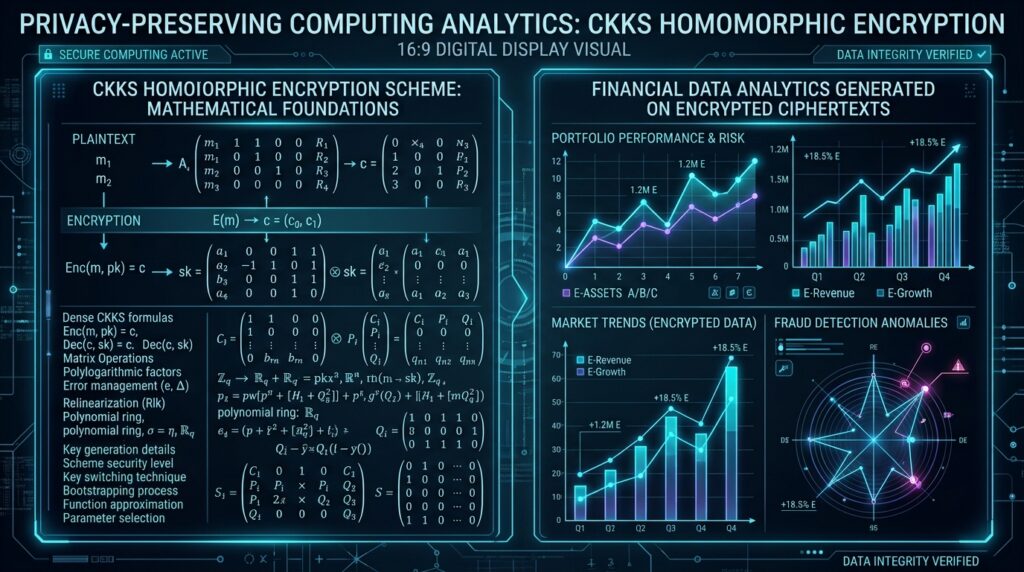
For floating-point arithmetic required in quantitative asset evaluation and risk metrics, Zanus embeds the Cheon-Kim-Kim-Song (CKKS) homomorphic encryption scheme. Data remains fully encrypted on untrusted backend workers as a multi-component ciphertext vector $c = (c_0, c_1) \in R_q^2$.
Decryption occurs strictly at the authorized user’s workstation using the private key $s(X)$ via the linear relation:
$$\tilde{m} = c_0 + c_1 \cdot s \pmod q \approx m + e_{\text{final}}$$
This ensures that the underlying metrics are never exposed in cleartext during heavy server-side matrix operations.
3. Native Regulatory Compliance Architecture
Zanus AI addresses recordkeeping mandates by structuring all prompt histories, model variations, and generation outputs onto a local NVMe RAID-10 storage array configured as a Write Once, Read Many (WORM) vault. This layout provides an immutable audit trail that directly satisfies the stringent record-retention requirements of SEC Rule 17a-4 and the Written Supervisory Procedures (WSP) mandated under FINRA Rule 3110. Every autonomous agent action is locally tracked and archived, mitigating regulatory exposure to “AI washing” investigations.
Limitations & Structural Trade-offs
No infrastructure solution is without compromises. Adopting Zanus AI requires enterprise decision-makers to accept significant operational trade-offs:
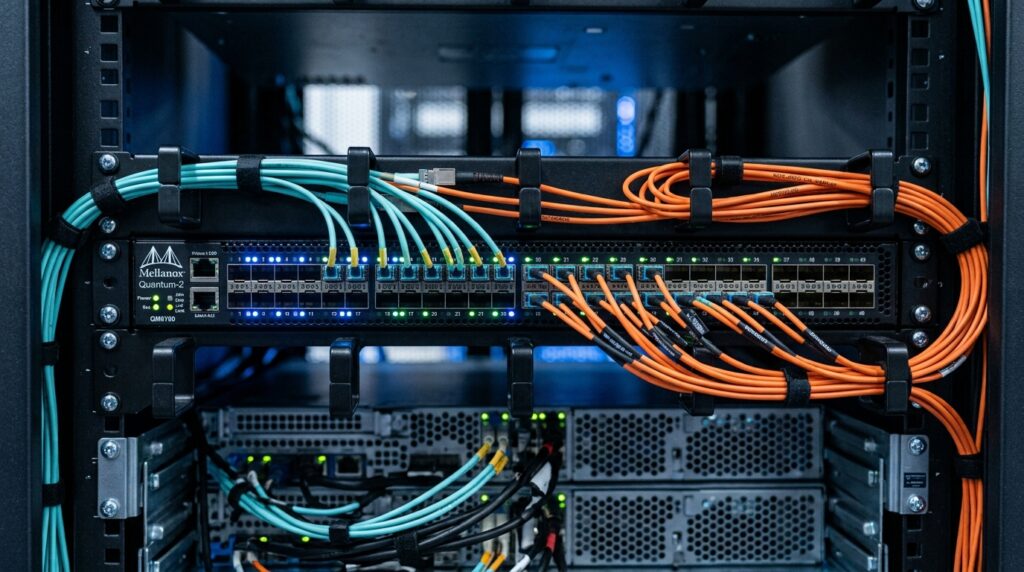
- Substantial Upfront CapEx Requirements: Deploying this solution demands an extensive initial capital layout. Beyond software licensing, enterprises must fund the complete hardware stack, including dedicated GPU nodes and high-performance interconnect switches like the Mellanox Quantum-2 NDR 400 Gb/s InfiniBand switch to sustain microsecond-level fabric latency.
- Cryptographic Computational Overhead: Executing complex analytics like K-means clustering or soft-margin Support Vector Machines (SVM) over Fully Homomorphic Encryption (FHE) cyphertexts requires ongoing relinearization and bootstrapping. This noticeably reduces inference throughput compared to plain-text cloud environments.
- Isolated Model Life-cycle Management: Because the system operates in an offline mode to eliminate outward-bound telemetry, pulling down base model updates, security patches, or new weights requires a highly manual physical staging and validation protocol.
Pricing & Commercial Structure
Zanus AI for Finance utilizes an enterprise-grade capacity licensing model rather than a consumption-based token framework:
| Cost Component | Deployment Vector | Commercial Consideration |
| Zanus Software Licensing | Per-GPU Node Tiered Subscription | Requires a minimum 3-year term commitment |
| Application Compute Infrastructure | On-Premises Bare-Metal Hardware | High initial fixed CapEx expenditure |
| Maintenance & Operations Support | Internal SysOps / Tier-3 Dedicated Support | Elevated headcount and engineering overhead |
Editor’s Take
If your financial institution is operating under intense regulatory scrutiny driven by the 2026 SEC/FINRA oversight mandates, and you maintain data-heavy workloads processing upwards of 60 million sensitive tokens per day, then migrating to Zanus AI for Finance is a sound strategic choice. Because this infrastructure lets you claim absolute data sovereignty, eliminates the unpredictable OpEx long-tail of commercial cloud tokens, and rings-fences critical IP from multi-tenant environments. However, if your internal data governance protocols are unrefined, deploying an air-gapped system like Zanus will amplify existing structural data issues rather than fix them.
If you are scaling your enterprise AI deployment and need robust, high-bandwidth bare-metal hosting without exorbitant cloud egress fees, check out our in-depth NovoServe Review and our NovoServe vs Hetzner Comparison to find the right server specs for your budget. Additionally, if your team manages multi-language workflows or cross-border project documentation, read our hands-on Palabra AI Review and Palabra AI vs Lokalise Breakdown to learn how automated AI localization can streamline your content pipeline.
Viable Alternatives
- NVIDIA AI Enterprise (NIM Containers) on Private Bare-Metal: Offers a more flexible approach, allowing infrastructure teams to deploy optimized AI containers on custom hardware. However, it shifts the entire burden of engineering mathematical privacy layers onto your internal data science team.
- AWS Nitro Enclaves: A hybrid cloud alternative that isolates workloads within highly secure, isolated compute environments. This path lowers initial capital investments but maintains a persistent dependency on public cloud networks and outbound endpoints.
Final Recommendation
Do not buy Zanus AI for Finance if your goal is simply to deploy basic productivity assistants or text summarizers. This infrastructure is purpose-built for high-stakes, mission-critical financial analytics.
- If absolute data isolation and regulatory compliance are your primary drivers: Choose Zanus AI. The predictable, upfront CapEx investment typically amortizes fully within 14 to 16 months of continuous operation compared to standard commercial cloud billing.
- If you require deployment speed and capital liquidity: Deploy a hybrid cloud architecture using client-side encryption frameworks before committing to a full scale, air-gapped data center footprint.
Firms considering this path should begin by auditing their internal data flows and executing a tightly bound Proof of Concept (PoC) on a single compute node before pursuing a large-scale cluster acquisition.
Your Next Step
Achieving total intellectual property insulation and shielding your high-velocity financial analytics from public web exposure requires a deliberate shift toward hardware-level server containment. To successfully evaluate your corporate technology readiness and pitch a clear capital asset allocation plan to your executive leadership team, we recommend analyzing our separate integration networks:
- System Capacity Tiers: Verify the exact computational density and VRAM thresholds required for your local dataset indexing by reading the Zanus AI Prime vs Quantum infrastructure breakdown.
- Hardware Sizing Metrics: Audit your private data center space, power availability, and office storage thermal allocations using the Zanus AI Hardware Infrastructure manual.
- Architecture Core Capabilities: Discover how the pre-installed local operating platform orchestrates containerized data parsing modules in our detailed Zanus AI Deep Review.
- Civilian Asset Applications: For an operational look at how edge-native computing layers automate high-volume asset inspection telemetry under strict state regulations, see our technical guide on minimizing the Florida SB-4D inspection cost.
Don’t let variable cloud API billing models or sudden model weight drift compromise your corporate data auditing security—conduct your internal compliance analysis and deploy your turnkey zanus ai for finance software node today.
If you are scaling your enterprise AI deployment and need robust, high-bandwidth bare-metal hosting without exorbitant cloud egress fees, check out our in-depth NovoServe Review and our NovoServe vs Hetzner Comparison to find the right server specs for your budget. Additionally, if your team manages multi-language workflows or cross-border project documentation, read our hands-on Palabra AI Review and Palabra AI vs Lokalise Breakdown to learn how automated AI localization can streamline your content pipeline.
References
- U.S. Securities and Exchange Commission (SEC), SEC Rule 17a-4 Electronic Records Storage Requirements, https://www.sec.gov
- Financial Industry Regulatory Authority (FINRA), 2026 Regulatory Oversight Report: Generative AI and Agent-Based Risks, https://www.finra.org
- NVIDIA Corporation, NVIDIA AI Enterprise & NIM Container Deployment Guide, https://docs.nvidia.com
- arXiv Information Repository, Privacy-Preserving Financial Analytics Using Homomorphic Encryption Schemes, https://arxiv.org