1. Editorial Philosophy & Market Context
Evaluating zanus ai for accounting architectures demonstrates that most corporate finance departments do not need another AI marketing brochure.. They need a definitive strategy to solve a critical operational bottleneck: the compliance and security liabilities of public cloud APIs.
While enterprise accounting departments rush to capture the efficiencies of automation, transmitting general ledgers, active balance sheets, tax filings, and corporate payroll records over external Wide Area Networks (WANs) introduces multi-layered vulnerability vectors. These financial payloads contain not only proprietary corporate metrics but also extensive personally identifiable information (PII) and material non-public information (MNPI), heavily governed by global regulatory frameworks.
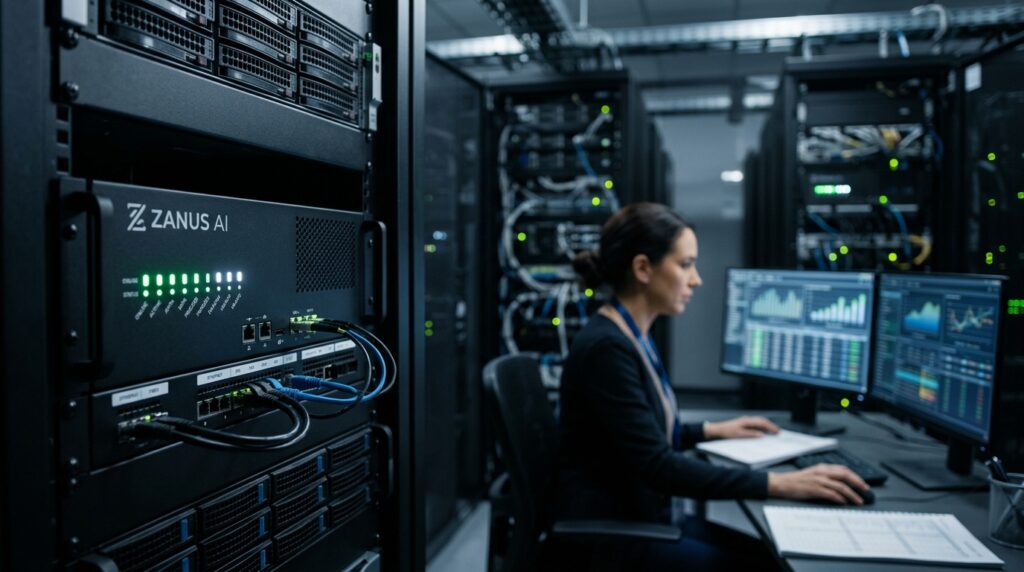
For organizations running high-throughput financial operations, Zanus AI has emerged as a specialized infrastructure option designed to reconcile the efficiency of generative AI with the strict security mandates of corporate accounting. Rather than relying on multi-tenant public cloud endpoints, Zanus AI focuses on localized, air-gapped, or highly isolated deployments that prevent sensitive financial data from leaving the corporate boundary.
This technical audit evaluates Zanus AI within the context of corporate accounting automation, analyzing its deployment frameworks, integration capabilities, compliance alignments, and core operational trade-offs.
2. Technical Capabilities & Strategic Value
What Problem Does Zanus AI Solve?
Traditional generative AI architectures rely on public cloud infrastructure, which creates systemic exposure risks such as fourth-party subprocessor vulnerabilities, hypervisor escape exploits, and data retention mandates for abuse monitoring. Zanus AI addresses this structural flaw by providing an enterprise-grade AI execution layer that operates independently of public cloud dependencies. It allows corporate accounting teams to run deep ledger analytics, automated reconciliations, and pattern recognition within an environment that maintains absolute data custody.
Who Should Use It?
- Large Enterprises: Multi-national organizations managing complex general ledgers across multiple subsidiaries.
- Highly Regulated Entities: Corporate finance departments subject to strict SEC, FINRA, and GDPR oversight.
- Financial Auditors: Internal and external audit teams requiring unalterable transaction-level audit trails and deterministic verification layers.
Who Should Avoid It?
- Early-Stage Startups: Small businesses with basic accounting needs that do not justify the infrastructure overhead of isolated hosting.
- Organizations Lacking Internal IT Infrastructure: Companies without the engineering capacity to manage private server clusters or dedicated local virtualization environments.
3. Deep-Dive Performance & Architectural Architecture
Core Financial System Integration
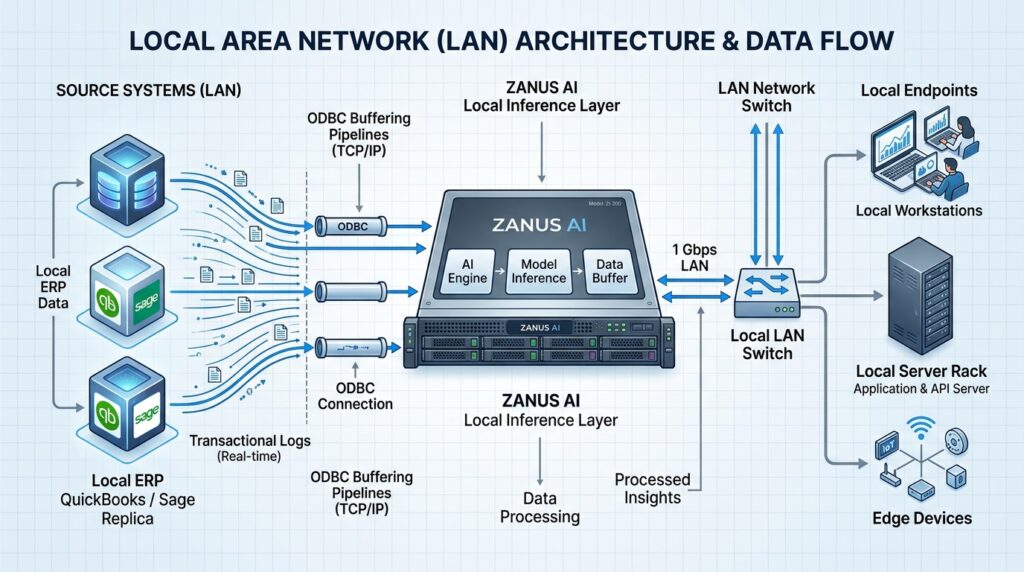
Zanus AI interfaces directly with enterprise accounting environments and localized data systems through structured API integration layers and data connectors.
+---------------------------------------------------------------------------------+
|                          CORPORATE SECURE NETWORK (LAN)                         |
|                                                                                 |
|  +-----------------------+                    +------------------------------+  |
|  | Local ERP Environment |                    |      Private AI Server       |  |
|  | (QuickBooks / Sage /  |---[Local ODBC]---->| (Zanus AI Execution Layer /  |  |
|  | SQL Server Replica)   |                    |   Local Open-Weights LLM)    |  |
|  +-----------------------+                    +------------------------------+  |
|                                                              |                  |
|                                                     [Protected Append]          |
|                                                              v                  |
|                                               +------------------------------+  |
|                                               |     Physical WORM Drives     |  |
|                                               |  (SEC 17a-4 / FINRA 4511)    |  |
|                                               +------------------------------+  |
+---------------------------------------------------------------------------------+
Localized Database Connectivity
When deployed alongside localized systems like QuickBooks Enterprise (which runs on a Sybase SQL Anywhere relational engine), the architecture utilizes optimized Open Database Connectivity (ODBC) pipelines. Zanus AI leverages transactional buffering flags, such as FQSaveToCache, to stage multi-line journal entries in secure system memory. This ensures that the system executes batch ledger updates without causing database locks or partial write corruptions; a final commit command pushes the verified transaction to the database backend as a single, structurally complete unit.
Cloud ERP Isolation & Offline Targets
For natively cloud-hosted enterprise planning platforms like Sage Intacct, a secure, isolated deployment requires an on-premises analytical target. The Zanus AI framework integrates with localized synchronization tools (such as CData Sync) running within the local network.
Using log-based Change Data Capture (CDC), the pipeline pulls incremental transactional changes from the cloud ERP over an encrypted connection and writes them to a local Microsoft SQL Server instance. This read-only local replica acts as the primary query target for the AI engine, ensuring that intensive transaction processing, natural language ledger audits, and pattern analysis occur entirely inside the local infrastructure.
The Private AI Compute Node
The Zanus AI execution layer runs on dedicated physical hardware (such as NVIDIA H100 or L40S GPU configurations) located within an enterprise data center or private cloud partition.
- Model Isolation: The platform compiles and hosts open-weights large language models (such as Llama-3.3-70B-Instruct) using optimized inference frameworks like vLLM.
- Data Masking Workflows: Prior to feeding information into the local model, automated orchestration scripts execute PII redaction. Named entity recognition (NER) models parse the data fields, identifying and masking sensitive elements like employee identification numbers or routing codes in memory before the prompt reaches the core model.
- Network Isolation Policies: The compute architecture enforces strict virtual network isolation. All outbound external WAN routing is disabled at the network switch level, eliminating telemetry leaks, metadata exfiltration, or unauthorized third-party human-in-the-loop review vectors.
If you are scaling your enterprise AI deployment and need robust, high-bandwidth bare-metal hosting without exorbitant cloud egress fees, check out our in-depth NovoServe Review and our NovoServe vs Hetzner Comparison to find the right server specs for your budget. Additionally, if your team manages multi-language workflows or cross-border project documentation, read our hands-on Palabra AI Review and Palabra AI vs Lokalise Breakdown to learn how automated AI localization can streamline your content pipeline.
4. Compliance, Vulnerabilities & Security Mitigations
When financial data travels across shared network paths to public cloud destinations, data security relies on logical multi-tenancy isolation. This exposes the organization to hypervisor vulnerabilities and compelled third-party legal seizures. Furthermore, standard cloud services retain logs for up to 30 days to handle abuse monitoring, which can route flagged financial payloads to external personnel—violating standard internal controls over financial reporting (ICFR).
Zanus AI addresses these compliance vulnerabilities by localizing the entire computational loop.
| Compliance / Security Framework | Core Technical Requirement | Public Cloud API Vulnerability | Zanus AI Local Mitigation |
| NDA & Client Confidentiality | Absolute data isolation; no unauthorized third-party transfers. | Data is transmitted over the WAN to multi-tenant servers, risking logical isolation failure. | Physical network isolation ensures data never leaves the corporate perimeter. |
| SOC 2 Type II (Confidentiality) | Continuous verification of secure data handling and restricted access. | Abuse monitoring logs allow potential human review by external cloud personnel. | All processing occurs within the enterprise-controlled environment; zero external access. |
| ISO 42001 (AI Management) | System transparency, data governance, and bias monitoring. | Proprietary, closed-source models operate as opaque “black boxes” with shifting weights. | Local deployment of open-weights models allows direct weight locking and full auditability. |
| GDPR (Data Privacy & Localization) | Uncompromised control over personal data and localized processing. | Personal payroll and tax identifiers are exported to cloud subprocessors. | Data processing is restricted to local compute nodes with zero third-party subprocessing. |
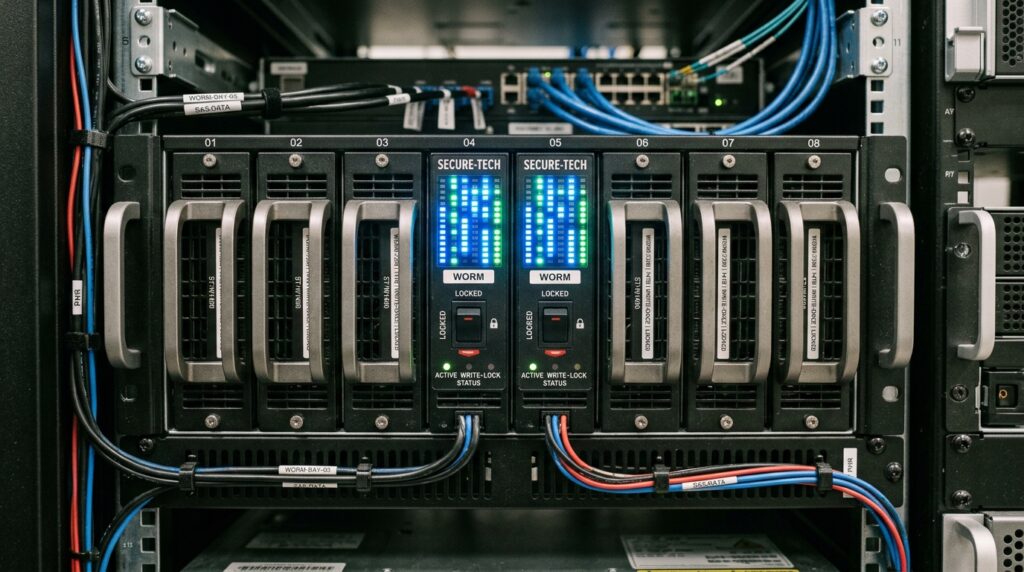
| SEC Rule 17a-4(f) / FINRA 4511 | Immutable, non-erasable recordkeeping and searchable indexing. | Lack of transaction-level audit trails and permanent state tracking in transient APIs. | Mandatory integration with local write-once, read-many (WORM) storage infrastructure. |
Immutability & Chronological Auditing Control
To satisfy strict financial recordkeeping frameworks like SEC Rule 17a-4(f), the platform routes all system inputs, generated analyses, and operational outputs to compliance-locked object storage buckets. Utilizing command-line parameters like --allow-protected-append-writes, the system continuously appends new audit logs while blocking any deletion or modification of historical data sectors by administrative or root credentials.
Bash
# Example: Configuring an immutable compliance target bucket for local audit retention
mc mb local-worm/compliance-audit-logs --with-lock
mc retention set compliance-audit-logs compliance 2190d --autocommit
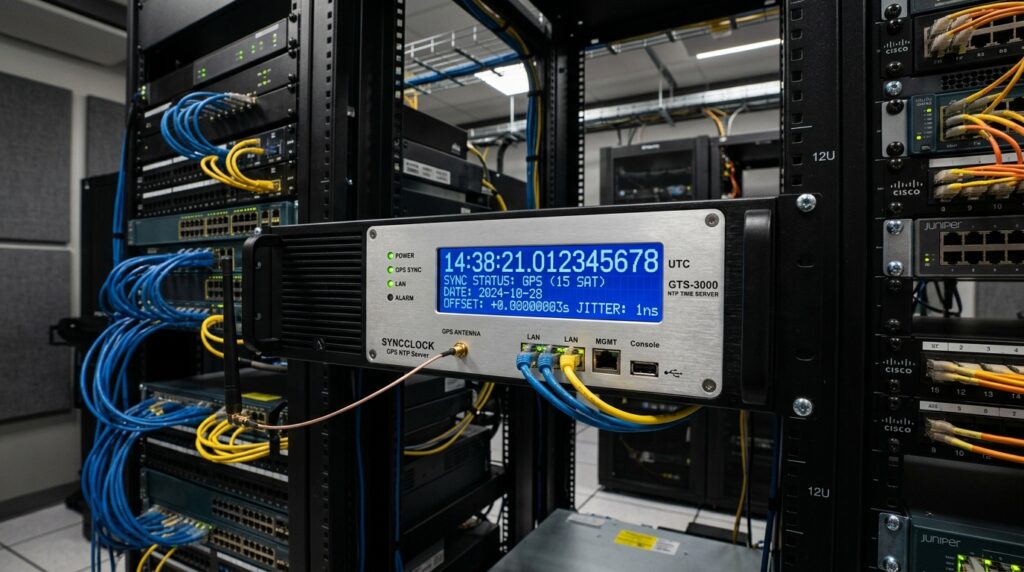
Because an air-gapped system cannot access public Network Time Protocol (NTP) servers, the architecture integrates an on-premises, physical GPS-disciplined NTP server. By mounting a dedicated hardware receiver directly within the server environment, the network synchronizes internal system clocks across the database, AI engine, and storage controllers to within a strict 30-millisecond threshold ($|t_{\text{node}} – t_{\text{GPS}}| < 30\text{ms}$). This creates a reliable, mathematically non-repudiable timeline for regulatory examinations.
Additionally, accountability is enforced through serialized cryptographic chaining. For every automated audit step or proposed transaction adjustment, the platform generates a structured block ($D_i$) containing the prompt payload, model version, and GPS timestamp. It then calculates a continuous SHA-256 cryptographic hash:
$$H_i = \text{SHA256}(H_{i-1} \parallel D_i)$$
This continuous mathematical link ensures that any unauthorized modification of historical log entries will instantly break the hash chain, alerting compliance officers during regular integrity sweeps.
5. Alternatives & Critical Trade-offs
When developing a secure corporate AI architecture, infrastructure teams must evaluate Zanus AI against alternative deployment methodologies.
1. Proprietary Public Cloud APIs (e.g., Azure OpenAI with Modified Abuse Monitoring)
- Strengths: Rapid deployment; access to massive foundational models; zero local hardware maintenance.
- Weaknesses: Relies entirely on logical multi-tenancy isolation; vulnerable to WAN outages; requires a complex legal application process to disable cloud data retention.
2. Custom Internal Open-Source Deployments (e.g., Llama-Index + vLLM on Private Bare Metal)
- Strengths: Complete architectural control; open optimization paths; no vendor licensing costs.
- Weaknesses: Extreme engineering overhead; requires custom development for database connectors, transactional caching, and regulatory compliance logging.
Operational Trade-offs of Zanus AI
While Zanus AI provides maximum data security, it introduces clear operational compromises:
- Infrastructure Overhead: Setting up physical GPU nodes, local WORM drives, and GPS time servers requires significant upfront capital expenditure (CapEx) and specialized IT management.
- Model Capacity Limitations: On-premises hardware configurations are constrained by physical VRAM limitations. Hosting massive models requires large multi-GPU nodes, meaning teams must balance model size against hardware acquisition costs.
- Integration Effort: Synchronizing cloud-native ERP platforms with local read-only targets requires maintaining stable Change Data Capture (CDC) pipelines, increasing the complexity of the overall data fabric.
6. Buying Advice & Final Recommendation
Buying Advice
The choice of an automated accounting AI platform should be determined by your organization’s specific data gravity and compliance risk profile rather than software marketing claims.
If your company operates under standard non-disclosure agreements with institutional clients, or processes sensitive employee payroll records subject to GDPR and California FEHA guidelines, using public cloud endpoints introduces unmitigated legal risks.
Editor’s Perspective: Deployment Insight
One pattern appears repeatedly across enterprise finance deployments: companies that invest heavily in clean data hygiene and local master data governance before introducing AI achieve faster automation ROI. If warehouse inventory sizes or payroll master fields are poorly structured, even an isolated, highly secure AI model will generate inaccurate operational suggestions. Fix the data environment first, then deploy the automation layer.
If your priority is eliminating third-party data custody risks, maintaining absolute control over model weights, and ensuring compliance with SEC and FINRA audit trails, then investing in a localized architecture like Zanus AI is a sound long-term decision. Conversely, if your organization does not handle sensitive PII, operates outside of highly regulated industries, and lacks the internal engineering capacity to support local GPU hardware, a cloud-managed service with strict data-handling terms may offer a faster path to deployment.
Final Recommendation
- If your corporate environment requires absolute compliance isolation and must eliminate all third-party subprocessor risks, choose Zanus AI for your accounting workflows. Deploy it on dedicated physical GPU hardware within a secure, LAN-isolated network segment, and pair the deployment with physical WORM storage arrays.
- If your organization prioritizes rapid software adoption and operates in a lower-risk compliance environment, consider cloud-hosted options, but ensure that your procurement team secures explicit, zero-retention data agreements from the vendor before routing any financial records through public endpoints.
Actionable Next Steps
- Conduct a Data Custody Audit: Map every payload, API call, and storage point involved in your current corporate accounting software stack to identify hidden cloud dependencies.
- Evaluate Compute Readiness: Audit your internal data center space to determine if you have the power, cooling, and network capacity to support dedicated local GPU infrastructure.
- Initiate Regulatory Compliance Planning: If you are deploying an automated recordkeeping system under SEC Rule 17a-4(f), begin drafting your formal 90-day regulatory notification and secure an independent Designated Third Party (D3P) service contract early to avoid production implementation delays.
Your Next Step
Safeguarding transaction-level audit trails and insulating your general ledger from public network exposures requires an intentional pivot toward hardware-level isolation. To successfully map your department’s compute requirements and present a clear infrastructure acquisition proposal to your executive leadership team, we recommend analyzing our dedicated platform resources:
- Appliance Performance Tiers: Evaluate the precise memory parameters and GPU configurations required for your local dataset scaling by exploring the Zanus AI Prime vs Quantum architectural breakdown.
- Server Facility Roadmap: Audit your internal data center layouts, cooling systems, and physical space configurations via the Zanus AI Hardware Infrastructure manual.
- Operating System Core Features: Discover how the pre-installed private operating platform orchestrates localized document intelligence modules in the Zanus AI Deep Review.
- Structural Asset Management: For an operational look at how edge-native computing layers automate high-volume inspection telemetry under regional statutes, see our technical blueprint on managing the Florida SB-4D inspection cost.
Don’t let variable public cloud API billing models or unexpected multi-tenant isolation bugs compromise your financial auditing security—conduct your data custody review and deploy your turnkey zanus ai for accounting automation cluster today.
If you are scaling your enterprise AI deployment and need robust, high-bandwidth bare-metal hosting without exorbitant cloud egress fees, check out our in-depth NovoServe Review and our NovoServe vs Hetzner Comparison to find the right server specs for your budget. Additionally, if your team manages multi-language workflows or cross-border project documentation, read our hands-on Palabra AI Review and Palabra AI vs Lokalise Breakdown to learn how automated AI localization can streamline your content pipeline.
References
- FINRA, Books and Records Requirements / SEA Rule 17a-4,
- CData Software, Sage Intacct Data Pipeline & Replication Integration,
- MinIO Object Storage, Object Locking & Compliance Mode Architecture (SEC/FINRA),
- Microsoft Learn, Azure OpenAI Data Privacy, Retention, and Security Architecture,
- California Department of Fair Employment and Housing (FEHA), Automated Decision Systems (ADS) Regulations and Enforcement Guidelines,