
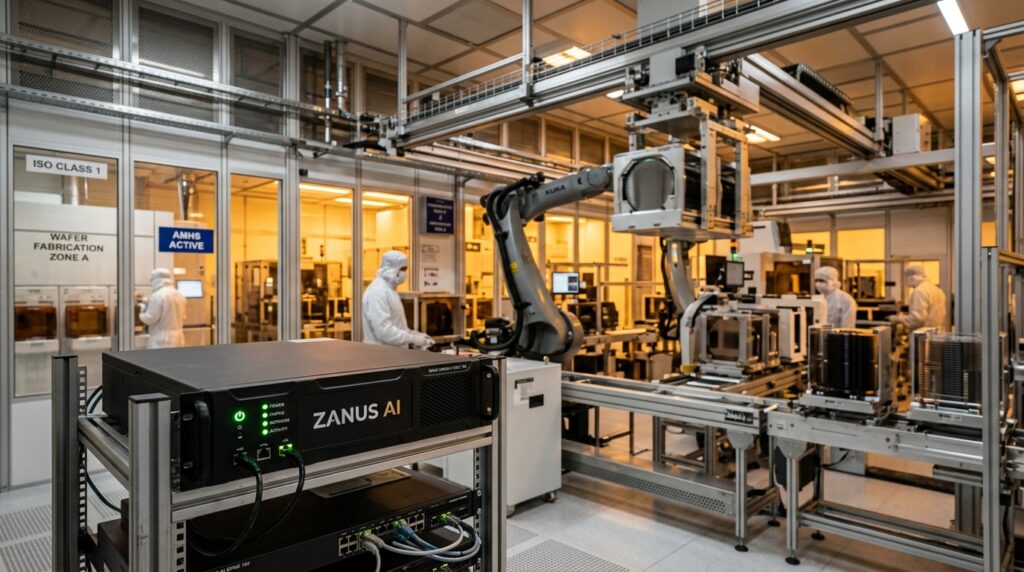
Evaluating zanus ai for manufacturing architectures demonstrates that most plants do not need another experimental AI model.. They need a practical way to eliminate operational bottlenecks that quietly bleed profitability through scrap, unplanned downtime, and quality defects. While the promise of Industry 4.0 is massive, industrial leaders face a stark architectural crossroads: route sensitive factory telemetry to the public cloud or process it locally at the edge.
For high-velocity sectors—such as semiconductor fabrication, automotive assembly, and precision pharmaceuticals—this choice impacts more than just network latency. It defines the security of core intellectual property and determines whether a physical rejection line can operate without catastrophic timing failures.
Cyber-Physical Risk Profiling and Intellectual Property Sovereignty
In high-value manufacturing, intellectual property (IP) represents the foundation of market capitalization. This IP is crystallized in digital assets: commercial engineering blueprints, high-resolution component CAD models, and trade-secret manufacturing recipes. Moving these digital assets outside the physical facility introduces severe cyber-physical risks.
Public Cloud Vulnerabilities and Industrial Espionage
Transmitting raw telemetry, high-resolution camera feeds, and multi-dimensional CAD files to a public cloud network expands the attack surface far beyond the factory floor. Data in transit traverses external networks, wide-area network (WAN) routing hops, and third-party gateways, leaving it vulnerable to interception, domain name system (DNS) hijacking, and man-in-the-middle exploits.
Within the public cloud domain, multi-tenant environments introduce persistent risks from hypervisor vulnerabilities, credential leaks, and insider threats. Sophisticated threat actors target these cloud environments to exfiltrate proprietary designs.
The theft of 2D and 3D CAD models allows competitors to bypass years of research and development, fabricating counterfeit replicas at a fraction of the cost. These replicas erode market share and inflict severe reputational damage when low-quality knock-offs are associated with the original brand.
Beyond static designs, the theft of trade-secret manufacturing sequences presents a major operational vulnerability. In process-driven industries, specific parameters—such as raw material compositions, chemical ratios, thermal curing schedules, and toolpath velocities—are embedded within operational technology (OT) systems. When this data is uploaded to a public cloud for predictive optimization, the core recipes of the physical products are exposed.
If an adversary exfiltrates these sequences, the loss of competitive advantage can persist for years. Competitors can immediately replicate identical material properties, neutralizing the innovator’s market advantage. Furthermore, plant-level data historians that aggregate data over extended periods represent a primary target for lateral movement. An adversary infiltrating a cloud-connected OT environment can manipulate or exfiltrate data from these historians to gain unauthorized access to historical quality logs and process limits.
Purdue Model Alignment and Level 3 Edge Integration
To protect operational trade secrets, modern industrial cybersecurity relies on the Purdue Enterprise Reference Architecture (PERA). The Purdue Model establishes strict, hierarchical network segmentation to isolate physical control systems from enterprise IT and external public networks:
- Level 0 (Physical Process): Physical sensors, actuators, and raw machinery executing operations on the line.
- Level 1 (Basic Control): Programmable Logic Controllers (PLCs) and Remote Terminal Units (RTUs) that translate sensor data into physical commands.
- Level 2 (Supervisory Control): Human-Machine Interfaces (HMIs) and Distributed Control Systems (DCS) for localized operator monitoring.
- Level 3 (Site Operations): Manufacturing Execution Systems (MES), localized batch controllers, and data historians managing production workflows.
- Level 3.5 (Industrial DMZ – iDMZ): A critical security buffer containing firewalls, proxy servers, and data diodes designed to terminate direct communication between the OT environment (Levels 0–3) and the IT domain.
- Level 4 (Enterprise Network): Corporate enterprise resource planning (ERP) systems, logistics scheduling, and office IT infrastructure.
- Level 5 (External Cloud): External networks, remote databases, and public cloud software-as-a-service (SaaS) platforms.
Integrating cloud-dependent AI systems frequently conflicts with the hierarchical isolation principles of the Purdue Model. Cloud-centric models require bidirectional, low-latency links that puncture multiple security layers, connecting Level 1 or Level 2 controllers directly to Level 5 cloud endpoints. This direct path bypasses the protection of the Industrial DMZ and establishes an unregulated channel through which malware can propagate downward to compromise physical machinery.
| Evaluation Criterion | Public Cloud AI Architecture | Turnkey On-Premises AI Server | Custom On-Premises GPU Build |
| Purdue Model Layer | Level 4/5; forces Level 1/2 systems to bypass the iDMZ. | Level 3; localized execution behind secure Level 3.5 iDMZ. | Level 3; local execution, but often requires custom routing. |
| Data Sovereignty | Data leaves the physical facility, traversing external networks. | 100% on-premises; fully capable of running in an air-gap. | Localized, but depends heavily on custom IT configuration. |
| Deployment Timeframe | 3 to 6 months of continuous cloud integration and pipeline tuning. | 6 to 12 weeks from delivery to fully operational status on-site. | 9 to 18 months spent in manual assembly and driver testing. |
| Supply Chain Validation | None; dependent on public cloud infrastructure providers. | ISO 9001:2015 and ISO/IEC 20243:2018 verified supply chain. | Variable; high risk of unvalidated hardware components. |
| Risk of Lateral Movement | High; cloud connection can be leveraged to pivot directly to PLCs. | Negligible; restricted to Level 3 site operations via iDMZ proxies. | Moderate; depends on the security maturity of the internal team. |
| Operational Cost Model | Variable; scales unpredictably with frame rates and API volumes. | Predictable capital expenditure with stable service fees. | High initial CapEx combined with variable internal maintenance costs. |
Deploying hardware-isolated, turnkey AI servers at Level 3 of the Purdue Model contains high-bandwidth camera streams, sensor telemetry, and proprietary models within the local OT boundary. These edge servers communicate with Level 1 and Level 2 control loops via local industrial protocols such as OPC-UA, Modbus, or EtherNet/IP.
Any metadata updates or telemetry rollups intended for enterprise IT are mediated through a secure Level 3.5 iDMZ using one-way push mechanisms, data diodes, or secure proxies. This deployment architecture prevents external cyberattacks from propagating laterally from the IT corporate network to the physical assembly line.
If you are scaling your enterprise AI deployment and need robust, high-bandwidth bare-metal hosting without exorbitant cloud egress fees, check out our in-depth NovoServe Review and our NovoServe vs Hetzner Comparison to find the right server specs for your budget. Additionally, if your team manages multi-language workflows or cross-border project documentation, read our hands-on Palabra AI Review and Palabra AI vs Lokalise Breakdown to learn how automated AI localization can streamline your content pipeline.
Hardware-Level Isolation and Device Hardening
On-site edge AI systems require robust physical and cryptographic security controls to prevent tampering, unauthorized access, and model theft. Modern industrial AI servers achieve this through a multi-layered security architecture rooted directly in physical hardware:
- Hardware Root of Trust (HRoT): A dedicated, physically isolated cryptographic processor embedded on the system silicon that provides secure key storage and cryptographic services.
- Secure and Measured Boot: At power-on, the HRoT cryptographically verifies the digital signature of the initial bootloader, system firmware, operating system kernel, and application containers before execution. This prevents unauthorized or modified code from booting on the system, defending against firmware implants and rootkits.
- Firmware Trusted Platform Module (fTPM): Provides secure storage for cryptographic keys, certificates, and platform configuration measurements, allowing remote attestation of system integrity.
- Hardware-Accelerated Memory and Storage Encryption: Turnkey industrial edge platforms utilize inline DRAM Error-Correcting Code (ECC) and cryptographic memory encryption engines. This prevents side-channel memory attacks, physical bus snooping, and cold-boot vulnerabilities, ensuring that models and CAD data remain encrypted while active in memory.
- Trusted Execution Environments (TEEs): Using secure container partition hypervisors, the server creates isolated execution environments. This isolates real-time AI workloads, model parameters, and industrial control loops from the host operating system, preventing an attacker from accessing sensitive data even if the host OS is compromised.
To ensure the physical integrity of the hardware prior to deployment, systems are sourced from organizations possessing ISO 9001:2015 and ISO/IEC 20243:2018 certifications. These international standards enforce strict supply chain risk management (SCRM) protocols, mitigating the threat of counterfeit components and malicious firmware tampering at the silicon level.
Editor’s Perspective
The biggest mistake an operations manager can make is assuming that firewall rules alone can protect an internet-facing AI model connected to a PLC. True industrial security requires absolute data containment. By locking down the AI compute infrastructure at Level 3 and strictly enforcing hardware-level isolation, manufacturers eliminate the structural vulnerabilities inherent in public cloud routing.
Physical Determinism, Latency Budgets, and Local Edge Compute Architecture
High-speed physical manufacturing operates within strict, millisecond-level time constraints. Executing deep-learning computer vision tasks—such as real-time defect detection, surface anomaly scanning, and packaging verification—requires a highly deterministic control loop.
Physical Mathematics of Rejection Pipelines
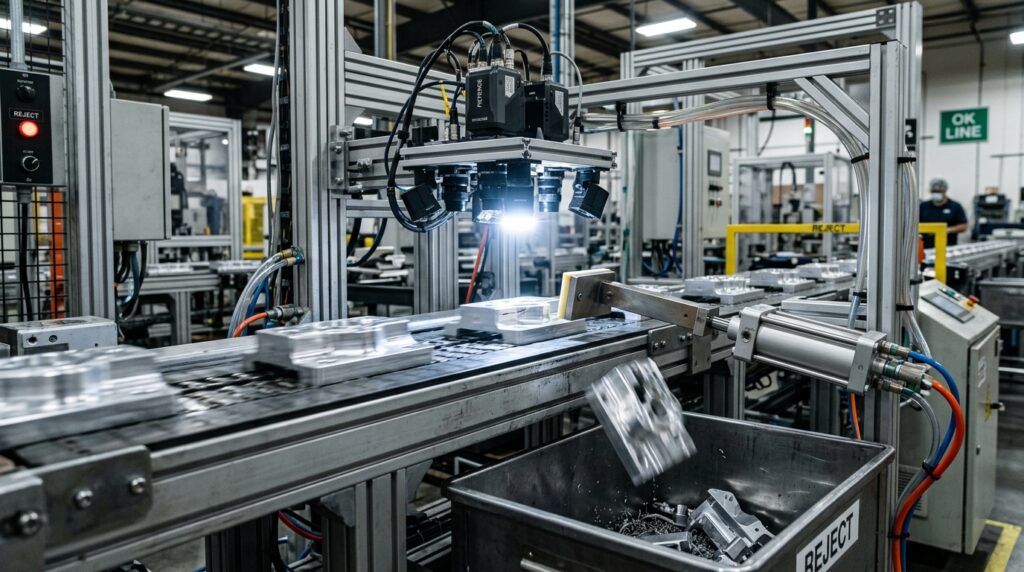
To evaluate the operational limits of edge-based processing versus public cloud networks, one must calculate the exact physical time budget available to a vision system on a moving assembly line. Consider a rapid-motion conveyor belt transporting solid parts. The physical pipeline is defined by the following system equations:
Let $D$ be the distance from the camera field of view centerline to the centerline of the downstream pneumatic rejection valve (m), and let $v$ represent the constant velocity of the conveyor belt (m/s). The transit time $t_{\text{transit}}$ available for the entire system before the part reaches the rejection point is given by:
$$t_{\text{transit}} = \frac{D}{v}$$
Let $L$ be the physical length of the part along the direction of travel (m). The part passage window $t_{\text{passage}}$, which represents the total time a single part occupies a given point on the line (the physical target window), is:
$$t_{\text{passage}} = \frac{L}{v}$$
For the pneumatic rejection mechanism to strike the defective part accurately without touching adjacent non-defective parts, the entire system must trigger the valve within a specific time boundary. The maximum permissible pipeline latency $t_{\text{pipeline\_max}}$—encompassing image capture, hardware encoding, deep-learning model inference, PLC queue processing, and electronic command propagation—is constrained by:
$$t_{\text{pipeline\_max}} = t_{\text{transit}} – t_{\text{actuation}} – t_{\text{safety}}$$
Where:
- $t_{\text{actuation}}$ is the physical response and stabilization time of the pneumatic valve and actuator (s).
- $t_{\text{safety}}$ is the engineering safety margin allocated for mechanical tolerances, PLC scan times, and minor physical belt slip (s).
To evaluate these dynamics, two physical line configurations are analyzed, using a constant high-speed conveyor velocity of $v = 3.0 \text{ m/s}$, a standardized part length of $L = 0.05 \text{ m}$ (50 mm), an actuator delay of $t_{\text{actuation}} = 45 \text{ ms}$ (0.045 s), and an engineering safety margin of $t_{\text{safety}} = 10 \text{ ms}$ (0.010 s):
Configuration A: Long-Transit Layout
- Camera-to-valve distance: $D = 1.5 \text{ m}$
- Transit time calculation:$$t_{\text{transit}} = \frac{1.5 \text{ m}}{3.0 \text{ m/s}} = 0.500 \text{ s} = 500.00 \text{ ms}$$
- Part passage window calculation:$$t_{\text{passage}} = \frac{0.05 \text{ m}}{3.0 \text{ m/s}} \approx 0.01667 \text{ s} = 16.67 \text{ ms}$$
- Maximum allowable pipeline latency:$$t_{\text{pipeline\_max}} = 500.00 \text{ ms} – 45.00 \text{ ms} – 10.00 \text{ ms} = 445.00 \text{ ms}$$
Configuration B: Compact Machine-Integrated Layout
- Camera-to-valve distance: $D = 0.5 \text{ m}$
- Transit time calculation:$$t_{\text{transit}} = \frac{0.5 \text{ m}}{3.0 \text{ m/s}} \approx 0.16667 \text{ s} = 166.67 \text{ ms}$$
- Maximum allowable pipeline latency:$$t_{\text{pipeline\_max}} = 166.67 \text{ ms} – 45.00 \text{ ms} – 10.00 \text{ ms} = 111.67 \text{ ms}$$
Latency Profiles and the Impact of WAN Jitter
Comparing these physical limits against the latency profiles of public cloud and edge-based infrastructures reveals an operational divergence. The latency of a public cloud pipeline ($t_{\text{cloud}}$) is modeled as a function of multiple variables:
$$t_{\text{cloud}} = t_{\text{capture}} + t_{\text{uplink}} + t_{\text{inference\_cloud}} + t_{\text{downlink}} + t_{\text{plc}} + t_{\text{jitter}}$$
Where:
- $t_{\text{capture}}$ is the time required to acquire, serialize, and encode the video frame (typically 15 ms).
- $t_{\text{uplink}}$ and $t_{\text{downlink}}$ represent the wide-area network (WAN) round-trip time (RTT), ranging from 40 ms to 120 ms under optimal fiber or local 5G setups.
- $t_{\text{inference\_cloud}}$ is the model run time on a centralized data center GPU (typically 20 ms).
- $t_{\text{plc}}$ is the queuing and execution scan time on the local controller (typically 5 ms).
- $t_{\text{jitter}}$ is the statistical variance in WAN transit times, which regularly spikes from 5 ms to 30 ms or more due to internet congestion, routing changes, or packet loss.
Under optimal network conditions, $t_{\text{cloud}}$ achieves a baseline of approximately 120 ms ($15 + 40 + 20 + 40 + 5$). However, when WAN jitter is introduced, $t_{\text{cloud}}$ can easily swell to 280 ms or more.
For the long-transit Configuration A ($t_{\text{pipeline\_max}} = 445 \text{ ms}$), cloud processing is theoretically possible during stable periods. However, any transient network degradation that pushes the round-trip latency past 445 ms will cause the system to miss the part, resulting in missed defects and contaminated batches.
For the compact Configuration B ($t_{\text{pipeline\_max}} = 111.67 \text{ ms}$), the cloud pipeline is structurally non-viable, as even the best-case cloud latency (120 ms) exceeds the total physical transit time. Relying on a timer-based PLC sync with cloud inference is highly error-prone because of network jitter. In contrast, edge-based systems decouple high-speed image acquisition from processing, utilizing index-based PLC tracking (such as FIFO shift registers triggered by physical encoders) to ensure precise physical alignment.
By running inference on local edge GPU clusters, WAN variables are eliminated. The local latency is deterministic:
$$t_{\text{edge}} = t_{\text{capture}} + t_{\text{local\_transit}} + t_{\text{inference\_edge}} + t_{\text{plc}}$$
Where $t_{\text{local\_transit}}$ over local switched network infrastructure is less than 2 ms, and local GPU execution ($t_{\text{inference\_edge}}$) is highly stable, delivering an end-to-end local latency of 10 ms to 50 ms. This deterministic execution ensures that even compact line configurations can reliably inspect and reject parts without line stops or manual intervention.
Hardware Performance Profiles: IGX Orin vs. IGX Thor
To meet the computational requirements of real-time multi-camera defect classification, manufacturers deploy industrial-grade edge architectures. The table below contrasts the technical specifications of the current industrial standards, the NVIDIA IGX Orin and the NVIDIA IGX Thor platforms:
| Technical Parameter | NVIDIA IGX Orin Platform | NVIDIA IGX Thor Platform |
| CPU Architecture | 12-core Arm Cortex-A78AE @ 1.996 GHz | Server-class high-performance core architecture |
| GPU Architecture | Ampere (2,048 CUDA cores, 64 Tensor cores) | Blackwell Architecture (Integrated & Discrete options) |
| AI Processing Power | Up to 275 TOPS (iGPU only) | Up to 5,581 FP4 Teraflops (iGPU + dGPU combined) |
| Memory Configuration | 64 GB LPDDR5 with Inline ECC (204.8 GB/s) | 128 GB LPDDR5x with ECC (273 GB/s bandwidth) |
| Networking Throughput | 200 Gb/s high-speed Ethernet (ConnectX-7) | 400 Gb/s enterprise-grade connectivity |
| Expansion Capabilities | PCIe Gen5 x16 slot for discrete GPU (e.g., RTX 6000) | Scalable high-bandwidth PCIe Gen5 connectivity |
| Functional Safety | Real-time functional-safety roadmap built-in | Advanced hardware-level safety-island architectures |
| Operating Lifetime | 10-year enterprise lifecycle support (through 2033) | Extended industrial deployment window |
Integrating these edge processors allows factories to transition from simple threshold-based machine vision to deep-learning instance-segmentation models (e.g., YOLOv8x-Seg). For example, in bottle quality control, changing from standard Mask R-CNN (processing latency of 160 ms to 240 ms) to YOLOv8x-Seg running on a local GPU reduces inference latency to 20 ms–70 ms. This latency reduction enables conveyor speeds to increase from 45 cm/s to 67.5 cm/s, raising throughput from 226 to 428 bottles per minute with 100% inspection accuracy.
Similarly, in high-volume packaging applications, such as cement bag packing, local deep-learning inference analyzes bag integrity, seal gaps, and print anomalies in under 100 ms, triggering a local divert gate within a 400 ms window to catch defects before they reach the downstream palletizer.
Advanced Algorithmic Workloads and Sensor Fusion at the Edge
Turnkey edge AI platforms process diverse algorithmic workloads simultaneously. In the area of inline quality assurance, systems execute deep learning pipelines such as YOLOv8x-Seg to classify defects in real time. For instance, on automated packaging lines, high-speed vision systems utilize Canny edge detection and texture anomaly segmentation to identify tears from 5 mm upward.
In specialized inspection setups, such as transparent pharmaceutical ampoule verification, the edge server integrates stress measurements using the photoelastic method and subpixel contour extraction. This enables the measurement of residual stress (with an error of $\pm 3 \text{ nm}$) and dimensional accuracy (within $\pm 0.2 \text{ mm}$) alongside surface defect identification on a single unified inspection node.
Simultaneously, the edge server runs multi-sensor fusion algorithms for predictive maintenance and machinery diagnostics. Long Short-Term Memory (LSTM) neural networks process vibration, thermal, acoustic, and electrical current signatures from mechanical components. Incorporating specialized systems like Zanus AI for manufacturing allows the platform to synchronize deep-learning computer vision with high-precision motion control feedback loops. By analyzing these multi-modal streams locally, the AI detects structural anomalies, bearing wear, and motor degradation 3 to 6 weeks before failure occurs, enabling maintenance to be scheduled during planned windows rather than emergency shutdowns.
Operational Impact
Decoupling the plant floor from WAN dependencies guarantees deterministic execution. When the physical processing window drops to under 150 milliseconds, any cloud-based architecture is fundamentally unviable. Edge computing transforms machine learning from an analytical luxury into a deterministic, real-time control tool.
Disconnected Operational Resilience and High Availability Control Frameworks
Ensuring 100% operational uptime on the plant floor requires a robust architectural strategy for handling complete regional WAN outages. When wide-area connectivity is interrupted, physical production must continue without degradation.
The Offline-First Edge Architecture
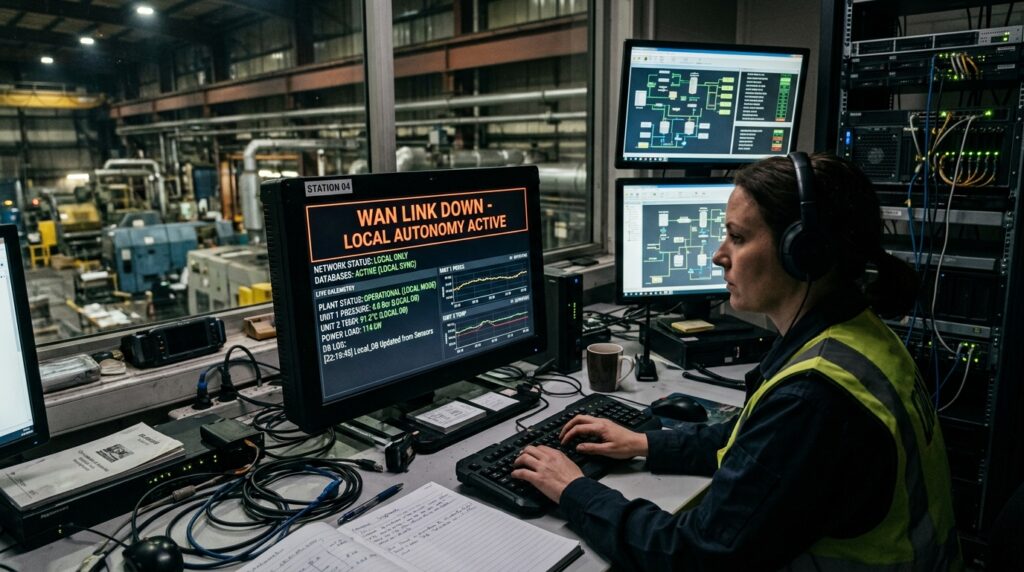
Turnkey industrial edge systems employ an “offline-first” architecture designed to treat wide-area network disconnects as a standard operational state rather than an emergency exception. This design ensures that all core execution logic, real-time inference pipelines, and physical control feedback loops reside entirely within the local Level 3 server, removing external internet services from the primary operational path.
To support local processing without cloud dependency, the edge server utilizes a tiered, localized storage architecture. Relational transactional data, configuration metrics, and localized quality logs are stored within a local SQLite database, providing complete ACID transactional guarantees on the factory floor.
Complex analytical queries and local process-drift calculations are handled by DuckDB, an embedded analytical engine optimized for high-performance OLAP on resource-constrained devices. Real-time state metrics and cross-process telemetry are cached within Redis Edge to facilitate low-latency local communication. Lightweight, NoSQL object persistence is managed by ObjectBox to map complex data models with minimal serialization overhead.
Store-and-Forward Synchronization Mechanisms
To maintain synchronization with central enterprise systems without depending on persistent connectivity, the edge architecture utilizes a store-and-forward pattern. The communication fabric relies on NATS leaf nodes or MQTT brokers deployed directly on the local server. Since enterprise security policies forbid opening inbound ports from the WAN to the OT network, the edge server utilizes an “outbound dial-out” design. The local NATS leaf node dials out to the central enterprise hub cluster over a secure TLS tunnel.
During a WAN outage, the local server continues to perform real-time model inference and write all generated transactional records, quality events, and performance logs to its local databases. The NATS leaf node buffers these outbound messages in a persistent, disk-backed circular queue.
Once WAN connectivity is restored, the system automatically detects the active connection and initiates a structured sync. The queued messages are transmitted to the central enterprise databases using a guaranteed, exactly-once delivery pattern. This architecture ensures that zero data is lost during communication drops, and enterprise systems are updated with chronological accuracy.
Tactical Degradation Modes (SOMUT)
When the wide-area network disconnects, the edge server transitions from standard operations to a state-aware Tactical Degradation Mode (operationally termed SOMUT in industrial settings). This mode prioritizes computational tasks and optimizes local storage allocation:
- Critical Control Path Preservation: The system prioritizes real-time local control actions, ensuring that vision-guided defect detection and automated physical rejection gates continue operating with zero interruption.
- Telemetry Down-Sampling and Filtering: Rather than attempting to queue high-bandwidth raw sensor streams, the local engine filters noise and aggregates data (e.g., executing local one-minute averages or change-of-state only logging). This reduces local disk space usage during long outages.
- Local Storage Management (Dashcam Logic): High-bandwidth artifacts, such as raw uncompressed inspection videos, are written to a localized, circular buffer. If the edge model detects a defect, the specific frame or video segment is flagged for long-term retention and eventually uploaded when WAN is restored. If no defect is detected, the buffer is automatically overwritten, maintaining a minimal physical storage footprint.
- Operational Authority Delegation: Non-essential enterprise services, such as global dashboard updates or model retraining pipelines, are deferred. The edge system handles operational events locally and syncs with central systems once connectivity returns.
| Recovery Metric | Cloud-Dependent AI Architecture | Turnkey Edge AI Server (SOMUT) |
| Inference Status | Offline immediately; real-time defect classification and mechanical diagnostics halt. | 100% active; local GPU clusters execute model inference locally. |
| Data Preservation | High risk of data loss; raw sensor streams are dropped or fail to be ingested. | Zero data loss; outbound events are queued locally in persistent, disk-backed storage. |
| Rejection Mechanism Sync | Complete failure; PLC timers or index arrays lose real-time sync with cloud servers. | Normal operation; local edge-to-PLC communication loops remain fully active. |
| Storage Strategy | None; localized buffers are easily overwhelmed by uncompressed raw video. | Intelligent filtering; system uses “dashcam logic” to selectively retain only verified defect frames. |
| Reconnection State | Often requires manual rebooting and manual data reconciliation to resolve sync conflicts. | Automatic state reconciliation; NATS leaf nodes upload buffered logs using an exactly-once pattern. |
To protect the system against supply chain-level attacks on its software and configurations, updates to the edge models are protected by strict cryptographic signatures. Binary updates and neural network weights are signed using asymmetric cryptography (such as minisign) and verified by the local edge agent against pinned public keys. This eliminates the risk of malicious firmware injection or model hijacking over compromised WAN links, reinforcing operational safety during updates.
System-Level High Availability (HA)
To guard against hardware-level failure, turnkey AI servers are deployed in local High Availability (HA) clusters. This setup uses a lightweight, production-grade Kubernetes orchestrator (such as K3s) with an embedded etcd consensus cluster.
By deploying redundant physical edge nodes within the facility, the containerized AI application is distributed across multiple compute units. A local load balancer monitors the status of each node through a continuous network heartbeat.
If a physical server fails—due to a power supply failure, memory crash, or local storage corruption—the backup node detects the loss of heartbeat through the consensus layer. The load balancer and container runtime automatically failover the active video processing and PLC communication containers to the standby server. This localized transition occurs in under 10 seconds, preventing line stoppage, protecting active processes, and ensuring continuous operational uptime.
Real-world Consideration
A factory that stops production when the internet goes down isn’t automated; it’s dependent. Implementing an offline-first storage architecture combined with a local container failover framework ensures that line execution remains independent of WAN stability.
Strategic Operational Integration and Financial Viability
Implementing edge-based, hardware-isolated turnkey AI servers provides a clear operational and financial path forward for manufacturing organizations.
Enterprise Systems Integration and Regulatory Compliance
The localized quality data generated by the edge server is integrated directly into plant-level and enterprise systems. Turnkey platforms utilize built-in OPC-UA connectors and REST APIs to push real-time quality events, inline inspection results, and machinery wear metrics directly into manufacturing execution systems (MES) and enterprise resource planning (ERP) databases, including SAP, Oracle, and Infor.
| Operational Integration Vector | Integrated Edge Platform Capabilities |
| Automation Interconnection | Direct connection to Level 1 and 2 systems via OPC-UA, Modbus, and GMSL camera lines. |
| Enterprise Sync | Real-time REST API connectors push quality and OEE metrics to ERP systems (SAP, Oracle). |
| Immutable Traceability | Cryptographic hash chains generate tamper-proof logs with 7-year retention. |
| Regulatory Support | Simplifies compliance audits for IATF 16949, FDA 21 CFR Part 11, and EU CBAM. |
Every defect classification, statistical process control (SPC) signal, and preventative maintenance event is timestamped and recorded as an immutable digital quality record. By establishing cryptographically hashed ledger logs (with up to 7-year retention), the system supports direct compliance with stringent regulatory standards, including IATF 16949 automotive audits, FDA 21 CFR Part 11 requirements for pharmaceutical manufacturing, and EU Carbon Border Adjustment Mechanism (CBAM) environmental audits.
Capital and Operational Cost Structures
From a financial perspective, turnkey edge AI servers replace highly volatile cloud subscription models with a predictable, structured capital and operational expense framework.
Cloud-first architectures expose manufacturers to fluctuating wide-area network ingress and egress fees, variable API usage charges, and compute-on-demand pricing that can scale unpredictably with high frame rates or multiple camera streams. In contrast, a turnkey edge platform utilizes a predictable capital expenditure (CapEx) for the physical hardware and setup, combined with a stable, flat-rate subscription for ongoing updates.
For example, a standard turnkey server deployment carries a clear, upfront cost structure:
$$\text{Initial Turnkey Investment} = \text{Hardware Cost} + \text{Model Installation Service}$$
Using real-world figures from industrial procurement, the initial hardware deployment is priced at €10,995, with an integrated model installation service of €995, resulting in a total predictable Day-0 investment of €11,990 per node. Ongoing updates are managed through a Sovereign Model Updates Subscription of €299 per month, which delivers weekly security backports, monthly NIM microservice refreshes, and daily zero-day hotfixes.
This pricing structure eliminates the variable operational expenses associated with cloud computing, allowing financial planners to accurately model the long-term total cost of ownership (TCO) across multiple facilities.
Summary of Strategic Advantages
By choosing turnkey, hardware-isolated edge servers over custom on-premises builds, manufacturers realize a substantial time-to-value advantage. Custom-built edge nodes require manual component sourcing, custom operating system configuration, complex CUDA driver validation, and model optimization. This typically demands a highly specialized, in-house team and 9 to 18 months of development and testing before deployment.
A pre-configured, turnkey server arrives pre-loaded with optimized deep learning SDKs and validated model bundles, reducing the time-to-live deployment window to just 6 to 12 weeks. This rapid deployment schedule, combined with 10-year enterprise lifecycle support, provides a predictable, secure, and operationally resilient foundation for physical AI on the modern factory floor.
Deployment Insight
Procurement teams often fixate on the initial capital cost of on-premises hardware while ignoring the hidden operational drain of cloud data egress fees. A flat-rate capital expense structure combined with an offline-first deployment model provides long-term financial predictability and ensures that scaling production lines doesn’t lead to exponentially growing cloud software bills.
Your Next Step
Achieving absolute physical isolation and shielding your high-velocity production line from network latency demands an intentional pivot toward edge-level server containment. To successfully evaluate your facility’s technology readiness and present a certified infrastructure acquisition proposal to your operations board, we recommend analyzing our separate enterprise cluster resources:
- Computational Density Benchmarks: Verify the exact VRAM parameters and GPU processing thresholds required for your multi-camera pipelines by exploring the Zanus AI Prime vs Quantum infrastructure matrix.
- Production Facility Layouts: Audit your secure server room’s electrical draw, cooling capacity, and short-depth chassis dimensions using the Zanus AI Hardware Infrastructure manual.
- Embedded Software Architecture: Discover how the pre-installed private operating engine manages local business automation modules by reading our extensive Zanus AI Deep Review.
- Structural Compliance Telemetry: For a detailed engineering guide on how edge-native visual computing layers automate structural inspection profiles under regional regulations, see our technical blueprint on minimizing the Florida SB-4D inspection cost.
Don’t let unstable wide-area networks or volatile token consumption bills stall your active factory floor operations—audit your master data architecture and deploy your turnkey zanus ai for manufacturing deployment cluster today.
If you are scaling your enterprise AI deployment and need robust, high-bandwidth bare-metal hosting without exorbitant cloud egress fees, check out our in-depth NovoServe Review and our NovoServe vs Hetzner Comparison to find the right server specs for your budget. Additionally, if your team manages multi-language workflows or cross-border project documentation, read our hands-on Palabra AI Review and Palabra AI vs Lokalise Breakdown to learn how automated AI localization can streamline your content pipeline.
References
- NVIDIA Corporation, NVIDIA IGX Industrial Edge AI Platform Technical Specifications, https://www.nvidia.com/en-us/edge-computing/products/igx/
- International Organization for Standardization, ISO/IEC 20243:2018 Information Technology — Open Trusted Technology Provider V1.1 (O-TTPF), https://www.iso.org/standard/74438.html
- Palo Alto Networks, What Is the Purdue Model for ICS Security? A Guide to PERA, https://www.paloaltonetworks.com/cyberpedia/what-is-the-purdue-model-for-ics-security
- ResearchGate, Real-Time Bottle Quality Control: Comparing Mask R-CNN and YOLOv8x-Seg on an Industrial Conveyor, https://www.researchgate.net/publication/378451290_Real-Time_Bottle_Quality_Control
- MDPI, A Multi-Parameter Inspection Platform for Transparent Packaging Containers: System Design for Stress, Dimensional, and Defect Detection, https://www.mdpi.com/2076-3417/13/4/2180
- PARTEE Systems, Trustworthy Real-Time Containers for the Physical AI Era, https://partee.systems/architecture/