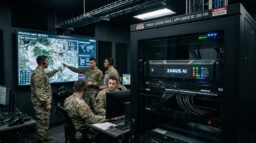
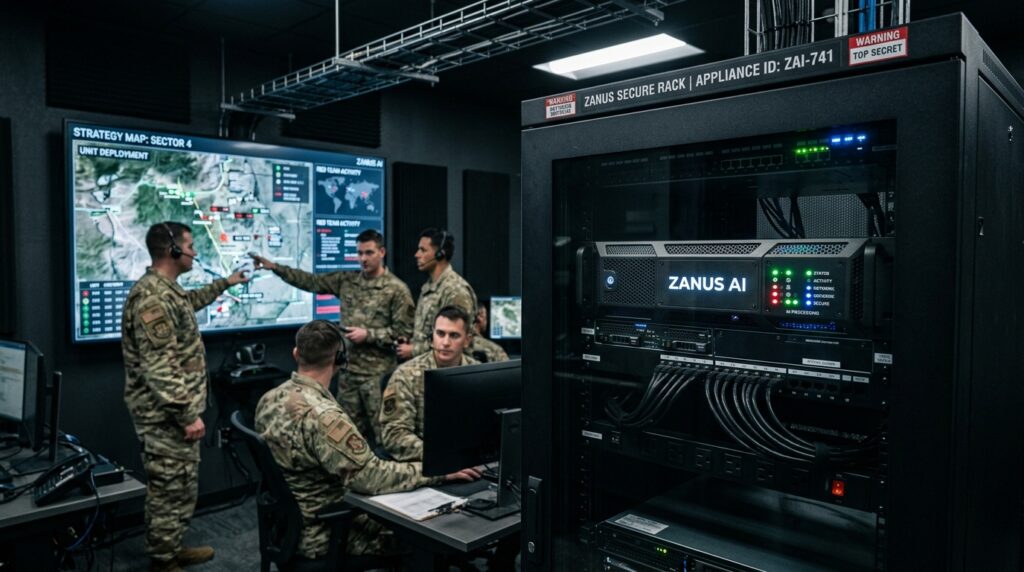
Most defense agencies and municipal operations teams do not need another high-level technology briefing. They need a concrete strategy to solve a critical operational vulnerability: how to deploy large language models (LLMs) and deep reasoning systems without exposing classified mission telemetry, critical infrastructure schematics, or sensitive public safety records to external networks.
While public cloud ecosystems offer rapid software iteration, they introduce unacceptable risks when dealing with nation-state threat vectors, strict regulatory frameworks like CJIS or NIST SP 800-53, and the threat of remote code execution (RCE) zero-day exploits. To eliminate these network data egress pathways completely, procurement teams are actively analyzing private, physical compute architectures.
This technical assessment provides an independent evaluation of Zanus AI for defense & government systems, analyzing the practical trade-offs of physical air-gapping, local vector database integration, and the long-term lifecycle costs of turnkey sovereign servers versus cloud-hosted enclaves or unverified do-it-yourself (DIY) hardware builds.
The Vulnerability of Logical Boundaries: Why Defense Architectures Require Physical Isolation
Modern defense and intelligence IT frameworks often rely on virtualized security perimeters to isolate sensitive data workloads. However, automated red-team evaluations indicate that logical network segmentation—such as Virtual Local Area Networks (VLANs), Layer 3 Access Control Lists (ACLs), and software-defined firewalls—frequently fails under targeted nation-state cyber campaigns.
VLAN hopping via double-tagging attacks demonstrates the inherent risk of switch-level logical separation. An adversary can manipulate an Ethernet frame by prepending two distinct IEEE 802.1Q tags:
$$\text{Frame}_{\text{manipulated}} = [\text{Preamble}][\text{MAC}_{\text{dest}}][\text{MAC}_{\text{src}}][\text{VLAN}_{\text{outer}}][\text{VLAN}_{\text{inner}}][\text{Type}][\text{Payload}][\text{FCS}]$$
When the primary switch strips the outer native tag, it forwards the packet to a trunk port without evaluating the inner tag, allowing the packet to bypass router-enforced ACLs upon reaching the downstream switch. Additionally, software-based firewalls remain vulnerable to administrative control plane vulnerabilities. If an attacker achieves arbitrary code execution on a hypervisor or edge security device, all logical downstream boundaries become invalid, enabling lateral movement straight into internal network clusters.
To mitigate this surface vector, rigorous defense environments require a true physical air-gap. Achieving this standard requires the absolute elimination of all physical, electromagnetic, and acoustic transmission pathways. In the context of hardware deployment, platforms like Zanus AI for defense & government enforce this boundary by physically desoldering and removing all integrated wireless microchips—including Wi-Fi, Bluetooth, and Near-Field Communication (NFC) modules—directly from the motherboard. This prevents firmware-level rootkits from covertly establishing radio frequency (RF) egress channels to nearby listening posts.
+-------------------------------------------------------------------------+
|                    MILITARY-GRADE AIR-GAPPED MOAT                        |
+-------------------------------------------------------------------------+
|  [External Networks] --X--> [Physical Air-Gap] --X--> [Internal LAN]     |
|                                                          |              |
|   - Motherboard wireless chips physically desoldered      v              |
|   - Enclosed within TEMPEST-shielded chassis           [Zanus AI Server] |
|   - Inbound updates restricted via physical data diodes                 |
+-------------------------------------------------------------------------+
Side-Channel Defenses and Physical Shielding
Even within a physical air-gap, advanced intelligence exploits can leverage hardware side-channels to exfiltrate information. These techniques do not rely on standard network routing; instead, they capture physical signals generated during intensive compute operations:
- TEMPEST Profiling: System memory buses and digital video interfaces generate unintentional electromagnetic emissions. Specialized high-gain receivers can capture these emissions from a distance ($r$) and reconstruct plain text, calculated via the electromagnetic signal-to-noise ratio ($SNR_{em}$):$$SNR_{em}(r) \propto \frac{P_{\text{trans}} \cdot G_{\text{ant}}}{r^2 \cdot N_{\text{env}}}$$where $P_{\text{trans}}$ represents emanated signal power, $G_{\text{ant}}$ is the receiver antenna gain, and $N_{\text{env}}$ is the ambient environmental noise.
- Bus Modulation (e.g., RAMBO): Malware can intentionally modulate CPU workloads to generate specific radio frequencies through the internal data bus of system RAM, turning the motherboard components into a temporary transmission antenna.
- Acoustic Exfiltration: Malware can regulate internal cooling fan speeds to generate precise acoustic frequencies or physical vibrations, leaking data to close-proximity listening devices.
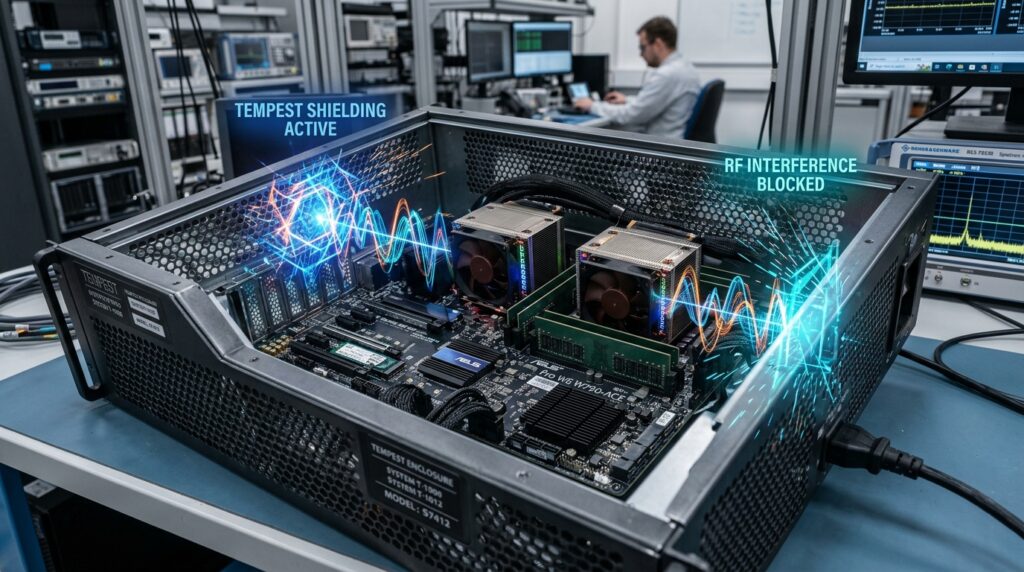
Defeating these complex attack vectors requires moving away from standard commercial-off-the-shelf (COTS) server chassis. Turnkey sovereign deployments must use TEMPEST-shielded enclosures outfitted with electro-conductive gaskets, honeycomb ventilation filters, and physical data diodes. A hardware data diode severs the inbound transmission pathway at the physical layer, utilizing a single internal LED transmitter pointing to a decoupled photodiode receiver, making incoming network commands structurally impossible.
Editor’s Perspective: The Isolation Compromise
Physical air-gapping drastically reduces the risk of external cyber attacks, but it introduces major operational compromises. It eliminates real-time software updates, prevents immediate access to foundational model improvements, and complicates daily administration. Security officers must determine whether their operational threat model justifies the significant friction of manual, offline patch cycles and restricted physical access controls.
Localized Vector Databases and Autonomous Municipal Operations
Municipalities, public safety networks, and regional utility departments handle vast arrays of highly sensitive data, including spatial blueprints for water grids, law enforcement incident logs, and critical infrastructure routing. Processing this data through public cloud APIs presents severe regulatory validation hurdles and exposes the data to third-party data mining or third-party legal subpoenas.
To maintain local data sovereignty, public sector entities are shifting to localized Retrieval-Augmented Generation (RAG) architectures deployed on physical networks.
In-Network RAG Architecture
A localized RAG pipeline operates entirely within the boundaries of a secured local network, utilizing high-performance on-premises storage arrays to index and search municipal files without WAN dependencies.
[Unstructured Data Input] (CAD Blueprints, Transcripts, GIS Data)
         │
         ▼
[Local Embedding Model] ───> Projects data into dense vector space
         │
         ▼
[Offline Vector Store]  ───> Local similarity search (Cosine Similarity)
         │
         ▼
[On-Premises GPU Array] ───> Context injection into local LLM window
During document ingestion, unstructured files (such as complex CAD drawings or incident transcripts) are broken into chunks locally. These chunks are transformed into dense vector representations via a local embedding model. The semantic similarity between a user query vector ($\vec{q}$) and a stored document vector ($\vec{d}$) is calculated on the local GPU array using cosine similarity:
$$\text{Cosine Similarity}(\vec{q}, \vec{d}) = \frac{\vec{q} \cdot \vec{d}}{\|\vec{q}\| \|\vec{d}\|} = \frac{\sum_{i=1}^{n} q_i d_i}{\sqrt{\sum_{i=1}^{n} q_i^2} \sqrt{\sum_{i=1}^{n} d_i^2}}$$
These high-dimensional vectors are organized within an offline vector store located on internal RAID 10 NVMe drives. When a civil engineer or intelligence analyst queries the system, the vector engine pulls relevant data chunks and embeds them directly into the offline model’s context window. The data never traverses a public router, shielding the organization from external network intercepts.
Turnkey Operating Environments vs. Component Assembly
Operationalizing these workflows requires a cohesive software ecosystem built over the physical compute tier. Turnkey private solutions integrate specialized server OS environments containing local business modules—such as multi-tenant client management, automated scheduling, and role-based access control (RBAC)—which allow different public departments to utilize the same physical hardware cluster safely without cross-contaminating data structures.
If you are scaling your enterprise AI deployment and need robust, high-bandwidth bare-metal hosting without exorbitant cloud egress fees, check out our in-depth NovoServe Review and our NovoServe vs Hetzner Comparison to find the right server specs for your budget. Additionally, if your team manages multi-language workflows or cross-border project documentation, read our hands-on Palabra AI Review and Palabra AI vs Lokalise Breakdown to learn how automated AI localization can streamline your content pipeline.
Public Sector Implementations
| Municipal Application | Local Vector DB Input | Automated Municipal Action | Security & Egress Profile |
| Utility Grid Mapping | GIS coordinates, CAD schematics, SCADA event logs | Evaluates excavation permits, traces pipeline anomalies, plans maintenance | Air-gapped isolation protects critical infrastructure blueprints from remote cyber attacks. |
| Public Safety Analysis | Witness transcripts, incident reports, forensic logs | Aggregates investigative threads, indexes evidence, cross-references cold cases | Maintained entirely on-site; complies with CJIS mandates and preserves chain-of-custody rules. |
| City Operations Automation | Citations, civil filings, building permit requests | Routes inbound citizen requests, drafts responses, manages department workflows | Eliminates cloud data exposure, safeguarding citizen privacy and preventing leaks of pending real estate plans. |
Operational Impact: The Data Governance Prerequisite
Localized RAG systems are only as precise as the data ingested into them. If an agency processes disorganized records, out-of-date GIS coordinates, or corrupted CAD files, the local model will generate inaccurate outputs. Organizations must invest heavily in internal data cleansing and master data governance before deploying an on-premises AI stack; otherwise, they are simply automating bad information.
Procurement Analysis: Turnkey Private Hardware vs. Cloud Enclaves vs. DIY Builds
Procurement directors face three distinct paths when acquiring hardware-enforced AI capabilities: leasing enterprise cloud enclaves, constructing a custom build using open-source packages, or purchasing a pre-configured turnkey appliance like Zanus AI for defense & government.
                           PROCUREMENT SELECTION MATRIX
                                        │
         ┌──────────────────────────────┼──────────────────────────────┐
         ▼                              ▼                              ▼
  [Cloud Enclaves]              [DIY GPU Builds]              [Turnkey Servers]
  - High long-term OpEx         - Extreme driver friction     - High initial CapEx
  - Continuous data risk        - Zero vendor warranty        - Hard-capped costs
  - WAN dependency              - Telemetry leak risks        - TAA/DISA compliant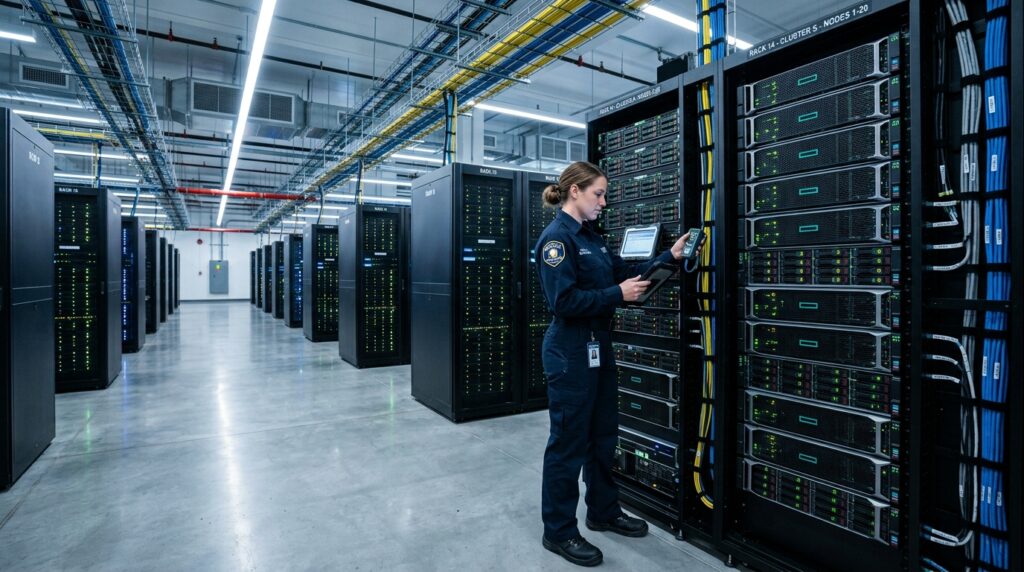
1. Cloud Enclaves (Government Cloud Subscriptions)
While specialized government clouds offer isolated infrastructure, they function on highly variable operational expense (OpEx) frameworks. High token volume utilization, continuous database indexing, and secure network gateway fees lead to volatile monthly billing cycles. Furthermore, these architectures require a persistent WAN connection, maintaining a persistent logical attack surface.
2. DIY Server Assembling (Custom Builds)
Assembling commercial components (e.g., combining consumer-grade GPUs with open-source model wrappers like Ollama) introduces high deployment risks. These configurations require weeks of manual troubleshooting, frequently encounter driver conflicts (such as CUDA and Linux kernel incompatibilities), and lack a unified hardware warranty. More importantly, unverified open-source libraries may contain hidden tracking code that subtly transmits usage telemetry back to external servers, violating strict defense data boundaries.
3. Turnkey Sovereign Appliances (e.g., Zanus AI Prime / Quantum)
Turnkey private servers convert ongoing data expenses into a predictable, front-loaded capital expense (CapEx). The system is deployed directly on the organization’s balance sheet as a physical capital asset.
For large-scale, continuous workloads—such as automated monitoring of military asset telemetry or processing vast municipal archives—a dedicated hardware appliance typically achieves financial parity and breaks even compared to equivalent cloud subscription costs within 14 months of deployment.
Hardware Specification Configurations
To support localized environments, hardware packages are divided into discrete performance tiers scaled to data density requirements:
- Tactical Server Tier (Zanus AI Prime Cfg): Standard 19-inch 8U rackmount enclosure using air-cooled thermal dissipation (avoiding liquid loops that pose leakage risks). Engineered to index up to 2,000,000 documents and 50,000 hours of audio/video on mirrored internal storage, running on standard AC circuits without custom high-voltage data center rewiring.
- Enterprise Concurrency Tier (Zanus AI Quantum Cfg): Configured with expanded system memory and enhanced GPU density to manage up to 5,000,000 text files and 100,000 hours of media content, supporting simultaneous queries across multiple municipal departments.
- Sovereign Cluster Architecture: Multi-node configurations that mirror vector stores across distinct geographical command facilities to ensure continuous operation across large-scale theater commands.
Procurement Insight: Obsolescence Tracking
Purchasing physical hardware locks the organization into a specific generation of compute performance. Unlike cloud instances that can be upgraded with a software command, on-premises accelerators must be physically replaced as AI architectures evolve. Procurement strategies must factor in hardware depreciation and secure long-term vendor warranties (ideally 5 years) that match the system’s planned operational lifecycle.
Disaster Recovery and Immutable Auditing in Isolated Environments
In strict defense enclaves, conventional cloud backup mechanisms cannot be used because they breach physical isolation mandates. As a result, systems must deploy fully localized disaster recovery (DR) protocols that comply with NIST SP 800-53 requirements, specifically targeting Information Flow Enforcement (AC-4) and Audit Record Retention (AU-9).
1. Multi-Tiered Offline Backup Parameters
- Symmetric Drive Mirroring: Local storage volumes must utilize RAID 10 arrays using enterprise solid-state media, combining mirroring and block-level striping to deliver low Recovery Time Objectives (RTO) in the event of hardware drive failure.
- Firmware-Enforced LTO WORM Backups: For permanent archiving, systems interface with physical Linear Tape-Open (LTO) Write Once, Read Many (WORM) robotic tape libraries. LTO WORM cartridges utilize factory-encoded servo tracks and hardware-level locks within the tape drive firmware to physically prevent data erasure or modification.
- Physical Vaulting Policies: Encrypted backup media must be physically ejected from the server rack and manually stored in GSA-approved security safes within a secure facility (SCIF), mitigating the risk of remote ransomware attacks.
2. Trusted Intermediary Pattern for Offline Update Delivery
Maintaining model weights and security patches without a WAN link requires a highly structured, secure data ingestion sequence:
[Secure Vendor Facility] ──> Cryptographic SHA-256 Hash + FIPS 140-3 Private Key Sign
                                    │
                                    ▼
[Physical Data Diode Term] ─> Write-only execution onto verified update media
                                    │
                                    ▼
[Manual SCIF Transport] ───> Physical insertion into air-gapped system terminal
                                    │
                                    ▼
[Isolated Update Daemon] ──> Local Public Key Verification Check ──> Package Deployment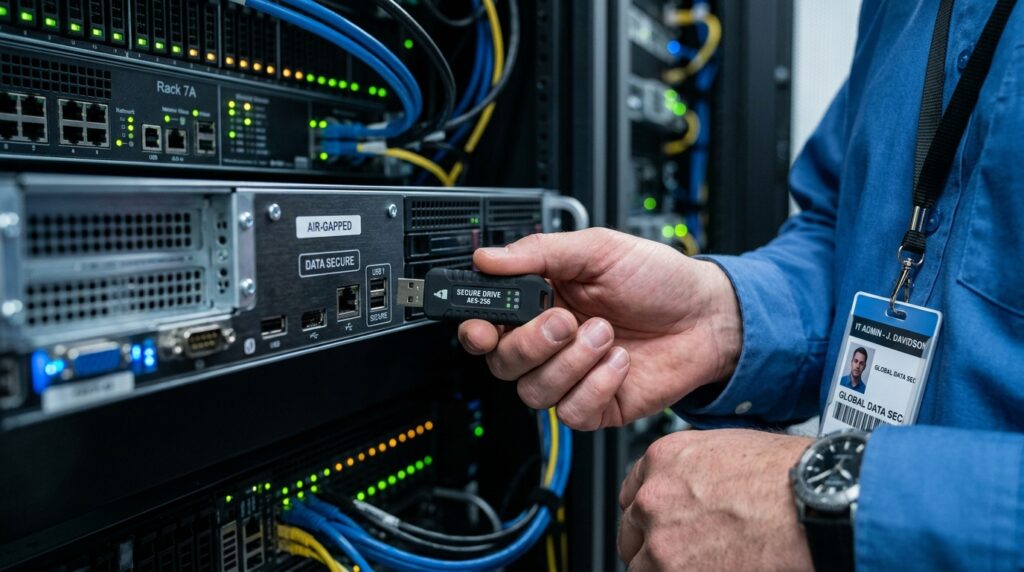
- Cryptographic Package Signing: The vendor compiles update files inside an isolated, internet-connected assembly environment, generating a SHA-256 hash signed with a private key stored inside a FIPS 140-3 Level 3 Hardware Security Module (HSM).
- Diode Isolation Transfer: The signed update package passes across a physical data diode onto a dedicated update creation machine, preventing any reverse attack path from modifying the source build.
- Manual Media Transport: A cleared administrator copies the file to a verified physical drive and manually carries it into the air-gapped server environment.
- Signature Verification Execution: The system’s isolated update service stops auto-run behaviors, calculates the package hash, and evaluates the signature via pre-installed public keys:$$\text{Verify}(M, \sigma, K_{\text{pub}}) = \begin{cases} \text{Accept}, & \text{if } \text{Decrypt}(\sigma, K_{\text{pub}}) = \text{Hash}(M) \\ \text{Reject}, & \text{otherwise} \end{cases}$$If any validation check fails, the package is rejected and flagged as an internal security anomaly.
3. Immutable WORM Audit Tracking
To comply with SOC 2 Type II and federal audit metrics, the server must maintain a permanent record of all user activities and model operations. System logs are piped to an internal, compliance-locked WORM directory.
Once written, these files cannot be modified or deleted by any system credential, including root administrative accounts, during the retention window. To ensure data block integrity, the logging engine joins each entry with the hash of the preceding block, building a continuous cryptographic chain:
$$\text{Hash}_n = \text{SHA-256}(\text{Log Entry}_n \mathbin{\Vert} \text{Hash}_{n-1})$$
Any attempt to modify historical log files instantly breaks the validation chain, alerting compliance officers during routine manual audits.
Final Recommendation & Operational Roadmap
Choosing between cloud-based AI, do-it-yourself software setups, or a turnkey system like Zanus AI for defense & government depends directly on your environment’s risk level and user access demands.
When to Deploy Zanus AI Sovereign Hardware:
- You are operating within a classified enclave, public safety center, or critical infrastructure node that bars all WAN connections.
- You are processing millions of automated telemetry, GIS, or document prompts daily, where variable cloud token pricing creates financial unpredictability.
- Your organization requires documented compliance with TAA regulations, AS9100 quality certifications, and strict NIST SP 800-53 security mandates.
When to Consider Alternative Cloud Enclaves:
- Your team requires rapid access to changing public foundation models and lacks internal technical staff to manage physical server systems.
- Your processing workloads are highly intermittent, making upfront capital expenditure economically inefficient compared to low-volume cloud utilization.
Immediate Action Plan for Infrastructure Teams:
- Execute a Data Sanitization Audit: Before integrating local vector storage layers, confirm that internal records and GIS data are clean, parsed, and ready for embedding generation.
- Map Electrical and Thermal Tolerances: Review the power capacity of your on-site sever rooms to ensure support for continuous 8U hardware loads (averaging 2.5 kW to 10.0 kW depending on cluster node count) without requiring facility electrical upgrades.
- Standardize the Update Protocol: Establish a formal team workflow for the Trusted Intermediary Pattern to coordinate the safe, manual intake of offline patches using verified transfer media.
Your Next Step
Achieving absolute data sovereignty within classified parameters demands an uncompromising commitment to hardware-level isolation. To successfully draft your agency’s procurement framework and present a certified deployment roadmap to your command structure, we recommend exploring our complete technical cluster:
- System Capacity Comparison: Evaluate the exact computational and memory thresholds required for your nationwide department data by reading Zanus AI Prime vs Quantum.
- Component Architecture Mapping: Audit your secure facility room’s thermal draw and physical requirements via the Zanus AI Hardware Infrastructure.
- Platform Core Review: Explore the complete range of built-in offline OS modules and processing layers in our comprehensive Zanus AI Deep Review.
- Civilian Asset Applications: For a detailed engineering look at how localized computing secures drone mapping metrics under strict regional laws, see our manual on automating the Florida SB-4D inspection cost.
Don’t let remote zero-day vulnerabilities or unpredictable cloud pricing models stall your operational readiness—audit your secure infrastructure bounds and deploy your turnkey sovereign enclave today.
If you are scaling your enterprise AI deployment and need robust, high-bandwidth bare-metal hosting without exorbitant cloud egress fees, check out our in-depth NovoServe Review and our NovoServe vs Hetzner Comparison to find the right server specs for your budget. Additionally, if your team manages multi-language workflows or cross-border project documentation, read our hands-on Palabra AI Review and Palabra AI vs Lokalise Breakdown to learn how automated AI localization can streamline your content pipeline.
References
- National Institute of Standards and Technology (NIST): SP 800-53 Rev. 5: Security and Privacy Controls for Information Systems and Organizations. https://nvlpubs.nist.gov/nistpubs/SpecialPublications/NIST.SP.800-53r5.pdf
- NDSS Symposium: SpiralSpy: Exploring a Stealthy and Practical Covert Channel to Attack Air-gapped Computing Devices via mmWave Sensing. https://www.ndss-symposium.org/ndss-program/ndss-2024/
- MDPI Computers Journal: A Survey on Air-Gap Attacks: Fundamentals, Transport Means, Attack Scenarios and Challenges. https://www.mdpi.com/journal/computers
- Zanus AI Architecture Guides: Zanus AI Prime & Quantum Sovereign Server Specifications. https://zanusai.com/products/prime-soverign-server
- Mender.io Open Source OTA Updates: Managing Updates for Air-Gapped Infrastructure via the Trusted Intermediary Pattern. https://hub.mender.io/