
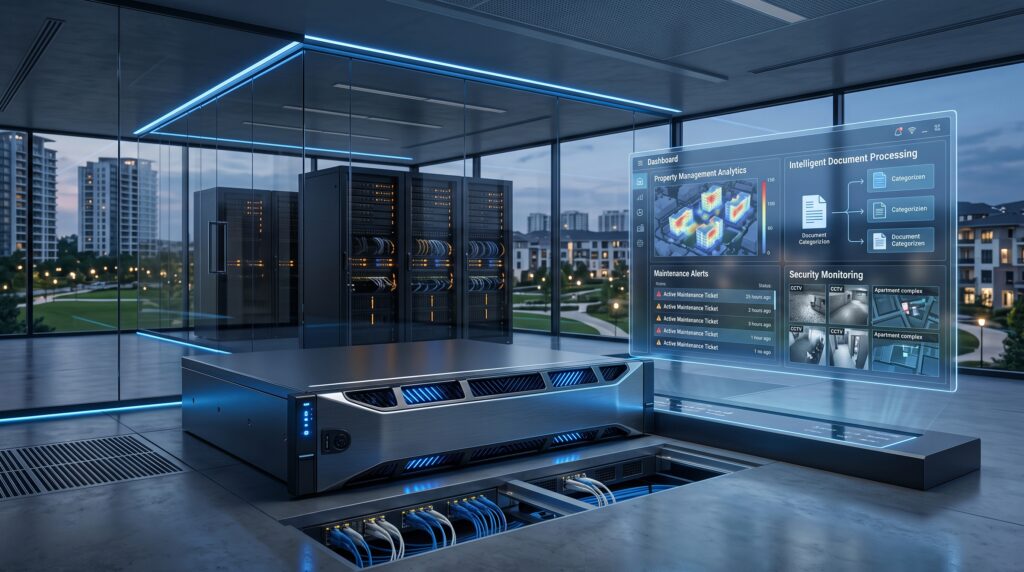
Zanus AI Appliance vs Dedicated AI Server is becoming one of the most important infrastructure decisions for organizations moving from public cloud AI to Private AI. To protect data sovereignty, eliminate unpredictable token costs, and reduce latency, many CTOs and CIOs are evaluating which architecture delivers the best long-term value.
The migration from public cloud AI to Private AI infrastructure is no longer a luxury—it is a strategic necessity for organizations handling highly sensitive data.
The migration from public cloud AI to Private AI infrastructure is no longer a luxury—it is a strategic necessity for organizations handling highly sensitive data. To protect data sovereignty, eliminate unpredictable “token taxes,” and reduce latency, chief technology officers (CTOs) and chief information directors (CIOs) are moving workloads on-premises.
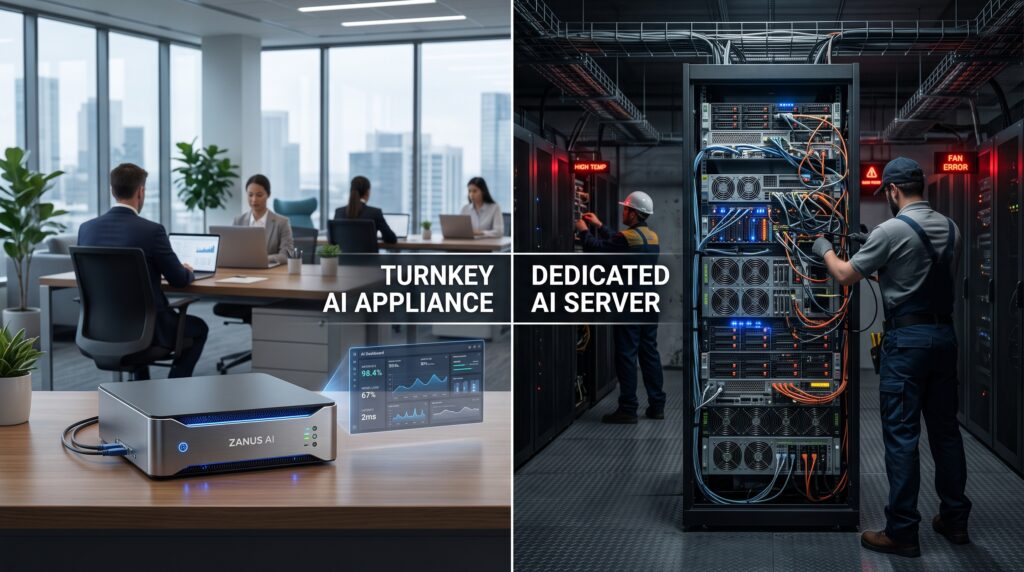
When deploying on-premises Private AI, decision-makers face two distinct paths: a turnkey integrated hardware-software appliance (Zanus AI Appliance) or a self-configured, bare-metal server system (Dedicated AI Server).
This guide strips away the marketing hype to compare both architectures across performance, operations, data security, and Total Cost of Ownership (TCO), helping you determine the exact right fit for your organization.
Quick Summary: The Bottom Line
- Choose Zanus AI Appliance if your priority is immediate deployment (Day 1 ROI), zero infrastructure complexity, absolute air-gapped security, and predictable fixed costs without hiring an internal team of machine learning engineers.
- Choose a Dedicated AI Server if your core business is AI development, and you require deep hardware customization, low-level architecture control, pre-training models from scratch, and already maintain an enterprise-grade data center and a dedicated DevOps team.
The Winner: Zanus AI Appliance (For 90% of Commercial Enterprise Deployments)
For organizations using AI as a leverage tool to increase operational efficiency rather than building proprietary AI models from scratch, the Zanus AI Appliance is the superior strategic investment. It eliminates integration failure risks, requires no specialized AI staff, and stabilizes long-term operational expenses.
Expert Insight
Many organizations assume that purchasing GPU hardware is the most significant investment in Private AI. In practice, software integration, infrastructure maintenance, and engineering salaries often exceed the hardware cost over a three-year period. Organizations evaluating AI infrastructure should therefore compare the entire lifecycle cost rather than focusing solely on the initial server purchase.
Zanus AI Appliance vs Dedicated AI Server: Head-to-Head Comparison
| Evaluation Metric | Zanus AI Appliance (Prime / Quantum) | Dedicated AI Server (DIY / OEM Bare-Metal) |
| Best For | Enterprise Ops, Finance, Legal, Health, Real Estate | AI Research Labs, Deep Tech R&D, Tech Giants |
| Deployment Speed | Turnkey (Plug-and-play within hours) | Months of integration, coding, and testing |
| Software Layer | Pre-installed Zanus AI OS + 15+ Enterprise Modules | None (Must build or license all software/UIs) |
| Vector Database | Native Precision Vector Store (Hardware-optimized) | Manual setup required (Milvus, Qdrant, PGVector) |
| Maintenance | Hands-off (Automated, single-vendor patches) | High risk (Manual tracking of CUDA, PyTorch, Drivers) |
| Infrastructure Needs | Standard office AC & power (Quiet operation) | Dedicated server room, industrial 3-phase power, cooling |
| Primary Cost Driver | Fixed upfront CAPEX (Zero per-seat or token fees) | Continuous, unpredictable OPEX (High engineering salaries) |
Architecture & Technical Performance: Deep Dive
1. Silicon and Compute Scaling (CPU & GPU)
Both solutions utilize market-leading accelerator architectures, but they manage them in fundamentally different ways.
- NVIDIA H100 SXM5 & A100: These enterprise-grade chips power high-throughput private inference. The H100’s Transformer Engine dynamically scales between FP8 and FP16 precision, drastically accelerating Large Language Model (LLM) performance without sacrificing output accuracy. The A100 remains an enterprise workhorse due to its robust Multi-Instance GPU (MIG) support, which divides a single physical card into seven isolated instances to serve parallel workflows cleanly.
- NVIDIA L40S: Built on the Ada Lovelace architecture, the L40S serves as an economical inference alternative. While it lacks FP64 double-precision cores (making it unsuited for heavy scientific simulations), its outstanding FP32 performance (91.6 TFLOPs) provides a highly cost-efficient upgrade for standard enterprise LLM tasks.
2. Memory Architecture: HBM3 vs. GDDR6
The choice of graphics memory directly impacts your model’s Time-to-First-Token and overall response throughput.
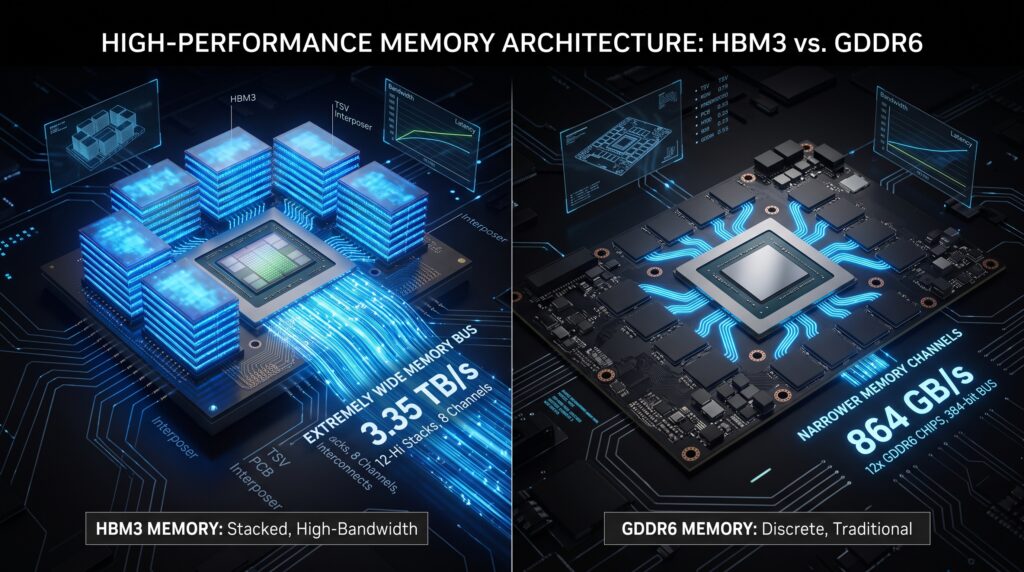
High-Bandwidth Memory (HBM3), found in the H100, utilizes a vertical 3D stacking architecture placed directly on the silicon interposer next to the GPU. This allows for an ultra-wide memory bus width (1024-bit per stack) resulting in a massive bandwidth of up to 3.35 TB/s.
Conversely, GDDR6 (used in the L40S) relies on traditional narrow 32-bit channels, capping maximum bandwidth around 864 GB/s. For real-time enterprise LLM inference, where every generated token forces the system to reread entire model weights from VRAM, HBM3’s wider bus dramatically cuts down user latency.
If you are scaling your enterprise AI deployment and need robust, high-bandwidth bare-metal hosting without exorbitant cloud egress fees, check out our in-depth NovoServe Review and our NovoServe vs Hetzner Comparison to find the right server specs for your budget. Additionally, if your team manages multi-language workflows or cross-border project documentation, read our hands-on Palabra AI Review and Palabra AI vs Lokalise Breakdown to learn how automated AI localization can streamline your content pipeline.
3. Interconnects: NVLink vs. PCIe Gen 5
When an LLM’s size surpasses the VRAM capacity of a single GPU, the model splits across multiple cards using Tensor Parallelism.
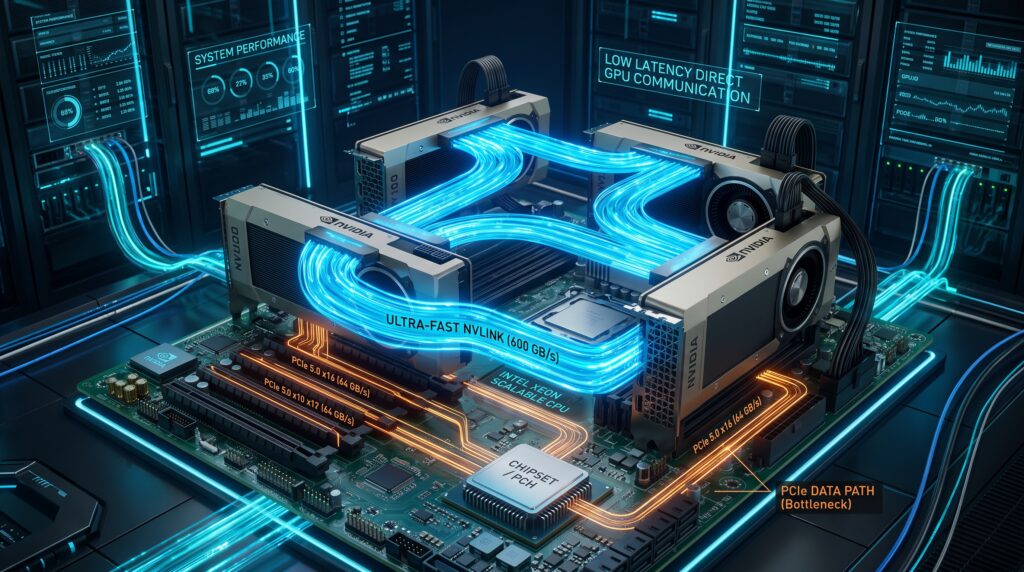
- NVIDIA NVLink 4.0 provides a direct mesh network between physical GPUs within the same node, supplying a bidirectional bandwidth of 900 GB/s. This creates a unified memory space with sub-microsecond latency.
- PCIe Gen 5, while standard on DIY bare-metal servers, forces communications through the CPU and system chipset via a hierarchical tree structure. This raises latency to 15–25 microseconds, degrading multi-GPU scaling efficiency under heavy concurrent enterprise loads.
Operational Reality, Security, and Data Sovereignty
Operating in True Air-Gapped Environments
Isolating your AI infrastructure completely from the internet is non-negotiable for sectors handling tightly regulated records.
- Property Management & HOA Networks: Managing resident financial transactions, internal board minutes, and legal disputes requires absolute local containment. The Zanus AI Appliance indexes files locally out-of-the-box, ensuring zero data packets leave the building. A self-assembled Dedicated Server presents an ongoing security liability: a single misconfigured firewall or an exposed vector database API port leaves proprietary tenant logs completely vulnerable to automated web scanners.
- For readers who are still comparing deployment models, our Cloud AI vs. On-Premises AI guide explains when cloud infrastructure becomes more expensive than local AI systems.
- Financial & Investment Services: Regulatory bodies like the SEC and FINRA demand unalterable audit trails. Moving financial compliance processing to public clouds invites institutional risk. An on-premises, air-gapped system completely cuts off third-party data collection. However, on a Dedicated Server, your IT staff must manually write role-based access controls (RBAC) and system logs from scratch. Zanus implements these security layers directly within its core operating system.
- Healthcare Facilities: To comply with HIPAA mandates, Protected Health Information (PHI) must be encrypted at rest and in transit. Zanus ensures this by containing medical summaries and clinical charts on physical RAID 10 NVMe storage arrays inside your medical facility.
If your organization is evaluating completely offline deployments, you may also want to read our guide on Air-Gapped AI for Property Management, where we explain how offline AI systems improve privacy, compliance, and operational resilience.
The Maintenance Treadmill
Maintaining a private AI stack goes far beyond swapping broken hard drives; it requires constant upkeep of a rapidly shifting software ecosystem.
The Upgrade Path Contrast:
- Zanus AI Appliance:
New model/patch released$\rightarrow$Zanus engineers test, optimize, and package bundle$\rightarrow$One-click secure sync to your appliance(Zero customer debugging required).- Dedicated AI Server (DIY):
CUDA or package updates$\rightarrow$Internal IT manually debugs dependencies$\rightarrow$Resolves driver-to-framework conflicts$\rightarrow$Fixes broken broken RAG pipelines$\rightarrow$System restores after prolonged downtime.
Financial Analysis: Total Cost of Ownership (3-Year Outlook)
Many organizations fall into a common “hardware cost trap,” looking only at the initial price tag of bare-metal servers while ignoring the compounding costs of software development and human capital.
If you’re just getting started with secure enterprise AI, our What Is Private AI? guide explains the core concepts behind on-premises language models, local vector databases, and secure Retrieval-Augmented Generation (RAG).
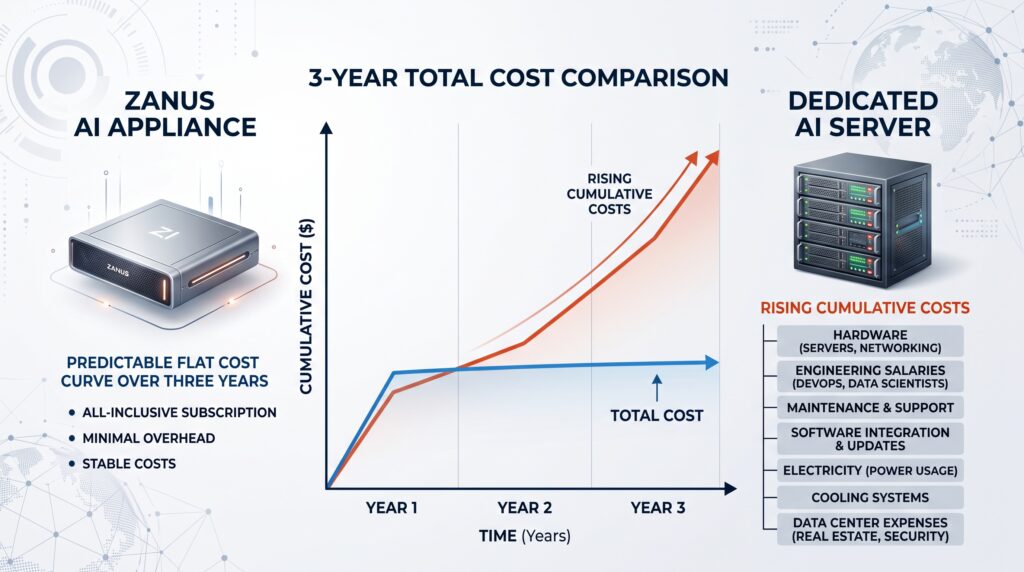
CAPEX vs. OPEX Realities
The financial breakdown between an integrated appliance and a self-built machine reveals two entirely different cash flow models:
$$\text{TCO}_{\text{Appliance}} = \text{CAPEX}_{\text{Turnkey Appliance}} + \sum_{t=1}^{n} (\text{OPEX}_{\text{Power}} + \text{OPEX}_{\text{Hardware Support}})$$
$$\text{TCO}_{\text{Dedicated Server}} = \text{CAPEX}_{\text{Bare-Metal Hardware}} + \text{CAPEX}_{\text{Custom Software Dev}} + \sum_{t=1}^{n} (\text{OPEX}_{\text{Power/Cooling}} + \text{OPEX}_{\text{Engineers Salary}})$$
- Zanus AI Appliance: Upfront CAPEX bundles hardware, enterprise storage, and an unrestricted, perpetual license for Zanus AI OS and its 15+ functional business modules. There are zero per-seat licenses and zero token costs for the lifespan of the machine. Because it uses patented air-cooled technology, it runs quietly within standard office temperatures, plugging directly into standard AC outlets without industrial 3-phase power retrofitting.
- Dedicated AI Server: The initial bare hardware invoice from an OEM seems lower. However, you must immediately fund a massive software development lifecycle. Building data pipelines, reliable RAG systems, and clean user interfaces from scratch easily adds $200,000 to $500,000 in hidden developer labor. Furthermore, raw GPU server chassis draw immense power (6–10 kW under full load) and generate severe heat and fan noise. This forces your company to rent expensive data center co-location space or build out a dedicated, cooled, and soundproofed server room.
Final Recommendation: Which Path Matches Your Strategy?
Choose Zanus AI Appliance if:
- You want an operational AI platform running on Day 1 without integration delays.
- You do not want to hire, manage, or retain highly paid Machine Learning or DevOps engineers.
- Your primary use cases are practical business solutions: semantic enterprise search, automated document processing, secure local RAG, or automated compliance monitoring.
- You need to deploy the infrastructure outside a data center—such as corporate headquarters, satellite branches, clinics, or schools—where noise control and standard power grids matter.
Choose a Dedicated AI Server if:
- Your organization’s primary product is a proprietary AI model, requiring you to pre-train specialized neural networks from scratch.
- Your engineering team must experiment with custom or non-standard hardware accelerators like Google TPUs or AWS Trainium.
- You have an established, international-standard data center with liquid cooling loops, backup UPS architecture, and a dedicated team of system engineers ready to manage software dependency stacks 24/7.
Executive Decision Matrix
| If your organization is… | Recommended Solution |
|---|---|
| Property Management Company | Zanus AI Appliance |
| Hospital or Healthcare Provider | Zanus AI Appliance |
| Law Firm | Zanus AI Appliance |
| Financial Institution | Zanus AI Appliance |
| Manufacturing Company | Zanus AI Appliance |
| AI Startup Building Foundation Models | Dedicated AI Server |
| University Research Lab | Dedicated AI Server |
| Enterprise AI Research Team | Dedicated AI Server |
Frequently Asked Questions
What is a Zanus AI Appliance?
A Zanus AI Appliance is an integrated private AI platform that combines enterprise-grade hardware, preconfigured AI software, vector databases, and local language models into a single turnkey system. Unlike a traditional AI server, it is designed for immediate deployment without requiring complex software integration.
Is a Zanus AI Appliance better than a dedicated AI server?
For most enterprises, yes. Organizations that primarily use AI for document search, compliance, automation, and knowledge management benefit from a turnkey appliance. Dedicated AI servers remain the better option for companies developing proprietary AI models or performing large-scale model training.
Can a Zanus AI Appliance work without an internet connection?
Yes. One of its biggest advantages is true air-gapped deployment. Documents, AI models, and vector databases remain inside the organization’s local network, allowing secure AI operations even during internet outages.
Which industries benefit most from Zanus AI Appliance?
Industries handling sensitive information—including healthcare, financial services, government agencies, legal firms, manufacturing, and property management—benefit the most because data never leaves the organization’s infrastructure.
Does a Zanus AI Appliance reduce long-term AI costs?
In many enterprise deployments, yes. While the initial investment is higher than cloud subscriptions, organizations eliminate recurring token charges, reduce dependency on external APIs, and achieve more predictable long-term operating costs.
What to Do Next
- Audit Your Workloads: Document your average monthly data volume and identify whether your workflows center on using AI models (Inference) or building them (Training).
- Review Internal Talents: Assess if your current IT staff has the bandwidth and deep ML expertise required to configure and patch bare-metal GPU systems monthly.
- Calculate True TCO: Use the equations above to calculate your projected 3-year costs, making sure to include developer salaries and server room power retrofitting.
If you are scaling your enterprise AI deployment and need robust, high-bandwidth bare-metal hosting without exorbitant cloud egress fees, check out our in-depth NovoServe Review and our NovoServe vs Hetzner Comparison to find the right server specs for your budget. Additionally, if your team manages multi-language workflows or cross-border project documentation, read our hands-on Palabra AI Review and Palabra AI vs Lokalise Breakdown to learn how automated AI localization can streamline your content pipeline.