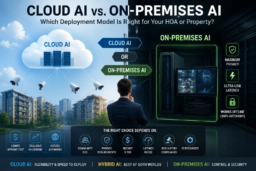
Cloud AI vs On-Premises AI has become one of the biggest technology decisions for homeowners associations (HOAs) and property managers. Choosing the right deployment model affects privacy, long-term costs, system performance, and regulatory compliance.
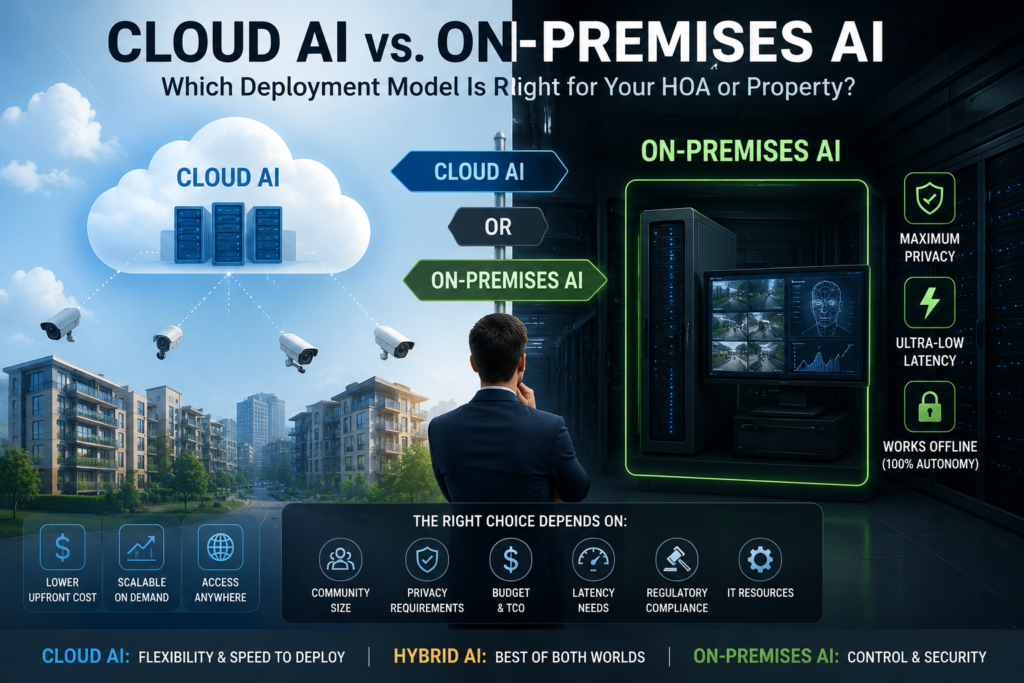
Deploying AI in property management is easy. Integrating it into daily workflows without draining your maintenance funds or violating strict data privacy laws is the real challenge.
For Homeowners Associations (HOAs) and property boards, choosing between Cloud AI and On-Premises AI (Local Infrastructure) is no longer just a technical debate. It is a high-stakes financial and legal decision that directly impacts long-term property value.
This guide cuts through the marketing hype to help you make the right investment decision for your community.
Quick Summary
- Choose Cloud AI if: You manage a single, mid-market, or budget-friendly residential building with limited upfront capital (CapEx), no dedicated server rooms, and only need event-based analysis (rather than continuous 24/7 video processing).
- Choose On-Premises AI if: You run a premium gated community that demands absolute privacy for high-profile residents, requires instant gate-barrier response times (<10ms), and needs to fully comply with local data protection laws (like Vietnam’s Decree 13/2023/NĐ-CP) without administrative bottlenecks.
- Choose Hybrid AI if: You operate large-scale smart townships with thousands of cameras and dense IoT sensor networks. This model offers the best of both worlds: instant security processing at the edge and deep big-data analytics in the cloud.
Key Takeaways
- Cloud AI offers lower upfront costs but creates ongoing operational expenses.
- On-Premises AI provides greater privacy, lower long-term costs, and offline resilience.
- Hybrid AI combines local processing with cloud analytics for large-scale property operations.
- The right deployment model depends on portfolio size, compliance requirements, and IT capability.
Which AI Deployment Model Fits Your Organization?
| Your Organization | Recommended AI Model | Why |
|---|---|---|
| Small HOA (under 100 homes) | Cloud AI | Low upfront cost and simple deployment |
| Mid-sized HOA | Hybrid AI | Balances privacy, cost, and scalability |
| Luxury HOA | On-Premises AI | Maximum privacy and local processing |
| Multi-property management company | Hybrid AI | Supports multiple sites while reducing cloud costs |
| Enterprise property portfolio | On-Premises AI | Full data control and predictable long-term costs |
Head-to-Head Comparison: Cloud AI vs. On-Premises AI
| Evaluation Criteria | Cloud AI Solution | On-Premises AI Solution |
| Upfront Investment (CapEx) | Low; no specialized server hardware required at launch. | Very High; requires dedicated GPU servers and network infrastructure. |
| Ongoing Operations (OpEx) | Scales linearly with the number of cameras and API call volume. | Low and predictable; primarily consists of electricity and routine maintenance. |
| Security & Privacy | Moderate; sensitive data travels over the internet, complicating compliance. | Absolute; data is stored securely within the building’s local network. |
| Response Latency | High (500ms – 5s); heavily dependent on external internet bandwidth. | Ultra-low (<10ms); instant processing via the local LAN. |
| Offline Autonomy | None; the entire system goes dark if the internet connection drops. | 100%; keeps analyzing and alerting even during a total internet blackout. |
| Technical Staffing | Minimal; standard IT staff can manage the software interface. | High; requires system engineers to manage physical hardware and network security. |
Deep Dive: The 3 Operational Bottlenecks That Matter
1. The Financial Reality: 5-Year Total Cost of Ownership (TCO)
Cloud AI platforms look attractive initially due to their pay-as-you-go pricing. However, if your security setup requires continuous, real-time video analytics for facial recognition and behavioral tracking, cloud API fees can quickly spiral out of control.
For a community with 200 cameras and 5,000 units, continuous cloud processing (even at a standard sample rate of 1 frame per second) creates a massive long-term operational deficit. On the flip side, an On-Premises setup requires an initial hardware investment of $30,000 to $100,000 for high-performance GPU edge servers, but the marginal cost per analysis drops to nearly zero afterward.
Editor’s Note: Once local GPU utilization crosses the 20% threshold, an On-Premises AI system typically hits its break-even point within 4 to 6 months. Over a 5-year cycle, it can slash operational costs by up to 70% compared to equivalent cloud services.
Expert Insight
Many organizations focus on the initial hardware investment when evaluating AI. In practice, long-term operational expenses, compliance requirements, and internet dependency often have a much greater impact on total ownership costs than the purchase price alone.
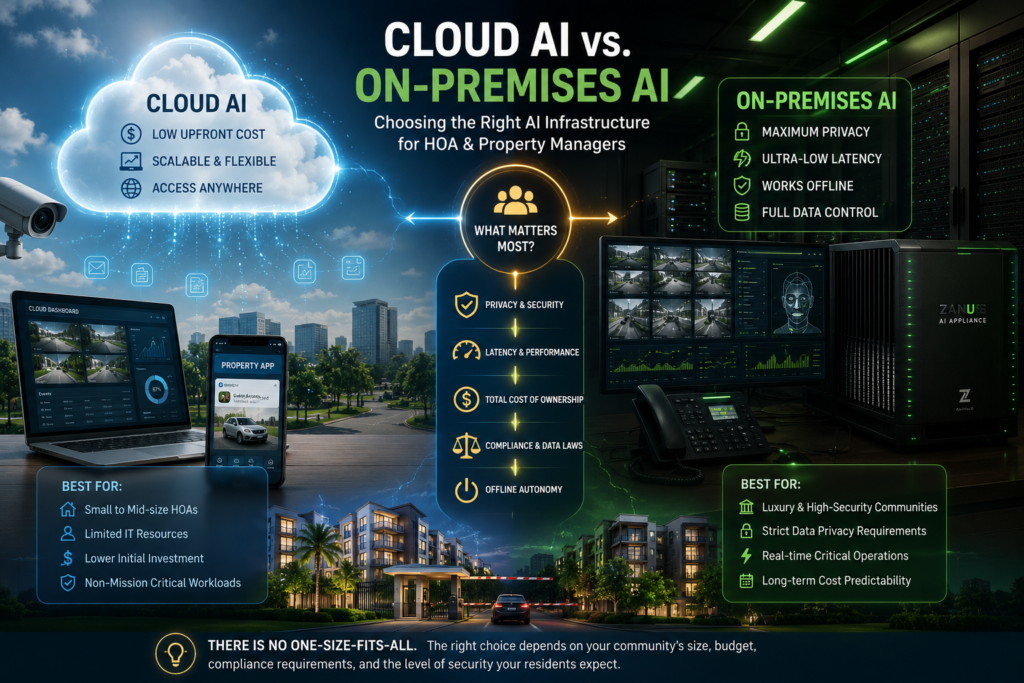
2. Legal Risk: Data Privacy Compliance
Security camera footage captures biometric data, which regional regulations classify as highly sensitive personal information.
- The Cloud AI Bottleneck: Streaming continuous surveillance feeds to public cloud servers—especially those located across borders—forces HOAs to complete exhaustive cross-border data transfer impact assessments for government cyber-security bureaus. This is a complex administrative hurdle that also requires end-to-end encryption to meet stringent internet protocol standards.
- The On-Premises Advantage: By keeping all processing within the building’s local area network (LAN), raw video and facial recognition metadata never leave the property. This localized storage ensures compliance with strict privacy laws naturally, eliminating international data liability entirely.
3. Latency and Offline Autonomy
In physical security, the difference between milliseconds and seconds can compromise resident safety. On-Premises AI handles data locally to deliver sub-10ms response times, ensuring gate barriers lift the moment a vehicle approaches.
More importantly, if an ISP fiber-optic cable is cut or a storm knocks out external internet access, a local system continues to run license plate recognition, fire detection, and access control protocols without a hitch. A cloud-dependent system will fail completely in the same scenario.
System Risks & Mitigation Strategies
Every technology choice comes with distinct trade-offs. Boards must recognize and actively mitigate the risks inherent to each model:
- Cloud AI Risks: Heavy vendor lock-in to proprietary APIs and the vulnerability of public cloud data centers to wide-scale ransomware attacks.
- Mitigation: Deploy end-to-end data encryption before transmission, and partner exclusively with regional cloud providers that hold verified ISO 27001 certifications.
- On-Premises AI Risks: Physical hardware depreciation, component failures (GPUs or SSDs) from 24/7 heavy workloads, and technical obsolescence within 3 to 5 years.
- Mitigation: Implement high-availability (HA) redundant server clustering and sign strict 4-hour on-site hardware replacement Service Level Agreements (SLAs) with your system integrator.
The Hybrid AI Framework: Best for Large-Scale Townships
For sprawling master-planned communities or multi-tower complexes, a Hybrid AIoT (Artificial Intelligence of Things) architecture offers the most resilient long-term solution. This approach splits workloads across a four-layer system:
[Layer 1: Field Devices] (IP Cameras & Sensors)
          │ (Raw Video/Data)
          ▼
[Layer 2: Edge Computing] (Local Micro-Servers; <100ms real-time filtering)
          │ (Metadata/Filtered Events Only - Saves 90% Bandwidth)
          ▼
[Layer 3: Hybrid/Private Cloud] (Central GPU Cluster; Deep analytics & Local LLMs)
          │ (Insights & Automation Triggers)
          ▼
[Layer 4: Application Layer] (Property Dashboard & Resident Mobile App)
- Field Device Layer: Smart IP cameras, utility sensors, and access control readers collect raw environmental data on the ground.
- Edge Computing Layer: Industrial micro-servers installed in outdoor technical cabinets handle real-time processing under 100ms. They instantly catch gate entries, pool-area falls, or fire hazards. By filtering out static footage and sending only event metadata to the center, they reduce internet bandwidth consumption by up to 90%.
- Hybrid Cloud Layer: High-performance central servers located in the main property office run complex long-term workloads. This includes forecasting HVAC energy efficiency, scheduling predictive maintenance for elevators, and running local Retrieval-Augmented Generation (RAG) language models so staff can instantly query complex building blue-prints and regulations.
- Application Layer: An Intelligent Operations Center (IOC) displays a unified dashboard for facility managers, while a cloud-backed mobile app pushes automated billing and maintenance updates directly to residents.
Buying Advice
If your organization manages a standalone residential building or operates on a strict technology budget of under $5,000, then you should choose a subscription-based Cloud AI (SaaS) solution. Because this setup gives you immediate access to modern AI features without the burden of maintaining server hardware or cooling infrastructure.
However, if you are managing a premium high-rise or a sprawling smart township where data privacy liabilities and zero-latency execution are non-negotiable, then you must invest in an On-Premises or Hybrid AI architecture. Because it is the only way to lock in predictable 5-year operational costs, maintain sub-10ms response speeds, and insulate your community from data leaks and compliance penalties.
AI Deployment Readiness Checklist
✔ Existing IP cameras support ONVIF

✔ Stable local network infrastructure

✔ Dedicated server location

✔ Data privacy policy updated

✔ Backup strategy documented

✔ IT support available

✔ Pilot project approved

✔ Budget allocated
Frequently Asked Questions
Is Cloud AI always cheaper than On-Premises AI?
Cloud AI usually requires less upfront investment, but subscription fees, API usage, and storage costs can exceed the cost of an on-premises deployment over several years.
Can On-Premises AI work without the internet?
Yes. Local AI systems continue processing data even if the internet connection is unavailable, making them suitable for security-critical environments.
Is Hybrid AI suitable for most HOAs?
Hybrid AI is often the best choice for medium to large communities that need both local processing and cloud-based analytics.
Which AI model offers the best privacy?
On-premises AI provides the highest level of privacy because sensitive data remains within the organization’s own infrastructure.
When should a property manager choose Cloud AI?
Cloud AI is generally suitable for organizations with limited budgets, minimal IT resources, and lower privacy requirements.
Related Guides
If you’re exploring AI for property management, you may also find these articles helpful:
- What Is Private AI? A Beginner’s Guide
- Air-Gapped AI Explained
- AI HOA Violation Management
- Best AI for HOA Management
- Zanus AI Review
Action Plan for HOA Boards: What to Do Next
To ensure your community’s capital reserve fund is invested wisely, your board should execute this three-step roadmap:
- Step 1: Audit Your InfrastructureHire a technician to evaluate your existing IP cameras. Determine if they support standard integration protocols (like ONVIF) to ensure they can feed video to an AI system without needing full replacement.
- Step 2: Update Your Privacy PolicyRevise your community’s data governance rules to account for biometric collection before turning on any facial recognition features. Secure explicit resident consent through your community app and post visible signage at all monitored entry points.
- Step 3: Run a Limited PilotAvoid massive, all-at-once software rollouts. Launch a 90-day pilot program confined to a single high-traffic use case—such as license plate recognition at a main parking gate. Evaluate the actual return on investment (ROI) and system reliability before committing capital reserve funds to a full-scale deployment.