Most enterprise technology leaders do not need more raw information about infrastructure. They need to solve a critical structural bottleneck: as machine learning models scale from pilot projects to scaled production, pure public cloud strategies frequently run into financial and regulatory ceilings. Industry data shows a stark reality. Approximately 46% of proofs-of-concept fail to reach production, and 42% of enterprise AI initiatives were abandoned entirely due to infrastructure mismatches, unmanaged data readiness gaps, and unpredictable operational costs.
Choosing between a 100% on-premises deployment and an orchestrated hybrid framework is not an academic debate. It is a fundamental financial and operational decision that defines an enterprise’s long-term competitive position.
Quick Summary & Comparison Table
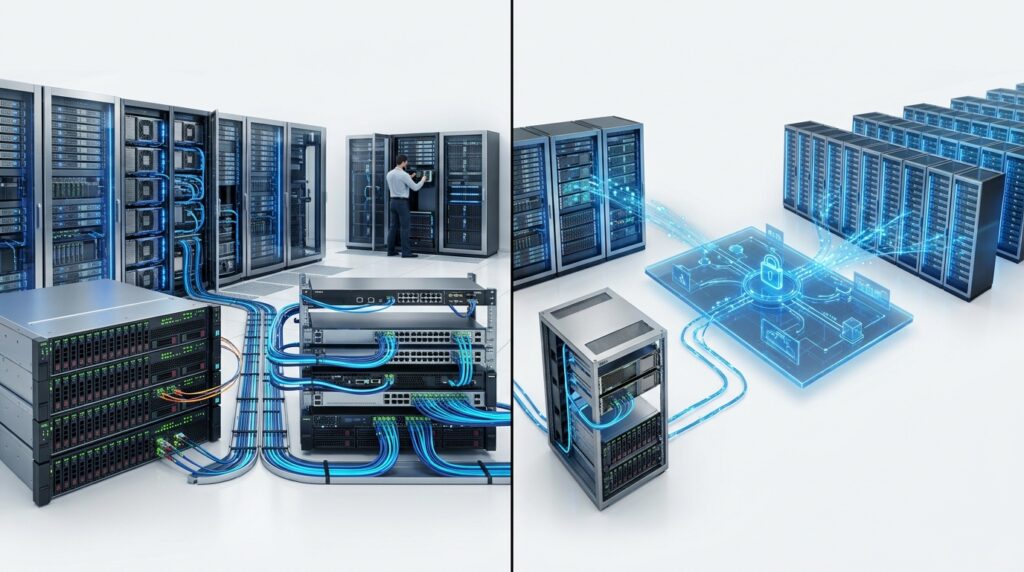
Evaluating Hybrid AI Infrastructure vs On-Premises Deployments
For organizations requiring total physical data custody, absolute regulatory compliance, and predictable long-term costs under stable, high-volume production workloads, a 100% On-Premises Architecture provides a clear long-term edge.
Conversely, for companies managing highly variable token volumes, utilizing a mix of open-source and proprietary frontier models, or lacking the space and capital for immediate high-density data center upgrades, an orchestrated Hybrid AI Framework delivers the necessary agility without sacrificing operational boundaries.
| Evaluation Dimension | 100% On-Premises Architecture | Hybrid AI Infrastructure |
| Sourcing Adaptability | Optimized for open-source foundation models requiring deep local customization. | Supports both open-source and proprietary cloud APIs via dynamic routing. |
| Financial Structure | High CapEx; low, highly predictable ongoing OpEx. | Blended model; moderate CapEx for local tiers with elastic cloud OpEx. |
| Data Control & Sovereignty | Absolute; physical custody of data, weights, and audit trails. | Conditional; segmented based on strict data classification policies. |
| Scalability & Elasticity | Hard ceiling; scaling is constrained by physical hardware acquisition cycles. | Elastic; seamless bursting to public cloud hyperscalers for peak loads. |
| Egress Fees | Zero. | Variable; typically accounts for 15% to 30% of total cloud AI spend. |
| Operational Complexity | High; requires deep in-house expertise in hardware, cooling, and physical MLOps. | High; requires dual-competency in both cloud-native and physical infrastructure. |
| Latency Profile | Deterministic; near-zero transit latency for localized operations. | Tiered; sub-10ms at the edge, variable latency across cloud boundaries. |
| Deployment Horizon | Slow; restricted by hardware procurement, data center prep, and provisioning. | Rapid; immediate access to pre-trained APIs and elastic cloud instances. |
Why This Matters
Evaluating infrastructure based entirely on raw compute power obscures the true cost centers. The long-term profitability of an enterprise AI stack depends heavily on data ingestion pathways, compliance frameworks, and network architecture choices.
On-Premises Architecture: The Case for Absolute Physical Custody
Strengths
- Total Control Over Intellectual Property: Operating entirely within a private data center protects highly sensitive assets, such as proprietary source code or specialized models, from public network exposure.
- Predictable Operational Unit Economics: High sustained hardware utilization transforms unpredictable inference pricing into a steady, amortizable capital asset.
- Deterministic Low Latency: Eliminating external cloud boundaries ensures ultra-low response times for industrial applications, financial compliance checks, and real-time operations.
Weaknesses
- Substantial Upfront Capital Expenditures: Procuring high-density hardware stacks forces companies to lock up valuable capital early in the lifecycle.
- Silicon Obsolescence Risks: The rapid evolution of AI chips means physical hardware risks falling behind newer, more efficient architectures within a three-to-five-year window.
- Rigid Facility Constraints: Scaling requires physical square footage, advanced power infrastructure, and complex cooling configurations that cannot be provisioned instantly.
Best For
Large financial institutions, defense applications, and healthcare networks processing steady, high-volume production inference (>50 million tokens per day) under non-negotiable regulatory compliance mandates.
Hybrid AI Infrastructure: The Case for Orchestrated Elasticity
Strengths
- Dynamic Sourcing Fluidity: Seamlessly splits workloads between lightweight local open-source models for routine processing and public cloud frontier APIs for deep reasoning.
- Elastic Resource Scalability: Provides instant compute access for sudden model training or seasonal inference spikes, bypassing long hardware procurement pipelines.
- Architectural Risk Mitigation: Reduces initial hardware costs, giving enterprise teams the breathing room to test workflows before building local high-density infrastructure.
Weaknesses
- Data Pipeline Complexity: Synchronizing real-time data flows between private databases and public clouds creates complex tracking challenges and potential performance bottlenecks.
- Unpredictable Cloud Egress Fees: Moving high volumes of enterprise data across cloud boundaries often introduces significant, unbudgeted billing surcharges.
- Dual-Competency Operational Overhead: IT teams must successfully manage both on-premises bare-metal components and cloud-native container environments simultaneously.
Best For
Fast-growing enterprises, software platforms, and specialized logistics operations managing highly variable compute demands, multi-model applications, or distributed edge systems.
Performance & Infrastructure Benchmarks: The True Cost of Dense Silicon
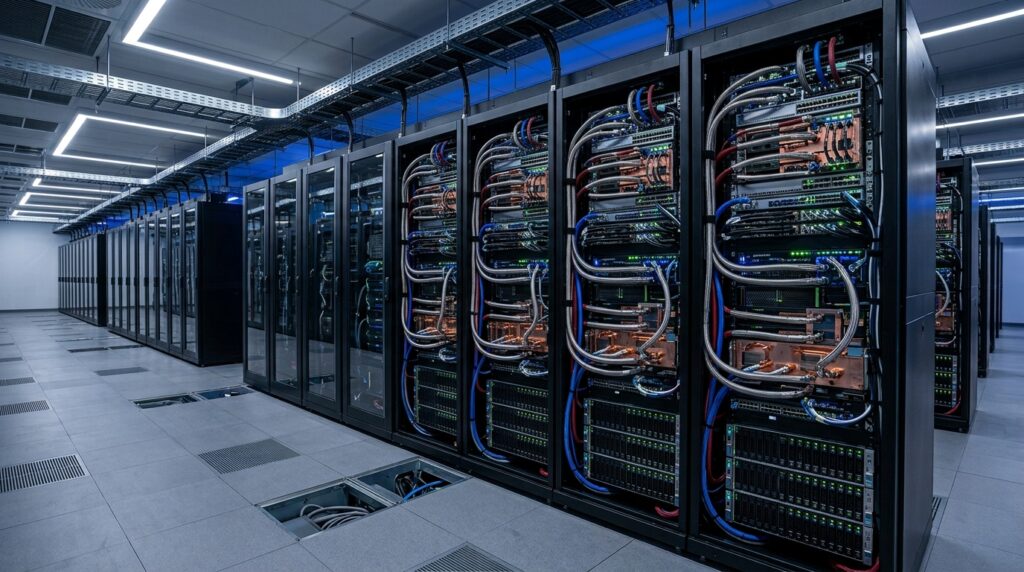
Deploying local high-density AI nodes, powered by state-of-the-art architectures like NVIDIA’s Hopper or Blackwell configurations, requires a major departure from traditional enterprise server setups. Traditional server configurations are fundamentally incapable of handling the power distribution and thermal dissipation demands of modern AI infrastructure.
Physical and Technical Capacity Constraints
- Power Density: Traditional enterprise data centers operate at standard baselines of 5 kW to 10 kW per rack. Modern AI-optimized setups require 10 kW to 30 kW per rack, with cutting-edge dense installations easily exceeding 100 kW per rack. Upgrading an existing localized space can run $50,000 per rack, while full facility modernization can pass $500,000.
- Thermal Management: Traditional forced-air cooling methods fail above 25 kW per rack. Advanced liquid-to-air or liquid-to-liquid cooling loops are mandatory for high-density GPU deployment, running an average of $100,000 to $300,000 per row of racks.
- Networking Fabric: Standard 10/25 Gbps Ethernet introduces severe communication delays during large-scale model updates. High-performance configurations demand 100 Gbps+ Remote Direct Memory Access over Converged Ethernet (RoCE) or InfiniBand switching networks, adding $50,000 to $200,000 per rack for infrastructure integration.
GPU Utilization Inefficiencies and the vLLM Mitigation
A major vulnerability in the purely local business case is low hardware utilization. Typical enterprise environments often see operational GPU utilization sit between 30% and 50% due to processing delays and memory block limitations. This inefficiency causes significant financial waste while idle silicon depreciates.
To fix this bottleneck, modern deployments use high-performance inference frameworks like vLLM. By deploying continuous batching and PagedAttention, organizations can boost Model FLOP Utilization (MFU) from a poor 35% up to an efficient 60% to 80%. This effectively cuts the operational cost per inference in half, heavily strengthening the financial argument for on-premises hosting. Furthermore, separating the compute-heavy prefill stage from the memory-heavy decode phase across distinct processors lets enterprises optimize hardware workloads and drop inference costs without losing flexibility.
Editor’s Take
If your existing facility cannot comfortably handle dense power allocations and liquid cooling modifications, rushing into a 100% on-premises deployment will create massive hidden facility costs. In these scenarios, a hybrid infrastructure is the safer, more realistic stepping stone.
Financial Structures & Pricing: The Deloitte TCO Threshold
A sound infrastructure roadmap must look past upfront equipment costs and evaluate the full operational lifecycle across multiple key areas: compute capacity, active data storage, cloud egress fees, premium margins, the staffing gap, and unavoidable hardware refresh cycles.
The Deloitte Tech Trends Threshold Formula
Research shows that the tipping point for cloud cost repatriation or hybrid migration typically falls within the 60% to 70% cloud expenditure threshold. When the ongoing operational cost of public cloud AI resources hits more than 60% of the cost of equivalent dedicated hardware, the math shifts heavily toward localized or hybrid deployments.
Enterprise architects can calculate this specific inflection point using the threshold formula:
$$R = \frac{C_{\text{onprem\_amortized}} + C_{\text{staffing\_delta}}}{C_{\text{cloud\_reserved}} + C_{\text{egress}}}$$
Where:
- $C_{\text{cloud\_reserved}}$ is the monthly cloud compute cost based on 3-year reserved instance pricing (not premium on-demand rates).
- $C_{\text{egress}}$ is the average monthly cloud egress fees associated with data movement.
- $C_{\text{onprem\_amortized}}$ is the monthly amortized capital expenditure of equivalent physical hardware over a 36-month lifecycle.
- $C_{\text{staffing\_delta}}$ is the monthly operational staffing delta required to support physical MLOps and infrastructure.
An investment profile yielding an operational threshold score of $R \ge 0.60$ warrants a structured migration plan out of pure public cloud setups.

Volume-Based Architecture Decision Triggers
- Low Volume (<10 Million Tokens/Day): Serverless public cloud resources are highly cost-effective. At this minor scale, the operational overhead of physical infrastructure cannot justify the initial capital cost.
- Transitional Volume (10M to 50 Million Tokens/Day): This is the middle ground. If usage patterns are highly consistent (such as 12+ sustained GPU-hours per day), enterprises should run the threshold formula to evaluate a hybrid shift.
- Extreme Volume (>50 Million Tokens/Day): At this level, local or hybrid models are almost always financially superior. High cloud pricing, combined with compounding egress fees, makes pure cloud configurations economically unsustainable.
The 6-Hour Rule
A practical operational guideline: if your AI workloads run consistently for more than 6 hours per day on a public cloud, the cumulative usage charges will typically exceed the cost of deploying, housing, and maintaining the equivalent dedicated hardware on-premises.
Five-Year TCO Breakdown (8× NVIDIA H100 Configuration)
The table below compares the 5-year Total Cost of Ownership for an 8× NVIDIA H100 GPU server setup (using a baseline platform like the Lenovo ThinkSystem SR675 V3, with an upfront hardware cost of roughly $833,806) against equivalent public cloud deployment models.
| Cost Category | On-Demand Cloud | 3-Year Reserved Cloud | On-Premises Architecture |
| Initial Capital Expenditure | $0 | $0 | $833,806 |
| Operational & Hosting Cost | $4,306,416 | $2,362,811 | $38,106 ($0.87/hour utility rate) |
| Staffing Delta (0.5–1.5 FTE) | Included in service | Included in service | $300,000 to $900,000 |
| Egress Fees (15-30% of spend) | $645,962 to $1,291,924 | $354,421 to $708,843 | $0 |
| Effective 5-Year Total Cost | $4,952,378 to $5,598,340 | $2,717,232 to $3,071,654 | $1,171,912 to $1,771,912 |
Operational Impact
Omitting the internal staffing delta is the most common error in enterprise on-premises business cases. Managing bare-metal AI nodes typically requires 0.5 to 1.5 specialized DevOps or infrastructure FTEs, which can add substantial overhead that must be explicitly tracked.
Vendor Ecosystem Analysis: Choosing the Right Deployment Platform
Building an optimized, high-density AI infrastructure requires deploying tightly integrated hardware and software architectures. Rather than attempting to assemble generic, standalone servers, technology teams should utilize validated reference architectures from specialized platform providers.
Dell AI Solutions
Dell delivers highly integrated hardware and software suites designed to standardize data preparation, model training, and production inference across edge and corporate environments.
- Trade-off: Offers exceptional stability and reliable enterprise support, but locks organizations into a predictable, premium pricing model that limits custom third-party hardware integration.
HPE Juniper AI Data Center Networking
Focuses on providing automated, lossless networking architectures for high-performance AI clusters. Juniper’s automated systems use advanced telemetry to eliminate transit blockages during intense processing cycles.
- Trade-off: Substantially reduces the operational complexity of managing complex data paths, but requires a steep learning curve for teams not already operating within the HPE software ecosystem.
Hitachi Vantara (Hitachi iQ)
An elite, hyper-accelerated infrastructure package built on certified NVIDIA DGX BasePOD and HGX reference systems. It is engineered for heavy data environments, moving up to 80+ GB/s of direct bandwidth to each active GPU node.
- Trade-off: Delivers massive data throughput scalability, but demands a premium capital commitment that can be difficult for mid-market enterprises to justify.
DDN Infinia
Provides advanced distributed software management for massive, unstructured datasets across high-speed flash, traditional disks, and cloud storage tiers.
- Trade-off: Optimizes storage placement automatically across diverse storage targets, but adds architectural software layers that require specialized internal data-management expertise.
InstructLab Platform
A community-driven, open-source customization platform that allows teams to continually add targeted knowledge and skills to local foundation models using synthetic data generation.
- Trade-off: Drastically cuts down on the need for expensive, large-scale model training runs, but demands continuous oversight from technical teams to monitor and review synthetic data output quality.

Final Recommendation: Which Infrastructure Fits Your Long-Term Roadmap?
Choose a 100% On-Premises Architecture if:
Your organization handles highly regulated data assets (such as defense networks, core banking platforms, or private health records), requires absolute physical custody to protect proprietary IP, maintains a steady inference volume exceeding 50 million tokens a day, and has the data center space to run high-density liquid-cooled rack configurations.
Choose an Orchestrated Hybrid Framework if:
Your day-to-day token volume fluctuates unpredictably, your current workflows require dynamic routing between local models and public frontier APIs, and you need to deploy quickly while avoiding massive upfront capital expenditures on data center renovations.
Related Technical Deep-Dives
If you are expanding your organization’s localized infrastructure roadmap, explore our collection of specialized enterprise AI deployment guides:
- Enterprise AI Hardware Buying Guide – Learn how to verify unified support lifecycles, navigate production licensing boundaries, and evaluate the best turnkey AI appliances for 2026.
- Zanus AI Deployment & Architecture – A deep-dive study into technical on-premises deployment, drone video ingestion pipelines, and private structural analysis frameworks.
- Manual Inspection Bottlenecks vs. Automated AI Workflows – An operational analysis comparing traditional enterprise process constraints with high-throughput private AI automation.
- Turnkey AI Appliance Configurations for Data Centers – A granular look into hyperconverged infrastructure (HCI) sizing, liquid-cooling distributions, and high-speed GPU networking fabrics.
References
- IDC Analysis: “IDC Predicts: 75% of Enterprise AI Workloads to Run on Hybrid Fit-for-Purpose Infrastructure by 2027,” my.idc.com
- MDPI Research Foundations: “Bridging the Semantic Gap in 5G: A Hybrid RAG Framework for Dual-Domain Understanding,” mdpi.com
- Broadcom Infrastructure Guidelines: “On-Premises AI Infrastructure Balances Innovation and Security,” docs.broadcom.com
- SoftwareSeni Data Studies: “Cloud vs On-Premises vs Hybrid AI Inference — A Decision Framework Based on Real Cost Data,” softwareseni.com
- Aurelio Labs Engineering Documentation: “Semantic Router: Superfast AI Decision Making,” github.com/aurelio-labs/semantic-router