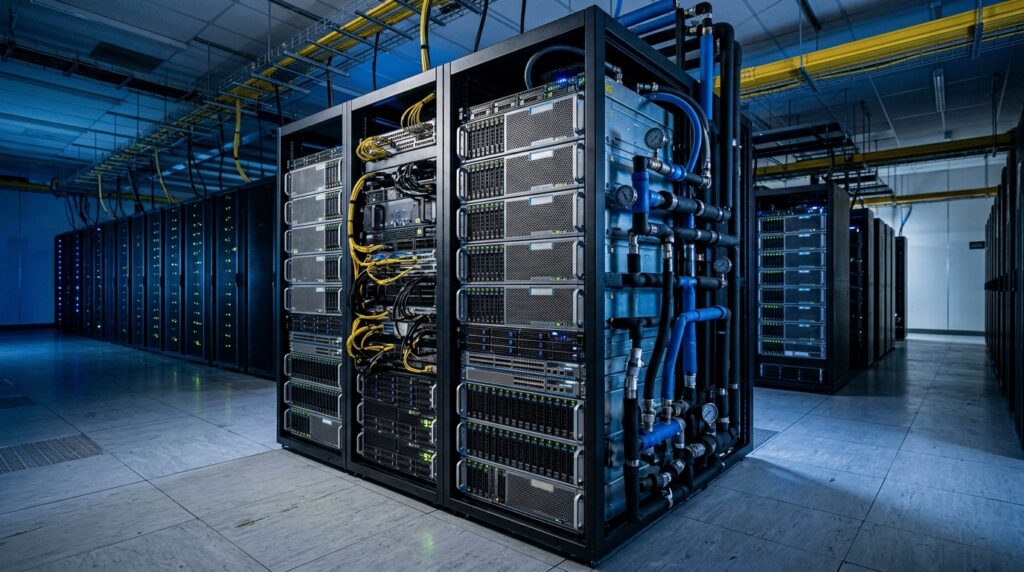
Welcome to our comprehensive Enterprise AI Hardware Buying Guide, designed to help organizations navigate the transition toward on-premises repatriation in 2026.
Editor’s Executive Summary
The initial wave of generative AI adoption relied almost exclusively on public cloud APIs. However, real-world operational realities in 2026 have triggered a major transition toward on-premises repatriation. Organizations embedding AI into core industrial, financial, and transactional operations cannot accept the “best effort” uptime, unpredictable token latency, variable billing, and systemic security hazards inherent in cloud-first approaches. Data sovereignty, strict regulatory compliance, and operational risk mitigation are driving a critical demand for turnkey systems managed entirely within the enterprise perimeter.
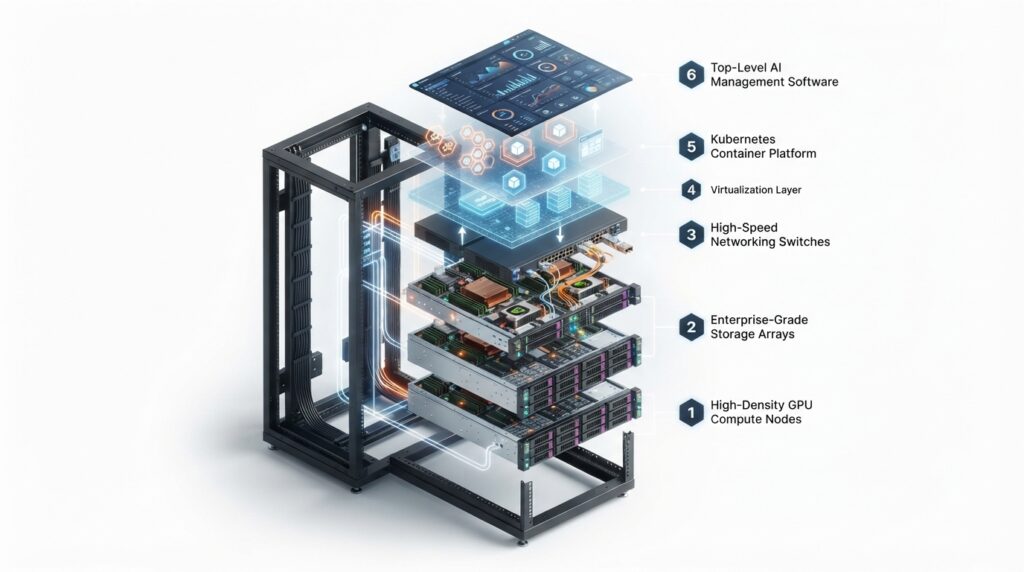
A critical source of clarity for procurement officers is the market’s bifurcation of the term “AI appliance.” In consumer and smart-home electronics, “AI appliance” describes consumer-grade conversational models integrated into hardware. For enterprise IT procurement, however, AI appliances are defined strictly as turnkey, hyperconverged infrastructure (HCI) systems. These systems integrate high-density GPU compute, scale-out storage, high-speed networking, virtualization layers, and automated machine learning operations (MLOps) orchestration into a single, factory-validated SKU.
Enterprise AI Hardware Buying Guide: Turnkey AI Appliance Market Dynamics
The enterprise turnkey appliance market is dominated by co-engineered platforms and validated reference architectures. These pre-validated clusters eliminate the traditional integration burden—sourcing servers, designing cooling loops, and manual software stack debugging—compressing deployment timelines from quarters to days.
- HPE Private Cloud AI: Developed in close partnership with NVIDIA, featuring deep integration with the GreenLake control plane.
- Dell AI Factory with NVIDIA: Leverages automated deployment blueprints and scalable PowerScale data storage.
- Nutanix GPT-in-a-Box 2.0: Pairs the Nutanix Cloud Platform with hyperconverged data services and Nutanix Enterprise AI orchestration.
- Supermicro Turnkey AI Workload Solutions: Focuses on high-density AI SuperClusters built for massive scale-out capacity.
Critical Vendor Evaluation Criteria
Evaluating turnkey AI appliance vendors requires looking beyond raw compute metrics. Because these systems tightly couple physical hardware with advanced software layers, procurement teams must assess vendors across three foundational pillars: support lifecycles, software update orchestration, and software-to-model compatibility.
Key Takeaways
✔ Verify unified support instead of separate hardware and software vendors.
✔ Prioritize automated lifecycle management.
✔ Confirm enterprise model compatibility before procurement.
✔ Require production-ready validation—not just benchmark numbers.
1. Hardware Warranty and Lifecycle Support
Beyond GPU specifications, procurement teams should verify how the vendor handles long-term operational support.
Key evaluation points:
- Unified hardware and software support through a single point of contact.
- Complete Level 11/12 factory validation, including full rack assembly, cabling, firmware validation, and stress testing.
- Pre-shipment thermal verification to eliminate on-site deployment conflicts.
- Documented lifecycle support policy covering firmware, BIOS, and driver updates.
Why it matters
Multi-vendor environments often create ownership disputes when firmware, GPU drivers, or operating systems conflict. A unified support model dramatically reduces downtime and simplifies incident resolution.
2. Software Stack and Hypervisor Update Cadence
The software layer determines how easily an AI appliance can be maintained throughout its lifecycle.
Procurement checklist
- One-click platform upgrades
- Automated Life Cycle Manager (LCM)
- Rolling firmware updates
- GPU driver orchestration
- Container runtime compatibility
- Hypervisor support (AHV, VMware, OpenShift)
Why it matters
Manual updates across Kubernetes, GPU drivers, firmware, and storage controllers increase operational risk. Automated orchestration significantly reduces maintenance complexity.
3. Model Compatibility and Pre-Flight Testing
Hardware specifications alone do not determine deployment success.
Verify that the appliance supports:
- NVIDIA NIM
- Hugging Face
- Automated pre-flight GPU memory validation
- Model Context Protocol (MCP)
- Secure enterprise database integration
Why it matters
Production failures often occur because model memory requirements exceed available GPU resources. Automated validation prevents these deployment errors before production.
Appliance Sizing and Capability Matrix
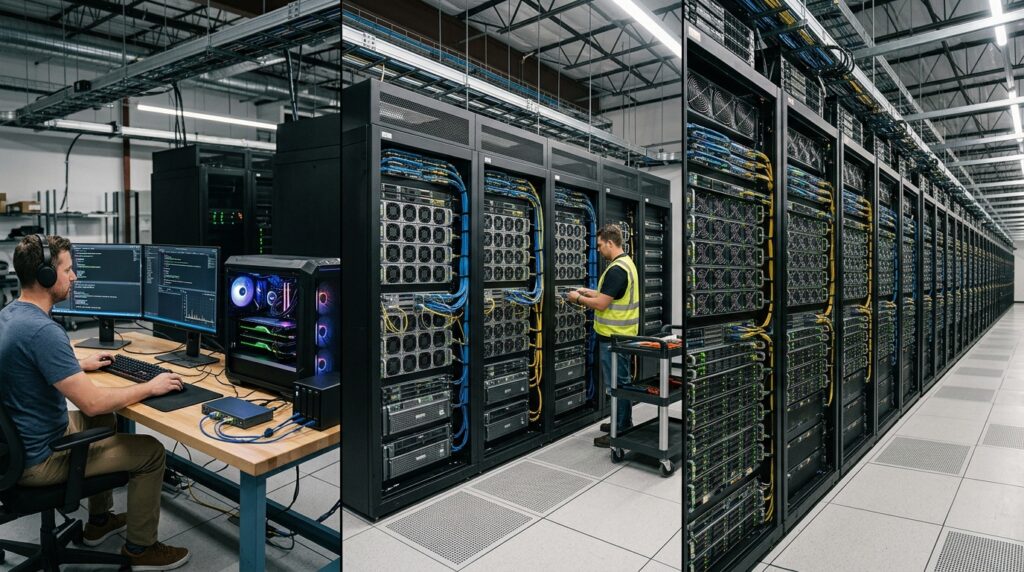
AI appliance sizing must balance compute throughput against physical datacenter constraints like space, power, and cooling. The matrix below compares standard configurations ranging from Edge setups to hyper-dense Enterprise Scale-Out clusters.
| Sizing Dimension | Developer / Small Business Scale | Medium Departmental / Mid-Market | Enterprise Scale-Out Private Cloud |
| Typical Target Workloads | Local low-to-mid parameter model development, rapid edge visual computing, basic offline inference. | Departmental AI inference, Retrieval-Augmented Generation (RAG), and data engineering pipelines. | High-throughput production inference, deep RAG, complex model fine-tuning, and visual AI. |
| Example Reference Systems | ASUS Ascent GX10, HPE Private Cloud AI Developer System, Supermicro Workstations. | HPE Private Cloud AI (Small/Medium), Lenovo ThinkAgile HX650 V3, Supermicro SYS-532AW-C. | HPE Private Cloud AI (Large), Dell AI Factory with NVIDIA, Supermicro AI SuperClusters. |
| Processor & GPU Configuration | 2x Intel Xeon 32-Core CPUs (or Intel AMX acceleration); up to 2x NVIDIA RTX Pro 6000 or 1x GB10 Grace Blackwell. | 1x or 2x Intel Xeon Scalable CPUs (up to 86 cores); 4x to 8x NVIDIA RTX Pro 6000 or H200 GPUs per node. | Dual-socket Xeon 6 P-Core or AMD EPYC; 16x up to 144x NVIDIA H200 or Vera Rubin NVL4 GPUs per rack. |
| Memory & Storage Specs | 128GB to 256GB system RAM; 22TB to 32TB integrated NVMe file and object storage. | Up to 8TB DDR5 system memory; 109TB usable scale-out storage (e.g., Alletra MP or Unified Storage). | Multi-terabyte RAM configurations; 217TB to 249TB+ high-performance flash (e.g., Dell PowerScale, Weka WEKApod). |
| Networking Fabric | Customer-provided 100GbE or 200GbE internal networking switches and cabling. | 2x NVIDIA SN4700M 400GbE switches, 2x Aruba 6300M out-of-band management switches. | 4x NVIDIA SN4700M 400GbE switches, integrated SmartFabric, automated storage networking. |
| Power & Cooling Footprint | Up to 2.2 kW; standard office HVAC and 110V/220V wall outlets. | 12 kW to 13 kW; standard 42U rack with integrated 3-phase PDUs. | 17.4 kW up to 300 kW+ per rack; hyper-dense racks requiring active direct liquid cooling (DLC). |
Total Cost of Ownership & Software Licensing Realities
A robust procurement strategy must balance initial capital expenditure (CapEx) against long-term operating costs (OpEx). Turnkey AI appliances represent a shift from the variable utility billing of public cloud APIs to a highly predictable, fixed-capacity cost model.
Amortizing Local Inference Costs
In public cloud environments, inference costs scale linearly with the volume of input and output tokens. For high-utilization production applications, this model can quickly become financially unsustainable.
In contrast, on-premises turnkey appliances require significant upfront acquisition and setup costs but deliver a marginal cost per token that approaches zero. For sustained, high-throughput enterprise workloads, deploying dedicated local hardware can reduce inferencing costs by up to 65% compared to public cloud equivalents.
To quantify this transition, procurement teams can model the local inference cost per thousand tokens ($C_{\text{token}}$) using the following amortized formula:
$$C_{\text{token}} = \frac{HW_{\text{capex}} \cdot (1+r)^n + \sum_{t=1}^{n} (SW_{\text{sub}_t} + Support_t + Power\_Cooling_t)}{\sum_{t=1}^{n} Tokens_t}$$
While hardware depreciation represents the largest capital expense, software licensing frequently becomes the hidden operational cost that procurement teams underestimate.
The following licensing comparison summarizes the recurring software subscriptions and enterprise support plans commonly required when moving from prototype deployments into production-scale AI infrastructure.
Where:
- $HW_{\text{capex}}$ is the upfront capital cost of the hardware appliance, networking switches, and rack integration.
- $r$ is the corporate cost of capital or financing rate.
- $n$ is the planned operational lifecycle of the appliance, typically 3 to 5 years.
- $SW_{\text{sub}_t}$ represents the annual recurring software licensing fees for the hypervisor, orchestration plane, and model registries.
- $Support_t$ is the cost of unified hardware/software support and maintenance agreements in year $t$.
- $Power\_Cooling_t$ represents the calculated annual utility costs for both hardware power draw and server room cooling.
- $Tokens_t$ is the projected annual volume of inference tokens served by the appliance in year $t$.
Navigating the Production Licensing Boundary
A common pitfall in AI hardware procurement is overlooking the licensing transition between development and production environments. For example, while running certain containers or utilizing standard repositories locally is cost-free for prototyping, moving to live production environments running business-critical transactions often mandates commercial platform licensing.
Procurement must factor these explicit subscription and perpetual structures into long-term TCO models:
| Licensing Tier / Component | Term | Estimated Cost per GPU | Support SLA Included | Key Capabilities |
| NVIDIA AI Enterprise Subscription | 1 Year | $4,500 | Standard 8×5 Support | Production NIM deployment, Triton, TensorRT |
| NVIDIA AI Enterprise Subscription | 3 Years | $13,500 | Standard 8×5 Support | Multi-year pricing stability |
| NVIDIA AI Enterprise Subscription | 5 Years | $18,000 | Standard 8×5 Support | 5 years of support for the price of 4 |
| NVIDIA AI Enterprise Perpetual | Perpetual | $22,500 | 5 Years Maintenance | High upfront CapEx, lower long-term OpEx |
| NVIDIA Business Critical Support | 5 Years | $5,000 | 24×7 Mission-Critical | Rapid hardware-software issue resolution |
| NVIDIA Run:ai (Self-Hosted) | 3 Years | $18,000+ | Co-termed 24×7 Support | Advanced GPU scheduling and slicing |
⚠️ Procurement Warning
Hardware pricing alone rarely reflects the total investment. Enterprise software subscriptions, support contracts, power consumption, cooling infrastructure, and licensing renewals often account for a significant portion of long-term operational costs.
Hyperconverged Software Licensing Tiers
For hyperconverged software infrastructure (e.g., Nutanix Enterprise AI), licensing is structured around CPU cores, vCPUs, or allocated GPU memory.
- Starter / Pro Tiers: Provide foundational endpoint APIs for leading models (such as NVIDIA NIM and Hugging Face) and include standard enterprise management portals.
- Ultimate Tiers: Add advanced capabilities such as multi-site data replication, near-synchronous disaster recovery, and high-security compliance options (including software-based and self-encrypting drive data-at-rest encryption).
Strategic Procurement Questions for Vendor Negotiations
To safeguard your organization against proprietary vendor lock-in and ensure long-term architecture flexibility, use this structured question framework during active contract negotiations.
1. Virtualization and Hypervisor Openness
Procurement Question: “Does the appliance software stack require a proprietary hypervisor, or does it natively support heterogeneous virtualization environments such as Nutanix AHV, VMware ESXi, Red Hat OpenShift, or bare-metal Kubernetes?”
- Evaluation Objective: Avoid locking the organization into a single virtualization ecosystem, which introduces massive financial and operational risk if licensing structures change unexpectedly.
- Target Standard: The system should support standard container orchestration platforms, allowing seamless workload migration across hypervisors without requiring model or pipeline reconfiguration.
2. Silicon Independence and Software Portability
Procurement Question: “How does the software orchestration layer handle non-CUDA hardware targets, and what is the documented migration path for running existing models on alternative accelerators, such as AMD Instinct or Intel Gaudi, using open software frameworks like ROCm or OneAPI?”
- Evaluation Objective: Ensure the organization can adopt alternative, cost-effective silicon if GPU supply chains tighten or market pricing shifts.
- Target Standard: The vendor must demonstrate that key microservices, model libraries, and data pipelines can compile and run on alternative hardware platforms using open-source, non-proprietary compilation layers.
3. Subscription Lapses and Hardware Ownership
Procurement Question: “If the software orchestration or management subscription (e.g., HPE GreenLake, Dell Automation, or Nutanix NAI) is allowed to lapse, does the underlying server hardware remain fully functional as standard x86 compute, and does the organization retain access to base system management, firmware, and BIOS?”
- Evaluation Objective: Prevent “hardware bricking” or forced subscription renewals, ensuring the physical server assets retain long-term value as general-purpose compute.
- Target Standard: Contracts must state that if software subscriptions lapse, the physical hardware remains accessible via standard, unlicensed management tools (e.g., standard IPMI or iDRAC), allowing the installation of alternative operating systems or hypervisors.
4. Operational Air-Gap and Dark Site Autonomy
Procurement Question: “Does the appliance support 100% offline local operational capabilities (completely air-gapped dark site execution) without requiring periodic cloud-based telemetry, licensing handshakes, or model validation connections back to vendor servers?”
- Evaluation Objective: Guarantee compliance with strict regulatory, sovereign, and defense-grade security protocols that prohibit external network traffic.
- Target Standard: The platform must natively support local license servers, local storage repositories for security patches, and completely offline model validation procedures.
5. Modular Upgradability and Datacenter Standards
Procurement Question: “Does the physical rack and power cabinet infrastructure adhere to open datacenter standards, such as Open Rack v3 (ORv3), and is the system designed to support future GPU physical form factors without requiring a full forklift replacement of the rack, switches, and cooling infrastructure?”
- Evaluation Objective: Protect capital investments in core datacenter infrastructure (cabling, high-speed switching fabrics, and liquid-cooling distribution units) across multiple hardware lifecycles.
- Target Standard: Demand a modular chassis design with standard power busbars, universal quick-connect manifolds for liquid-cooled configurations, and support for industry-standard PCIe expansion slots.
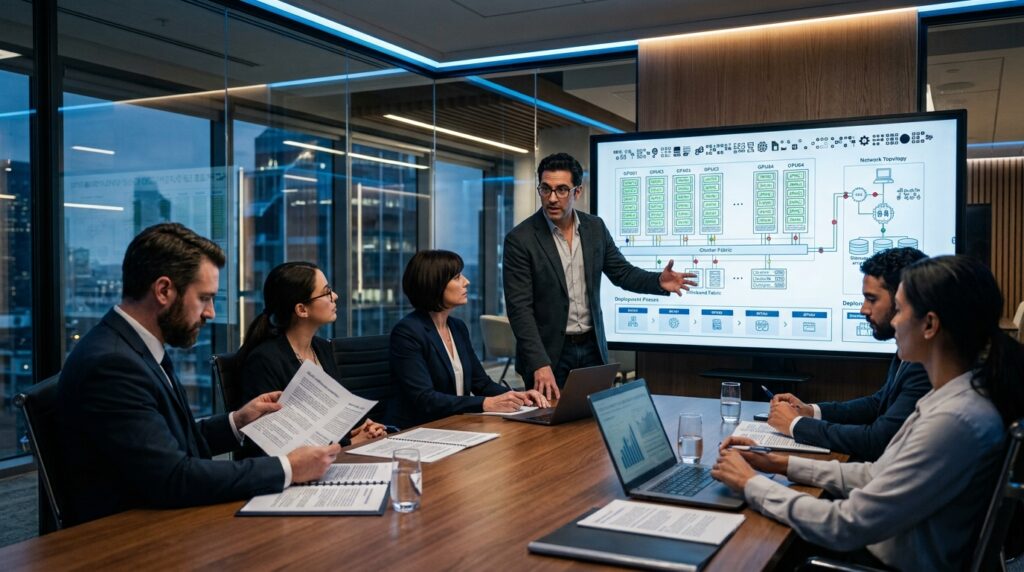
Enterprise Procurement Checklist
Before approving an AI appliance purchase, verify that your shortlisted platform includes:
- □ Factory Level 11/12 validation
- □ Unified hardware and software support
- □ Automated lifecycle management
- □ Open hypervisor compatibility
- □ MCP-ready model integration
- □ Air-gap deployment capability
- □ Transparent production licensing
- □ Future GPU upgrade roadmap
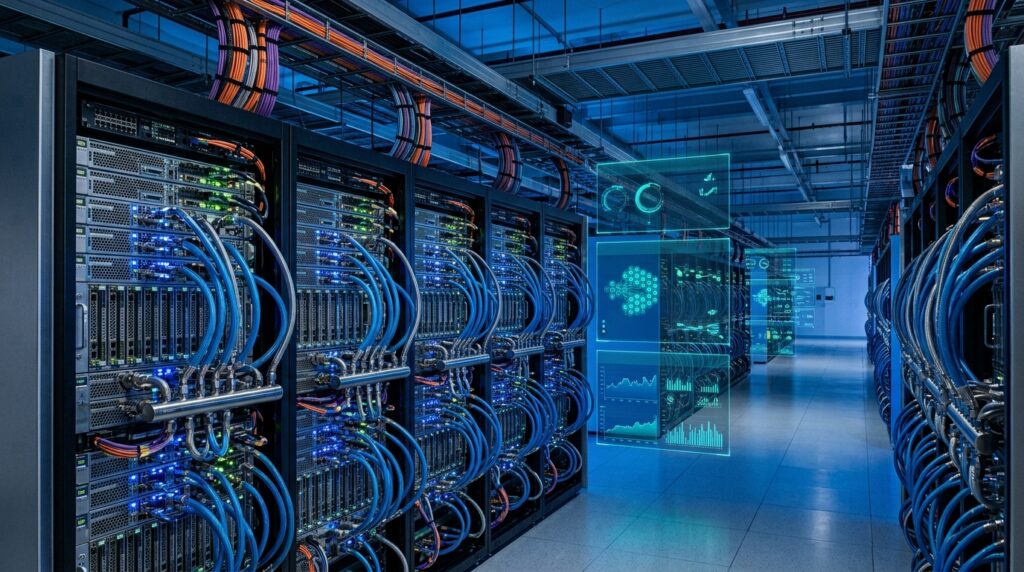
Final Recommendation
- If your immediate priority is minimizing deployment risk within an established enterprise virtualization environment: Choose a co-engineered platform tightly coupled with your existing stack (such as the Dell AI Factory with NVIDIA for VMware shops, or Nutanix GPT-in-a-Box 2.0 for hyperconverged environments). This ensures rapid operational velocity and automated full-stack maintenance.
- If your priority is avoiding vendor lock-in and maximizing long-term hardware flexibility: Prioritize solutions built on modular, open infrastructure (such as Supermicro Turnkey AI Workload Solutions), ensuring explicit contract terms regarding open hypervisor compatibility, silicon independence, and completely air-gapped operational autonomy.
What you should do next: Audit your targeted datacenter’s available power and cooling headroom, determine your projected monthly inference token volumes, and request a factory-validated bill of materials (BOM) from your shortlisted vendor establishing clear production licensing boundaries.
When planning an on-premises migration, procurement teams should directly verify technical integration matrices with primary vendors. For instance, detailed infrastructure blueprints can be cross-referenced via the official platforms of Dell AI Factory with NVIDIA
and HPE Private Cloud AI
, ensuring your hardware sizing aligns with validated enterprise standards. Additionally, before committing to a physical hardware footprint, it is critical to understand the specific AI software components driving these systems. For a deeper operational deep-dive into autonomous inspection frameworks and localized machine learning models, look at our comprehensive analysis on Zanus AI deployment to see how specialized modules operate within private corporate perimeters.