
Most organizations do not need another large language model to experiment with. What they actually require is a concrete architecture to eliminate cross-departmental operational bottlenecks without leaking proprietary data assets to public cloud environments.
As corporate data sovereignty, volatile token billing frameworks, and cloud-layer security vulnerabilities become increasingly critical risks, the traditional “AI-as-a-Service” model is exposing its structural limits. Zanus AI for Enterprise positions itself as a distinct architectural alternative: an all-in-one on-premises appliance that closely couples dedicated physical GPU clusters, a specialized operating system (Zanus AI OS), and locally hosted large language models.
This technical review deconstructs the system’s actual performance capabilities, Capital Expenditure (CapEx) versus Operational Expenditure (OpEx) financial models, and infrastructure constraints to help Chief Technology Officers (CTOs) and infrastructure architects make an informed deployment decision.
Product Overview
Zanus AI for Enterprise is neither an open-source software stack requiring manual pipeline assembly nor an API wrapper routing queries to external hyperscalers. It is an integrated, multi-node private AI server cluster designed for deployment strictly within an organization’s internal local area network (LAN) or a logically isolated, air-gapped enclave.
The platform addresses a major vulnerability in modern enterprise AI implementations: the fragmentation between compute hardware, localized vector store indices, and the upstream business application layer. By consolidating enterprise-grade accelerators (GPUs), an NVMe storage subsystem configured in RAID-10, and the Zanus AI OS—which integrates over 15 native functional modules spanning knowledge management, business process automation, and enterprise resource planning (ERP) connectors—the appliance builds a self-contained intelligence environment. The core engineering objective is ensuring that zero data bits ever exit the corporate network boundary.
Best For
- Highly Regulated Industries: Banking institutions, financial entities, healthcare networks (requiring absolute HIPAA compliance), public sector agencies, and core R&D facilities that must enforce strict protection over corporate intellectual property.
- Global Manufacturers and Complex Supply Chains: Entities requiring seamless data orchestration across cross-border production facilities and regional hubs without risking latency spikes or relying on unstable international internet gateways.
- High-Volume Production Deployments: Organizations running millions of monthly inference queries where public cloud token usage costs would otherwise cause unpredictable and unstably scaling OpEx budget overruns.
Key Strengths
1. Absolute Sovereign Isolation (Air-Gapped Capacity)
The primary architectural advantage of Zanus AI is its capacity to operate entirely severed from external networks. Unlike typical enterprise software platforms that demand persistent internet connectivity for dependency updates, license verification, or remote telemetry, the system operates fully locally post-initialization. This eliminates remote API exfiltration vectors and the risk of third-party vendors utilizing proprietary prompt context windows to fine-tune public models.
2. Predictable Asset Amortization (Fixed-Cost Model)
Instead of forcing enterprises into variable billing loops tied to shifting input/output token counts, the platform operates under a flat procurement model. Once the initial hardware assets and core software licenses are capitalized and amortized over their operational lifecycle, the marginal cost of scaling query volumes, extending access to new business units, or increasing headcount drops to zero.
3. Native Integration Without Infrastructure Replacements (Legacy Integration)
The Zanus AI OS incorporates pre-compiled REST APIs and webhook connectors that hook directly into foundational enterprise systems including SAP, Oracle, ServiceNow, and Microsoft 365. The appliance functions as an overlay intelligence layer, pulling and processing unstructured enterprise data directly from the ERP core to execute predictive scenarios or automate approval workflows without forcing an expensive rip-and-replace of legacy database schemas.

Deployment Insight
The decision to package the hardware compute layer and software stack into a single appliance significantly mitigates deployment integration risk. Rather than spending quarters manually configuring host-channel drivers, connecting standalone vector databases, and optimizing inference runtimes on bare-metal GPU nodes, enterprise infrastructure teams can bring the cluster to an operational state within days.
Limitations & Operational Risks
Despite its robust security posture, deploying Zanus AI for Enterprise introduces distinct infrastructure challenges that require thorough technical evaluation:
- High Initial CapEx Commitments: Securing a multi-node, accelerator-dense physical server cluster requires a major upfront capital investment compared to the zero-dollar entry barrier of cloud-based Software-as-a-Service (SaaS) APIs.
- Accelerated Hardware Depreciation Risks: The silicon space for AI accelerators remains intensely volatile. High-end GPU configurations deployed today are subject to a secondary-market depreciation rate of 15% to 20% annually as next-generation microarchitectures emerge, reducing the relative compute efficiency per watt.
- Internal Infrastructure Management Overhead: Operating a completely air-gapped system shifts the entire burden of hardware maintenance, physical disk array management, and localized patch deployment lifecycle management directly onto internal IT staff without the benefit of automated cloud-delivered operations.
Technical Comparison: Private Sovereign Cluster vs. Public Frontier Cloud
| Evaluation Criteria | Zanus AI for Enterprise | Frontier Cloud AI (e.g., Public API Hubs) |
| Deployment Model | On-premises / Fully air-gapped enclave | Public Cloud / External API endpoints |
| Cost Structure | Fixed CapEx (Amortized physical asset) | Variable OpEx (Billed per million tokens) |
| Data Exfiltration Risk | Negligible (Data never exits local fabric) | High (Dependent on third-party security bounds) |
| System Latency | Low and deterministic (Internal LAN/InfiniBand) | Variable (Subject to public internet congestion) |
| Enterprise Integration | Pre-built ERP connectors (SAP, Oracle) | Custom API development required |
| Upgrade Management | Manual (Requires secure offline intake protocols) | Automated (Managed by the cloud vendor) |
Total Cost of Ownership (TCO) Analysis
To establish an accurate financial foundation, we model a 5-year quantitative cost trajectory for a standard corporate headquarters supporting 5,000 active employees, averaging 15 queries per user per day, with a mean context length of 2,500 total tokens per query:
- Public Cloud Frontier Model Tier: The annual token consumption volume results in a linear operating cost of approximately $328,125.00 per year. Cumulatively, the enterprise spends $1.64 million USD over 5 years with zero equity in physical infrastructure assets.
- Sovereign Local Hardware Deployment (Zanus Enterprise Configuration): The initial CapEx allocation—covering two HGX/DGX-class 8-GPU nodes, 400 Gb/s InfiniBand networking fabric, enterprise NVMe storage arrays, and cooling infrastructure—totals $880,000.00. Dedicated annual OpEx (power utility draw at a PUE of 1.3, hardware maintenance spares, enterprise OS licensing, and 0.5 FTE systems engineer allocation) stabilizes at $155,851.00 per year.
5-Year Cumulative Cost Trajectory (USD)

Year 1:
Cloud Frontier:   $328,125  =================
Sovereign On-Prem:$1,035,851 =====================================================

Year 3:
Cloud Frontier:   $984,375  ======================================================
Sovereign On-Prem:$1,347,553 =======================================================================

Year 5 (Break-Even):
Cloud Frontier:   $1,640,625 =============================================================================================
Sovereign On-Prem:$1,659,255 ==============================================================================================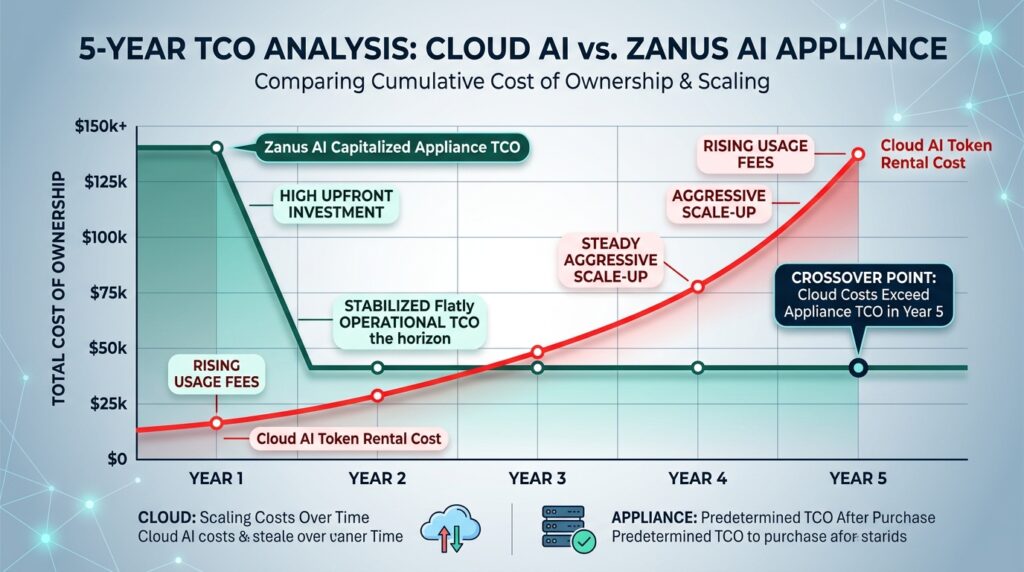
Operational Impact
The mathematical model demonstrates that the financial break-even point between the Zanus AI Enterprise cluster and public frontier cloud APIs occurs toward the end of Year 5. However, if an organization’s internal workflows consist entirely of low-complexity, non-sensitive administrative tasks that can be safely processed by utility-class cloud micro-models (e.g., GPT-4o mini), a local hardware deployment will not yield a financial return. Procurement of Zanus AI must be driven by verifiable data isolation mandates, regulatory compliance obligations, and IP protection requirements, rather than simple cost-reduction metrics.
Pros & Cons
Pros
- Absolute Data Control: Prevents sensitive internal corporate information from crossing the corporate network boundary.
- Financial Predictability: Eradicates monthly cloud billing volatility caused by unexpected internal user consumption spikes.
- Minimal Network Latency: Delivers high-throughput inference times by utilizing local InfiniBand fabrics instead of public routing.
- Operational Continuity: Maintains uninterrupted local AI processing capacity during comprehensive external internet outages.
- Built-In Compliance Architecture: Simplifies adherence to rigid data privacy standards like GDPR, HIPAA, and ISO 27001 out of the box.
Cons
- Substantial Upfront Capital Investment: Requires a significant initial budget allocation before generating operational value.
- Depreciation and Obsolescence Risks: Local compute clusters face rapid relative performance degradation as new hardware arrives.
- High Internal Maintenance Requirements: Demands specialized on-premises system administration capabilities to maintain high availability.
Editor’s Take
IF your organization operates within a highly scrutinized industry handling heavily protected data domains (such as corporate finance, healthcare delivery, or national defense) and must comply with strict legal frameworks that block public cloud data hosting, THEN Zanus AI for Enterprise represents one of the most operationally viable infrastructure paths available today, BECAUSE it solves the conflict between enterprise automation and zero-trust security by enclosing the entire inference lifecycle within an immutable physical asset under your direct operational control.
Alternatives
- DIY Open-Source Infrastructure Stack: Procuring commodity bare-metal GPU servers and deploying open-source models (such as Llama 3 or Mistral) utilizing vLLM inference engines coupled with standalone vector databases (e.g., Qdrant or Milvus). This approach reduces software licensing fees but significantly increases deployment complexity and ongoing engineering risks.
- Hybrid Cloud Infrastructure Platforms (e.g., AWS Outposts / Azure AI Studio): Deploying managed cloud hardware inside the corporate data center to maintain local data residency while preserving access to public cloud management planes. This setup offers automated patching cycles but requires maintaining a persistent, outbound network connection.
Final Verdict
Do not procure Zanus AI for Enterprise if your near-term objective is simply providing a generic copywriting or basic document summarization assistant for a small internal team. Doing so introduces unjustified capital inefficiency.
Choose Zanus AI for Enterprise only if: You have explicitly mapped high-value, core business workflows containing highly sensitive intellectual property that must be automated across the entire enterprise print, and you intend to establish your corporate AI capability as a long-term capitalized infrastructure asset on your balance sheet rather than an open-ended cloud operational liability.
What to do next: Conduct an exhaustive internal data governance and workflow audit to quantify your actual document corpus size, verify your existing legacy ERP integration points, and calculate your team’s real daily query volume. Following the audit, engage the vendor to execute an on-site Proof of Concept (PoC) within a strictly isolated network sandbox. This allows you to directly benchmark the real-world latency, domain-specific accuracy, and context-handling performance of the Zanus AI OS before making a long-term capital commitment.

Your Next Step
Eliminating unpredictable token usage bills and stabilizing your downstream agentic workflows requires an intentional shift toward hardware-level isolation. To successfully map your enterprise infrastructure scale and present a definitive capital asset allocation proposal to your executive leadership team, we recommend utilizing our comprehensive technical cluster blueprints:
- Performance Capacity Evaluation: Contrast the compute density and memory thresholds of the dedicated node architectures by exploring the Zanus AI Prime vs Quantum infrastructure tiers.
- Hardware Sizing Roadmap: Audit your internal data center space allocations, electrical metrics, and server room footprints via the Zanus AI Hardware Infrastructure manual.
- Local Operating Engine Review: Discover how the pre-installed secure OS manages built-in document parsing and private API gates in our Zanus AI Deep Review.
- Civilian Asset Applications: For a detailed engineering guide on how edge-native visual computing automates drone photogrammetry under strict regional compliance laws, see our manual on minimizing the Florida SB-4D inspection cost.
Don’t let variable public cloud API billing models or unexpected multi-tenant isolation bugs compromise your corporate data auditing security—conduct your data custody review and deploy your turnkey zanus ai for enterprise operations cluster today.
References
- Zanus AI Official Product Catalog, “Zanus AI Enterprise — Multi-Node Private AI Server Cluster”: https://zanusai.com/products/zanus-ai-enterprise-private-ai-server
- Zanus AI Technical Documentation, “AI Software for Enterprise Operations”: https://zanusai.com/products/ai-software-for-enterprise-operations
- Zanus AI Whitepaper Series, “The Rise of Sovereign Enterprise Intelligence”: https://zanusai.com/blogs/what-is-zanus-ai/zanus-ai
- NVIDIA Enterprise Architecture Specifications, “DGX H100 System Architecture and Interconnect Data Sheets”: https://www.nvidia.com/en-us/data-center/dgx-h100/
- National Institute of Standards and Technology (NIST), “SP 800-82r3: Guide to Operational Technology (OT) Security”: https://nvlpubs.nist.gov/nistpubs/SpecialPublications/NIST.SP.800-82r3.pdf