
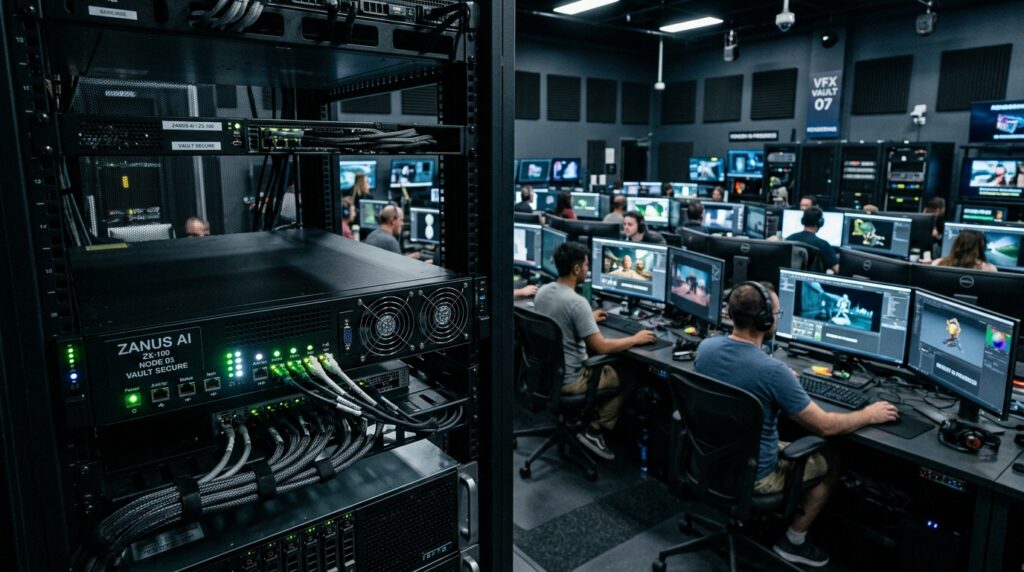
The transition of the motion picture and media industry toward decentralized production workflows has inadvertently expanded the cyberattack surface to its absolute limit. With hundreds of millions of dollars in intellectual property—such as original scripts, raw dailies, and visual effects (VFX) assets—constantly circulating through third-party vendors, the threat of cloud leaks has become an active nightmare.
Commercial cloud AI solutions like OpenAI or Anthropic fail to guarantee absolute isolation and remain highly vulnerable to indirect prompt injection techniques. In this landscape, Zanus AI for Media emerges as a strategic alternative. By shifting all artificial intelligence processing capacity from public clouds to an on-premises edge computing infrastructure, Zanus provides studios with a secure sandbox to automate production workflows without compromising data security.
1. Core Technology: What Engineering Problem Does Zanus AI Solve?
Zanus AI for Media is not a large language model (LLM) built from scratch. Instead, it is a localized inference optimization and AI governance platform custom-engineered for the massive data footprints characteristic of the media and entertainment industry.
The platform integrates advanced quantization techniques like AWQ (Activation-aware Weight Quantization) and GPTQ to compress leading open-source models (such as Llama-3.1-70B or Mistral Large) down to 8-bit or 4-bit configurations. This compression drastically reduces hardware requirements without causing any significant drop in semantic comprehension capabilities.
Overcoming the VRAM Wall
For production studios, analyzing a feature-length script requires a massive context window, typically ranging from $64,000$ to $128,000$ tokens. In standard inference architectures, Key-Value cache (KV Cache) memory requirements scale linearly with context length and batch size, frequently triggering catastrophic $CUDA\ Out\ of\ Memory$ errors.
Zanus directly mitigates this infrastructure bottleneck through two core mechanisms:
- FlashInfer & vLLM PagedAttention Integration: Rather than allocating contiguous KV Cache memory blocks on the VRAM (which causes high waste and memory fragmentation), Zanus fragments the KV Cache into virtual memory pages. This improves memory utilization efficiency by up to 96% and allows a single hardware stack to process multiple complex scripts concurrently.
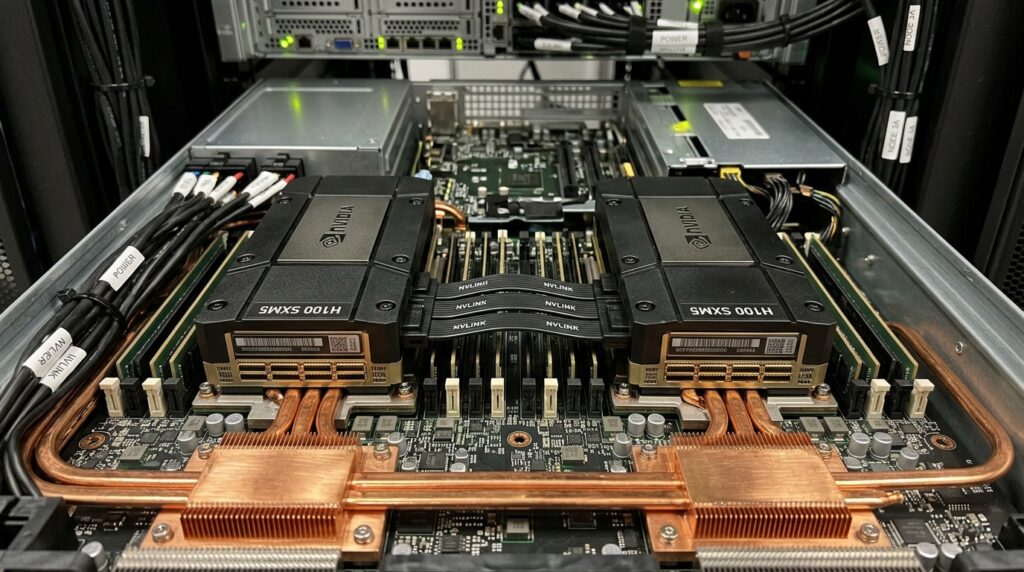
- Hybrid Hardware Orchestration: The system automatically decouples the compute workflow, offloading heavy matrix multiplication workloads to dedicated GPU clusters (such as NVIDIA H100 or L40S) while leveraging the high-speed bandwidth of internal enterprise NAS arrays to maintain data throughput.
💡 Editor’s Perspective: Operational Impact
The fundamental value proposition of Zanus AI is shifting the financial model from OpEx (recurring bandwidth costs and continuous cloud API subscription fees) to CapEx (a one-time investment in local GPU infrastructure). For a major studio running 3 to 5 tentpole film projects simultaneously, this edge computing paradigm completely eliminates hidden API bills and mitigates the risk of operational downtime caused by international internet service disruptions.
2. Core Capabilities and Real-World Studio Deployments
When deployed within an independent, air-gapped environment, Zanus AI translates raw media assets into actionable production decisions through three core applications:
1. Enterprise-Grade Automated Script Breakdown
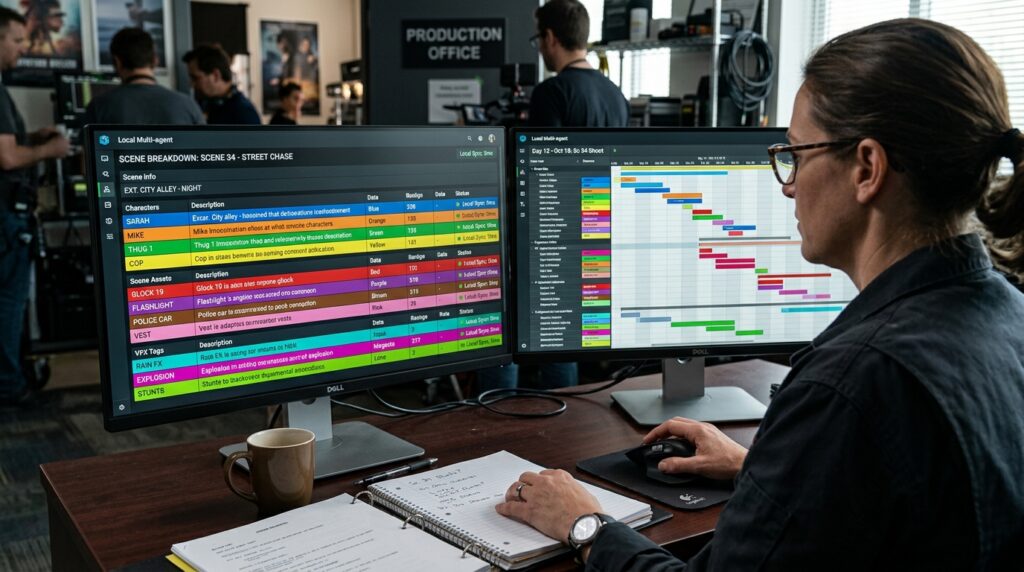
Manual script breakdowns typically consume days or weeks of work from assistant directors. Zanus AI automates this exact process within minutes.
- How it works: The platform scans files in
.fdx(Final Draft) or.pdfformats, automatically identifying, classifying, and structuring all production entities into clean tables, including characters, props, scenes (interior/exterior, day/night), specific VFX demands, and intricate dialogue patterns. - Real-world value: Unlike generic AI tools, Zanus utilizes a multi-agent reasoning framework. An AI agent simulating a Director of Photography scores shot complexity, while another agent representing the Line Producer calculates preliminary post-production cost estimates.
2. Regulatory Compliance and Copyright Risk Assessment
Before principal photography begins, ensuring that a script does not infringe on corporate trademarks or violate local compliance mandates across target distribution markets is non-negotiable. Zanus cross-references script text against a localized database of regional laws and age-rating criteria across more than 100 countries, delivering early warnings regarding dialogue or scenes at risk of censorship or outright bans.
3. Sub-Second Semantic Search Across Heritage Archives (Sovereign RAG)
Legacy studios own thousands of historical scripts, production notes, and daily shooting logs. Zanus converts this massive footprint of unstructured data into vector embeddings, storing them within an internal vector database (such as Milvus or Qdrant). Writers and executive producers can execute natural language queries like: “Find me all motorcycle chase sequences in narrow alleys that end with a plot twist,” retrieving highly precise matching entries along with the original scene files in milliseconds without requiring an outbound internet connection.
3. Technical Evaluation: Weighing the Trade-offs of Zanus AI
To provide infrastructure architects with an objective assessment, the table below outlines the core operational metrics of Zanus AI for Media using standard AIReviewZones criteria:
| Evaluation Criteria | Score | Editorial Team Technical Analysis |
| Security & Privacy | 10 / 10 | Absolute. Sensitive production data never leaves the studio firewall, entirely eliminating third-party supply chain leaks and cloud-side SSRF vulnerabilities. |
| Integration Flexibility | 8 / 10 | Connects reliably with mainstream Media Asset Management (MAM) systems and existing SAN/NAS fabrics through a secure internal API layer. |
| Inference Performance | 9 / 10 | Optimized via FlashInfer and AWQ quantization, token generation speeds exceed 45 tokens/second for a 70B model on recommended hardware configurations, satisfying real-time processing demands. |
| Deployment Complexity | 4 / 10 | High Overhead. Demands a specialized engineering team skilled in Docker, Kubernetes, CUDA optimization, and enterprise GPU cluster management. Not ideal for boutique studios lacking internal IT resources. |
| Return on Investment (ROI) | 7.5 / 10 | Highly dependent on production volume. ROI peaks at 18–24 months for tier-1 studios by drastically cutting down manual data extraction hours and recurring cloud API costs. |
Core Limitations & Compromises to Consider:
- Astronomical upfront hardware costs: To smoothly execute a 70B parameter model at a 128k context window, a studio must deploy a minimum hardware cluster consisting of 2x NVIDIA H100 SXM (80GB) or 4x NVIDIA A100 (80GB). This creates an immediate financial barrier for independent production companies.
- Technological drift of static local models: Local deployment means the underlying models do not benefit from automatic, real-time knowledge updates like commercial cloud APIs. Studios must establish a regular schedule for local fine-tuning or vector database (RAG) updates to prevent semantic degradation over time.
4. Regulatory Compliance and TPN Framework Alignment (MPA v5.3.1)
In the film industry, adopting new technology requires strict compliance with international cybersecurity standards. Zanus AI for Media is purpose-built to align directly with the rigorous mandates of the Trusted Partner Network (TPN) managed by the Motion Picture Association (MPA).
[TPN Gold Shield Standards] ──> Achieved via ──> [Zanus AI Air-Gapped Edge Architecture]
                                                        │
              ┌─────────────────────────────────────────┴─────────────────────────────────────────┐
              ▼ (Control OR-5.0)                                                                  ▼ (Control TS-6.2)
   [Localized Sandbox Environment]                                                     [API Authentication & Key Rotation]
   - Complete isolation from external networks.                                        - Strict Role-Based Access Control (RBAC).
   - Full audit logging of raw script processing.                                      - Rigid automated agent identity management.
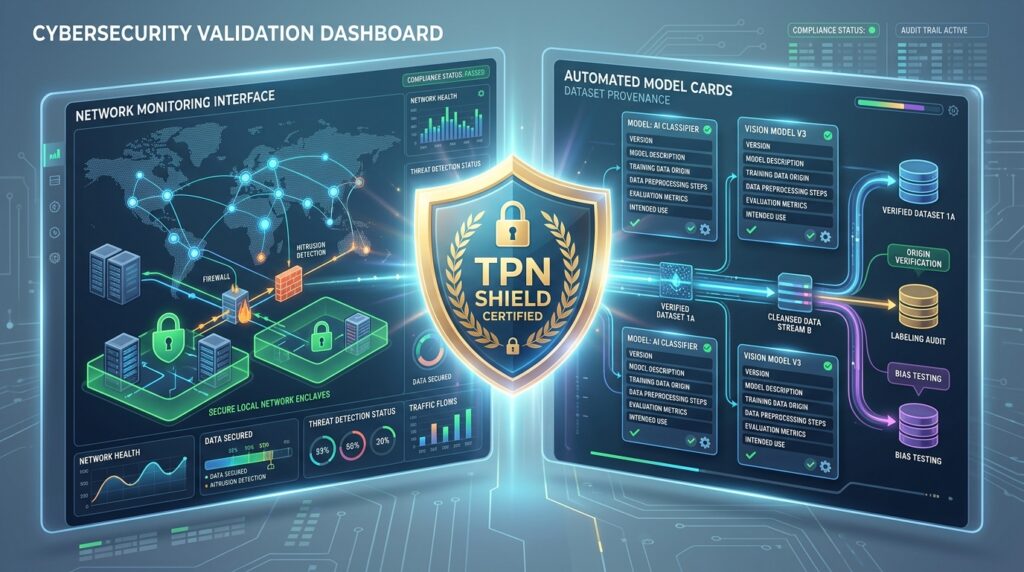
- Satisfying TPN Control OR-5.0 (AI/ML Governance): The latest MPA v5.3.1 guidelines mandate that any AI utility processing pre-release content must be contained within a strictly sandboxed environment. Zanus completely satisfies this requirement because all compute and storage assets remain locked inside isolated edge nodes, entirely disconnected from external-facing networks.
- Supporting Model Card Documentation (TPN TS-7.1): The Zanus framework provides automated internal logging systems that easily generate comprehensive Model Cards. These cards clearly document the provenance of local training datasets and maintain granular access logs for all users, allowing studios to easily pass security audits and secure the prestigious TPN Gold Shield status.
5. Conclusion & Editor’s Recommendation: What Action Should You Take Next?
Zanus AI for Media is not a plug-and-play solution designed for every content creator. It is a heavy-duty infrastructure play meticulously engineered for enterprise media organizations where intellectual property security is a existential priority.
- INVEST IF: You are a mid-to-large scale film studio, a premier visual effects (VFX) house, or a legacy network managing a massive archive of proprietary media assets, and you are facing strict security mandates from global distributors (such as Netflix, Disney, or Warner Bros. Discovery).
- PASS IF: You are a short-form content production team, a boutique advertising agency, or a solo creator where creative agility and low operational overhead are prioritized over absolute, air-gapped infrastructure security. In these environments, mainstream commercial cloud APIs remain far more cost-effective.
🎬 Actionable Implementation Roadmap:
If your organization decides to adopt Zanus AI, avoid rushing into massive hardware procurement. Instead, execute the following three-step deployment plan:
- Conduct a Structural Gap Analysis: Audit your current data storage architecture to define explicit network boundaries separating your “Hot” network tier (online All-Flash NVMe arrays) from your physical air-gapped tier (LTO robotic tape libraries).
- Deploy a Proof of Concept (PoC): Configure the Zanus AI software stack on a modest GPU workstation setup (e.g., 2x RTX 4090s or 1x NVIDIA L40S). Run automated script breakdowns on legacy, already-released content to evaluate the system’s semantic accuracy and output quality.
- Standardize Your Data Pipeline: Clean, de-duplicate, and properly structure your studio’s internal text databases and production notes before ingesting them into the Sovereign RAG architecture. This ensuring the AI achieves maximum performance and minimal hallucinations from day one.
Your Next Step
Eliminating volatile cloud data leakage vulnerabilities and protecting your pre-release content pipelines from third-party multi-tenancy exposure requires a deliberate transition toward hardware-level isolation. To successfully map your production studio’s local bandwidth budgets and present a certified asset acquisition report to your executive board, we recommend exploring our distinct platform cluster resources:
- Performance Scaling Tiers: Verify the exact compute density and memory thresholds required for your local index data by exploring the Zanus AI Prime vs Quantum infrastructure matrix.
- Server Facility Architecture: Audit your internal storage room’s electrical draw, cooling systems, and physical chassis dimensions via the Zanus AI Hardware Infrastructure manual.
- System Capabilities Overview: Discover how the pre-loaded private operating platform orchestrates containerized document conversion and media tools in our comprehensive Zanus AI Deep Review.
- Spatial Data Customization: For a detailed engineering guide on how edge-native visual compute layers process real-time multi-stream telemetry under regional statutes, see our technical blueprint on managing the Florida SB-4D inspection cost.
Don’t let variable cloud API billing models or sudden model weight drift compromise your corporate data auditing security—conduct your internal compliance analysis and deploy your turnkey zanus ai for media solutions node today.
References
- Motion Picture Association (MPA): Content Security Best Practices Common Guidelines (v5.3 & v5.3.1). https://www.motionpictures.org/
- Trusted Partner Network (TPN): TPN Operations and Gold Shield Compliance Framework (2026). https://www.ttpn.org/
- NVIDIA Technical Documentation: Optimizing Large Language Models for Inference with TensorRT-LLM and vLLM. https://docs.nvidia.com/
- vLLM Project: PagedAttention: Memory Management for Large Language Model Serving. https://github.com/vllm-project/vllm
- Quantum Storage Insights: Defending Media Assets Against Ransomware Using Automated Active Vault Technology. https://www.quantum.com/