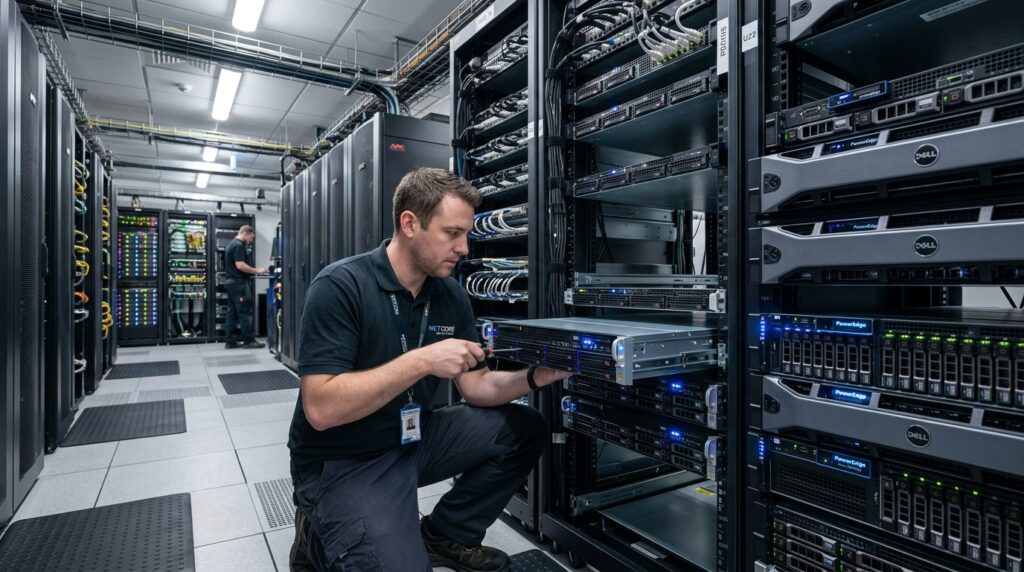
Analyzing the best zanus ai alternatives demonstrates that the mandate for absolute data sovereignty in 2026 has forced corporate technology leaders into a complex infrastructure dilemma.. Deploying on-premises artificial intelligence (AI) is no longer a mere cybersecurity preference—it is a strict regulatory necessity. However, investing in premium turnkey appliances like Zanus AI Enterprise or multi-node Quantum clusters requires upfront capital expenditures (CapEx) ranging from $120,000 to $150,000. Even a single-node setup like Zanus AI Prime demands a steep $54,900 commitment.
To bypass these massive financial barriers, enterprises are increasingly evaluating disaggregated, semi-turnkey on-premises alternatives. This analysis provides a rigorous technical and financial evaluation of three budget-friendly configurations. By comparing them directly against premium turnkey baselines, we expose the long-term operational realities of self-managed sovereign AI.
Quick Summary
Minimizing year-zero CapEx through open-source stacks or custom hardware builds often creates a dangerous economic illusion. When you detach bare-metal compute from pre-integrated enterprise software and deployment services, your internal IT organization must absorb the total cost of system configuration, driver interoperability, and storage optimization.
For organizations with an established, high-velocity MLOps engineering team, leveraging standard Supermicro or Dell hardware configurations running vLLM offers exceptional customization and deep source-code control. Conversely, if your primary corporate objectives are fast time-to-value and predictable, flat operational expenditures (OpEx), premium turnkey appliances remain the safest strategic anchor—despite their intimidating upfront price tag.
Infrastructure Architecture Comparison
| Evaluation Criteria | Premium Zanus AI Enterprise | Lamini AI Appliance | Supermicro/Dell + vLLM Node | MinIO + Vector DB White-Box |
| Ideal Segment | Enterprises needing immediate deployment without internal MLOps expertise | Organizations requiring deep LLM fine-tuning on mid-market infrastructure | Enterprises with established, high-velocity systems engineering teams | High-capacity document retrieval systems optimizing for storage costs |
| Estimated CapEx | $120,000.00 | $30,000.00 | $20,000.00 | $9,500.00 |
| Deployment Model | Monolithic turnkey appliance (Proprietary 8U Chassis) | Semi-turnkey platform (Supermicro AS-8125GS) | Standard enterprise server (Dell PowerEdge R760xa) | Self-assembled commodity hardware (White-Box 2U Chassis) |
| Learning Curve | Low (Administered via standard management UI) | Moderate (Requires familiarity with AMD/NVIDIA compute platforms) | High (Demands deep Linux kernel and runtime optimization skills) | Very High (Requires specialized knowledge of distributed storage and vector indices) |
| Core Value Drivers | End-to-end alignment from hardware to business logic | Purpose-built enterprise LLM fine-tuning pipelines | Open-source runtime optimization via PagedAttention memory management | Software-defined WORM compliance for high-capacity data tiering |
| Free Evaluation Path | None (Vendor-coordinated custom proof-of-concept only) | Available (Through limited cloud sandbox tiers) | Free open-source software (vLLM/Ollama); capital hardware purchase required | Free community versions available (MinIO Community / Qdrant) |
Deep-Dive Analysis of the 3 Best Zanus AI Alternatives
Evaluating budget-friendly alternatives requires isolating the capital requirements of unbundled hardware, software licenses, and system integration services. The following three configurations represent distinct positions on the spectrum between turnkey convenience and open-source self-assembly.
1. Lamini AI Pricing and Semi-Turnkey Infrastructure Cost
This semi-turnkey model pairs enterprise orchestration software with mid-market hardware. Rather than delivering a consumer-facing application layer, Lamini provides a specialized platform optimized for running and fine-tuning large language models (LLMs) like Llama 3 or Mistral on AMD Instinct and NVIDIA accelerators.
- Hardware Configuration: The compute layer typically utilizes an enterprise server like the Supermicro AS-8125GS-TNMR2, configured with dual AMD EPYC 9534 CPUs, 1.5 TB of DDR5 ECC system memory, and high-bandwidth accelerators such as the AMD Instinct MI300X or MI250.
- Operational Trade-offs: While this architecture slashes initial hardware acquisition costs to $25,000 (plus $5,000 for physical installation and networking), it binds the enterprise to an ongoing $15,000 annual software license. A critical technical bottleneck is its heavy reliance on the AMD ROCm software ecosystem. ROCm has a significantly narrower developer community compared to NVIDIA CUDA, meaning internal engineers must be prepared to manually resolve niche compiler and framework optimization challenges.
2. Dell PowerEdge R760xa Cost for Open-Source vLLM Deployments
This architecture relies on standard, high-density enterprise server platforms paired with open-source inference runtimes like vLLM or Ollama to completely eliminate software licensing fees.
- Hardware Configuration: The foundation is a Dell PowerEdge R760xa—a 2U rack server optimized for dense GPU workloads. The node features dual 4th or 5th Gen Intel Xeon Scalable processors, 32 DDR5 ECC DIMM slots (supporting up to 8TB of system memory), dual redundant 2400W power supplies, and up to four double-width enterprise GPUs, such as the NVIDIA RTX 6000 Ada or L40S.
- Operational Trade-offs: The base hardware chassis and dual-GPU configuration cost approximately $18,000. Allocating $2,000 for driver installations and initial container configurations brings the entry CapEx to an attractive $20,000. However, the true risk here is labor overhead. Without a proprietary management layer, the internal IT team must dedicate substantial engineering hours to manual Linux kernel updates, driver stability checks, and continuous model performance monitoring.
3. MinIO Enterprise License Price and White-Box Storage Enclaves
Designed specifically for data ingestion, unstructured document lakes, and high-capacity semantic search, this configuration utilizes a white-box 2U storage server paired with a low-power GPU to handle vector embeddings.
- Hardware Configuration: The white-box bare-metal server and high-density storage drive array require a capital investment of only $8,000. Adding $1,500 for storage clustering and index configuration results in an incredibly accessible entry CapEx of $9,500. The software combines a commercial MinIO Enterprise subscription with self-hosted vector databases such as Qdrant or Milvus.
- Operational Trade-offs: This setup is strictly limited to Retrieval-Augmented Generation (RAG) and document indexing workflows. It completely lacks the high-performance compute required to train or fine-tune large foundation models. Furthermore, relying on white-box components (unbranded, mixed-vendor parts) exposes the enterprise to hardware reliability risks and prolonged downtime, as it lacks the 24/7 on-site hardware support guarantees provided by tier-one vendors.
💡 Implementation Insight
Low-cost hardware is not a financial silver bullet; it simply shifts fiscal weight from CapEx to ongoing monthly OpEx. By stripping away pre-validated software layers, an enterprise effectively transforms its internal IT department into a custom systems integrator.
Quantitative FinOps Analysis: The 3-Year TCO Break-Even Point
A classic financial pitfall when planning on-premises AI infrastructure is hyper-focusing on the initial equipment invoice (Year-Zero CapEx) while ignoring the compounding operating expenses (OpEx). These ongoing costs include commercial software licenses, specialized engineering labor, and data center utility draws.
The following matrix projects the true total cost of ownership (TCO) across a standard three-year depreciation cycle:
3-Year TCO Projections
| Financial Category | Premium Zanus AI Enterprise | Lamini AI Appliance | Supermicro/Dell + vLLM | MinIO + Vector DB White-Box |
| Upfront CapEx (Y0) | $120,000.00 | $30,000.00 | $20,000.00 | $9,500.00 |
| Annual Software Licenses | $0.00 | $15,000.00 | $0.00 | $24,000.00 |
| Annual SysOps/MLOps Labor | $8,000.00 | $24,000.00 | $64,000.00 | $32,000.00 |
| Annual Power & Cooling Utilities | $2,628.00 | $1,971.00 | $1,577.00 | $657.00 |
| Total Cumulative OpEx (3-Yr) | $31,884.00 | $122,913.00 | $196,731.00 | $169,971.00 |
| Total 3-Year TCO | $151,884.00 | $152,913.00 | $216,731.00 | $179,471.00 |
| TCO Variance vs. Premium Baseline | Baseline Reference | +0.68% | +42.70% | +18.16% |
Mathematical Break-Even Modeling
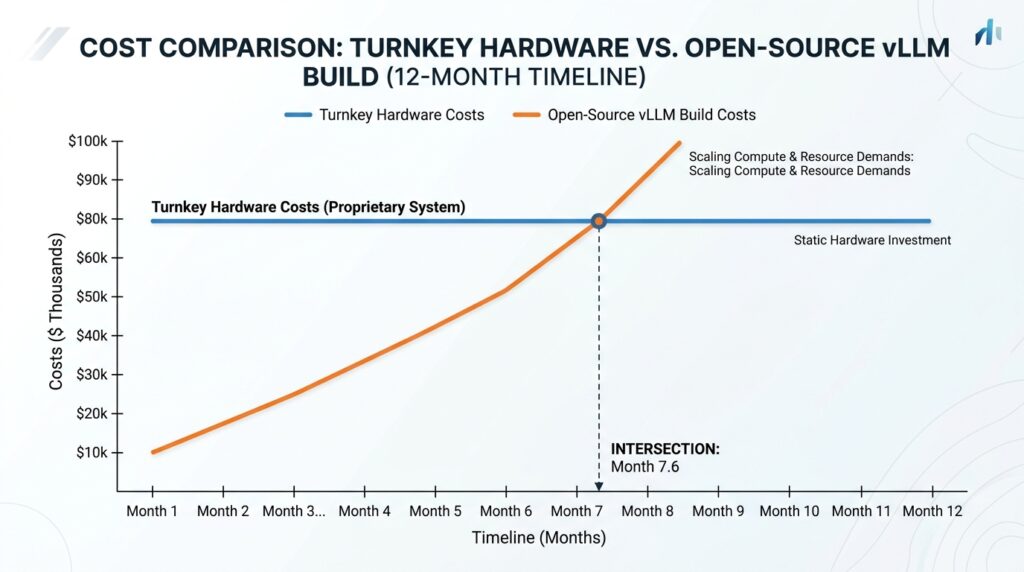
Let’s look at a concrete mathematical model comparing a standard turnkey Zanus AI Prime system (Year-Zero CapEx of $54,900, which includes $35,000 for hardware and a $19,900 flat software activation fee) against the open-source Supermicro/Dell server running vLLM.
While the open-source server reduces day-one CapEx by an impressive 63.57%, the specialized engineering labor required to maintain the unbundled stack dramatically changes the long-term financial trajectory.
Let $T$ represent time in years. The cumulative TCO functions for both strategies are modeled as follows:
$$TCO_{\text{Prime}} = 54,900 + T \times (0 + 8,000 + 2,628) = 54,900 + 10,628T$$
$$TCO_{\text{vLLM}} = 20,000 + T \times (0 + 64,000 + 1,577) = 20,000 + 65,577T$$
To isolate the exact inflection point where the turnkey system becomes the more economical choice, we set the two equations equal to each other:
$$TCO_{\text{Prime}} = TCO_{\text{vLLM}}$$
$$54,900 + 10,628T = 20,000 + 65,577T$$
$$34,900 = 54,949T$$
$$T \approx 0.635 \text{ years} \approx 7.6 \text{ months}$$
Financial Conclusion: In just 7.6 months of production operation, the initial capital savings from the open-source hardware approach are completely erased. This rapid cost inversion is driven entirely by ongoing MLOps labor overhead (modeled at a conservative 0.4 FTE allocation for the self-managed stack versus a minimal 0.05 FTE IT administration requirement for the highly automated turnkey system).
Regulatory Compliance & Storage Governance
When moving away from high-end turnkey platforms—which typically feature out-of-the-box compliance certifications—the entire burden of configuring software layers to pass strict corporate audits falls squarely on internal engineering teams.
1. SEC Rule 17a-4 and FINRA Rule 4511 (Immutability and WORM Storage)
For financial institutions, storing trade records and AI training logs in a non-rewritable, non-erasable (WORM) format is non-negotiable. Turnkey architectures ensure this compliance using air-gapped operating environments and hardware-enforced RAID arrays.
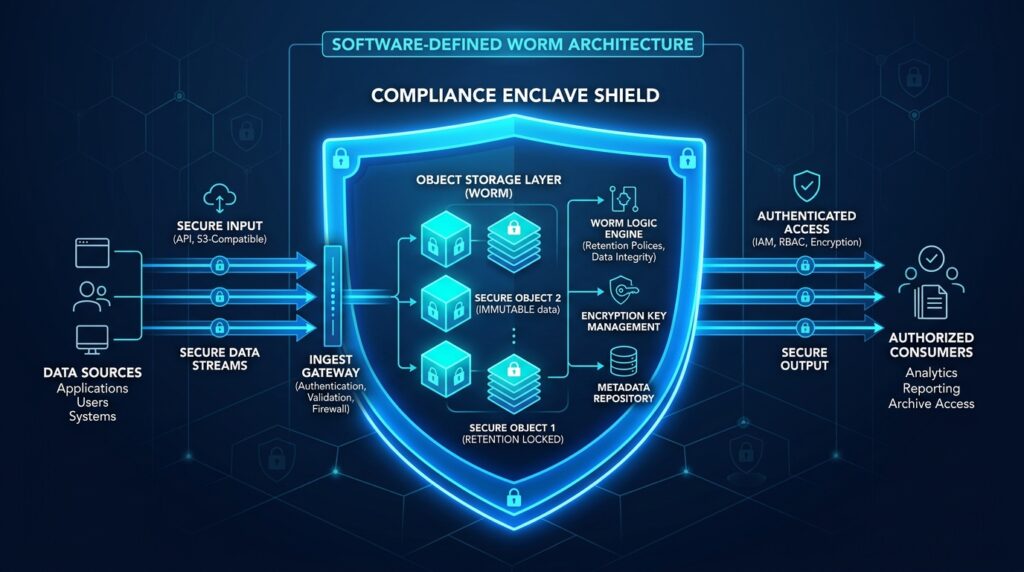
In a disaggregated architecture built on MinIO Enterprise, this must be handled programmatically via software-defined storage controls:
- Compliance-Mode Object Locking: Once activated at the bucket level, the data retention policy becomes absolute. The software actively blocks all modification, overwrite, or deletion commands from every account—including the system root administrator—until the retention period expires.
- Independent Validation: This software-defined WORM implementation is Veeam-certified and validated by Cohasset Partners. It allows enterprises to meet rigorous SEC 17a-4(f) electronic recordkeeping standards without investing in proprietary storage appliances.
2. GDPR Compliance and the Right to Be Forgotten in Vector Spaces
GDPR mandates that personally identifiable information (PII) must be permanently erased upon a user’s request. Executing a true physical deletion within a production Retrieval-Augmented Generation (RAG) architecture is exceptionally complex compared to executing a simple DELETE statement in a standard relational database.
- The Index Rebuild Bottleneck: Modern vector databases utilize dense spatial graphs, such as Hierarchical Navigable Small World (HNSW) networks, to perform high-speed semantic queries. Erasing an individual vector node immediately corrupts the mathematical integrity of the graph, making real-time index rebuilds incredibly resource-heavy.
- The Standard Operations Pipeline: To circumvent performance degradation, database engines typically apply soft deletes, masking records with runtime “deletion vectors.” To comply with GDPR’s strict permanence requirements, systems administrators must schedule off-peak maintenance windows to run deep structural consolidation commands:
SQL
REORG TABLE vector_records APPLY (PURGE);
This must be immediately followed by a physical VACUUM routine executed directly across the underlying MinIO S3 storage blocks. This two-step process purges the data blocks from the physical disk and forces a clean index rebuild in system memory, ensuring the user’s data is entirely unrecoverable.
⚠️ Operational Warning
Running intensive data compaction and physical
VACUUMroutines on low-cost white-box storage arrays during peak business hours can easily drive CPU utilization to 100%. This chokes system I/O throughput and can trigger severe latency spikes or system crashes across your active AI inference workloads.
Engineering Bottlenecks in Self-Managed Architectures
Organizations choosing to design and build their own custom AI infrastructure must prepare to face three distinct architectural challenges:
1. Compute Starvation
When executing large language models on custom-built infrastructure, high-throughput GPUs require a massive, uninterrupted stream of data. If an enterprise connects its hardware to white-box storage arrays utilizing older SATA or SAS protocols instead of high-performance NVMe fabric, the storage layer will fail to saturate the motherboard’s PCIe Gen 5 lanes. This results in compute starvation—your expensive GPUs sit idle waiting for data to arrive, causing sudden performance drops and severe response latency.
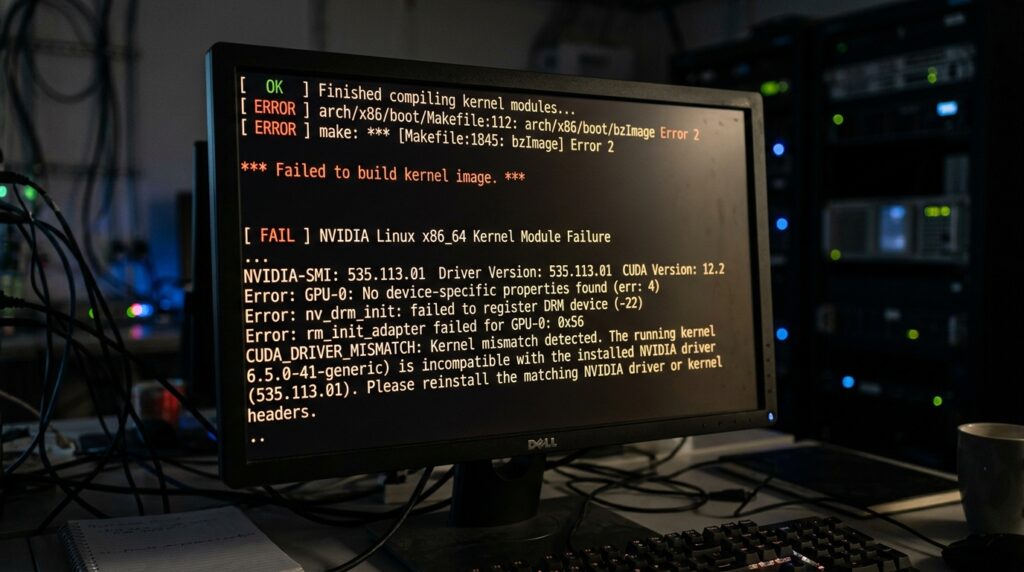
2. Driver Maintenance Loops
Maintaining a self-assembled AI stack requires absolute synchronization across four distinct layers: the host Linux kernel, GPU-specific runtime compilers (such as NVIDIA CUDA or AMD ROCm), container runtimes (Docker/Podman), and the orchestration stack (vLLM). A single automated operating system patch (apt upgrade) can introduce a new Linux kernel that breaks compatibility with the underlying GPU driver. This instantly halts the entire production environment, forcing internal IT staff to spend hours troubleshooting and downgrading system packages.
3. The Missing Application Layer
Turnkey platforms command a premium because they include pre-validated business logic and native software integration hooks for core enterprise platforms like SAP S/4HANA or Oracle. Opting for a disaggregated server running raw vLLM means you are only purchasing raw compute capacity. To deliver an actual business solution, the internal development team must design, build, and maintain the user interfaces, role-based access controls (RBAC), and contextual data pipelines from scratch. This custom software engineering effort typically spans 6 to 18 months and introduces substantial consulting fees that can quickly outweigh the initial hardware savings.
Strategic Architecture Recommendations
Selecting the right sovereign AI architecture requires looking past upfront hardware costs and carefully balancing internal engineering capabilities against long-term business goals.
                  SOVEREIGN AI HIERARCHICAL DECISION ENGINE

 Do you have an established, dedicated internal MLOps/SysOps team?
                           │
             ┌─────────────┴─────────────┐
             ▼ Yes                       ▼ No
   Prioritize custom Dell/      Does your business prioritize immediate
  Supermicro nodes utilizing     deployment or long-term software flexibility?
  open-source vLLM runtimes.     │
                                 ├──────────────────────────┐
                                 ▼ Speed & Stability        ▼ Cost Flexibility
                              Deploy Turnkey Appliances.    Select Lamini AI Platforms.
Deploy Turnkey Private AI Appliances When:
Your organization prioritizes rapid deployment, immediate operational value, and highly predictable annual expenditures. This model is ideal for enterprises that view AI as an operational tool rather than a custom engineering project, allowing them to bypass the complexities of building, securing, and maintaining a disaggregated infrastructure stack from the ground up.
Deploy Dell/Supermicro Nodes with vLLM When:
Your enterprise possesses an experienced MLOps engineering department and considers infrastructure-level customization a core competitive advantage. While this approach demands higher long-term maintenance and custom software development, it grants technical teams complete control over model optimization, framework adjustments, and long-term protection against vendor lock-in.
Deploy White-Box MinIO & Vector Database Clusters When:
Your primary workload centers on long-term data archival, extensive document indexing, and unstructured data ingestion. By separating the storage architecture from high-end compute nodes, this approach enables highly cost-effective data tiering for massive corporate knowledge bases while ensuring full compliance with federal recordkeeping standards.
Your Next Step
Minimizing your initial capital deployment metrics while maintaining strict data localization bounds requires a rigorous evaluation of downstream operational frictions. To successfully scale your corporate infrastructure footprints and pitch an optimized multi-year financial strategy to your chief financial officer, we recommend exploring our separate platform ecosystem guides:
- Performance Sizing Matrix: Evaluate the exact hardware specifications and VRAM limits of integrated enterprise nodes by exploring the Zanus AI Prime vs Quantum baseline analysis.
- Server Closet Facility Sizing: Audit your internal technical room requirements, power consumption envelopes, and rack dimensions via the Zanus AI Hardware Infrastructure layout.
- System Engine Analysis: Discover how the pre-loaded secure operating system manages containerized document parsing and local database syncing in our Zanus AI Deep Review.
- Civil Spatial Architectures: For an operational breakdown of how edge-native visual compute models automate dynamic multi-stream telemetries under state statutes, see our technical blueprint on minimizing the Florida SB-4D inspection cost.
Don’t let unexpected developer labor loops or volatile data integration costs break your private automation goals—conduct your internal FinOps audit and deploy your custom infrastructure cluster today.
References
- Dell Technologies: “Dell PowerEdge R760xa Server Configuration and Enterprise Engineering Documentation” | https://www.dell.com/
- MinIO Inc.: “Implementation Architecture and Compliance Manual for Software-Defined WORM Storage Under SEC Rule 17a-4” | https://min.io/
- vLLM Project: “PagedAttention Dynamic Cache Management and Memory Allocation Parameters for High-Throughput Production Inference Engines” | https://docs.vllm.ai/
- Lamini AI: “Semi-Turnkey Infrastructure Architecture and Model Tuning Lifecycles on AMD Instinct Accelerator Hardware” | https://docs.lamini.ai/
- Zanus AI Corporate Intelligence Portal: “Quantitative Total Cost of Ownership (TCO) Comparison Matrix: Turnkey Appliances vs. DIY Infrastructure Builds” | https://zanusai.com/
- Qdrant Vector Databases: “High-Performance Spatial Data Ingestion, Index Compaction, and Hard Physical Compaction Manuals for Compliance Auditing” | https://qdrant.tech/