Deploying zanus ai for legal and compliance operations has become essential as the meteors of Generative Artificial Intelligence (GAI) have triggered a high-stakes technology race within the legal sector.

The Cloud Bottleneck: How Public SaaS Architectures Compromise Legal Privilege
The meteors of Generative Artificial Intelligence (GAI) have triggered a high-stakes technology race within the legal sector. From automating high-volume contract reviews to accelerating multi-terabyte discovery analysis, AI promises to compress operational timelines from weeks to minutes.
However, for Chief Legal Officers (CLOs), Chief Compliance Officers (CCOs), and managing partners at leading law firms, traditional public cloud SaaS models present a catastrophic systemic risk. Transmitting sensitive client data, internal corporate strategies, or proprietary work-product across third-party remote servers creates a fundamental compliance bottleneck. It directly threatens Attorney-Client Privilege, the Work-Product Doctrine, and strict global data sovereignty regulations such as the EU’s GDPR and California’s CCPA.
Riss and Repercussions: New Legal Precedents
- United States v. Heppner (S.D.N.Y. 2026): In a landmark decision, Judge Rakoff ruled that written exchanges between a defendant and Anthropic’s cloud-based AI platform, Claude, were completely stripped of attorney-client privilege and work-product protections. The court reasoned that because the vendor’s privacy policy explicitly reserved the right to collect user inputs for continuous model training and potential third-party disclosure, the defendant retained no reasonable expectation of confidentiality.
- Warner v. Gilbarco, Inc. (E.D. Mich. 2026): While a Michigan federal court conversely preserved work-product protection for a pro se litigant using ChatGPT, this deep jurisdictional split exposes enterprises to severe legal volatility. If a local court adopts the Heppner rationale, any corporate document review or drafting executed via public cloud APIs without explicit human legal supervision can be interpreted as a wholesale waiver of privilege.
- Harleysville Ins. Co. v. Holding Funeral Home, Inc. (W.D. Va. 2017): This foundational case demonstrated that routing sensitive corporate data through cloud networks without absolute environment isolation risks an inadvertent waiver of privilege. In this matter, an unencrypted 32-character cloud hyperlink was shared unintentionally, leading the magistrate judge to famously equate the oversight to leaving an open file folder on a public bench. Even though the district judge partially modified the ruling under FRE 502(b), the precedent stands: cloud APIs lacking strict isolation can compromise privilege the moment vendor access controls falter.
The Data Sovereignty Collision Course (GDPR & CCPA)
When corporate records containing Personally Identifiable Information (PII) are transmitted to cloud-based LLMs, they are rarely just processed temporarily. They are frequently cached or permanently encoded into the model’s neural weights via continuous fine-tuning pipelines.
Once sensitive personal data is absorbed into the deep neural layers of a public cloud model, isolating and executing a clean data erasure under Article 17 of the GDPR (“The Right to be Forgotten”) becomes a mathematical impossibility. This architectural limitation exposes multinational corporations to massive statutory fines when handling cross-border discovery documents containing EU citizen data.
The Enterprise Choice: Zanus AI for Legal and Compliance Sovereignty
To address these compounding compliance conflicts, the American Bar Association (ABA) issued Formal Ethics Opinion 512, explicitly stating that attorneys have an ethical duty to understand the underlying architecture of the GAI tools they deploy. The opinion makes it clear that broad, boilerplate language in engagement letters does not constitute informed client consent for uploading sensitive case data to public cloud platforms.
For organizations determined to eliminate these operational liabilities, Zanus AI for legal & compliance offers a viable alternative. By packaging complete enterprise-grade intelligence within self-contained, offline physical hardware, the platform ensures that sensitive corporate data never leaves the organization’s physical perimeter.
Architectural Reality Check: Cloud AI (SaaS) vs. Zanus AI
Choosing an infrastructure model requires a careful calculation of risk, cost, and operational trade-offs. The table below breaks down how public cloud SaaS stacks up against the Zanus AI on-premises architecture:
| Evaluation Metric | Public Cloud AI (SaaS) | Zanus AI (On-Premises) |
| Data Control & Ownership | Data is routed via external APIs to third-party servers; exposed to continuous model training risks. | Data remains entirely within the enterprise’s physical firewall; zero external internet dependencies or API leaks. |
| Privilege Preservation | High risk of permanent privilege waiver based on emerging federal precedents like Heppner. | Absolute protection of attorney-client privilege; data never leaves the custody of the corporation. |
| Regulatory Compliance (GDPR/CCPA) | Severe exposure to cross-border transfer violations; unresolvable “Right to be Forgotten” conflicts. | 100% compliance; localized data storage permits verified physical purging from the underlying index. |
| Cost Structure | Variable operational expenditures calculated per token or seat; scales unpredictably during large-scale discovery. | Fixed, one-time capital investment (starting at $19,900); unlimited scaling with zero recurring seat licensing fees. |
| Model Stability | Highly volatile; frequent vendor API updates risk breaking complex internal downstream agents. | Completely stable; deterministic execution governed by internal protocols without unscheduled upstream shifts. |
Editor’s Perspective: The Legal Reality Check
If your organization handles highly sensitive IP, complex M&A due diligence, or cross-border class-action defense, public cloud SaaS platforms are an unnecessary liability. The primary compromise of an on-premises solution like Zanus AI is the upfront capital expenditure and the internal IT overhead required to maintain specialized server hardware.
However, when compared against the existential threat of losing attorney-client privilege in a major corporate lawsuit, that infrastructure overhead becomes a highly justifiable cost of doing business.
Production Blueprint: Architecting an Offline RAG Engine for 2.000.000+ Documents
Executing a comprehensive, automated contract audit across an offline repository of over 2,000,000 corporate records (approximately 20,000,000 individual pages) requires a highly optimized Retrieval-Augmented Generation (RAG) architecture running on dedicated internal compute stacks.
End-to-End Data Pipeline Architecture
[Raw Corporate Governance Documents (2.000.000+ PDFs/TIFFs)]
                           │
                           ▼
[Localized Text Extraction: Native Apache Tika / Internal OCR Engine]
                           │
                           ▼
 [Semantic Document Chunking - 512-Token Sliding Window]
                           │
                           ▼
[Local Vector Embedding Generation via On-Prem GPU (BAAI/bge-large-en-v1.5)]
                           │
                           ▼
┌──────────────────────────────────────────────────────────┐
│              Localized Vector Database Stack             │
│   (Qdrant / Milvus / pgvector on Enterprise NVMe SSDs)   │
└──────────────────────────┬───────────────────────────────┘
                           │
         ┌─────────────────┴─────────────────┐
         ▼ (Physical RAM < 144 GiB)           ▼ (Physical RAM >= 144 GiB)
 ┌───────────────┐                   ┌───────────────┐
 │ DiskANN       │                   │ In-Memory     │
 │ Indexing      │                   │ HNSW Indexing │
 └───────┬───────┘                   └───────┬───────┘
         │                                   │
         └─────────────────┬─────────────────┘
                           │
                           ▼
[Metadata Payload Filters executing concurrent RBAC Validation]
                           │
                           ▼
[Top-K Semantic Vector Similarity Retrieval]
                           │
                           ▼
[Internal Open-Weights LLM (Llama-3-70B-Instruct) Secure Response Generation]
Resource Calculation and Vector Index Engineering
To maintain sub-second retrieval speeds under significant query loads, system architects must calculate the memory footprint of the vector index. Suppose the semantic chunking strategy yields a total dataset size of $N = 2 \times 10^7$ document fragments. Utilizing a high-precision embedding model generating vectors with a dimensionality of $d = 1536$, each coordinate point is stored as a 32-bit floating-point value, requiring 4 bytes of storage.
The raw storage capacity required for the vector array ($S_{raw}$) is calculated as follows:
$$S_{raw} = N \times d \times 4 \text{ bytes}$$
$$S_{raw} = (2 \times 10^7) \times 1536 \times 4 \text{ bytes} = 122,880,000,000 \text{ bytes} \approx 114.44 \text{ GiB}$$
When implementing a Hierarchical Navigable Small World (HNSW) graph index to enable ultra-fast approximate nearest neighbor (ANN) searches, the index structure amplifies the overall memory footprint. Assuming optimal enterprise parameters for deep semantic precision (maximum connection links per node $M = 16$ and a construction search depth $efConstruction = 200$), the graph index introduces an amplification multiplier ($A$) of roughly $1.5\times$ to $2.0\times$ the raw vector volume:
$$S_{graph} \approx 1.5 \times S_{raw} = 171.66 \text{ GiB}$$
The absolute minimum physical RAM required to keep both the raw vector vectors and the HNSW graph index resident in system memory, thereby avoiding destructive disk-swapping page faults, is:
$$S_{total} = S_{raw} + S_{graph} \approx 286.10 \text{ GiB}$$
In enterprise deployments, maintaining steady-state operations generally requires approximately 6 GiB of RAM per one million 1536-dimensional vectors. For a repository of 20,000,000 vectors, this equates to a baseline memory footprint of $20 \times 6 \text{ GiB} = 120 \text{ GiB}$. Applying a mandatory 20% buffer to absorb concurrent query threads and prevent Out-Of-Memory (OOM) kernel crashes establishes the structural threshold:
$$\text{Recommended Enterprise RAM Allocation} = 120 \text{ GiB} \times 1.20 = 144 \text{ GiB}$$
Infrastructure Optimization for Resource-Constrained Environments
If the internal server infrastructure cannot allocate 144 GiB of dedicated system memory exclusively to the vector database, systems engineers must implement optimized structural alternatives to ensure stable offline performance:
- DiskANN Indexing (Vamana Algorithm): Unlike HNSW, which suffers severe performance degradation if the graph index is forced out of volatile memory, the DiskANN framework keeps a highly compressed structural index map in RAM while storing the raw vector files on high-speed NVMe SSDs. This architectural shift allows a modest 32 GiB RAM server to comfortably index over 100,000,000 dense vectors, though it reduces peak query throughput from roughly 4,200 Queries Per Second (QPS) down to 1,800 QPS.
- Binary Quantization (BQ): BQ compresses standard 32-bit floating-point numbers into single-bit binary representations (0 or 1), reducing the vector array size by up to 32 times. The engine executes a rapid first-stage search across the quantized binary array using hardware-accelerated XOR operations, followed by a targeted reranking pass over a small pool of high-precision candidates retrieved from the NVMe storage layer. This strategy drops system RAM requirements by a factor of four while maintaining semantic search accuracy above 98%.
Document-Level Security and Hardened RBAC Compliance
An on-premises AI system is only as viable as its underlying access control mechanisms. In enterprise legal environments, implementing granular Document-Level Security is non-negotiable for preventing internal lateral data leaks between conflicting corporate departments or distinct client matter teams.
Vector-Level Role-Based Access Control (RBAC) via Pre-Filtering
Traditional post-query filtering architectures—where the AI searches the entire vector space and subsequently strips out unauthorized files at the application layer—contain critical security flaws. If the top similarity results ($Top-K$) match restricted internal files, the application returns a blank or truncated response to the user. This severely limits system utility and introduces risks of metadata exposure via embedding inversion attacks.
To mitigate this vector leak, enterprise systems must enforce Metadata Pre-Filtering. Access Control Lists (ACLs) are injected directly into the payload metadata of each specific vector segment during the initial indexing phase. When a user executes a query, the application automatically appends the user’s authenticated corporate credentials directly into the vector search argument. The localized database filters out unauthorized nodes during the HNSW graph traversal, guaranteeing isolation at the database layer.
Below is an enterprise-grade JSON payload schema demonstrating the metadata structure required for a secure Precision Vector Store:
JSON
{
  "chunk_id": "m_and_a_doc_2026_chunk_18",
  "text": "Section 12.4: The Acquirer explicitly agrees to maintain strict operational confidentiality regarding the Target's proprietary customer list for a mandatory duration of 5 years...",
  "metadata": {
    "document_id": "ma_agreement_target_corp_2026",
    "security_class": "Strictly_Confidential",
    "owner_department": "Mergers_and_Acquisitions",
    "allowed_roles": [
      "Senior_Partner",
      "Lead_MA_Counsel",
      "Compliance_Director"
    ],
    "allowed_users": [
      "usr_corp_9912",
      "usr_law_7741"
    ],
    "regulatory_tags": [
      "GDPR_Sensitive",
      "CCPA_Covered"
    ],
    "retention_policy": {
      "expire_at": "2036-12-31T23:59:59Z",
      "action": "Physical_Purge"
    }
  }
}
Operational Impact: Payload Optimization
When indexing a high-volume repository of 20,000 documents with an average of 24 semantic chunks per document, duplicating a comprehensive 3 KB corporate metadata payload across every individual vector node adds approximately 1.4 GiB of structural overhead within Qdrant.
To optimize performance on resource-constrained on-premises servers, architects should store the heavy metadata payload once within a separate relational document index and execute logical joins using a lightweight document ID. This reduces the vector database RAM overhead to less than 60 MiB, protecting memory space for core query processing.
Implementing an Immutable Two-Track Incident Response Framework
To satisfy rigorous corporate compliance audits, the on-premises system must log all data interactions to an immutable Write Once, Read Many (WORM) storage drive. The logging protocol must capture ingestion hashes (SHA-256), distinct query arguments, specific vector coordinates, and the exact textual output generated by the internal LLM.
However, if a data breach or an internal compliance failure occurs, the organization must be careful not to inadvertently waive privilege during the subsequent forensic investigation. Landmark rulings in Guo Wengui v. Clark Hill, PLC and In re Capital One Consumer Data Security Breach Litigation show that generic cybersecurity reports are frequently stripped of work-product protection if they are used for standard business continuity purposes or shared broadly with internal IT teams and law enforcement.
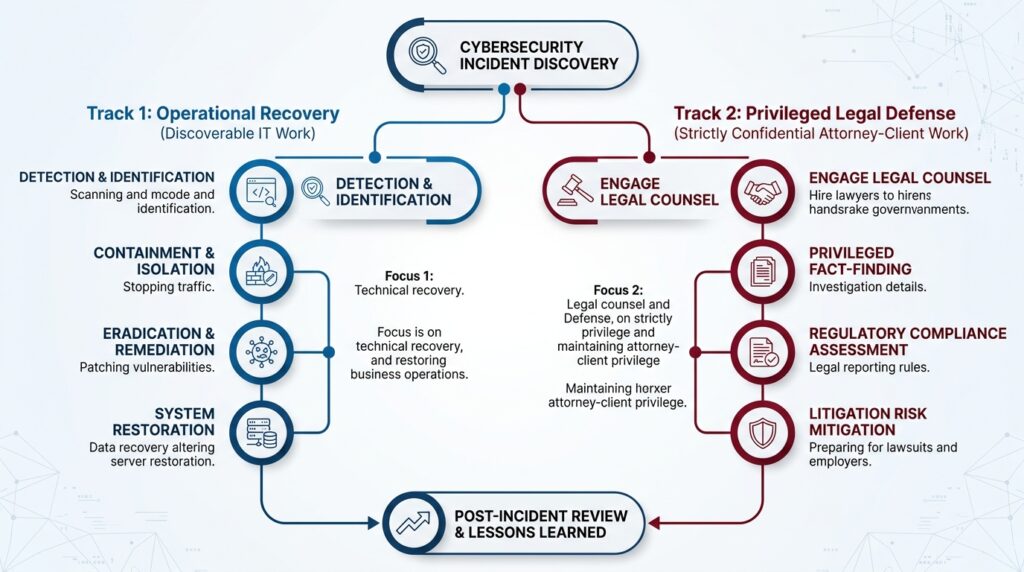
To ensure that internal AI forensic investigations remain protected under the umbrella of legal privilege, corporate legal departments must execute a strict Two-Track Incident Response Framework:
[Detection of Internal AI Data Leak / Cyber Incident]
                       │
        ┌──────────────┴──────────────┐
        ▼                             ▼
[Track 1: Operational Recovery]  [Track 2: Privileged Legal Defense]
- Managed by internal IT/Ops.   - Retained by External Legal Counsel.
- Employs standard IT vendors.   - Employs independent forensic firm.
- Focuses on patch deployment,   - Focuses strictly on evaluating legal
  system uptime, & restoration.    liability & preparing for litigation.
- Work product is DISCOVERABLE   - Reports are kept STRICTLY CONFIDENTIAL;
  in subsequent litigation.        protected under Attorney-Client Privilege.
Defensive Strategies: The True Cost of Infrastructure Negligence
Failing to maintain modern security controls around corporate legal data exposes organizations to severe professional liability, malpractice claims, and breach-of-contract lawsuits. The standard of care demanded of corporate legal departments and elite law firms has shifted past basic password protection.
Critical Precedents in Legal Malpractice and Cyber Liability
- Guo Wengui v. Clark Hill, PLC (D.D.C. 2021): A prominent law firm suffered a severe network intrusion, exposing sensitive client files. Because the firm consolidated its technical forensic investigation into a single internal report shared across IT and operational leadership, the DC district court ruled that the entire investigative file was discoverable, stripping the firm of its privilege defense and exposing it to severe malpractice claims.
- Shore v. Johnson & Bell, Ltd. (N.D. Ill. 2016): A Chicago law firm was hit with a class-action lawsuit by its own clients for maintaining outdated, unpatched time-entry software and unencrypted VPN connections. Crucially, the federal court allowed the case to proceed to arbitration despite the lack of a verified, quantifiable data leak. The ruling established that maintaining deficient data security infrastructure is, by itself, a clear breach of a lawyer’s fiduciary duties and standard of care.
- Millard v. Doran (Sup. Ct. N.Y. Cty. 2016): A real estate attorney processed high-value financial transactions using an unpatched computer and an unencrypted, consumer-grade personal email account. Hackers intercepted the communications and redirected $2 million in client funds. The New York court found the attorney guilty of gross professional negligence, confirming that using unencrypted, consumer-grade cloud communication for sensitive client matters carries significant financial liability.
Final Recommendation: What to Do Next
The integration of Generative AI into enterprise workflows is an infrastructure decision that directly impacts corporate liability. To protect sensitive assets, preserve attorney-client privilege, and ensure compliance with global data sovereignty mandates, enterprise technology and legal leaders should implement the following steps:
- Step 1: Audit Your Current AI Exposure Pipeline. Immediately catalog all internal automated workflows that touch sensitive legal documentation, contract libraries, or HR data. Flag any process that routes data through public cloud networks or third-party commercial LLM APIs.
- Step 2: Transition to Localized Open-Weights LLMs. Replace public API dependencies with high-performance, open-weights model families (such as Llama-3-70B-Instruct) hosted entirely on secure, internal physical hardware.
- Step 3: Mandate Metadata Pre-Filtering at the Vector Layer. Re-architect internal vector database pipelines to enforce role-based access controls during the graph-traversal phase. Reject any implementation that relies on dangerous application-layer post-filtering.
- Step 4: Establish a Privileged Two-Track Incident Response Protocol. Review your organization’s cybersecurity response blueprint. Ensure that any deep forensic investigation into internal AI systems or data pipelines is managed through external legal counsel under a dedicated Track 2 framework to protect the resulting work-product from discovery.
Your Next Step
Safeguarding client confidentiality and preventing inadvertent privilege waivers requires a foundational change in your firm’s infrastructure. To successfully draft your technical defense matrix and secure executive procurement approval, we recommend exploring our complete enterprise evaluation network:
- Technology Tier Evaluation: Determine the optimal computational scale and memory configuration for your database footprint at Zanus AI Prime vs Quantum.
- Component Specifications: Audit your physical server room readiness and GPU memory requirements via the Zanus AI Hardware Infrastructure.
- Operational Systems Review: Discover the complete range of built-in business processing tools by reading our comprehensive Zanus AI Deep Review.
- Physical Asset Applications: For a practical look at how sovereign computing automates inspection data under strict state laws, read our blueprint on managing the Florida SB-4D inspection cost.
References
- American Bar Association (ABA): Formal Opinion 512: Generative Artificial Intelligence in the Practice of Law (July 2024). https://www.americanbar.org
- Harvard Law Review: United States v. Heppner & The Erosion of Attorney-Client Privilege in Cloud AI Platforms (2026). https://harvardlawreview.org
- Zanus AI Official Documentation: The Rise of Sovereign Enterprise Intelligence & On-Premises Architecture Specifications (2026). https://zanusai.com
- Qdrant Tech Blog: Document-Level RBAC and Pre-Filtering for Large-Scale Vector Databases (2026). https://qdrant.tech
- Baker McKenzie Global Litigation News: Protecting Privilege over Forensic Incident Reports in Data Breach Cases: Lessons from Clark Hill and Capital One (2021). https://globallitigationnews.bakermckenzie.com
- EDiscovery Law Journal: Privilege Waived as to Unprotected Information on File Share Sites – Analysis of Harleysville Insurance Co. v. Holding Funeral Home (2017). https://ediscoverylaw.com