
AI HOA violation management is transforming how homeowners associations (HOAs) enforce community rules. Instead of relying on inconsistent manual inspections, modern AI systems can automate violation detection, improve compliance accuracy, and reduce legal risks while building greater resident trust.
Most homeowners associations (HOAs) do not need stricter enforcement rules. They need a way to eliminate the operational bottlenecks, human bias, and legal vulnerabilities that quietly erode community trust every single day.
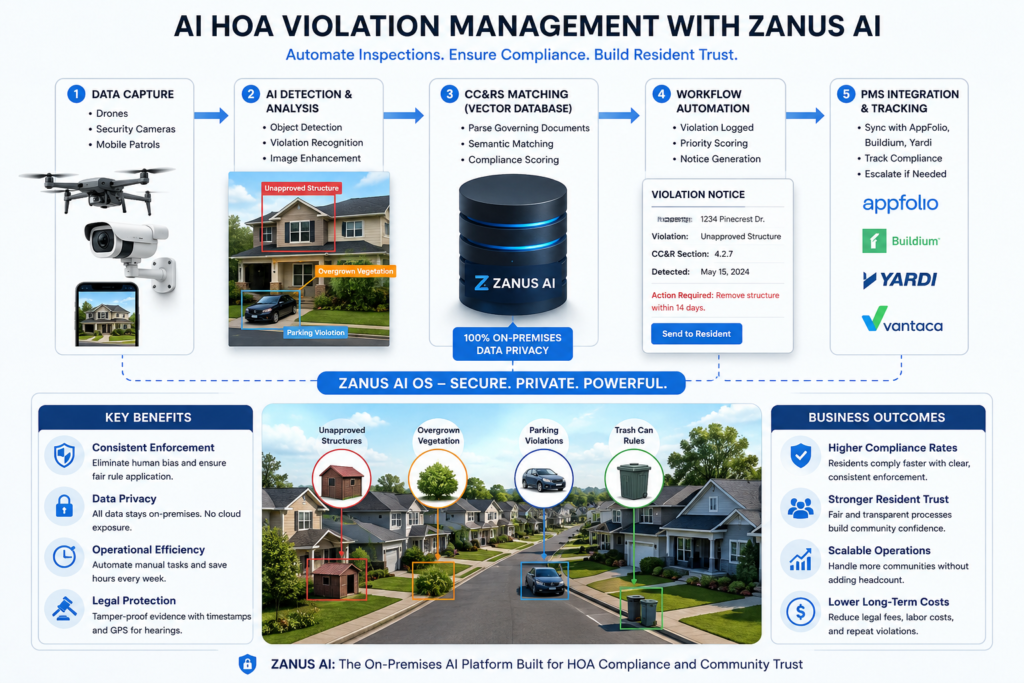
Traditional neighborhood code enforcement is notoriously inefficient. Property managers spend hours driving through communities, manually logging violations, and snapping photos on personal mobile devices. When enforcement relies entirely on the subjective eye of an inspector, consistency breaks down. One homeowner gets flagged for a minor lawn issue, while a neighbor with a similar violation is overlooked due to inspector fatigue or personal relationships.
This lack of consistency breeds accusations of selective enforcement and favoritism. Once residents lose faith in the board’s objectivity, cooperation plummets, and legal disputes escalate.
Furthermore, manual documentation rarely holds up under legal scrutiny. Photos without tamper-proof timestamps or precise GPS coordinates are easily challenged in hearings. Worse, an inspector accidentally photographing a fenced backyard or looking into a window can trigger severe privacy lawsuits under state laws like California’s Civil Code Section 1708.8.
AI HOA Violation Management with Zanus AI
Zanus AI offers an enterprise-grade hardware and software solution that replaces subjective oversight with an automated, on-premises AI system. By combining local computer vision with private vector data processing, the platform standardizes enforcement while completely isolating sensitive community data from the public cloud.
Product Overview
Zanus AI is an on-premises artificial intelligence platform designed to automate property inspections, compliance matching, and resident notification workflows. Instead of relying on cloud-based SaaS models that charge recurring token fees and expose personally identifiable information (PII), Zanus AI deploys dedicated physical servers directly within management offices or private data centers.
The system digitizes community governing documents (CC&Rs, bylaws, and design guidelines), turning quantitative physical data from cameras or drones into objective compliance decisions.
Best For
- Large-scale Property Management Companies (CAMs): Firms managing extensive portfolios that require standardized enforcement workflows across multiple communities.
- Master-Planned Communities & Large HOAs: Neighborhoods with complex architectural guidelines and high inspection overhead.
- Compliance-Focused Boards: Organizations operating in regions with strict data privacy laws (such as GDPR or CCPA) that prohibit uploading resident imagery to public cloud servers.
Key Strengths
- Absolute Data Sovereignty: Because the system runs entirely on localized hardware behind the HOA’s firewall, resident records, financial accounts, and property photos never leave the premises. This ensures native compliance with the Fair Housing Act and SOC 2 frameworks.
- Precision Vector Matching: Zanus AI uses a specialized vector database to parse and mathematicalize complex legal text. When visual data is ingested, the AI performs a semantic comparison against the exact section of the CC&Rs. The system does not hallucinate or guess; it references the community’s actual legal text.
- Bi-Directional PMS Integration: Through native RESTful APIs and real-time webhooks, the system syncs directly with major property management software like AppFolio, Yardi, Buildium, and Vantaca. It pulls resident contact info, logs violations, and initiates fine schedules automatically.
Limitations
- High Upfront Capital Expenditure: As an on-premises, buy-it-once solution, the initial investment for hardware procurement and perpetual licensing is substantially higher than standard monthly cloud subscriptions.
- Local Infrastructure Dependecy: Management teams must provide a secure physical space for the server and maintain local network stability for data ingest.
- Upstream Data Dependency: The AI’s accuracy depends entirely on the clarity of the ingested CC&Rs and the resolution of the patrol cameras or drones used. Vagueness in the original bylaws yields less definitive matching scores.
Manual Inspections vs. Cloud AI vs. Zanus AI On-Premises
| Evaluation Criteria | Traditional Manual Enforcement | Cloud-Based AI (SaaS Models) | Zanus AI On-Premises Server |
| Detection & Processing Time | 3 to 7 business days (manual logging) | Real-time (dependent on cloud upload) | Real-time (minutes via local processing) |
| Data Consistency | Low; highly vulnerable to human bias | High; standardized algorithms | Absolute; uniform algorithmic matching |
| Annual Recurring Cost | High (labor hours and fuel) | Compounding token & user seat fees | $0 recurring software fees (Perpetual ownership) |
| Data Privacy & Legal Risk | High (unsecured local storage) | Moderate (third-party cloud exposure) | Zero cloud risk (Contained within local firewall) |
| Offline Capabilities | Independent of network | Zero functionality during outages | 100% operational without internet access |
Why On-Premises AI Outperforms Traditional HOA Inspection Methods
| Evaluation Area | Manual Inspection | Cloud AI Platforms | Zanus AI |
|---|---|---|---|
| Inspection Speed | Slow and labor-intensive | Fast but internet-dependent | Fast with local processing |
| Data Privacy | Depends on staff practices | Data stored on third-party servers | All data remains on local infrastructure |
| Consistency | Varies by inspector | AI-assisted but cloud-based | Standardized local AI decisions |
| Operating Costs | High labor costs | Monthly subscription and token fees | One-time hardware investment |
| Internet Requirement | None | Required | Optional after deployment |
| Legal Audit Trail | Manual documentation | Cloud logs | Local immutable audit records |
| Best Fit | Small communities | Small to medium portfolios | Medium to large HOAs with strict compliance |
Operational Mechanics: Managing Enforcement Priority
To prevent over-enforcement and distribute management resources logically, the system calculates a violation enforcement priority score ($P_i$) using a localized mathematical matrix:
$$P_i = \beta \cdot S_v + \gamma \cdot D_{overdue} + \delta \cdot R_{history}$$
Where:
- $S_v$ represents the severity score of the specific violation (e.g., life-safety or fire hazards score a 10; an early trash can placement scores a 2).
- $D_{overdue}$ tracks the number of consecutive days the violation has remained unaddressed since the initial log.
- $R_{history}$ is the recurrence multiplier calculated over the past 12 months, distinguishing accidental first-time offenses from chronic non-compliance.
- $\beta, \gamma, \delta$ are localized weights configured by the board to align with specific community goals.
Violations that cross a customized $P_i$ threshold are automatically flagged on the manager’s dashboard, ensuring operational teams focus on critical community issues before they turn into legal liabilities.
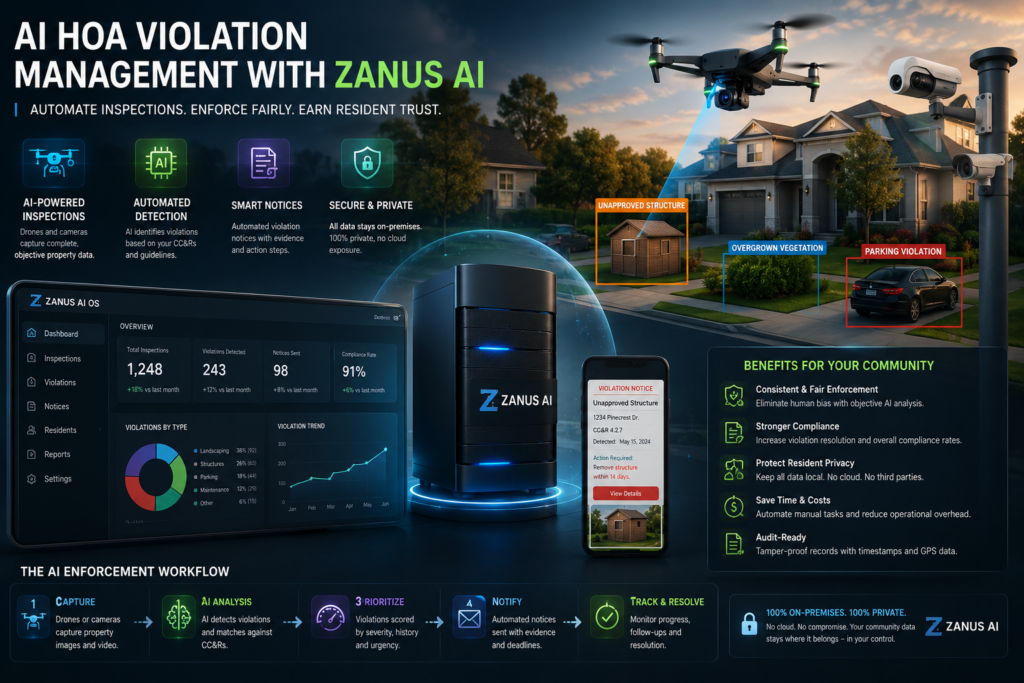
Real-World Case Study: Landscape Enforcement at Pine Crest Estates
To understand how this technical framework translates into community operations, consider this breakdown of an automated landscape violation workflow at a master-planned community.
1. Ingestion and Physical Property Parsing
At 10:15 AM on a Monday, an onboarding patrol vehicle equipped with a calibrated high-definition camera drives down Pine Crest Boulevard. The camera captures the front yard of Lot 302, where a commercial watercraft and a stack of unorganized construction timber are sitting on the lawn.
The image data is encrypted instantly at the edge and transmitted to the Zanus AI physical server located in the onsite management office. The computer vision model isolates the objects, identifying them as an unauthorized recreational vehicle and uncontained building materials in plain view.
2. Legal Alignment via Vector Queries
The system queries its local Precision Vector Store, scanning the 300-page CC&R document of Pine Crest Estates. Within 20 seconds, the system extracts two direct infractions:
- Section 7.4 (Vehicle Restrictions): Prohibits the parking of boats, trailers, or recreational watercraft in front yards or driveways for more than 24 consecutive hours.
- Section 9.1 (Lot Maintenance): Dictates that construction materials, refuse, or debris must be stored out of sight from common areas.
The integrated local Large Language Model (LLM) instantly drafts a conditional compliance notification, embedding the unedited imagery, a tamper-proof timestamp, and verified GPS metadata.
3. Human-in-the-Loop Verification
At 11:30 AM, the community manager logs into the Zanus AI dashboard. A pending notification for Lot 302 appears.
The manager reviews the visual evidence and checks the system logs. Because there is no active architectural variance or construction permit approved for Lot 302, the manager clicks “Approve.” This Human-in-the-Loop step ensures that legitimate temporary exceptions are never penalized by automated systems.
                  [ Visual Data Captured via Security/Patrol ]
                                       │
                                       ▼
                  [ Local Computer Vision Object Extraction ]
                                       │
                                       ▼
            [ Semantic Matching via Precision Vector Store (CC&Rs) ]
                                       │
                                       ▼
                  [ Local LLM Generates Contextual Draft ]
                                       │
                                       ▼
               [ Human-in-the-Loop: Property Manager Review ]
                     /                                   \
         ┌──────────┴──────────┐                       ┌──┴──────────┐
         │  Approved Flag      │                       │  Dismissed  │
         └──────────┬──────────┘                       └─────────────┘
                    │
                    ▼
       [ Automated PMS Sync & Multi-Channel Notification Dispatch ]
4. Empathetic, Multi-Channel Dispatch
The system synchronizes with AppFolio via an API webhook, pushing a notification to the resident’s mobile portal alongside an automated email. Rather than issuing a aggressive demand, the local LLM generates a professional, solution-oriented notification:
Subject: Helping Maintain Community Standards at Pine Crest Estates — Lot 302
Dear Resident,
The Management Team appreciates your continued role in keeping Pine Crest Estates a beautiful place to live.
During our routine community review on [Date], our automated system noted a watercraft and timber materials stored in the front yard area. To keep the neighborhood safe and visually consistent, Section 7.4 and Section 9.1 of the community CC&Rs require that recreational watercraft and raw building materials be stored within enclosed garages or designated offsite facilities.
We understand you may be preparing for a trip or working on a home project. To help keep your property in compliance, consider these options:
- Move the watercraft into your garage within the next 48 hours.
- If you need short-term storage, the HOA has partnered with the secure lot located 1 mile north of our entrance (details attached in your resident portal).
Please resolve this matter by 5:00 PM on [Date]. If you are experiencing unexpected delays or need to request a brief extension, please message us directly via the portal. Thank you for your cooperation.
5. Resolution and Automated Archiving
The homeowner reviews the notification on their phone. Because the tone is objective, clearly references the specific bylaws, and offers practical alternatives rather than immediate fines, potential friction is avoided. The homeowner moves the watercraft into the garage and stores the timber out of sight that evening.
On Wednesday’s follow-up patrol, the camera records a clear front yard at Lot 302. Zanus AI registers the resolution, logs a closure timestamp, sends a brief automated thank-you note to the resident, and moves the entire case history into immutable local storage. The matter is closed without an argument, an administrative bottleneck, or a single phone call to the office.
Editor’s Take
If your management firm or master association handles large portfolios with strict compliance needs, and you want to protect resident data privacy while stabilizing unpredictable IT operational costs, then Zanus AI is an exceptional long-term investment. Because by converting recurring SaaS expenses into a fixed, owned hardware asset, it eliminates ongoing token inflation while producing an unalterable audit trail that shields your association from selective enforcement liabilities.
Why Would an HOA Choose Zanus AI Instead of Cloud AI?
While cloud AI platforms are easier to deploy and usually require lower upfront costs, they introduce recurring subscription fees and potential privacy concerns because sensitive homeowner information is processed by third-party infrastructure. Zanus AI takes the opposite approach by keeping every document, image, and resident record inside the organization’s own network. For HOA boards prioritizing compliance, predictable long-term costs, and complete ownership of their data, the on-premises architecture provides advantages that cloud-only platforms cannot easily match.
Pros & Cons
Pros:
- Total Privacy Compliance: Eliminates the legal risks of cloud-based PII exposure under modern privacy laws.
- Zero Token Fees: No recurring API costs or variable user expenses; the infrastructure is owned entirely by the buyer.
- Predictable Enforcement: Eradicates individual inspector bias by applying uniform semantic matching logic across the entire community.
- Dynamic Language Tuning: Generates courteous, professional compliance notices that reduce resident friction and escalations.
Cons:
- Substantial Initial Investment: High upfront hardware deployment and system integration costs compared to basic SaaS tools.
- In-Office Workspace Footprint: Requires reliable, climate-controlled spaces to host server nodes safely.
- Garbage In, Garbage Out: Relies heavily on the clarity of original community governing documents to deliver high-confidence matching scores.
Alternatives
- Stan AI: A cloud-based generative AI agent designed primarily for automated resident communications, help-desk sorting, and inbound inquiry workflows. Best for communities looking for fast, low-overhead software deployment without hardware costs.
- Sentus AI: A cloud SaaS tool tailored for multifamily operations, focusing on visual maintenance triage and automated vendor dispatching.
- Manual PMS Inspections (AppFolio/Buildium Native): Best for small, single-family HOAs under 50 homes where community scale doesn’t justify advanced automation infrastructure and traditional inspections remain manageable.
Frequently Asked Questions:
Is Zanus AI suitable for small HOAs?
Small HOAs managing fewer than 50 homes may find traditional property management software or cloud-based automation sufficient. Zanus AI delivers the greatest value for medium to large communities where inspection volume, compliance complexity, and data privacy requirements justify an on-premises deployment.
Does Zanus AI require an internet connection?
No. Once deployed, Zanus AI is designed to operate entirely within the organization’s local network. Internet connectivity is only required for optional software updates or integrations that administrators choose to enable.
Can Zanus AI integrate with existing HOA software?
Yes. The platform is designed to integrate with leading property management systems such as AppFolio, Buildium, Yardi, and Vantaca using APIs and secure local integrations.
How accurate is AI violation detection?
Detection accuracy depends on image quality, governing document clarity, and camera placement. When high-quality inputs are available, AI can significantly improve inspection consistency by applying the same evaluation criteria across every property.
Is resident data sent to public AI models?
No. Zanus AI processes information locally on dedicated hardware. Sensitive homeowner records remain inside the organization’s own infrastructure rather than being transmitted to external cloud AI providers.
Related Resources
If you’re researching AI adoption for HOA operations, you may also find these guides helpful:
- Is Zanus AI Worth It? A Deep-Dive Review for HOA Boards & Property Managers
- Zanus AI Deployment Guide: From Hardware Installation to HOA Workflow Automation
- Manual vs. AI Property Inspections: How HOAs Can Improve Enforcement Reliability
Final Recommendation
- Choose Zanus AI if: You run a mid-to-large scale property management portfolio or a large-scale HOA, prioritize absolute resident data privacy, and want a permanent infrastructure asset that eliminates unpredictable cloud processing fees.
- Choose Stan AI if: You are managing smaller properties, prefer a low upfront cost with minimal setup time, and are comfortable routing non-sensitive community communication data through public cloud ecosystems.
What should you do next?
Before investing in an automated system, perform a data audit on your current neighborhood files. Ensure your association’s digital copies of CC&Rs, bylaws, and architectural design handbooks are complete, high-resolution PDFs. Clean, structured legal documents are the essential baseline needed before setting up a technical deployment trial with Zanus AI engineers.