
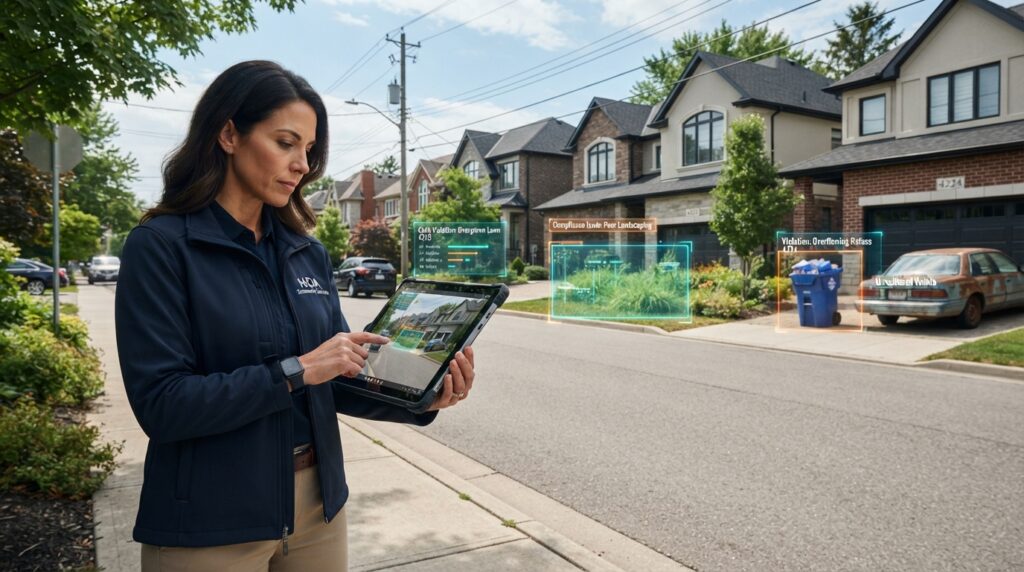
Learning how to automate HOA property inspections is essential because maintaining aesthetic and safety standards within communities managed by Homeowners Associations (HOAs) has long been a resource-intensive and conflict-prone process.
Maintaining aesthetic and safety standards within communities managed by Homeowners Associations (HOAs) has long been a resource-intensive and conflict-prone process. Traditional inspection methods rely heavily on code enforcement officers conducting walking or drive-by patrols, logging violations manually on paper or via disjointed snapshots. This legacy approach not only bottlenecks administrative workflows but also invites human error, subjective bias, and friction between residents and management.
The convergence of computer vision and Edge AI has unlocked a new era for property management. By automating the detection of landscaping issues, unauthorized structures, and exterior deferred maintenance, this technology slashes inspection times, eliminates administrative bottlenecks, and standardizes code enforcement with objective, data-driven accuracy.
1. How to Automate HOA Property Inspections: Operational Data Pipeline
The automated property inspection system operates on a closed-loop data pipeline, ensuring seamless data flow from field capture devices to local edge processors before syncing with the central management platform.
┌────────────────────────────────────────────────────────┐
│                  FIELD DATA CAPTURE                    │
│  - Mobile Devices (DoorLoop AI, HOALife)                │
│  - Patrol Vehicles w/ ALPR/RTSP (YOLOv8/11)            │
│  - Unmanned Aerial Vehicles (SkyeBrowse, Aerially)     │
└───────────────────────────┬────────────────────────────┘
                            │ (Real-time data streaming)
                            ▼
┌────────────────────────────────────────────────────────┐
│                 LOCAL EDGE AI PLATFORM                 │
│  - NVIDIA Jetson Orin NX (100 TOPS, PCIe-NX154PoE)     │
│  - Frame Pre-processing & SAHI Tiling Algorithms       │
│  - Multi-Object Tracking & Localization (DeepSORT)     │
└───────────────────────────┬────────────────────────────┘
                            │ (Violation metadata extraction)
                            ▼
┌────────────────────────────────────────────────────────┐
│             ANALYTICS LOGIC & GEO-REFERENCING          │
│  - Semantic Segmentation for Damage Assessment        │
│  - Multi-frame Confidence Scoring                      │
│  - GIS Map Matching & Automatic GPS Tagging            │
└────────────────────────────────────────────────────────┘
Field Data Capture Methods
To ensure comprehensive 360-degree coverage of a property, the system integrates three primary image acquisition channels:
- Handheld Mobile Devices: Inspectors utilize specialized field apps like DoorLoop AI Inspections or HOALife on smartphones. Guided workflows ensure standardized, multi-angle photo capture, automatically formatting records directly in the field.
- Drive-By Vehicle Patrolling: Management vehicles are outfitted with high-resolution cameras streaming via RTSP. As the vehicle cruises at a steady speed, the system continuously scans roadside properties, capturing real-time visual data.
- Unmanned Aerial Vehicles (UAVs/Drones): FAA Part 107 certified pilots deploy autonomous drones that fly pre-programmed orbital paths around buildings or lots. Utilizing platforms like SkyeBrowse or Aerially.ai, the system converts drone video footage into actionable 3D models within 2 to 10 minutes—achieving a relative accuracy of 2 to 6 inches on Lite tiers. This enables detailed audits of roof defects (e.g., cracked shingles, moss growth), building facades, and obscured fence lines inaccessible from the ground.
Local Edge AI Infrastructure
To eliminate reliance on cellular bandwidth and dodge hefty cloud data ingress fees, enterprise-scale property management firms favor edge computing. Industrial hardware platforms like the NVIDIA Jetson Orin Nano (delivering up to 40 TOPS on the 8GB variant) or the Jetson Orin NX (up to 100 TOPS) are mounted directly inside patrol vehicles. For parking enforcement or main gate surveillance, smart frame grabbers like the PCIe-NX154PoE—featuring an integrated NVIDIA System-on-Module (SoM)—are slotted into the station’s control PC to process parallel camera streams without overloading the host CPU.
This edge setup allows visual data to be cached safely using mobile-optimized databases like SwiftData, paired with on-device geo-referencing via Core Location.
Key Takeaways
- AI-powered HOA inspection systems reduce repetitive manual inspections while improving evidence consistency.
- Edge AI processes images locally, helping protect resident privacy and reduce cloud dependency.
- Human inspectors remain responsible for reviewing and approving every violation before enforcement.
- Modern computer vision models can identify common HOA violations such as overgrown lawns, abandoned vehicles, trash bins, and architectural modifications.
- The best deployments combine AI automation with transparent governance rather than replacing human decision-making.
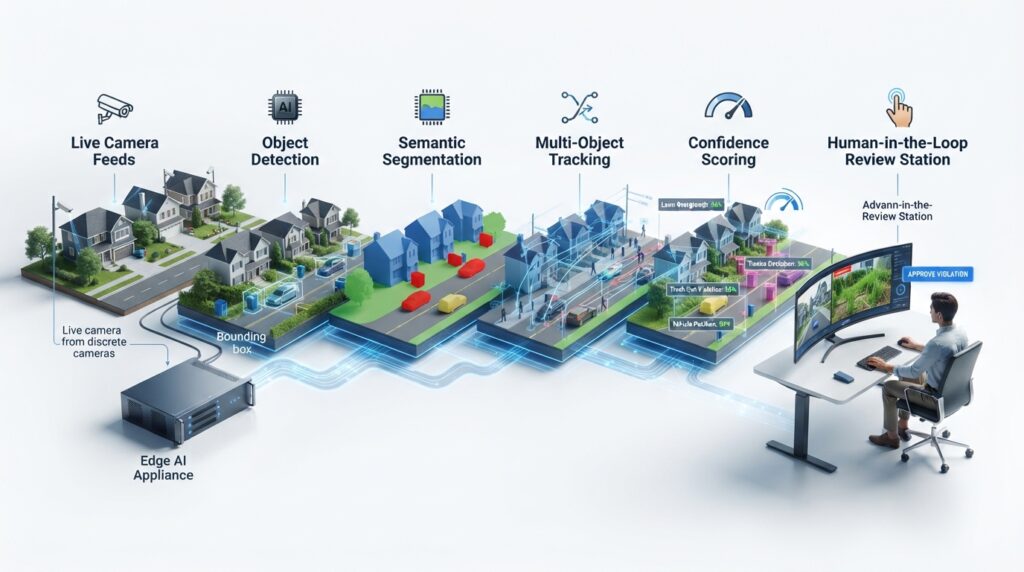
Computer Vision Algorithms & Detection Logic
1.Pre-processing & Slicing Aided Hyper Inference (SAHI):Step 1.
Because critical defects (such as hairline wall cracks or early-stage weed growth) often occupy a tiny pixel fraction in a wide-angle shot, the system applies SAHI. High-resolution images are sliced into a uniform grid with calculated overlaps, preventing the deep learning model from missing micro-targets at a distance.
2.Object Detection:Step 2.
Custom YOLOv8 or YOLO11 models, trained on proprietary property management datasets, bound and classify target entities. Classes include overgrown lawns, unauthorized sheds, peeling paint, misplaced trash cans, and fence damage.
3.Multi-Object Tracking (MOT):Step 3.
For dashcam or security feeds, the DeepSORT algorithm—backed by Kalman filtering—assigns a unique ID to each object (e.g., an unauthorized vehicle or a trash can left out past collection day). Tracking targets across consecutive frames filters out false positives caused by camera noise or transient motion.
4.Semantic Segmentation:Step 4.
To assess the severity of landscaping neglect or surface damage, a semantic segmentation model classifies images at the pixel level. The exact ratio of damaged surface area to the total asset area is computed to determine the appropriate enforcement tier.
5.Multi-frame Confidence Scoring:Step 5.
To ensure ironclad accuracy and minimize false alarms, the system calculates a cumulative confidence score across consecutive frames using the following formula:
$$C_{final} = 1 – \prod_{i=1}^{N}(1 – c_i)$$
Where $c_i \in [0,1]$ represents the confidence score returned by the YOLO model for the target object in the $i$-th frame within a continuous tracking sequence of $N$ frames. If $C_{final}$ surpasses a set threshold (typically 0.85), the violation is verified.
6.GIS and GPS Map Matching:Step 6.
Once a violation meets the confidence threshold, GPS metadata from the sensor is cross-referenced with the community’s digital GIS parcel map. The system automatically resolves coordinates into a physical street address and queries the property management database for the associated homeowner account.
2. Platform Comparison: Maximizing Efficiency and Eliminating Administrative Bottlenecks
In legacy operational models, administrative bottlenecks occur post-inspection. An inspector spends an average of 8 minutes per violation just uploading photos, hunting down the corresponding CC&R clause, drafting the notice, and routing it through approvals. This manual drag drops actual violation resolution rates below 20%.
Transitioning to AI-driven automation shifts property management from “reactive manual tracking” to “proactive automated enforcement,” boosting successful violation resolution rates to between 60% and 70%.
HOA Violation Management Software Comparison (2026 Metrics)
| Evaluation Criteria | Buildium | AppFolio | HOALife | DoorLoop AI |
| Data Capture Method | Manual web data entry; lacks a dedicated mobile field app. | Basic mobile app supporting manual photo uploads and notes. | Advanced field app featuring integrated GPS mapping and standardized checklists. | AI-guided mobile app for multi-angle photo capture with auto-sorting. |
| Workflow Automation Tier | Low. Managers must manually trigger subsequent notice and escalation tiers. | Medium. Supports smart templates and AI-assisted text generation via cloud. | High. Full automation engine from initial warning to fine assessment. | High. Automated tagging, batch report formatting, and bulk work-order generation. |
| Workflow Customization | Limited. Restricted to the platform’s out-of-the-box notice templates. | Moderately flexible. Capped at a default maximum of 4 escalation tiers. | Very High. Unlimited custom workflows tailored to hyper-specific CC&R sets. | Very High. Instantly converts detected violations into automated maintenance orders. |
| Average Processing Time / Case | ~10 – 12 minutes (includes account lookup, letter drafting, and print routing). | ~4 – 5 minutes (leveraging cloud-based AI copy generation tools). | < 1 minute (inspectors simply tap to confirm via app during drive-by). | < 1 minute (instantly translates field data into finalized reports). |
Editor’s Choice: For property management companies overseeing large portfolios with intricate CC&R structures that demand rigorous, multi-tier escalation, HOALife and DoorLoop AI deliver superior field automation compared to legacy, all-in-one property management systems.
Who Should Use AI-Powered HOA Inspections?
This solution is ideal for:
- Large HOAs managing more than 300 residential units.
- Property management companies responsible for multiple communities.
- Associations with recurring covenant violations.
- Communities seeking faster inspection cycles while maintaining consistent enforcement.
- Organizations that already operate CCTV cameras or mobile inspection workflows.
Who Should Avoid This Approach?
AI-powered inspections may not be the best investment if:
- Your HOA manages fewer than 80 homes.
- Violations occur only occasionally.
- There is no dedicated staff available to review AI-generated evidence.
- Your annual technology budget cannot support ongoing maintenance.
In these situations, traditional inspections or lightweight cloud-based inspection tools may provide a better balance between cost and operational simplicity.
Financial Impact of AI Drone Thermography
For mid-rise or high-rise condominium complexes, traditional facade and roof inspections require scaffolding that can run anywhere from $20,000 to $50,000 and take weeks to coordinate.
Deploying an autonomous drone solution via Aerially.ai equipped with FLIR thermal sensors allows teams to scan 90% to 100% of a building’s envelope for a fraction of the cost—typically $4,000 to $12,000. Thermal imaging uncovers subsurface moisture trapping, insulation failures, and latent structural issues before they manifest externally. Industry data shows that every dollar spent on proactive AI inspections saves up to $10 in emergency repairs and mitigates structural non-compliance fines that can reach up to $10,000/month.
Agentic RAG Architecture for Legal and Regulatory Cross-Referencing
To completely clear the paperwork bottleneck, modern systems employ an Agentic AI architecture paired with Retrieval-Augmented Generation (RAG) hosted on Azure AI Search. Instead of requiring managers to manually comb through hundreds of pages of community-specific bylaws, the system utilizes Semantic Kernel to orchestrate a team of specialized AI agents:
- Address Agent: Calls address-validation APIs to pin down the exact property flagged in the field.
- Search Agent: Runs semantic queries across vectorized PDF databases containing the community’s governing documents and CC&Rs.
- Conversational Agent: Leverages a Large Language Model (LLM) to synthesize findings from the Search Agent, cross-reference the resident’s real-world violation against specific HOA rules, and draft a tailored compliance notice citing the exact section and paragraph—completely eliminating hallucination risks.
3. Standard Operating Principles: Review Dashboards and Resident Relations
While AI delivers exceptional detection accuracy, real-world deployment requires strict operational guardrails to guarantee legal defensibility, data privacy, and community buy-in.

The “Human-in-the-Loop” Oversight Mechanism
AI is designed to liberate staff from repetitive, redundant workflows—not to replace human empathy and judgment. A human gatekeeper must review and sign off on any notice before it is issued for several reasons:
- Filtering Edge Cases: Adverse environmental factors—like complex shadow play, temporary seasonal leaf accumulation, or a guest’s car parked briefly at the curb—can be misclassified by AI as chronic violations.
- Validating Variances: A homeowner may hold an architectural variance or a temporary maintenance extension granted by the board. These administrative exceptions sit outside the visual context available to edge AI models.
- Mitigating Selective Enforcement Risks: Maintaining offline audit logs via apps like HOAGuard allows management to prove that inspections are conducted uniformly across the entire grid, shielding the association from claims of targeted enforcement.
- Democratic Voting Models: Cutting-edge platforms like Avōt route anonymized violation photos to a randomized peer-review panel of fellow community residents via a mobile app. Crowdsourcing violation verification slashes adversarial disputes with the board by 80% and defuses personal bias accusations.
Data Security and Resident Privacy Guardrails
Deploying dashcams and drones inside residential neighborhoods demands stringent privacy controls:
- Edge-Level Auto-Redaction: Right at the edge pre-processing layer (on the Jetson Orin device), all human faces and license plates of uninvolved vehicles are permanently blurred before any data hits cloud servers.
- Strict No-Fly Zoning: Drone flight paths are strictly geofenced to prevent imaging or analyzing private spaces behind windows or within low-altitude backyard perimeters.
- Data Governance & MOUs: Management companies must execute strict Memorandums of Understanding (MOUs) dictating that collected data—particularly Automated License Plate Recognition (ALPR) records—is used exclusively for neighborhood security or provided to law enforcement under a valid criminal warrant. Data must never be shared with third parties or repurposed for tracking.
Designing an Exception-Based Review Dashboard
To maximize manager approval workflows, central control panels are built around scannable, exception-based layouts:
+───────────────────────────────────────────────────────────────────────────+
│                        EXCEPTION REVIEW DASHBOARD                         │
+───────────────────────────────────────────────────────────────────────────+
│ [Filters: Confidence > 90%] [Category: Landscaping Maintenance]            │
+───────────────────────────────────────────────────────────────────────────+
│  Case ID: #V-2026-8801  |  Address: 405 Whispering Pines Dr               │
│  Timestamp: 2026-10-24 10:14:22 UTC                                       │
│                                                                           │
│  AI EVIDENCE OVERLAY:                    PROPERTY VIOLATION HISTORY:      │
│  +─────────────────────────+             - 03/14/2026: Overgrown Lawn     │
│  | [Field Capture Image]   |                           (Resolved)         │
│  | (Red bounding box:      |             - 10/24/2026: Current Violation  │
│  |  Grass height 12.5 in)  |                                              │
│  +─────────────────────────+             PROPOSED CC&R CLAUSE:            │
│                                          - Sec. 4.1.2: Max Turf Height    │
│                                            (Suggested Fine: $50)          │
│                                                                           │
│  [ APPROVE NOTICE ]     [ DISMISS / NO VIOLATION ]     [ REQUEST AUDIT ]  │
+───────────────────────────────────────────────────────────────────────────+
Reviewers focus solely on cases sorted by confidence score and severity. The interface integrates native annotation tools, allowing managers to circle surface anomalies or review previous homeowner communications to ensure consistent adjudication.
Standardizing Notices and Proactive Resident Portals
When an approved notice is issued, metadata is translated into a highly visual, clean communication format. Preserving community goodwill requires avoiding threatening or overly punitive language on first notices.
An optimal enforcement strategy follows a two-stage engagement model:
- Friendly Reminder Notices: Homeowners receive a polite notification explaining the issue caught during routine automated scans, backed by the cropped edge-AI photo as clear, objective proof, along with simple steps to fix it.
- Self-Service Resident Portals: Every compliance notice includes a unique, secure link or QR code leading to an online portal. Residents can bypass manual phone calls or emails entirely; once they complete the fix (e.g., mow the lawn or repaint the fence), they simply upload a photo via the portal. The central AI platform processes the resident’s upload, verifies the remedy, closes the case, and fires off an automated confirmation receipt—requiring zero manual clicks from management.
Frequently Asked Questions
Is AI-generated inspection evidence legally defensible?
Yes. However, the strongest governance models always require a human reviewer to validate AI-generated evidence before issuing an official violation notice.
How much does an AI-powered HOA inspection system cost?
Costs vary depending on deployment size. Small communities may spend only a few thousand dollars annually using cloud-based services, while enterprise Edge AI deployments require dedicated hardware investments.
Can existing CCTV cameras be integrated?
In most cases, yes. Modern AI inspection platforms support standard ONVIF and RTSP protocols, allowing existing surveillance infrastructure to be reused without replacing every camera.
How long does deployment usually take?
A limited pilot can often be completed within 30–90 days depending on hardware availability, software integration, and governance approval.
Editorial Conclusion
AI-powered property inspections are rapidly becoming a practical operational tool rather than an experimental technology.
The most successful HOA deployments do not replace inspectors. Instead, they automate repetitive image analysis while preserving human judgment for every enforcement decision.
Organizations should focus on building transparent governance processes, protecting resident privacy, and selecting AI systems that fit their operational scale rather than chasing the most advanced algorithms.

Next Steps for Your Operations
Pairing edge computer vision with automated, frictionless workflows allows property management enterprises to elevate neighborhood curb appeal while driving down operational overhead. To introduce these efficiencies into your portfolio, consider these practical starting steps:
- For High-Rise or Portfolio-Wide Structural Oversight: Partner with an aerial proptech vendor (like Aerially.ai) to run a pilot thermal scan on a select community to benchmark structural risks.
- For Optimization of Field Personnel: Request a demo of field-specific violation tracking software like DoorLoop AI or HOALife to test how effectively their rule engines integrate with your current CC&Rs.
Related Guides
If you’re evaluating AI infrastructure for property management, you may also find these guides useful:
- Air-Gapped AI for Property Management
- What Is Private AI?
- Cloud AI vs On-Premises AI
- Best Private AI Platforms
- Zanus AI Hardware Architecture & Server Setup Guide
Regulatory References & Frameworks
To maintain strict data compliance and structural alignment during automated enforcement workflows, property management firms should reference official statutory databases and engineering frameworks:
- Property Data Privacy: Review data processing compliance requirements under the [California Consumer Privacy Act (CCPA / CPRA)].
- Corporate Data Safeguards: Access cybersecurity infrastructure standards via the [New York SHIELD Act Legislation].
- Consumer Data Governance: Review large association oversight regulations within the [Virginia Consumer Data Protection Act (VCDPA)].
- Biometric & Financial Security: Check protected personal identifier rules under the [Florida Information Protection Act (FIPA)].
- Zero Trust Architecture: Align local edge network engineering with the [NIST SP 800-207 Zero Trust Guidelines].
- Edge AI Deployment: Consult parallel stream processing and hardware inference metrics through the [Official NVIDIA AI Enterprise Documentation].