

Most property management companies don’t need more data; they need more time.
Traditional HOA property inspections are an operational bottleneck. Sending a manager to drive through neighborhoods, manually log violations, take photos, and match them back to a spreadsheet at the office wastes dozens of hours every week. Worse, it leads to human error and defensive homeowner disputes over “selective enforcement.”
Artificial intelligence has changed this workflow entirely. By leveraging computer vision and edge-computed automation, modern property management platforms can detect property violations in real time from a moving vehicle or drone, match the infraction to a specific parcel map, and queue up a formal notice in seconds.
This guide evaluates the top AI-powered HOA violation detection systems on the market to help you choose the right solution for your portfolio.
Quick Summary
If you have limited time, here is a quick look at the best options available:
- ARCH Inspect: Best overall for automated, drive-by inspections using advanced computer vision ($YOLOv8$).
- Smartwebs System: Best for established management companies seeking deep, native end-to-end accounting and violation tracking.
- Custom API Framework (Lob + Twilio + YOLO): Best for enterprise operations with in-house development teams wanting total workflow control.
How We Evaluated These Platforms
To ensure a fair comparison, we evaluated every platform using the same enterprise-focused criteria rather than vendor marketing claims.
Our assessment considered:
- AI detection accuracy and computer vision maturity.
- Ease of deployment for HOA management teams.
- Workflow automation capabilities.
- Integration with existing accounting or property management systems.
- Compliance support for state-specific HOA regulations.
- Scalability across multiple communities.
- Long-term operational costs and maintenance requirements.
Our recommendations prioritize real-world operational efficiency over feature lists alone.
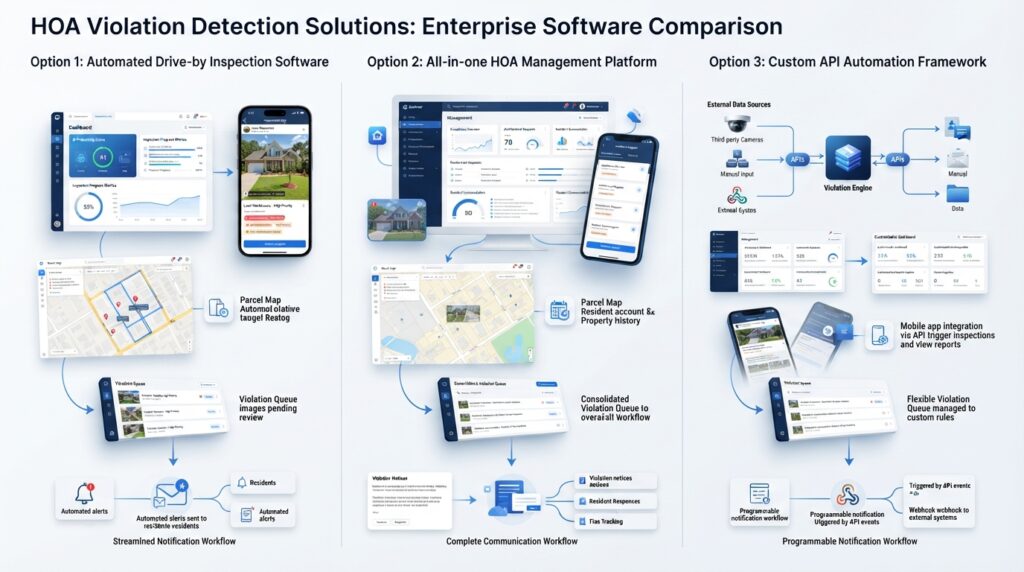
Comparison Table
| Platform / Approach | Best For | Standout Feature | Learning Curve | Deployment Model | Free Trial |
| ARCH Inspect | Scalable Fleet Inspections | GPS-driven automated parcel matching | Low | Mobile App + Cloud Dashboard | Request Demo |
| Smartwebs | Full Portfolio Management | Native architecture review and billing rails | Moderate | Complete Software Suite | Request Demo |
| Custom Integration (API) | Enterprise-grade Development | Unlimited workflow customization via Lob API | High | Self-hosted / Private Cloud | N/A (Open Source Components) |
Editor’s Choice
🏆 Best Overall: ARCH Inspect
Best for organizations seeking highly automated, drive-by inspections with minimal operational overhead.
💰 Best All-in-One Platform: Smartwebs
Ideal for management companies wanting inspections, compliance tracking, accounting, and homeowner communications within one ecosystem.
⚙️ Best for Enterprise Customization: Custom API Framework
Recommended for organizations with dedicated development teams requiring complete workflow automation and state-specific compliance logic.
Detailed Reviews
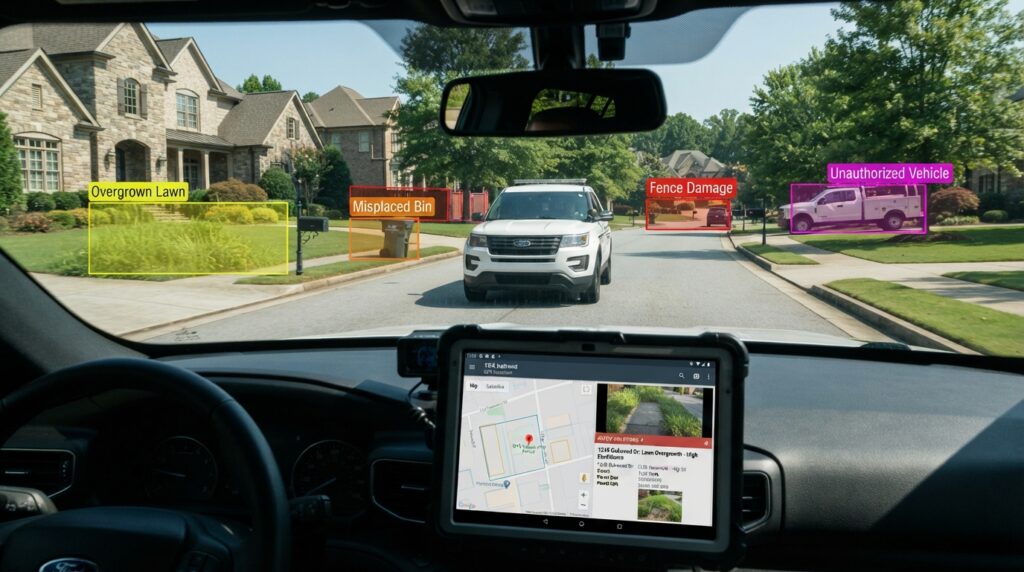
ARCH Inspect: Best Overall for Automated Fleet Inspections
ARCH Inspect focuses exclusively on cutting out the manual labor of neighborhood drive-by inspections. It leverages real-time edge processing via mobile devices or vehicle dashcams to capture violations while driving at normal speeds.
- How it Works: The app utilizes $YOLOv8$ instance segmentation to analyze your video feed dynamically. It measures aesthetic anomalies—such as calculating the precise percentage of brown patches on a lawn or tracking overgrown shrubbery—without requiring the vehicle to stop.
- Key Strengths: Outstanding GPS-driven auto-labeling. The software downloads virtual satellite parcel boundaries directly to the local device cache. It automatically crops the violation bounding box, maps it to the precise property address, and works seamlessly offline in poor cellular coverage zones.
- Limitations: It is highly specialized for physical inspections. It lacks a robust, built-in financial ledger, meaning you must integrate it with your existing property management accounting platform.
- Pricing: Custom enterprise pricing based on portfolio size and active vehicle nodes.

Smartwebs: Best for End-to-End HOA Management
Smartwebs is an industry pioneer that has layered AI automation atop its trusted compliance and architectural review workflows. It offers a more structured, traditional suite wrapped in intelligence.
- How it Works: Rather than relying solely on automated live-video feeds, Smartwebs provides a highly optimized administrative workflow where field photos are automatically matched against historical property trends using change-detection models.
- Key Strengths: Exceptional risk mitigation against “selective enforcement” claims. The platform forces compliance tracking based on strict mathematical baselines configured per community (e.g., triggering a letter only when lawn height objectively crosses an explicit rule limit). Every log entry contains permanent, unalterable metadata with geotags and timestamps.
- Limitations: The field execution is less “hands-free” compared to pure computer vision engines like ARCH Inspect, requiring a more intentional step-by-step route methodology.
- Pricing: Tiered annual contract options depending on the number of homes under management.

Custom API System (YOLO + Lob + Twilio): Best for Enterprise Teams
For large-scale management corporations running thousands of doors across multiple states, building a proprietary layer using dedicated APIs offers unmatched operational leverage.
- How it Works: Dashcams feed video frames to localized edge devices that run tailored object detection layers. Once an anomaly passes an internal human-in-the-loop (HITL) review dashboard, the system fires off direct server-side REST API calls to print services and communication channels.
- Key Strengths: Maximum automation and bottom-line efficiency. By integrating directly with the Lob REST API, certified letters are automatically printed, stuffed, stamped, and mailed without a human touching a piece of paper. The integration handles automated Coding Accuracy Support System (CASS) address verification natively, formatting destinations to USPS standards to eliminate returned mail costs.
- Limitations: Requires ongoing engineering resources. Managing API rate limits (such as handling
HTTP 429errors with exponential backoff algorithms) and maintaining deep learning models requires technical overhead. - Pricing: Highly cost-efficient at scale, paying only for raw API consumption (e.g., per text sent or per letter printed).
Platform Scorecard
| Platform | Ease of Use | Automation | Compliance | Scalability | Overall |
|---|---|---|---|---|---|
| ARCH Inspect | ⭐⭐⭐⭐⭐ | ⭐⭐⭐⭐⭐ | ⭐⭐⭐⭐☆ | ⭐⭐⭐⭐⭐ | 9.6/10 |
| Smartwebs | ⭐⭐⭐⭐☆ | ⭐⭐⭐⭐☆ | ⭐⭐⭐⭐⭐ | ⭐⭐⭐⭐☆ | 9.3/10 |
| Custom API | ⭐⭐⭐☆☆ | ⭐⭐⭐⭐⭐ | ⭐⭐⭐⭐⭐ | ⭐⭐⭐⭐⭐ | 9.4/10 |
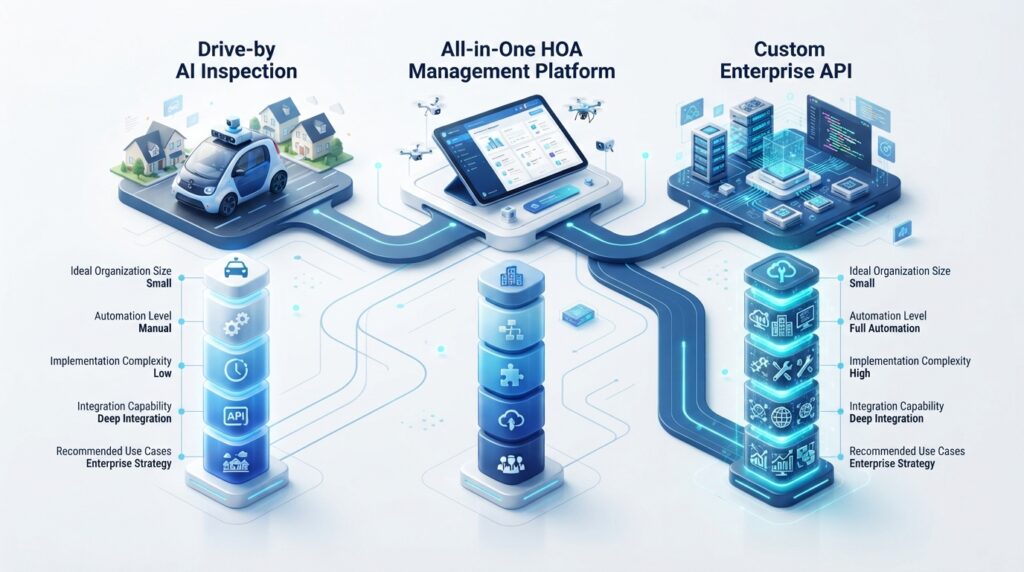
Buying Advice: Who Should Use What?
Choosing an implementation plan depends entirely on your current software stack and team capabilities:
- If you run an existing enterprise ERP: Choose ARCH Inspect. It acts as a lightweight, highly efficient data collection layer that integrates smoothly with external data endpoints via webhooks without disrupting your primary financial system.
- If you want a single platform for everything: Choose Smartwebs. Trying to string multiple applications together can complicate training if your office staff prefers an all-in-one compliance ledger.
- If you operate cross-state portfolios with custom rules: Build a Custom API Solution. The flexibility allows you to bake complex state-level notification laws directly into your software logic automatically.
Who Should Avoid AI Inspection Software?
AI-powered inspection platforms are not the right investment for every HOA.
Traditional manual inspections may remain the better choice if:
- Your community has fewer than 75 homes.
- Property inspections occur only a few times each year.
- Your annual technology budget is limited.
- No staff members are available to review AI-generated evidence before enforcement.
For smaller associations, simple mobile inspection apps or enterprise cloud-based documentation tools may deliver a better balance between cost and operational complexity.
⚠️ Critical Operational Warning
The biggest point of failure in adopting AI inspection tools isn’t the software algorithm—it’s your initial property database setup. If your digital parcel boundaries or homeowner mailing profiles are outdated, the system will accurately detect a violation but route the penalty to the wrong account, compounding your administrative burden. Clean your master records before deployment.
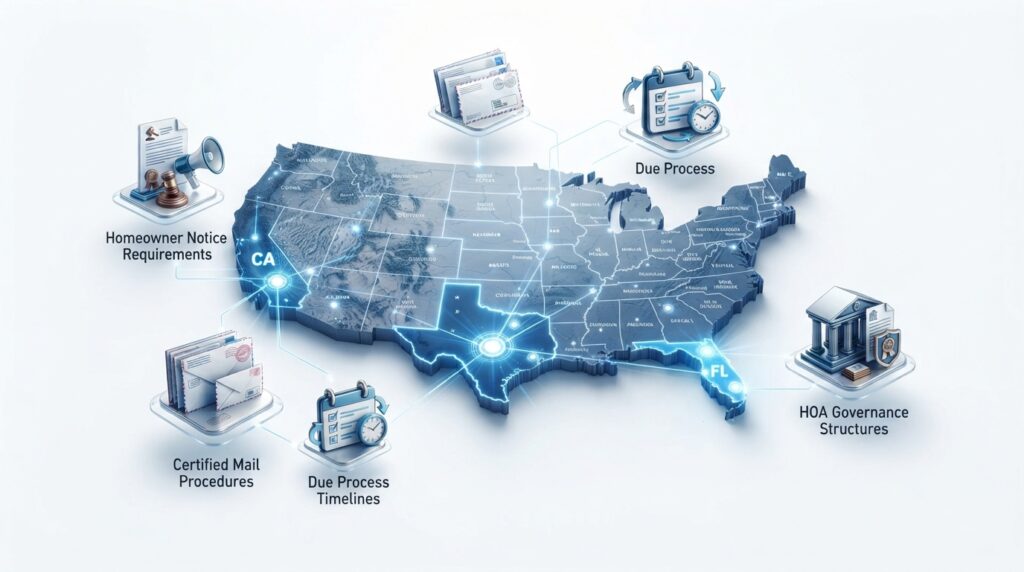
State-by-State Compliance & Legal Safeguards
AI automation must be tightly governed by the regulatory frameworks of the states where your communities reside. Your software rules should be adjusted based on these distinct guardrails:
Florida (Statutes Chapter 720)
Florida law mandates a high level of due process before a penalty sticks. The association must provide at least a 14-day written notice to the homeowner before a formal hearing can take place. Fines cannot be officially levied until the independent committee approves the action. Your review queue should hold all automated alerts for manual validation before dispatching legal text.
California (Civil Code Section 5855)
Under the Davis-Stirling Act, if an association is considering disciplinary action or financial penalties, the board must give the member a written notice at least 10 days prior to the meeting (or 15 days if the penalty includes suspending common area privileges). The AI system must space out its communication timelines dynamically to reflect these lead times.
Texas (Property Code Section 209.006)
Texas requires enforcement notices to be delivered via Certified Mail. The notification must describe the violation clearly and grant the homeowner a minimum 30-day cure period to fix the issue before any fine collection can legally begin. Here, utilizing an integrated print API like Lob to send verifiable certified mail automatically is a major operational advantage.
Frequently Asked Questions
What is the best AI HOA violation detection software?
ARCH Inspect is the strongest choice for automated drive-by inspections, while Smartwebs offers the most complete HOA management ecosystem.
Can AI replace HOA inspectors?
No. AI should assist inspectors by identifying potential violations, but every enforcement action should still be reviewed and approved by a human.
How much does AI inspection software typically cost?
Pricing varies by deployment size. Cloud platforms generally use annual subscriptions, while enterprise custom deployments require hardware, integration, and engineering investments.
Can existing CCTV cameras be used?
In most cases, yes. Many modern platforms support standard RTSP or ONVIF protocols, allowing existing camera infrastructure to be reused.
Editorial Recommendation
There is no universally “best” HOA inspection platform.
The right choice depends on your organization’s operational maturity.
Choose ARCH Inspect if reducing field inspection time is your highest priority.
Choose Smartwebs if you prefer a single platform for compliance management, homeowner communications, and accounting.
Choose a Custom API Framework if your organization manages thousands of homes across multiple jurisdictions and requires complete workflow automation.
Rather than focusing on AI features alone, evaluate each platform based on operational fit, legal compliance, integration capabilities, and long-term maintenance requirements.
Related Guides
If you’re planning to modernize HOA operations, these guides may also help:
- AI-Powered HOA Violation Detection: How Automated Property Inspections Work
- Air-Gapped AI for Property Management
- Best Private AI Platforms for Enterprises
- Cloud AI vs. On-Premises AI
- What Is Private AI?