Executive Summary
When evaluating Zanus AI Server Pricing, enterprise artificial intelligence is undergoing a structural economic shift. Over the past three years, organizations relied heavily on public cloud Large Language Model (LLM) endpoints like OpenAI API, Anthropic Claude, and AWS Bedrock. While public APIs eliminated initial capital expenditure (CapEx), continuous operational execution exposed a glaring financial vulnerability: unpredictable, compounding token expenses.
As enterprise workflows transition from simple conversational prompts to continuous, multi-agent Retrieval-Augmented Generation (RAG) pipelines, context windows routinely exceed 128,000 tokens. Every automated loop repeatedly resends system instructions, private document context, and interaction logs to remote data centers—creating an escalating tax on routine computations.
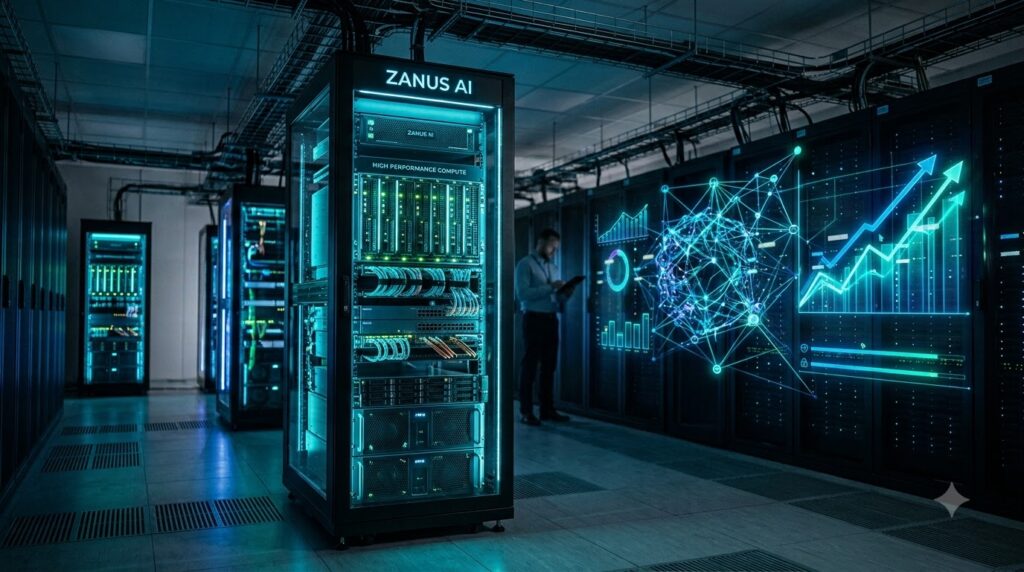
On-premises private AI server appliances, such as those manufactured by Fort Lauderdale-based Zanus AI, address this operational friction. By pairing enterprise hardware with a non-metered AI Operating System, organizations move AI expenditures from unpredictable cloud OpEx to depreciable CapEx.
This guide breaks down the true total cost of ownership (TCO), hardware tier pricing, IRS Section 179 tax deductions, power and cooling realities, and real-world ROI to help technology leaders evaluate whether bringing AI infrastructure on-premises makes financial sense.
The Economics of AI Infrastructure: Cloud OpEx vs. On-Premise CapEx
The Hidden Tax of Cloud API Scaling
Public cloud providers charge for AI inference on a metered, per-million-token basis. While baseline input rates appear manageable on paper, real-world multi-agent enterprise applications consume tokens exponentially:
- OpenAI GPT-4o: $2.50 / 1M input tokens | $10.00 / 1M output tokens
- Claude 3.5 Sonnet: $3.00 / 1M input tokens | $15.00 / 1M output tokens
- Advanced Reasoning Models (o1 / GPT-5 series): $15.00–$30.00 / 1M input tokens | $60.00–$180.00 / 1M output tokens
In an automated corporate setting, a single user prompt rarely costs just a few tokens. Background agentic validation passes, document parsing, vector database queries, and automated workflow triggers multiply raw prompt volume by 8× to 15×. Add third-party vector index hosting, data egress fees ($0.09/GB), and per-seat SaaS licensing, and a 50-user team running continuous background automation frequently incurs cloud API bills between $6,000 and $12,000 every month.
Financial Benefits of Private AI Deployment
Moving to a dedicated, on-premises AI server appliance shifts the cost model entirely:
- Zero Marginal Token Fees: Queries, context refills, and background loops run continuously without per-token charges or monthly per-seat license markups.
- Upfront Tax Deductions: Under US tax law (Section 179), qualifying businesses can write off up to $2,560,000 of hardware purchases in tax year 2026.
- Data Sovereignty: Sensitive customer records, health data (HIPAA), and legal filings remain strictly within physical premises, eliminating third-party data compliance exposure.
- Short Payback Horizon: Capital outlay for mid-market private servers is typically recouped within 5.5 to 8 months compared to equivalent cloud API volumes.
Editor’s Perspective: The Cloud Trap
Public cloud APIs are excellent for prototyping and unpredictable burst workloads. However, using public cloud token APIs for continuous daily operational automation is like renting a rental car for a four-year daily commute. The convenience eventually turns into financial drain.
Hardware Subsystem & Infrastructure Breakdown
Evaluating an AI server requires looking beyond marketing labels down to the raw silicon, memory bandwidth, and physical facility demands. Inference speed and concurrent user capacity are governed primarily by GPU VRAM capacity, memory bandwidth, and host system thermal limits.
+-----------------------------------------------------------------------+
|                         ZANUS AI SERVER NODE                          |
+-----------------------------------------------------------------------+
|  +-----------------------+  +--------------------------------------+  |
|  |  Enterprise Server CPU |  | System ECC DDR5 RAM (128GB - 1TB)    |  |
|  |  (AMD EPYC / Intel)   |  | (Context Routing & Data Prep)        |  |
|  +-----------------------+  +--------------------------------------+  |
|                             |                                         |
|  +-----------------------------------------------------------------+  |
|  |  PCIe Gen 5 NVMe RAID 10 Array (Fast Vector Search & Weights)   |  |
|  +-----------------------------------------------------------------+  |
|                             |                                         |
|  +-----------------------------------------------------------------+  |
|  |  NVIDIA GPU Acceleration Subsystem                              |  |
|  |  - RTX 6000 Ada (48GB GDDR6 ECC | 960 GB/s)                      |  |
|  |  - RTX PRO 6000 Blackwell (96GB GDDR7 ECC | 1.8 TB/s)             |  |
|  +-----------------------------------------------------------------+  |
+-----------------------------------------------------------------------+
1. Silicon Subsystem (GPUs)
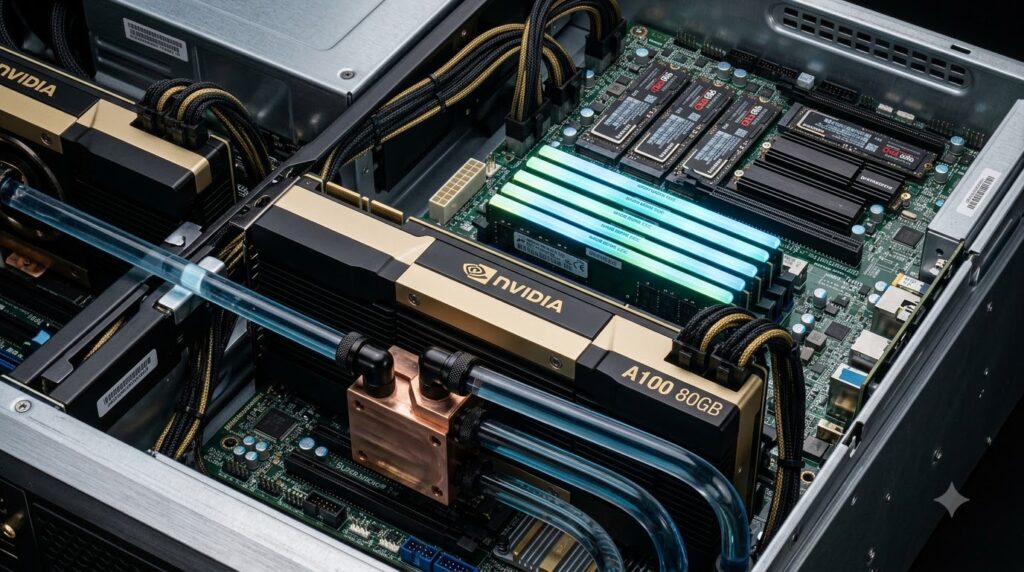
The GPU complex represents 60% to 75% of total server hardware cost. Modern enterprise AI inference relies heavily on GPU Video RAM (VRAM) capacity and memory bandwidth to keep large language models loaded without relying on slower system memory.
- NVIDIA RTX 6000 Ada Generation: Features 48GB GDDR6 ECC VRAM, 18,176 CUDA cores, 568 Tensor Cores, and 960 GB/s memory bandwidth at 300W TDP. It is ideal for mid-sized teams running 8B to 32B parameter open-weights models locally.
- NVIDIA RTX PRO 6000 Blackwell Series: Features 96GB GDDR7 ECC VRAM, 24,064 CUDA cores, 752 Tensor Cores with native FP4 precision support, and 1.8 TB/s memory bandwidth. Configured in 300W (Max-Q) up to 600W (Server Edition) variants, this card provides the necessary memory footprint to run unquantized 70B+ parameter models locally without drop-offs in output quality.
2. High-Speed NVMe Storage Arrays
Local vector search and multi-model swapping require high disk throughput. Zanus servers implement PCIe Gen 5 NVMe SSDs in RAID 10 configurations, reaching sequential read speeds beyond 14,000 MB/s. This prevents data retrieval bottlenecks when ingesting large document repositories into local vector stores.
3. System ECC DDR5 Memory
Host system memory manages background preprocessing, multi-agent task execution, and operating system overhead. Systems range from 128GB to 1,024GB of multi-channel DDR5 Error-Correcting Code (ECC) memory running at 5600 MT/s. ECC architecture is non-negotiable in enterprise settings to prevent silent data corruption caused by memory bit-flips during 24/7 operations.
4. Power, Thermal, and Facility Demands
A common mistake in IT planning is failing to account for physical facility requirements before purchasing high-density server hardware:
- Workgroup Systems (Single 300W GPU): Draws 500W–700W peak power. Runs safely on a standard 110V/15A wall outlet in an office environment, generating approximately 2,400 BTU/hr of heat.
- Flagship Systems (Quad 600W GPUs): Draws 2.5 kW–4.0 kW under sustained load. Requires a dedicated server room or rack, 208V/240V NEMA L6-30P power drops, and facility HVAC capable of exhausting up to 13,600 BTU/hr per chassis to prevent thermal throttling.
Zanus AI Server Pricing & Configuration Matrix
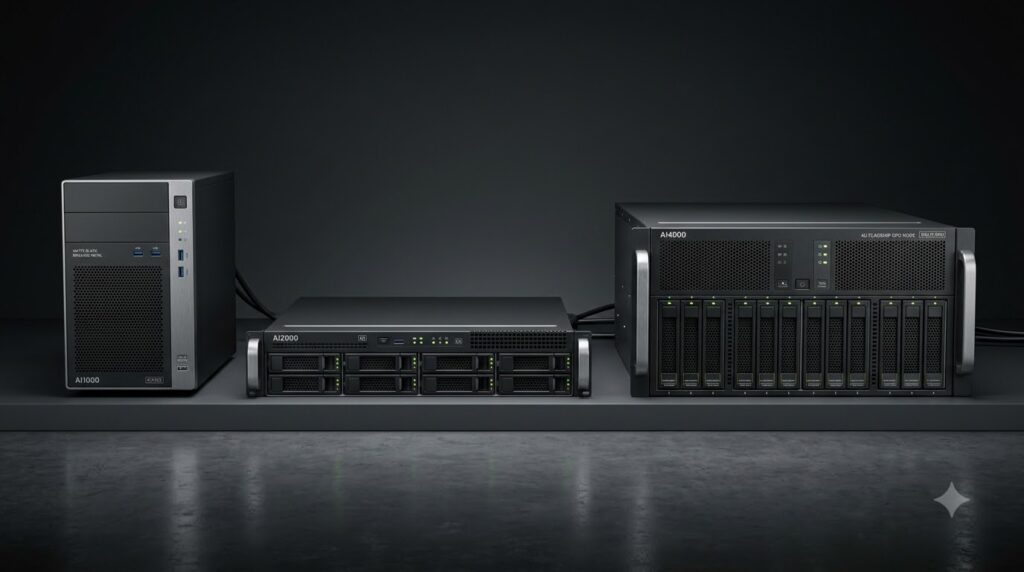
Zanus structures its hardware into three tiers based on active concurrent users, model parameters, and processing intensity. Each node ships with the pre-installed Zanus AI Operating System stack.
| Feature / Parameter | Entry-Level Workgroup | Mid-Market Enterprise | Sovereign Flagship |
| Target Scale | 1–15 Active Users | 15–50 Active Users | 50+ Active Users (Enterprise-Wide) |
| Primary Workloads | Local RAG, document parsing, legal drafting, admin workflows | Multi-department automation, background agent loops | Enterprise-wide high concurrency, long-context parsing |
| GPU Architecture | 1× NVIDIA RTX 6000 Ada (48GB GDDR6 ECC) | 1× RTX PRO 6000 Blackwell (96GB) or 2× RTX 6000 Ada | 4× NVIDIA RTX PRO 6000 Blackwell Server Edition (384GB Total VRAM) |
| Host CPU | 16-Core Server Processor | 32-Core Enterprise Server CPU | Dual 64-Core Enterprise Server CPUs |
| System RAM | 128GB DDR5 ECC | 256GB–512GB DDR5 ECC | 1,024GB DDR5 ECC |
| High-Speed Storage | 2TB PCIe Gen4 NVMe | 7.68TB PCIe Gen5 NVMe RAID 10 | 15.36TB PCIe Gen5 Enterprise RAID |
| Power Envelope | 700W PSU (110V AC Standard) | 1600W Redundant PSU (110V/208V AC) | 3200W Redundant (2+2) PSU (208V AC Data Center) |
| Estimated CapEx Price | $12,000 – $18,000 | $32,000 – $48,000 | $85,000 – $135,000 |
3-Year Total Cost of Ownership (TCO) Model
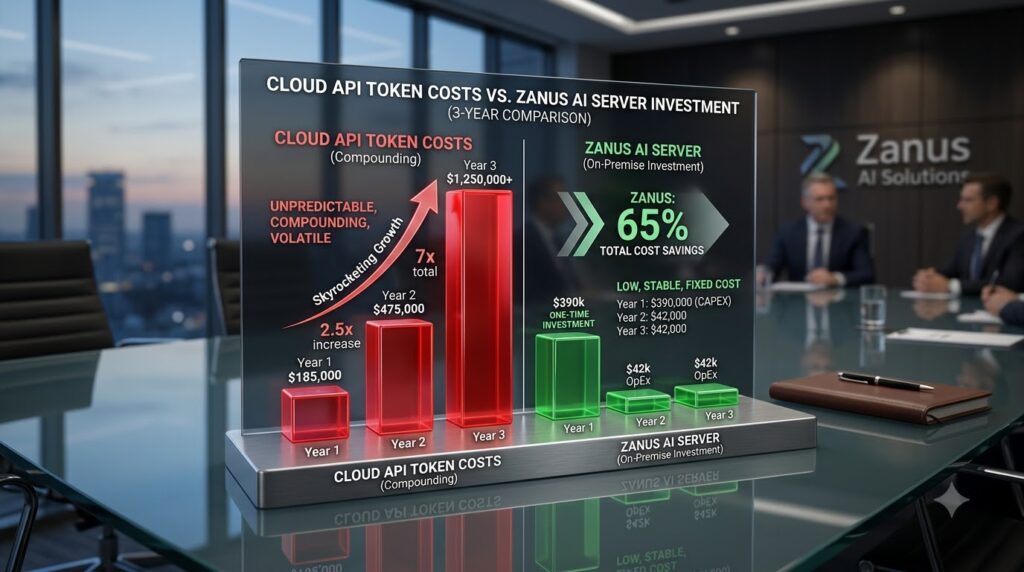
To illustrate the financial differences, the model below compares a 50-user organization running continuous document automation using public Cloud AI APIs versus deploying a dedicated Zanus Mid-Market Enterprise Server ($42,000 CapEx) over 36 months.
Cost Comparison Table (50 Users)
| Expense Category | Public Cloud APIs (GPT-4o / Claude Blend) | Zanus Mid-Market AI Server | Operational Notes & Financial Context |
| Upfront Hardware CapEx | $0 | $42,000 | One-time server purchase price |
| Upfront Software / OS | $0 | $0 | Included with Zanus hardware |
| Year 1 API / Token Fees | $96,000 | $0 | Based on ~$8,000/mo cloud API utilization |
| Year 2 API / Token Fees | $105,600 | $0 | Assumes conservative 10% annual usage growth |
| Year 3 API / Token Fees | $116,160 | $0 | Assumes conservative 10% annual usage growth |
| 3-Year Facility Power | $0 | $3,150 | ~800W continuous draw @ $0.15/kWh |
| Hardware Warranty (Y2-Y3) | $0 | $8,400 | Extended NBD on-site support extension |
| Vector Index / SaaS Add-ons | $18,000 | $0 | Managed vector search vs. native NVMe vector store |
| Gross 3-Year Outlay | $335,760 | $53,550 | Total unadjusted cash expenditure |
| IRS Section 179 Tax Savings | $0 | ($14,700) | 35% combined tax write-off on hardware |
| Net 3-Year Financial Cost | $335,760 | $38,850 | Net effective cost after US corporate tax offsets |
Financial Takeaways
- Net 3-Year Cash Savings: $296,910 (an ~88% drop in enterprise AI infrastructure spending).
- Breakeven Timeline: The hardware purchase pays for itself in roughly 5.5 to 8 months depending on daily background query volumes.
Tax Incentives: Leveraging IRS Section 179 in 2026
For US-based corporate buyers, tax policy lowers the effective upfront barrier to purchasing hardware. Under Section 179 of the Internal Revenue Code (updated for tax year 2026), businesses can deduct the full purchase price of qualifying hardware and off-the-shelf software in the year it is placed into service, rather than spreading depreciation over multiple years under standard MACRS schedules.
Key 2026 Section 179 Parameters
- Maximum 2026 Deduction Limit: $2,560,000
- Phase-out Equipment Threshold: Starts at $4,090,000
- Bonus Depreciation: 100% bonus depreciation applies to qualifying hardware purchases.
Real-World Tax Calculation Example
If an enterprise purchases a Zanus Mid-Market AI Server for $42,000:
- Eligible Section 179 Deduction: $42,000 in Year 1.
- Corporate Tax Offset: At a combined Federal and State tax rate of 35%, the deduction yields an immediate cash tax savings of
$42,000 × 0.35 = $14,700. - Net Effective Hardware Cost:
$42,000 - $14,700 = $27,300.
Included Software: The Zanus AI OS Advantage
Purchasing server hardware often introduces hidden software costs: operating system licenses, inference orchestration software, vector database subscriptions, and user management tools. Zanus bundles its proprietary Zanus AI Operating System with the hardware under a perpetual license.
+--------------------------------------------------------------------+
|                         ZANUS AI OPERATING SYSTEM                  |
+--------------------------------------------------------------------+
|  [Structured "Jobs" Workspaces]   [Multi-Thread Workspace Chat]    |
|  [Private Vector Knowledge Base]  [Local Hybrid Search Engine]     |
|  [Automated Doc Generation]       [CRM & Active Directory Sync]    |
|  [Automated Task Scheduler]       [Compliance & Audit Tracker]     |
+--------------------------------------------------------------------+
|               PERPETUAL LICENSE — NO PER-SEAT SaaS FEES            |
+--------------------------------------------------------------------+
Core Features Included Natively:
- Structured “Jobs” Workspaces: Isolated project containers holding documents, custom agent instructions, and user permissions.
- Private Vector Knowledge Base: Parsing engine that indexes local PDFs, legal filings, and internal databases directly onto NVMe drives.
- Local Hybrid Search: Combines semantic vector search with keyword matching behind strict Active Directory/Role-Based Access Controls (RBAC).
- Compliance Audit Tracker: Automated logging that creates cryptographic hashes for all queries, citations, and answers to support HIPAA, SOC 2, and legal compliance reviews.
- No Per-Seat Monthly Licensing: Organizations can onboard additional employees, departments, or background workflows without incurring monthly user fees or consumption penalties.
Vendor Neutrality & Operational Trade-offs
While private AI appliances eliminate token fees, they are not universally superior for every situation. Technology procurement teams must evaluate key operational trade-offs before committing to on-premises deployment:
1. Capital Expenditure Commitment
- Trade-off: Private deployment requires upfront capital commitment ($12,000 to $135,000+). Small startups with low, unpredictable query volumes or temporary projects are better off remaining on cloud APIs.
2. Maintenance and Lifecycle Overhead
- Trade-off: Cloud providers handle hardware updates and server maintenance automatically. On-premises hardware requires internal IT oversight, physical server space, power backup systems (UPS), and active warranty management.
3. Rapidly Evolving Model Architectures
- Trade-off: Proprietary frontier models (like OpenAI o1 or Google Gemini Ultra) update continuously in the cloud. While open-weights models (like Llama-3, DeepSeek, and Qwen) continue to close the gap, organizations requiring absolute state-of-the-art frontier reasoning model capabilities on day one may still need cloud API fallbacks.
4. Electricity and Cooling Management
- Trade-off: Deploying multi-GPU chassis without checking building power supply can result in tripped circuit breakers or thermal throttling. Flagship multi-card setups require dedicated 208V power lines and proper server room cooling.
Editor’s Verdict & Recommendations
Who Should Buy a Zanus AI Server?
- Mid-sized Enterprises (15 to 50+ users) incurring $4,000+ per month in cloud API or AI SaaS subscriptions.
- Regulated Industries (Healthcare, Legal, Defense, Finance) restricted by privacy rules from sending proprietary data to external cloud APIs.
- Organizations Running Continuous Background Automation where multi-agent loops and heavy document RAG consume millions of tokens daily.
Who Should Avoid It?
- Early-stage Startups & Solo Developers with low, inconsistent, or unpredictable AI usage patterns.
- Organizations Without Basic IT Infrastructure lacking physical server rooms or dedicated IT personnel to manage local hardware setups.
Final Recommendation
If your enterprise AI strategy relies on continuous daily workflows across multiple departments, the Zanus Mid-Market Enterprise Appliance offers one of the most practical and financially sound entry points on the market today. The combination of non-metered inference, strong local vector performance, and IRS Section 179 tax offsets makes on-premises AI deployment a logical long-term decision.
🔍 Explore Related Enterprise AI Guides & Benchmarks
If you are evaluating on-premises AI infrastructure, data security, or industry-specific deployment models, explore our related deep-dive reviews and comparative guides:
- Comprehensive Platform Assessment: Read our full Zanus AI Review & Enterprise Evaluation for an end-to-end breakdown of the local AI Operating System and built-in software modules.
- Hardware Architecture & Specifications: Compare GPU memory bandwidth, thermal thresholds, and storage configurations in our detailed Zanus AI Hardware & Infrastructure Guide.
- Appliance vs. Dedicated Server: Unsure which deployment model fits your IT roadmap? Read our head-to-head comparison on Zanus AI Appliance vs. Dedicated AI Server.
- Market Alternatives: Benchmark Zanus against competing local platforms in our guide to the Top 5 Zanus AI Alternatives in 2026.
- Healthcare & HIPAA Compliance: Discover how medical systems deploy air-gapped LLMs safely in our analysis of Zanus AI for Healthcare & Medical Environments.
References
- Block Advisors – Section 179 Deduction Guide 2026: Limits, Qualifications, and Exampleshttps://www.blockadvisors.com
- StorageReview – NVIDIA RTX 6000 Ada Generation Workstation GPU Deep Dive & Reviewhttps://www.storagereview.com
- Yotta Labs – RTX 6000 Ada vs RTX PRO 6000 Blackwell: Enterprise GPU Comparison (2026)https://yottalabs.ai
- Stob.AI – How Expensive Is Each OpenAI Model? 2026 Token Pricing Comparisonhttps://stob.ai
- InnerZero – On-Premises AI Infrastructure Options for Confidential Enterprise Datahttps://www.innerzero.com
- ServeTheHome – Enterprise Server Systems & GPU Accelerator Benchmarkshttps://www.servethehome.com