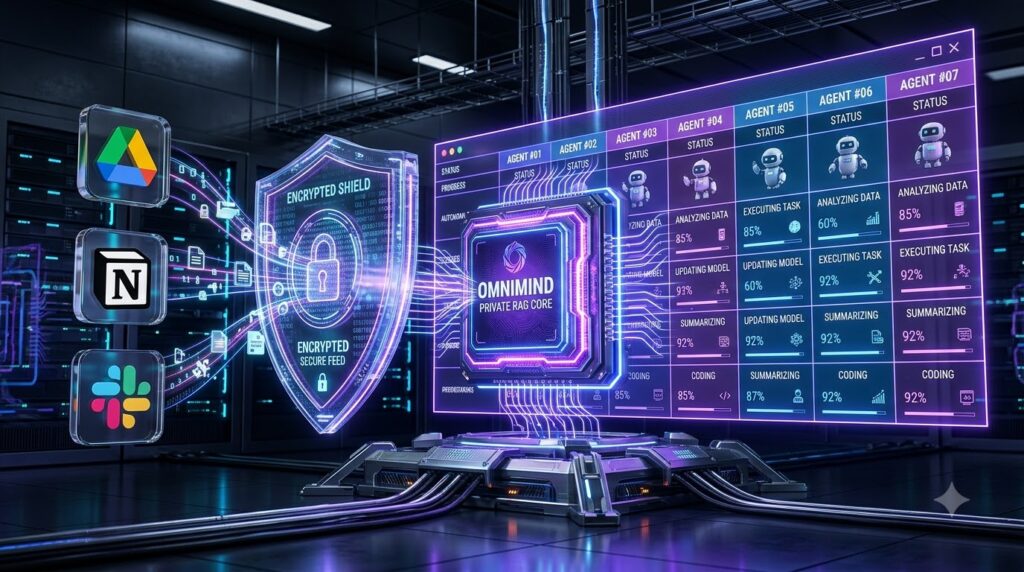
- Bottom Line: In this comprehensive Omnimind review, we examine how the platform bridges the gap between complex DIY orchestration frameworks and basic website support bots. It combines enterprise-grade retrieval-augmented generation (RAG) indexing with spreadsheet-native batch execution (Omnitables), making it one of the strongest no-code choices for operations, sales intelligence, and internal knowledge retrieval.
- Pricing: Starts at $79/month (Essentials) up to $149/month (Growth), with custom enterprise tiers and Bring-Your-Own-Key (BYOK) API cost decoupling.
- Best For: Mid-market teams and non-technical operators who need private, multi-source RAG agents and tabular batch data enrichment without managing vector databases or writing custom ETL pipelines.
The Real Problem with Enterprise Knowledge Management
Most companies do not suffer from a lack of data. They suffer from data fragmentation.
When technical documentation lives in Confluence, standard operating procedures hide in Notion, customer histories sit in HubSpot, and sales playbooks scatter across Google Drive, employees spend hours navigating disconnected silos.
Fragmented SaaS Silos (Notion, Drive, Confluence)
                       │
                       ▼
          [ Operational Bottleneck ]
                       │
        ┌──────────────┴──────────────┐
        ▼                             ▼
DIY Custom Build              Turnkey SaaS RAG
(LangChain / LlamaIndex)     (Omnimind / CustomGPT)
  • High upfront dev ($50k+)   • Fast time-to-value
  • Ongoing infra & DB ops     • Managed vector pipeline
  • Full code control          • Predictable operations
To solve this, organizations face a classic trade-off:
- Build a custom in-house RAG stack using LangChain or LlamaIndex. This delivers complete architectural control, but demands significant upfront software engineering budgets ($50,000 to $200,000+), vector database cluster maintenance, and ongoing observability overhead.
- Deploy entry-level chatbot builders. These platforms install in minutes, but frequently fall short on enterprise data governance, multi-channel flexibility, and automated batch-processing capabilities.
Omnimind targets this middle ground. It delivers a managed, zero-code RAG engine with enterprise compliance, deep connector support, and a tabular workflow framework known as Omnitables.
Omnimind at a Glance: Key Specifications
| Evaluation Dimension | Omnimind Architecture & Delivery |
| Primary Paradigm | No-code private RAG agents + Spreadsheet-native execution (Omnitables) |
| Data Ingestion Capacity | 30+ source types, 100+ native connectors (Google Drive, Notion, web scrapers, PDFs) |
| Deployment Channels | Embeddable web widgets, Slack bots, Microsoft Teams, WhatsApp API, REST API |
| Compliance & Security | SOC 2 certified, GDPR & HIPAA compliant, AES-256 encryption, zero model-training guarantee |
| Economic Model | Hybrid SaaS subscription + credit meter, with full BYOK (Bring-Your-Own-Key) OpenAI support |
| Starting Price | $79 / month (billed monthly) or ~$65.83 / month (billed annually) |
Competitor Matrix: Omnimind Review vs Custom DIY RAG & CustomGPT
1. Ingestion Pipeline & Hybrid Vector RAG
Omnimind ingests static documents and dynamic cloud repositories, standardizing unstructured text into an operational chunking format (~3,000 characters per unit page).
The platform isolates vector embeddings within tenant-partitioned workspaces. When an employee or customer queries an agent, the system conducts similarity search retrieval across stored vector spaces and grounds the LLM context directly in internal documentation, preventing hallucinations in compliance-sensitive workflows.
2. Omnitables: Tabular Batch-Agent Automation
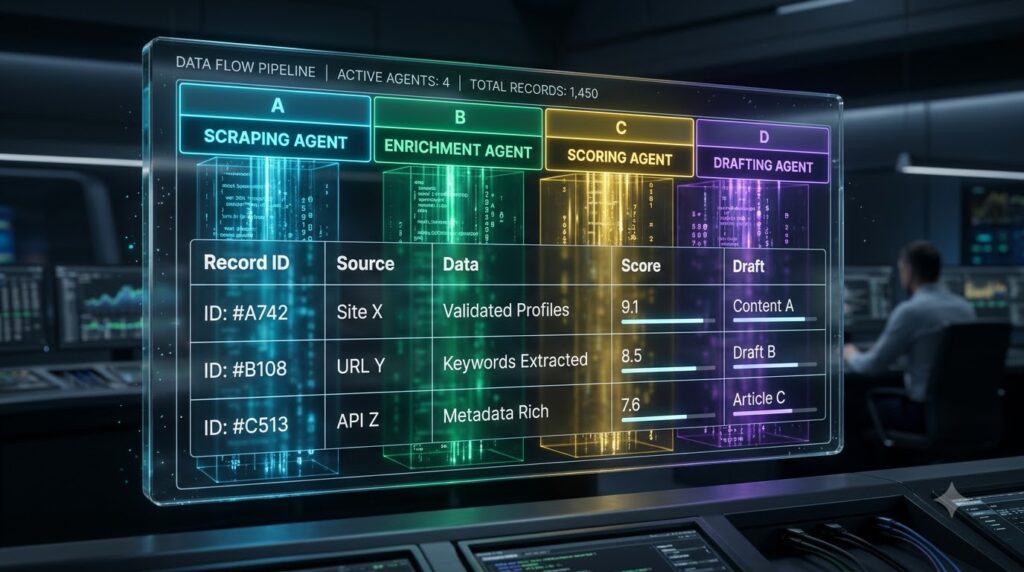
Standard AI search tools limit interactions to single-turn conversational chat interfaces. Omnimind breaks this bottleneck with Omnitables, a spreadsheet-native batch execution framework.
CSV Input (Domains / Leads)
  ├── Column A: Autonomous Web Scraping Agent (Extract ICP summary)
  ├── Column B: Enrichment Agent (Identify decision-makers via APIs)
  ├── Column C: Qualification Agent (Score lead fit against internal docs)
  └── Column D: Drafting Agent (Generate personalized outreach)
In an Omnitable, every column acts as an autonomous AI agent. Operators can import a CSV of accounts, configure Column A to scrape target websites, Column B to identify decision-makers, Column C to score prospect fit against internal criteria, and Column D to draft customized outreach. This parallel batch execution bypasses the need for custom Python ETL scripts or fragile multi-app Zapier sequences.
3. Bring-Your-Own-Key (BYOK) Cost Decoupling
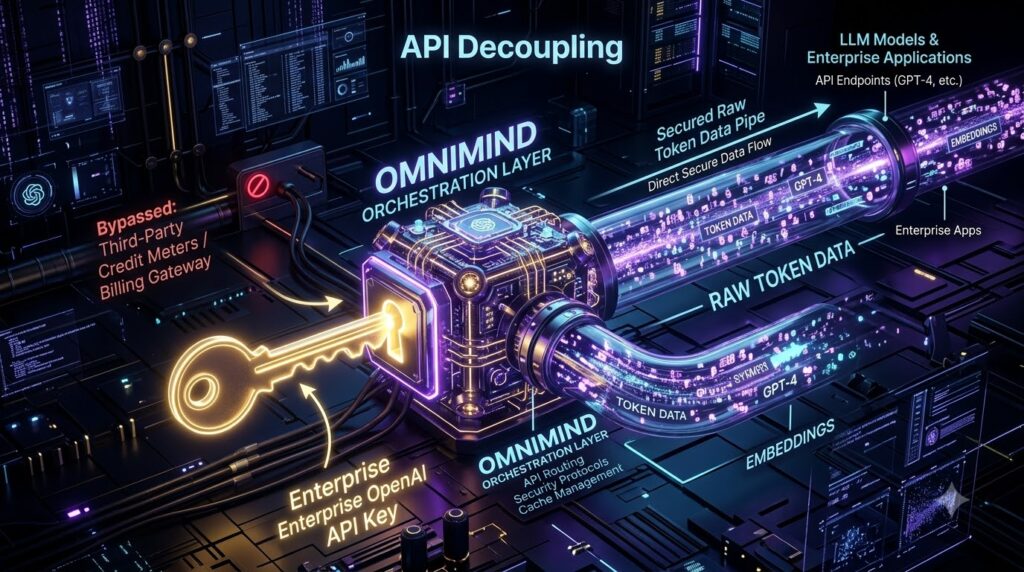
By default, Omnimind consumes platform credits for LLM inference. However, enterprise teams can input their corporate OpenAI API keys directly.
When BYOK is active, Omnimind functions purely as an ingestion, indexing, and orchestration layer. Inference charges route through the organization’s existing provider billing, preventing SaaS markup on high-volume production queries.
Editor’s Perspective: Operational Impact
The BYOK architecture transforms the commercial viability of Omnimind. In pure credit-metered platforms, scaling automated customer support or batch data enrichment leads to unpredictable billing spikes. BYOK gives IT directors fixed software licensing costs while retaining direct pricing control over raw LLM tokens.
Data Privacy & Security Posture
For corporate deployments, AI safety is defined by access control and data isolation. Omnimind meets core enterprise security baselines through structured safeguards:
- Zero Model Training: Explicit contractual and technical guarantees ensure user-uploaded enterprise IP is never ingested into public model training runs.
- Workspace Isolation: Data uploaded to an individual agent remains partitioned within that specific vector space. A customer-facing support bot cannot query internal HR or legal documentation unless explicitly mapped by administrators.
- Compliance Standards: Built to satisfy SOC 2, GDPR, and HIPAA regulatory frameworks, backed by AES-256 encryption at rest and TLS 1.2+ in transit.
Pricing & Credit Economics
Omnimind operates on a tier-based subscription model supplemented by credit consumption for platform actions.
| Subscription Tier | Monthly Billing | Annual Effective Rate | Monthly Credits | Agent Limit | User Seats | Storage | Key Features |
| Essentials | $79 / mo | ~$65.83 / mo | 1,000 | 5 agents | 3 users | 2 GB | Standard integrations, web widget, basic agents |
| Growth | $149 / mo | ~$124.16 / mo | 4,000 | 20 agents | 10 users | 10 GB | Omnitables, API/Webhooks, Slack & Teams bots |
| Business | Custom | Custom Annual | Custom | Unlimited | Unlimited | Custom | Dedicated CSM, priority SLA, advanced governance |
Credit Breakdown & Consumption Rates
- Document Ingestion: 0.03 credits per standard page (~3,000 characters). Ingesting a 1,000-page manual consumes only ~30 credits.
- Web Scraping: 1.00 credit per crawled page.
- LLM Inference (GPT-4o-mini): 1.00 credit per response.
- LLM Inference (GPT-4o): 10.00 credits per response (bypassed when BYOK is enabled).
- Data Enrichment Calls: 5.00 credits per profile/enrichment action.
Omnimind vs. The Competition
              ┌─────────────────────────────────────────────────────────┐
              │                Enterprise RAG Solutions                 │
              └────────────────────────────┬────────────────────────────┘
                                           │
         ┌─────────────────────────────────┼─────────────────────────────────┐
         ▼                                 ▼                                 ▼
┌──────────────────┐             ┌──────────────────┐             ┌──────────────────┐
│  Custom DIY RAG  │             │   Omnimind.ai    │             │   CustomGPT.ai   │
│(LangChain/Llama) │             │                  │             │                  │
├──────────────────┤             ├──────────────────┤             ├──────────────────┤
│• $50k–$200k dev  │             │• $948–$1,788/yr  │             │• $1,068–$5,388/yr│
│• Months to build │             │• Days to deploy  │             │• Hours to deploy │
│• High infra ops  │             │• Omnitables batch│             │• Deep format RAG │
│• Full code control│            │• Zero infra code │             │• Pure Q&A focus  │
└──────────────────┘             └──────────────────┘             └──────────────────┘
| Evaluation Vector | Omnimind | Custom DIY Build (LangChain/LlamaIndex) | CustomGPT.ai | Chatbase |
| Primary Focus | Managed RAG + Batch Omnitables | Custom-coded orchestration | Deep document search (1,400+ formats) | Website support widgets |
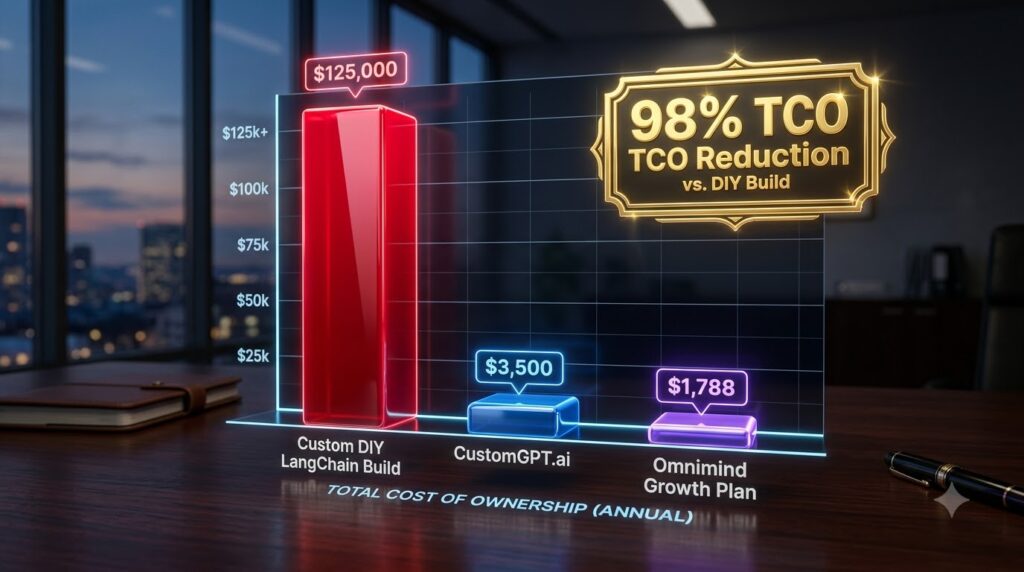
| Year 1 TCO | Low to Moderate ($948–$1,788/yr) | High ($50,000–$200,000+) | Moderate ($1,068–$5,388/yr) | Low to Moderate ($384–$4,800/yr) |
| Batch Automation | Native (Columnar agents) | Custom-engineered ETL required | None (Conversational Q&A only) | Limited sequential actions |
| Multi-Agent Scale | 5 to 20 agents included | Unlimited (self-built) | Plan-dependent tiers | 1 agent included (Add-ons: $300/agent/yr) |
| BYOK Support | Yes | Yes (Direct API) | Enterprise tiers | Limited |
Strategic Trade-Off Analysis
- Omnimind vs. Custom LangChain Builds: Custom code offers total control over graph topologies and fine-tuned embeddings, but maintenance eats 15% to 25% of the initial build budget annually. Omnimind eliminates infrastructure maintenance, shifting costs to a predictable monthly software subscription.
- Omnimind vs. CustomGPT.ai: CustomGPT.ai leads in static document ingestion breadth, indexing over 1,400 file types. However, CustomGPT.ai is restricted to chat-based Q&A interfaces. Omnimind provides greater operational value if your teams need to enrich datasets and automate multi-step operations via spreadsheets.
- Omnimind vs. Chatbase: Chatbase provides a fast entry point for single-widget customer service. However, adding extra bots costs $300/agent annually, and removing branding requires steep plan upgrades. Omnimind provides 5 to 20 distinct agents out of the box, making it far more cost-effective for multi-departmental deployments.
Pros & Cons
Pros
- Native Omnitables: Turns static RAG search into autonomous, multi-column batch processing.
- BYOK Architectural Flexibility: Direct OpenAI API integration eliminates SaaS markups on query volume.
- Multi-Channel Distribution: Native integrations for web embeds, Slack, Microsoft Teams, and WhatsApp.
- Predictable Ingestion Costs: Low computational credit cost for ingesting large corporate document stores.
Cons
- No On-Premise Air-Gapped Hosting: Operates strictly as a managed cloud solution.
- Fixed Model Topology: Lacks the deep code-level customization for custom graph RAG models available in raw Python frameworks.
- API Rate Limits on Entry Plan: Advanced programmatic triggers require the Growth ($149/mo) tier or above.
Final Verdict & Implementation Guidance
Who Should Buy Omnimind
- Operations & GTM Teams: Organizations that need to automate data enrichment, prospect research, and lead qualification without writing custom scraper pipelines.
- Mid-Market Companies: Businesses seeking to roll out 5 to 20 private internal assistants across Slack, Microsoft Teams, and support portals without hiring vector database engineers.
- Cost-Conscious Enterprise Units: Teams processing high query volumes who want to use their own OpenAI API keys (BYOK) to keep operational expenditures flat.
Who Should Avoid Omnimind
- AI Research & Deep Infrastructure Teams: Organizations requiring fine-tuned local embedding weights, complex graph RAG architectures, or fully air-gapped on-premise deployments.
- Simple Single-Page Sites: Small websites that only require a basic, single-prompt FAQ widget and do not need internal knowledge retrieval or batch processing.
5-Step Enterprise Implementation Roadmap
Step 1: Audit & Silo Discovery
  └── Catalog repositories (Notion, Drive, PDFs); clean internal PII.
Step 2: Provision & BYOK Activation
  └── Set up Growth Workspace; link corporate OpenAI API credentials.
Step 3: Ingestion & Grounding Verification
  └── Connect data sources; run retrieval edge cases for citations.
Step 4: Surface Deployment
  └── Inject web widgets, deploy Slack/Teams bots, configure Omnitables.
Step 5: Access Auditing & Re-Indexing
  └── Review query logs; establish continuous data re-indexing schedules.
- Audit & Silo Discovery: Catalog internal document repositories (Notion, Google Drive, technical PDFs). Clean out obsolete data and define operational access boundaries for sensitive HR or financial documents.
- Provision & BYOK Activation: Deploy an Omnimind Growth or Business workspace. Connect your corporate OpenAI API key in the admin settings to isolate inference costs from platform credit quotas.
- Ingestion & Retrieval Verification: Connect primary data silos. Test sample queries against technical and edge-case operational documentation to verify that vector retrieval returns accurate citations without hallucinations.
- Deploy Surfaces & Omnitables: Embed public widgets on customer portals, deploy OAuth bots into departmental Slack or Teams channels, and set up Omnitables for repetitive spreadsheet analysis.
- Establish Governance & Re-Indexing: Monitor admin interaction logs monthly to audit RBAC compliance and configure auto-sync intervals so agents stay updated as internal company documentation changes.
🔍 Related Enterprise AI & Knowledge Infrastructure Guides
For CTOs, operations leaders, and IT directors evaluating enterprise AI agents, private servers, and software ROI, explore our related technical reviews and benchmarks:
- AI Server Deployment: Learn how enterprise hardware hosts private LLMs in Zanus AI Server Deployment & Infrastructure Setup.
- Hardware vs Appliance: Compare local AI server architectures in Zanus AI Appliance vs Dedicated AI Server.
- Multi-Agent SaaS Costs: Analyze credit overages and voice surcharges in Is Lindy AI Worth It in 2026? Pricing & Alternatives.
- Automated SEO & AEO Engine: Bypass developer backlogs in Alli AI Review 2026: Enterprise Automated SEO.
- Workforce Productivity & Shadow AI: Monitor enterprise AI tool adoption in Insightful Review 2026: Workforce Analytics.
References
- Omnimind Official Platform & Omnitable Framework
- Omnimind Pricing & Plan Structure
- CustomGPT.ai Enterprise Security, SOC 2 & Compliance Architecture
- CustomGPT.ai Plans and Query Credit Specifications
- Chatbase Pricing, Agent Limits & Platform Documentation
- Chatbase Enterprise Security Overview
- LangChain Documentation & Production Framework Overview
- LlamaIndex Enterprise RAG Architecture & Data Framework