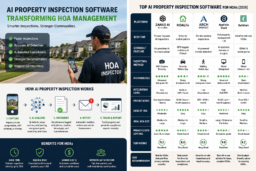
During one of our conversations with an HOA manager overseeing more than 800 homes, one complaint kept coming up: inspections consumed an entire workday, yet residents still disputed violation notices. That question led us to evaluate today’s leading AI inspection platforms.AI property inspection software is rapidly changing how HOAs inspect communities, document violations, and improve compliance. During one of our conversations with an HOA manager overseeing more than 800 homes, one complaint kept coming up: inspections consumed an entire workday, yet residents still disputed violation notices.
Today, a profound shift is occurring in property technology (PropTech). The convergence of Computer Vision, autonomous UAVs (Drones), and dynamic Drive-by Patrol Dashcams is redefining field inspections.
However, buying AI software is surprisingly easy—integrating it seamlessly into daily property operations without triggering resident backlash or legal liabilities is where most boards fail.
Why AI Property Inspection Software Matters for HOAs
This guide cuts through the marketing buzzwords to evaluate the leading AI-powered property inspection solutions available today. Whether you manage a boutique community of 50 townhomes or an enterprise portfolio of thousands of single-family residences, this analysis will help you choose the right platform with confidence.
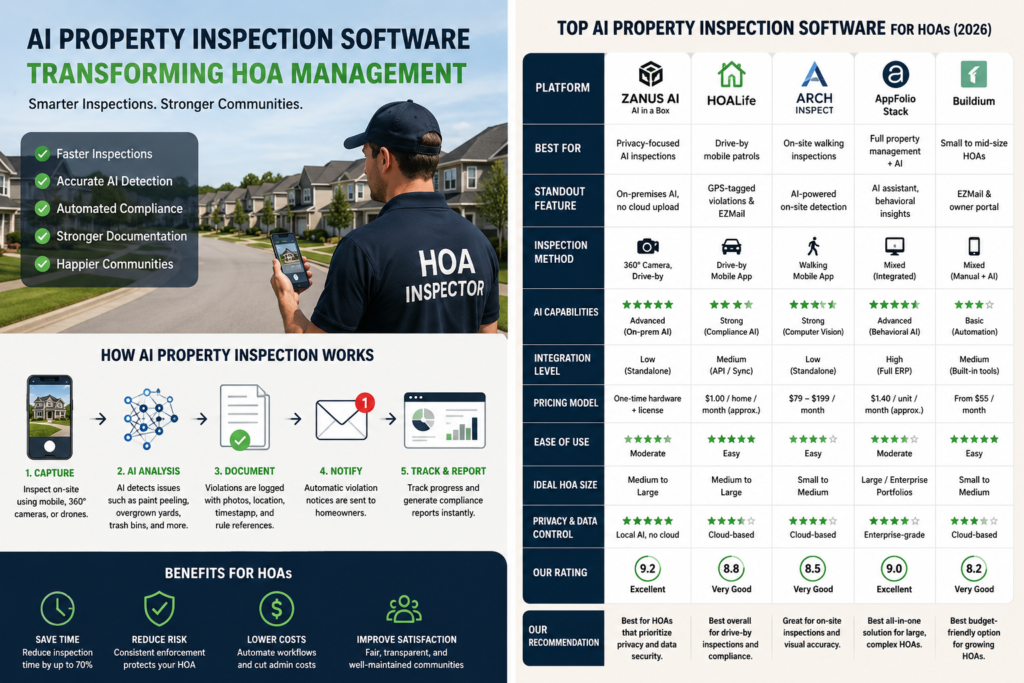
2026 HOA Property Inspection Software Comparison
The following table provides a high-level comparison of the leading platforms, focusing on criteria that directly impact business value, ease of adoption, and return on investment (ROI).
| Platform / Tool | Best For | Standout Feature | Learning Curve | Integration Level | Pricing Model |
| HOALife | Drive-by Mobile Patrols | GPS-tagged multi-stage violation escalation | Low | Moderate (Requires Sync) | Mid-tier ($1.00 / home / mo) |
| ARCH Inspect | Mobile Walking Inspections | SOC 2-compliant on-site architectural detection | Low | Independent (Built-in Stripe/Mail) | Flat-rate ($79–$199 / mo) |
| SkyeBrowse | Aerial & 3D Site Mapping | 2-minute videogrammetry 3D modeling | Moderate | Niche (Drone hardware required) | Custom Enterprise |
| AppFolio Stack | Full-Service Property Management | Smart AI text responses & behavioral trend spotting | Moderate | Fully Unified ERP | Scale-based ($1.40 / unit / mo) |
| Yardi Voyager | Large-Scale Enterprise Portfolios | Infinite multi-department branching rules | Steep | Heavy Enterprise Infrastructure | High-end Custom |
| TenantEvaluation | Onboarding & Resident Security | AI face verification & automated FCRA background checks | Moderate | Specialized Portal | Transactional / Unit-based |
| Buildium | Small to Mid-Size Portfolios | Integrated physical EZMail printing & delivery | Low | Entry-level Unified ERP | Budget-friendly (From $55 / mo) |
Top Picks: The Best AI Tools for HOA Managers
- Best Overall for Dedicated Field Inspections:HOALife
- Why: It strikes the ideal balance between ease of deployment and strict compliance tracking for mobile drive-by patrols, eliminating hours of administrative back-office work.
- Best Enterprise ERP with Built-in AI:AppFolio
- Why: For companies seeking a single, unified database where AI features connect directly with resident portals, communications, and ledger accounting without secondary sync tools.
- Best Specialized Tool for Aerial Mapping:SkyeBrowse
- Why: Its ability to transform standard drone video footage into hyper-accurate, measurable 3D models within minutes is unmatched for roof inspections and post-disaster insurance claims.
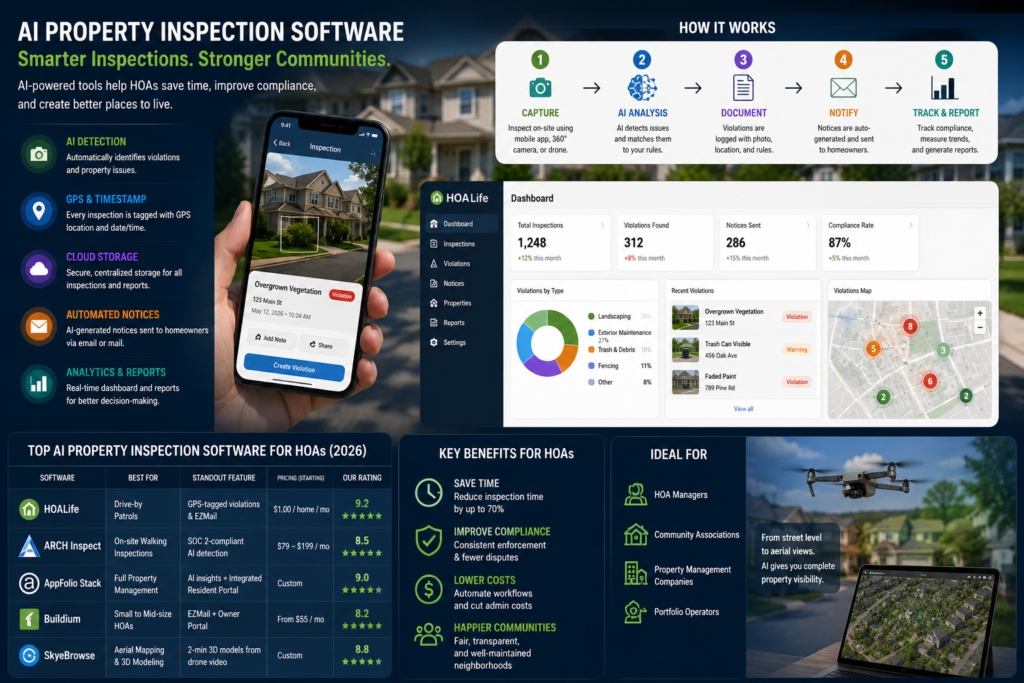
Detailed Software Reviews
1. HOALife — Best Overall for Dedicated Field Inspections
HOALife is engineered for one specific operational outcome: converting real-world neighborhood patrols into standardized, legally defensible compliance workflows. By prioritizing drive-by mobile operations, it removes the friction of manual field note tracking.
       [Field Data Capture]
                 │ (Image upload with GPS & Timestamp)
                 ▼
       [AI Vision Analysis] ──► (Matches anomaly against CC&R rules)
                 │
                 ▼
    [Human-in-the-Loop Review] ──► [Approve] ──► [EZMail Automated Delivery]
- Key Strengths: The platform excels at tracking multi-tier violation lifecycles. Its mobile engine handles spotty cellular connectivity gracefully, allowing field inspectors to log violations with automated GPS tagging and timestamps. The background system maps these instantly back to localized Covenants, Conditions, and Restrictions (CC&Rs) rules.
- Limitations: It lacks a native financial ledger or full-scale maintenance dispatch engine. To process fines directly to a community’s general ledger, you must deploy an API bridge or secondary integration sync to an external accounting platform.
- Pricing: Typically ranges around $1.00 per home per month, making it a highly predictable, value-driven SaaS cost for mid-to-large communities.
Editor’s Take
If your primary operational bottleneck is the labor-intensive gap between driving the neighborhood and generating compliant warning letters, then HOALife is your strongest choice because it is purpose-built to eliminate that exact administrative drain without forcing you to change your primary accounting software.
2. ARCH Inspect — Best for On-Site Walking Inspections
ARCH Inspect delivers a streamlined, mobile-first approach tailored for managers who inspect properties on foot or require strict, secure data isolation under SOC 2 frameworks.
- Key Strengths: Built with a clean interface that minimizes onboarding friction, the tool uses an integrated vision engine optimized for close-up architectural anomalies, such as broken fence pickets or unauthorized exterior structural changes. Its built-in Stripe payment integration and direct print-to-mail options mean it can run independently of massive corporate IT software stacks.
- Limitations: It is less efficient for high-speed, vehicular drive-by operations compared to platforms leveraging real-time continuous video streams.
- Pricing: Runs on a highly transparent flat-rate model ranging from $79 to $199 per month, depending on feature depth and volume.
Editor’s Take
If you manage boutique associations or historic districts where architectural precision matters more than scanning thousands of units at high speed, then ARCH Inspect provides an exceptional return on investment because its low overhead costs and specialized focus prevent your team from paying for complex, unused enterprise modules.
3. SkyeBrowse — Best Specialized Tool for Aerial Mapping
SkyeBrowse redefines aerial inspections by eliminating the traditional complexity associated with photogrammetry and drone flight mapping.
- Key Strengths: Using proprietary videogrammetry, it converts standard digital video format files (
.MP4or.MOV) recorded via commercial drones into a fully interactive, measurable 3D model in just two to ten minutes. This allows managers to audit roofs, evaluate clogged shared drainage systems, or catalog structural damage across entire townhouse rows safely from the ground. - Limitations: It is highly specialized. It does not generate letters, manage resident lists, track fine histories, or send compliance warnings. It serves strictly as a high-powered data collection and 3D evidence verification asset.
- Pricing: Available via Custom Enterprise Pricing models tailored to fleet scale and monthly processing volumes.
Editor’s Take
If your portfolio includes sprawling master-planned communities with extensive shared roofs, multi-story buildings, or complex drainage valleys, then SkyeBrowse is an essential addition to your operational toolkit because it completely eliminates the workplace safety risks of manual roof inspections while providing unassailable visual proof for insurance adjustments.
4. AppFolio — Best Enterprise ERP with Built-in AI
AppFolio represents the modern gold standard for comprehensive property management ERP systems that deliberately embed generative AI and machine learning into core day-to-day operations.
- Key Strengths: The AI engine acts as a digital assistant, automatically reading incoming resident messages, drafting contextual responses, and spotting historical violation patterns across specific accounts. Because it is a completely unified environment, field violations immediately connect to structural maintenance orders, automated resident ledger updates, and formal board communications.
- Limitations: Deep customization requires navigating rigid system architectures, and the platform caps its multi-tier violation workflows at a maximum of four distinct escalation stages.
- Pricing: Structured on a scalable corporate model at $1.40 per unit per month, typically requiring minimum monthly asset commitments.
Editor’s Take
If your organization intends to modernize its entire software ecosystem and values an all-in-one platform over disparate point solutions, then AppFolio is your ideal foundation because it removes the risk of data synchronization failures between separate operational departments.
5. Yardi Voyager — Best for Large-Scale Enterprise Portfolios
Yardi Voyager is the heavy-industry infrastructure choice for global real estate managers and elite, enterprise-level community portfolios.
- Key Strengths: The system features unmatched workflow customization. It accommodates infinitely complex conditional logic rules, diverse regional legal paths, and highly layered structural hierarchies across tens of thousands of homes. Its security, audit trails, and multi-bank financial systems are deeply robust.
- Limitations: The software has a steep learning curve. Deployment paths routinely consume three to six months, require dedicated professional service consultants to configure, and demand significant initial capital expenditures.
- Pricing: strictly handled through Custom Enterprise Agreements tailored to extensive multi-state deployments.
Editor’s Take
If you are managing a top-tier institutional portfolio where complex corporate compliance and infinite configuration capability override the need for rapid deployment, then Yardi Voyager remains the industry standard because no other platform matches its long-term database stability and enterprise scalability.
6. TenantEvaluation — Best Specialized Portal for Security & Identity Verification
TenantEvaluation steps back from physical property defects to focus entirely on the human element of HOA risk management: onboarding, residency verification, and fraud prevention.
- Key Strengths: Its IDVerify framework utilizes facial recognition and liveness detection algorithms to verify incoming residents, preventing unauthorized subleases or illegal lease transfers. It directly integrates with credit check systems like TransUnion and Equifax within an automated, FCRA-compliant platform.
- Limitations: It cannot scan yards, analyze architectural paint colors, or map physical property decay. It is strictly an identity, financial validation, and security onboarding platform.
- Pricing: Delivered on a custom transactional or unit-scale model depending on onboarding volumes and the depth of tenant vetting required.
Editor’s Take
If your HOA struggles constantly with high tenant turnover, unauthorized short-term rentals, or complex background check backlogs, then TenantEvaluation is an exceptional security layer because it automates the onboarding verification path while minimizing human bias.
7. Buildium — Best Budget-Friendly Unified ERP
Buildium serves as an accessible entry point for small-to-midsize property portfolios that need cohesive operational tracking without enterprise pricing overhead.
- Key Strengths: It offers an affordable entry point for all-in-one property management software. Its standout operational asset is the integrated EZMail feature, which allows managers to click a single button to have a digital violation record automatically printed, packed, and physically mailed via regular postal networks, saving hours of manual office labor.
- Limitations: The platform lacks deep AI automation for multi-tier violation escalation paths. Moving an infraction from an initial friendly warning to a secondary formal notice still requires manual status adjustments by an administrator. This missing step costs managers an average of 8 minutes per violation—which translates to a hidden loss of roughly $8,400 annually in manual administrative hours for a 500-unit portfolio.
- Pricing: Highly accessible tiering beginning at $55 per month for base configurations.
Editor’s Take
If your portfolio is under 200 units and you need an entry-level accounting and tracking framework that saves you from manually licking stamps and folding warning letters, then Buildium is a practical choice because its low upfront cost delivers immediate relief to small operations.
Strategic Buying Advice: Matching Software to Your Reality
The biggest mistake an association can make is selecting a platform based solely on its features rather than its operational alignment. Consider these three scenarios before making a choice:
Scenario A: Sprawling Single-Family Communities (500+ homes)
If your portfolio features extensive acreage where property managers spend whole days driving community roads, your primary financial drain is field labor and manual letter preparation.
- Strategic Advice: Prioritize specialized field capture engines like HOALife or automated drive-by integrations. The efficiency gained by scanning properties at 20 mph outweighs the convenience of an entry-level all-in-one platform.
Scenario B: High-Density Townhomes and Condominiums
When common elements like shared roofs, central heating systems, and multi-story building envelopes represent your largest structural risk, ground-level clipboards are highly inefficient.
- Strategic Advice: Deploy an aerial mapping asset like SkyeBrowse alongside a robust property management system. This configuration shifts your operational model from reactive patching to proactive maintenance, protecting your reserves from unexpected infrastructure failures.
Scenario C: Small Portfolios Seeking Low Overhead
If your business handles a boutique selection of properties and operates without full-time IT staff, complex enterprise software configurations will likely stall adoption.
- Strategic Advice: Stick to accessible SaaS solutions like Buildium or flat-rate tools like ARCH Inspect. These allow you to gain the immediate benefits of digital records, automated mailing, and basic tracking without a steep learning curve or high implementation fees.
Final Recommendation
Never conclude your software search by assuming one tool fits all conditions. Instead, map your choice directly to your top operational priority:
- If your priority is maximizing drive-by efficiency and streamlining violation letter creation, choose HOALife.
- If your priority is unifying property accounting, resident communications, and AI assistants under one roof, choose AppFolio.
- If your priority is safely mapping roofs and complex common structures from the air, choose SkyeBrowse.
What to Do Now
To ensure successful adoption without creating operational friction:
- Audit Your Current Database: Clean your existing property lists, owner records, and unit designations before migrating to any new AI tool.
- Define Your Workflows: Document your exact CC&R escalation timeline (e.g., 7-day warning, 14-day notice, formal fine) so it can be built into your new system’s rules engine.
- Schedule Hands-on Demos: Have your actual field inspectors and community managers test the mobile apps during a live trial before committing to long-term software contracts.
Best AI Tools for HOA Managers