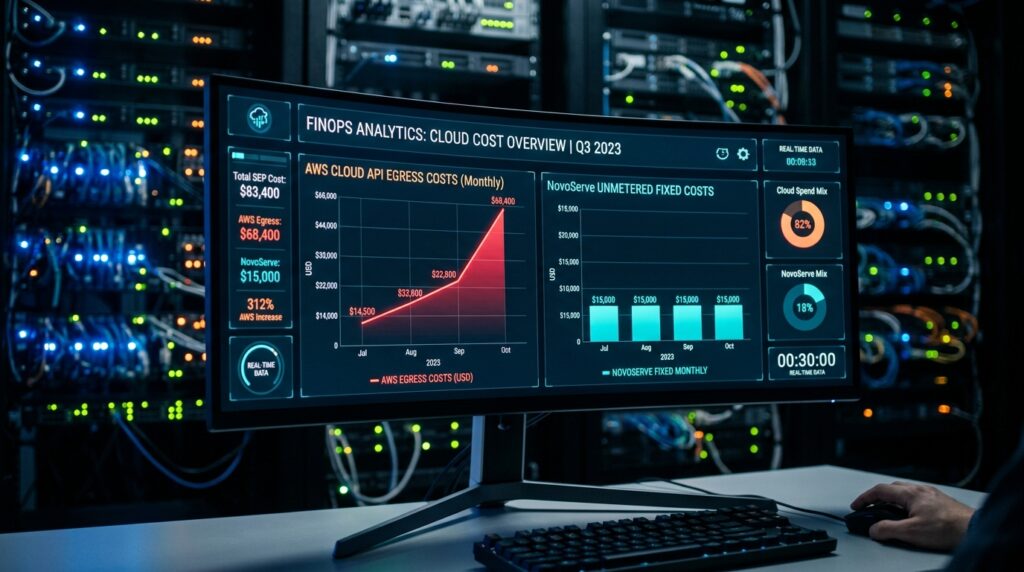
For modern digital enterprises, the most dangerous line item on a public cloud bill isn’t compute or block storage. It is outbound bandwidth.
If your organization operates high-throughput workloads—such as OTT video streaming, real-time AdTech bidding engines, SaaS data pipelines, or large-scale AI model replication clusters—you have likely experienced the steep penalty of hyperscaler networking. While bringing data into AWS, GCP, or Azure is virtually free, extracting that same data triggers an aggressive pricing structure designed to monetize every gigabyte that leaves the platform.
For scaling businesses, these variable network surcharges do not just erode gross margins; they create artificial architectural walls that make multi-cloud strategies and data extraction financially unviable.
There is a more sustainable approach: hybrid egress offloading. By shifting high-volume, network-intensive traffic away from metered hyperscalers and onto dedicated bare-metal unmetered bandwidth, enterprise engineering teams can reduce outbound networking costs by 60% to over 98% while establishing complete billing predictability.
1.The Hyperscaler Cloud Egress Fees Trap
The Asymmetric Monetization Model
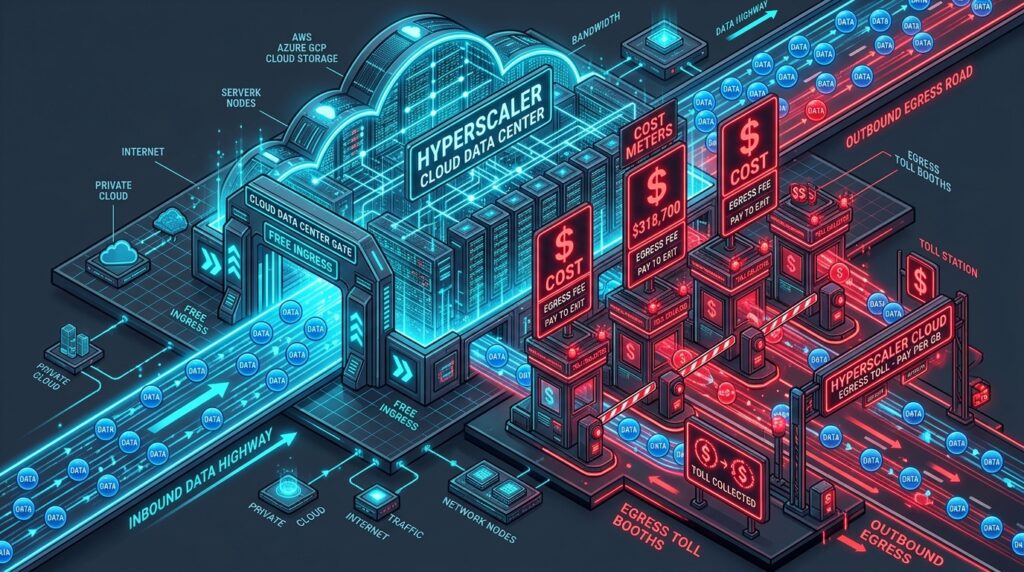
Public cloud architectures rely on an asymmetric economic design: free ingress, metered egress.
When hyperscalers originally built out global cloud infrastructure, transit bandwidth was genuinely scarce and costly. Over the past decade, however, the wholesale cost of dark fiber, optical transceivers, and IP transit has dropped exponentially. Yet, retail cloud egress tariffs have remained largely static. This widening margin gap between actual bandwidth commodity costs and public cloud retail rates creates an extractive financial model for cloud providers at the expense of high-throughput enterprises.
Under standard AWS EC2 rates, outbound internet transfer in core US and European regions starts at approximately $0.09 per GB for the first 10 TB per month (after a standard 100 GB allowance). As volume scales, the per-gigabyte price steps down incrementally:
- First 10 TB: $0.09 / GB
- Next 40 TB: $0.07 / GB
- Next 100 TB: $0.05 / GB
- Above 150 TB: $0.05 / GB
While pennies per gigabyte sound minor in isolation, the math compounds aggressively at enterprise scale:
- Moving 100 TB of monthly egress on AWS costs approximately $6,190/month ($74,280/year) in standalone transit fees.
- Pushing 500 TB per month incurs over $26,190/month ($314,280/year).
- Delivering 15 Petabytes (15,000 TB) monthly can run upwards of $75,000/month ($900,000/year).
To contextualize this penalty: transferring 32 TB of data—the equivalent capacity of a single physical enterprise drive costing around $700—incurs roughly $2,800 in AWS exit taxes.
Hidden Architectural Micro-Transactions
The financial toll of hyperscaler networking extends far beyond simple internet-bound transfer. Public cloud platforms monetize internal network boundaries, penalizing high-availability infrastructure designs:
- Cross-Availability Zone (AZ) Charges: AWS charges ~$0.01/GB in each direction for traffic crossing AZs. A multi-AZ database replication stream moving 50 TB monthly adds $1,000 in internal transfer fees before a single byte reaches an end-user.
- Managed NAT Gateway Processing Surcharges: Outbound traffic from private subnets routed through NAT Gateways incurs a $0.045/hour provision fee plus a $0.045/GB data processing charge. Combined with base internet egress ($0.09/GB), the effective initial egress rate jumps to $0.135/GB.
- Load Balancer & Transit Gateway Taxes: Application Load Balancers (ALB) levy Capacity Unit fees ($0.008/GB processed), while AWS Transit Gateways append another ~$0.02/GB for inter-VPC routing.
When combining cross-AZ sync, NAT Gateway processing, load balancer processing, and primary internet transit, the true operational cost of delivering cloud data to an end-user routinely approaches $0.15 to $0.18 per GB.
Enterprise Network Pricing Benchmark
| Network Pricing Component | Amazon Web Services (AWS) | Google Cloud Platform (GCP) | Microsoft Azure |
| Monthly Free Egress | 100 GB / month | 200 GB / month | 100 GB / month |
| Baseline Egress Rate | $0.09 / GB (First 10 TB) | $0.12 / GB (First 1 TB) | $0.087–$0.09 / GB (First 10 TB) |
| Mid-Volume Rate (10–50 TB) | $0.07 / GB | $0.08 / GB | $0.083–$0.085 / GB |
| High-Volume Rate (>150 TB) | $0.05 / GB | $0.04–$0.06 / GB | $0.05–$0.07 / GB |
| Cross-AZ Traffic | $0.01 / GB (each direction) | $0.01 / GB | $0.01 / GB |
| NAT Gateway Processing | $0.045 / GB + $0.045 / hr | $0.045 / GB processed | Managed NAT surcharges apply |
2. The NovoServe Unmetered Solution
To eliminate variable bandwidth volatility, infrastructure leaders are turning to dedicated unmetered bare-metal architecture. NovoServe provides physical infrastructure built specifically around flat-rate cost predictability, non-oversubscribed pipe delivery, and high-density performance.
Flat-Rate Economics vs. Metered Consumption
Unlike metered cloud models that charge for every byte transferred, an unmetered dedicated server grants access to full, dedicated uplink capacity 24 hours a day for a fixed Monthly Recurring Cost (MRC).
NovoServe allocates network throughput by physical port size rather than metered consumption:
- Entry Port Sizes (1 Gbps to 5 Gbps): Built for regional backends, custom database sync, and mid-tier platforms needing variable throughput without overage risks.
- High-Capacity Ports (10 Gbps to 25 Gbps): Engineered for high-throughput SaaS applications, distributed database replication, and heavy media streaming origin hubs.
- Hyperscale Pipelines (40 Gbps to 100 Gbps): High-capacity, non-blocking network uplinks optimized for real-time AdTech bidding engines, 4K broadcast distribution, and massive AI/ML model training clusters.
Under a flat-rate model, an enterprise running a dedicated 10 Gbps unmetered port can push up to 3,300 TB (3.3 Petabytes) of data per month at 100% continuous port utilization without triggering a single dollar in bandwidth overages. Once the monthly port allocation is committed, the marginal cost of outbound bandwidth drops to zero.
NovoServe guarantees non-oversubscribed backbone links, ensuring that a provisioned 10 Gbps or 50 Gbps pipe delivers dedicated throughput continuously without fair-use throttling or shared-layer contention.
Bare-Metal Isolation & Hardware Execution
Network performance requires compute hardware capable of handling high packet rates without hypervisor performance degradation. Operating as a Bare Metal as a Service (BMaaS) provider, NovoServe supplies dedicated physical servers direct to tenants without virtualized abstractions or noisy-neighbor performance bottlenecks.
Eliminating the hypervisor layer gives engineering teams direct silicon access to high-core-count AMD EPYC or Intel Xeon Scalable processors, maximizing RAM bandwidth and PCI-e network I/O throughput. Full root access allows custom kernel tuning, BGP routing daemons, and direct eBPF/DPDK packet processing—critical requirements for high-density networking.
From a regulatory standpoint, physical single-tenancy simplifies compliance with European GDPR, PCI-DSS, HIPAA, and NIS2 frameworks by guaranteeing that tenant data remains physically isolated within Tier-III data center facilities featuring N+1 power redundancy, biometric access, and 24/7 security monitoring.
Global Backbone & Transit Network
To maintain low latency alongside unmetered pricing, NovoServe operates an 18+ Tbps global network backbone with core routing hubs in Europe (the Netherlands and Denmark) and North America (New York):
- Tier-1 Transit Multihoming: Direct uplinks to major Tier-1 IP transit providers—including Arelion, Cogent, and GTT—ensure low-latency global reachability and automatic routing failover.
- Direct Internet Exchange Peering: Strategic placement at major Internet Exchange Points (IXPs)—including AMS-IX (Amsterdam), NL-IX, Speed-IX, Asteroid, and ERA-IX—allows traffic to bypass congested public transit paths.
- Private Peering (PNI): Direct Private Network Interconnections with major consumer ISPs, content networks, and cloud platforms reduce packet jitter and hop counts.
- Automated DDoS Mitigation: In-house scrubbing infrastructure analyzes and mitigates volumetric attacks at the edge before malicious traffic reaches tenant hardware.
3. Financial Breakdown: Cloud vs. Unmetered Bare Metal
To evaluate the financial impact of shifting outbound traffic from metered public cloud platforms to dedicated unmetered bare metal, consider four standard enterprise egress scenarios.
Quantitative Bandwidth Cost Comparison
The calculations below compare standard AWS regional internet egress tiering against equivalent NovoServe unmetered bare-metal configurations.
Scenario A: Mid-Tier Platform (20 TB Monthly Egress)
- AWS Monthly Cost: $1,591 / month ($19,092 / year)
- NovoServe Fixed Cost: High-Performance Bare Metal Server with a 2 Gbps port configuration (~$130 / month or $1,560 / year).
- Net Savings: 91.8% reduction ($17,532 annual net savings).
Scenario B: Scaling Enterprise / AdTech Engine (100 TB Monthly Egress)
- AWS Monthly Cost: $6,191 / month ($74,292 / year)
- NovoServe Fixed Cost: HPE Enterprise Bare Metal Server with a 5 Gbps unmetered uplink (~$260 / month or $3,120 / year).
- Net Savings: 95.8% reduction ($71,172 annual net savings).
Scenario C: High-Volume Media / Data Pipeline (500 TB Monthly Egress)
- AWS Monthly Cost: $26,191 / month ($314,292 / year)
- NovoServe Fixed Cost: HPE Enterprise Server with a dedicated 10 Gbps Unmetered Port (~$540 / month or $6,480 / year).
- Net Savings: 97.9% reduction ($307,812 annual net savings).
Scenario D: Hyperscale Video Delivery (15,000 TB / Month; ~500 TB/Day)
- AWS Monthly Cost: Outbound egress reaches roughly $75,000 / month ($900,000 / year) even after high-volume tiering discounts.
- NovoServe Fixed Cost: Multi-node bare-metal egress cluster (e.g., 40 nodes with 10G/40G unmetered uplinks) running ~$1,250 / month ($15,000 / year total network allocation).
- Net Savings: 98.3% network cost reduction ($885,000 annual net savings).
Cost Reduction Summary Table
| Monthly Bandwidth Volume | AWS Monthly Egress Fee | AWS Annual Egress Fee | NovoServe Fixed Monthly Cost | NovoServe Fixed Annual Cost | Annual Net Savings | Percentage Cost Reduction |
| 20 TB / month | $1,591.00 | $19,092.00 | $130.00 | $1,560.00 | $17,532.00 | 91.8% |
| 100 TB / month | $6,191.00 | $74,292.00 | $260.00 | $3,120.00 | $71,172.00 | 95.8% |
| 500 TB / month | $26,191.00 | $314,292.00 | $540.00 | $6,480.00 | $307,812.00 | 97.9% |
| 15,000 TB / month | $75,000.00 | $900,000.00 | $1,250.00 | $15,000.00 | $885,000.00 | 98.3% |
3-Year Infrastructure TCO Analysis
Looking beyond standalone network transit fees, FinOps teams must evaluate holistic Total Cost of Ownership (TCO), accounting for compute, memory, storage, and networking combined.
The following case study tracks a media distribution deployment consisting of 37 high-density physical nodes (560 CPU cores, 12 TB RAM, 322 TB NVMe storage, and a 10 Gbps uplink) delivering 500 TB of daily outbound traffic (15,000 TB monthly):
| Expense Category | Public Cloud (AWS / GCP / Azure) | NovoServe Bare Metal Unmetered | 3-Year Absolute Savings | Percentage Reduction |
| Compute / Storage / RAM | $540,000 / year | $145,000 / year | $1,185,000.00 | 73.1% |
| Network Egress Fees | $900,000 / year | $15,000 / year | $2,655,000.00 | 98.3% |
| Total Annual Opex | $1,440,000 / year | $160,000 / year | $1,280,000.00 | 88.9% |
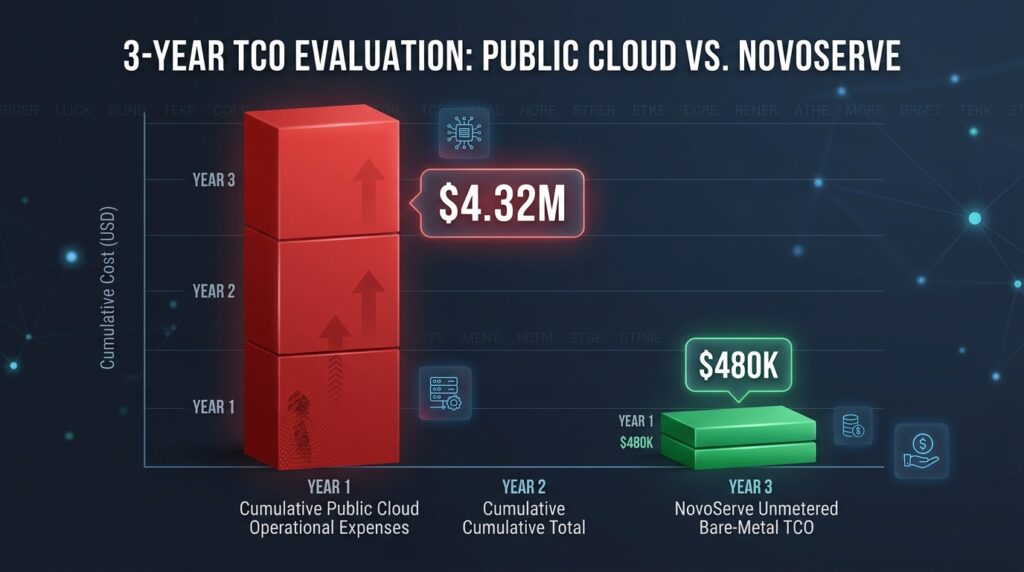
| 3-Year Cumulative TCO | $4,320,000.00 | $480,000.00 | $3,840,000.00 | 88.9% |
Operational Impact: By decoupling compute hardware and high-throughput network delivery from metered hyperscaler environments, enterprise teams can achieve up to an 88.9% reduction in 3-year overall infrastructure expenditures, transforming a volatile variable expense into a predictable fixed operational cost.
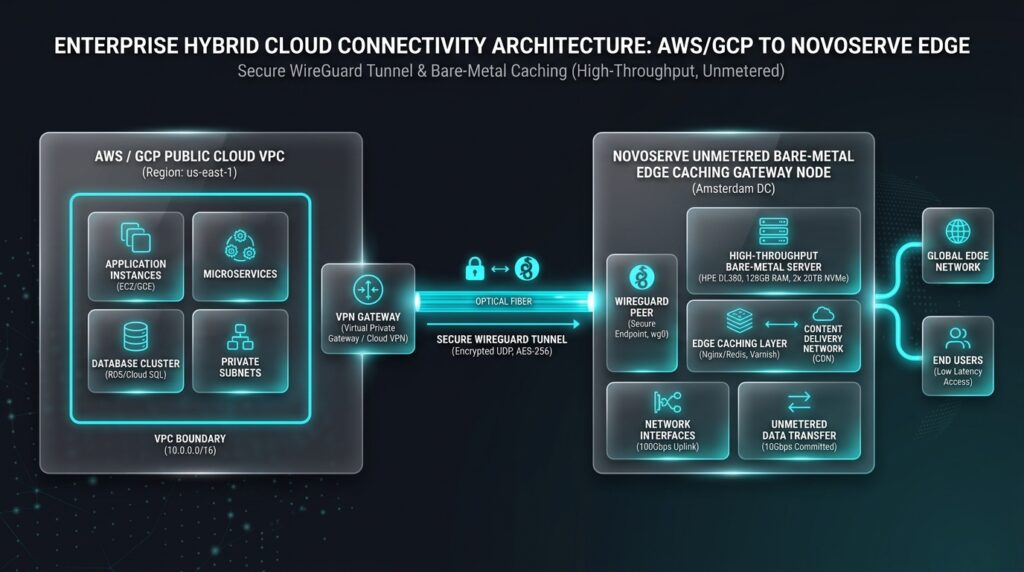
4. Architectural Blueprint: Hybrid Egress Offloading
Escaping hyperscaler egress fees does not require a risky “lift-and-shift” migration of your entire application stack. Modern engineering organizations adopt a Hybrid Egress Offload Strategy: keeping core application business logic, serverless functions, or managed databases within AWS/GCP while offloading the network-heavy delivery layer to NovoServe bare metal.
+-------------------------------------------------------------------------+
|                         PUBLIC CLOUD (AWS / GCP)                        |
|                                                                         |
|   +-----------------------+             +---------------------------+   |
|   | Core Application /    |             | Managed Database /        |   |
|   | Microservices         |             | Object Lake               |   |
|   +-----------+-----------+             +-------------+-------------+   |
+---------------+---------------------------------------+-----------------+
                |                                       |
                |   FREE INGRESS / LOW-COST INTERCONNECT| (Private Tunnel)
                v                                       v
+-------------------------------------------------------------------------+
|                   NOVOSERVE UNMETERED BARE METAL EDGE                   |
|                                                                         |
|   +-----------------------------------------------------------------+   |
|   | High-Performance NGINX / Varnish Caching & Reverse Proxy Nodes  |   |
|   +--------------------------------+--------------------------------+   |
+------------------------------------+------------------------------------+
                                     |
                                     | UNMETERED 10G/50G/100G PORT
                                     | (Zero Overage Charges)
                                     v
                        +-------------------------+
                        |       END USERS /       |
                        |   PUBLIC DESTINATIONS   |
                        +-------------------------+
Technical Migration Step-by-Step
Step 1: Egress Hotspot Audit
Utilize tools like AWS Cost Explorer, GCP Cloud Billing exports, or VPC Flow Logs to map outbound bandwidth vectors. Identify high-volume endpoints (e.g., public media assets, large file downloads, high-frequency API responses, software distribution).
Step 2: Provision Gateway Nodes
Deploy high-throughput NovoServe bare-metal instances (such as dual AMD EPYC or Intel Xeon systems backed by 10 Gbps or 50 Gbps unmetered network ports) in regions near your core user base (e.g., the Netherlands for European delivery or New York for North America).
Step 3: Establish Secure Private Interconnects
Set up secure networking between your public cloud Virtual Private Cloud (VPC) and the NovoServe bare-metal environment using WireGuard, IPsec VPN tunnels, or direct cloud interconnects:
- Inbound data transfer into AWS/GCP is 100% free.
- Private interconnect transfer rates out of public clouds are substantially lower than standard public internet egress fees, allowing cache-miss traffic to pass to the edge layer at negligible cost.
Step 4: Deploy Reverse Proxy & Edge Caching Layers
Configure high-performance reverse proxies (e.g., NGINX, HAProxy, Varnish, or custom eBPF daemons) on the NovoServe bare-metal instances:
- Incoming end-user traffic routes directly to the NovoServe edge nodes.
- Cached API responses, video fragments, or static assets serve directly from local NVMe storage and system RAM.
- Cache misses fetch origin data from the public cloud backend over the encrypted tunnel. Subsequent requests serve directly from NovoServe’s unmetered port—completely bypassing hyperscaler exit taxes.
Step 5: DNS Cutover
Use GeoDNS or Anycast DNS (e.g., Cloudflare, Route 53) to gradually shift public user endpoints from public cloud load balancers to the new NovoServe edge IP addresses. Staging the cutover (10% $\rightarrow$ 50% $\rightarrow$ 100%) allows DevOps teams to monitor throughput stability, verify cache hit ratios, and observe immediate egress savings.
Editor’s Perspective: When to Stay vs. When to Offload
Deployment Insight
Offloading egress to unmetered bare metal is one of the most reliable ways to reduce cloud infrastructure spend, but it is not a universal solution for every workload.
Stay on Public Cloud Egress if:
- Your total monthly outbound traffic across all services stays below 5 TB to 10 TB. At low volumes, the convenience of fully managed cloud networking outweighs the overhead of managing edge nodes.
- Your workload consists entirely of short-lived, unpredictable micro-bursts where compute scales to zero for days at a time.
Offload to NovoServe Unmetered Bare Metal if:
- Your outbound traffic consistently exceeds 20 TB per month, or you operate high-bandwidth delivery channels (media, AdTech, data replication, file distribution).
- Your network bill accounts for more than 20–30% of your total monthly infrastructure expenditure.
- You require predictable operational budgets without bandwidth price fluctuations.
- You need raw CPU and PCI-e throughput without virtualization latency or shared-layer congestion.
Final Recommendation & Next Steps
Public cloud providers offer excellent software ecosystems for building early-stage applications. However, using metered public cloud transit as a long-term delivery network for high-volume data introduces an unnecessary financial penalty.
By implementing a hybrid egress architecture—retaining managed services where they provide distinct functional value, while moving high-volume outbound bandwidth to NovoServe unmetered bare-metal infrastructure—enterprises can:
- Slash network egress spend by 60% to 98%.
- Convert unpredictable, usage-based networking bills into fixed, predictable operational costs.
- Gain raw, single-tenant physical performance with dedicated 10 Gbps to 100 Gbps network connectivity.
Action Plan for Engineering Leaders
- Audit Your Current Bill: Review your monthly cloud invoice to isolate your exact outbound internet egress volume (in TB) and NAT Gateway processing fees.
- Calculate Your Potential Savings: Compare your current monthly transit charges against flat-rate bare-metal port options using the NovoServe Bandwidth & Infrastructure Calculator.
- Deploy a Proof-of-Concept: Provision a single 10 Gbps unmetered bare-metal node, establish a private tunnel to your existing cloud VPC, and route a 10% test load through an edge NGINX reverse proxy to measure real-world performance and cost reduction.
To evaluate how single-tenant bare-metal infrastructure and unmetered bandwidth help eliminate cloud overhead, explore our technical benchmarks and ecosystem reviews:
- Bare-Metal & Hosting Comparisons: Compare hardware specs and network topologies in our deep-dive NovoServe vs Hetzner vs DigitalOcean Review.
- AI Compute & Private Infrastructure: See how bare-metal servers optimize high-throughput model inference in Deploying DeepSeek-R1 on NovoServe Bare-Metal, alongside benchmarks on the Top 5 On-Premise AI Platforms and DeepSeek-R1 Hardware Review.
- Edge Deployments & Automation: Explore low-latency hardware in our Qualcomm Dragonwing IQ-9075 Review and workflow engines in Dynamiq AI Review. Bookmark AI Review Zones for continuous infrastructure coverage.
References
- Amazon Web Services (AWS) — Amazon EC2 On-Demand Data Transfer Pricinghttps://aws.amazon.com/ec2/pricing/on-demand/
- Google Cloud Platform (GCP) — Network Service Tiers & Internet Egress Pricinghttps://cloud.google.com/network-tiers/pricing
- Microsoft Azure — Bandwidth Pricing Detailshttps://azure.microsoft.com/en-us/pricing/details/bandwidth/
- NovoServe B.V. — Unmetered Bare Metal Infrastructure & Global Network Backbonehttps://www.novoserve.com/unmetered-dedicated-server
- Cloudflare — Understanding AWS Data Transfer and Egress Costshttps://www.cloudflare.com/learning/cloud/aws-data-transfer-pricing/
- LowCloud Tech Analysis — Cloud Egress Fees Compared: AWS vs. Azure vs. GCP Pricing Benchmarkshttps://lowcloud.io