
Evaluating zanus ai for supply chain architectures demonstrates that most enterprises do not need another generic AI platform.. They need a system that addresses the operational bottlenecks quietly draining time and money every day without leaking core data assets.
When integrating artificial intelligence into supply chain management, organizations confront a critical risk: strategic data exposure. Routing multi-tier supplier networks, procurement contracts, bills of materials (BOM), and inventory forecasting data to public, multi-tenant cloud platforms introduces systematic vulnerabilities via hypervisor escapes, misconfigured control planes, or downstream data mining.
The Zanus AI turnkey on-premises ecosystem addresses this exact paint point for enterprises requiring absolute data sovereignty—particularly under modern regulatory pressures like the German Supply Chain Due Diligence Act (LkSG) and the European Union’s Corporate Sustainability Due Diligence Directive (CSDDD).
This independent review evaluates whether Zanus AI’s hardware and software ecosystem provides an essential safeguard for supply chain compliance and automation, or represents a prohibitively expensive operational burden.
The Zanus AI Ecosystem Architecture
Zanus AI rejects the Software-as-a-Service (SaaS) model entirely. Instead, the vendor delivers pre-configured hardware appliances designed to execute deep learning models completely offline within an enterprise’s physical network perimeter.
The product pipeline scales across three deployment tiers:
- Zanus AI Prime: The entry-level appliance built to ingest over 2,000,000 corporate documents and 50,000 hours of internal video analytics.
- Zanus AI Quantum: A mid-tier machine optimized for extended deep reasoning workloads, accommodating 5,000,000+ documents and 100,000 video hours.
- Zanus AI Enterprise Cluster (SKU: ZAI-PES-7700): A multi-node distributed network designed for multinational corporations. It expands index capacities past 50,000,000 documents, handles automated local load balancing, and integrates with physical, offline LTO robotic tape storage archives for long-term immutability.
Unlike typical enterprise GPU infrastructure, Zanus servers are engineered for standard office deployment. Operating via four standard IEC 60320 C20 inlets across an auto-ranging 90–240V power supply, peak consumption is restricted to 6 kW (dropping to ~1 kW at idle). This design choice eliminates the need for data-center-grade three-phase power routing or specialized raised-floor HVAC systems.
Zanus AI for Supply Chain: Operational Performance Evaluation
1. Document Extraction and Localized Retrieval-Augmented Generation (RAG)
To automate multi-tier procurement mapping without wide area network (WAN) exposure, Zanus runs a localized RAG framework. Standard text parsers frequently break rows and columns during PDF parsing, corrupting sensitive pricing tables. Zanus side-steps this by utilizing advanced layout engines like Docling to parse unstructured PDFs, Word documents, and Excel spreadsheets into structured Markdown entirely within physical memory.
For long-form compliance records, the platform implements an offset-true hierarchical chunking method. Rather than relying on arbitrary fixed-character window splits, the software structures data into a tree of parent-child relationships.
Granular sentences (typically 256-token child chunks) are mapped via locally hosted embedding models (such as IBM Granite or BGE) and indexed into a local PostgreSQL vector store using the Hierarchical Navigable Small World (HNSW) algorithm. When a query executes, the system targets the child node but injects the surrounding clause (the parent summary) into the LLM’s context window. This architectural choice dramatically mitigates hallucinations during supplier compliance audits.
2. Hardware Topology and Offline Inference Co-Optimization
Running open-weight large language models (such as Llama-3 or Qwen-2.5) entirely offline requires massive local hardware acceleration. Zanus handles inference using two primary topologies:
| Model Parameter Scale | VRAM Requirements | Required Local GPU Topology | Optimal Storage Architecture |
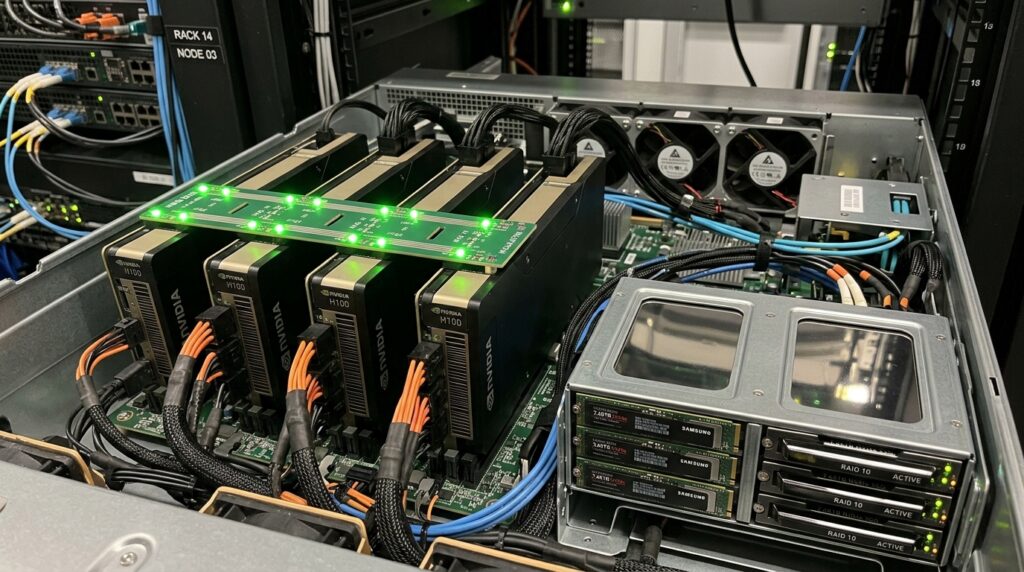
| Quantized Models (AWQ / NVFP4) | ~250 GB VRAM | Single-node: 4x NVIDIA B200 (191GB per GPU) | 1x RAID 10 PCIe Gen 5 NVMe Array ($\ge$ 14 GB/s read speeds) |
| Large-Scale Unquantized (FP16 / BF16) | ~1,000 GB+ VRAM | Multi-node: 8x NVIDIA H200 or B200 linked via high-speed NVLink | Multi-node mirrored PCIe NVMe arrays with high-bandwidth interconnects |
Operational Impact: The high-speed RAID 10 NVMe configuration is crucial. It permits massive weight tensors to stream into GPU VRAM with minimal latency, preventing response bottlenecks when supply chain managers pull real-time inventory adjustments.
Who It’s For
- Global Manufacturing Corporations: Organizations protecting proprietary component formulations, advanced hardware blueprints, or sensitive tier-2 and tier-3 sourcing geographies from competitor espionage.
- Enterprises Bound by CSDDD and LkSG Mandates: Compliance teams requiring absolute audit trail immutability and verifiable local data residency to automate forced labor (ILO Convention 182) and hazardous chemical tracing (Minamata/Basel Conventions).
Who Should Avoid It
- Small and Medium-Sized Businesses (SMBs): Companies lacking the dedicated internal IT infrastructure or systems engineers needed to manage on-premises hardware clusters.
- High-Velocity E-Commerce and Fast Retailers: Agility-focused operations where rapid experimentation with cloud-native APIs outweighs the risks of data exposure.
Core Advantages and Operational Trade-Offs
Pros
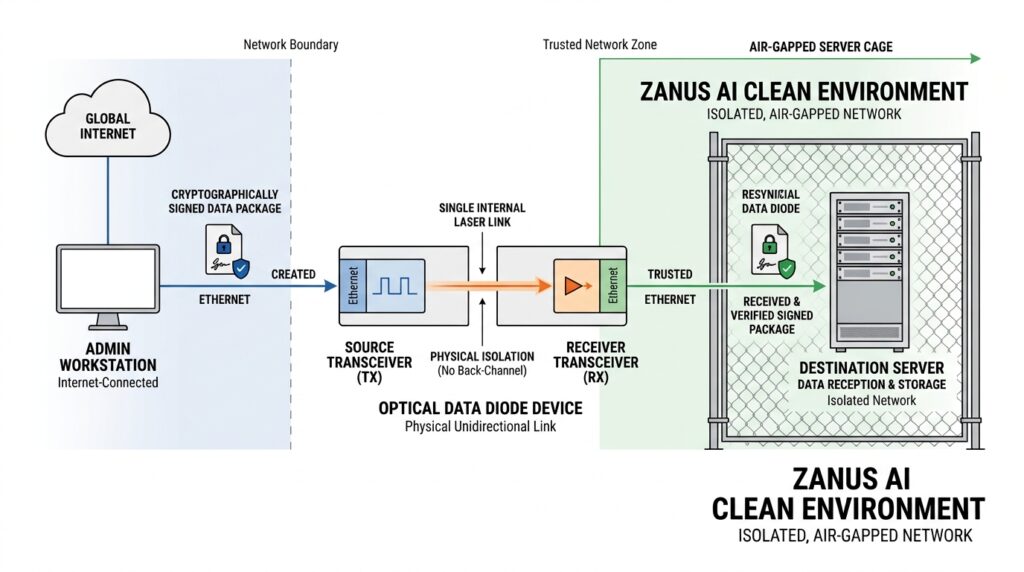
- Absolute Sovereign Security: The system operates in a complete air-gapped enclave with outbound telemetry disabled, eliminating public cloud exposure risks.
- Unidirectional “Build-and-Transfer” Pipeline: Updates from internet-facing machines are transferred via a hardware-enforced optical data diode. The file ingestion process validates cryptographically signed SHA-256 checksums before unpacking images into the clean environment, blocking runtime package injection vulnerabilities.
- Clearance-Aware Search Architectures: The RAG framework applies role-based access tokens to metadata indices. A user without logistics or financial clearance cannot pull contract volume discounts, even if that data shares the same physical vector database.
Cons
- Prohibitive Upfront CapEx: Enterprises face high initial hardware acquisition costs for dedicated GPU server clusters and perpetual software licenses, contrasting sharply with pay-as-you-go cloud pricing models.
- The Master Data Dependency Burden: Because the local AI operates deterministically when routing tasks to traditional ERP databases, any inaccuracies in upstream data (e.g., misrecorded pallet dimensions) will yield mathematically precise but practically unexecutable logistics recommendations.
- High Downstream Maintenance Overhead: Operating an isolated container environment requires internal specialists to manually orchestrate local Kubernetes/Docker layers and debug Python virtual environment conflicts without internet access.

Pricing and Commercial Structure
Zanus AI utilizes a Custom Enterprise Pricing model. The vendor does not offer standardized off-the-shelf software pricing or subscription tiers.
Total cost of ownership (TCO) scales across three lines item categories:
- Hardware Procurement: Direct acquisition costs for the physical Prime or Quantum appliances equipped with enterprise NVIDIA GPUs.
- Software Licensing: Perpetual or annual term licensing for the localized RAG engine, layout tools, and agent orchestration layer.
- Deployment and Integration Services: Engineering fees for building on-site API pipelines to interface with legacy ERP systems (such as SAP IBP or Oracle Cloud Supply Chain).
If you are scaling your enterprise AI deployment and need robust, high-bandwidth bare-metal hosting without exorbitant cloud egress fees, check out our in-depth NovoServe Review and our NovoServe vs Hetzner Comparison to find the right server specs for your budget. Additionally, if your team manages multi-language workflows or cross-border project documentation, read our hands-on Palabra AI Review and Palabra AI vs Lokalise Breakdown to learn how automated AI localization can streamline your content pipeline.
Market Alternatives
- AWS Bedrock via PrivateLink Virtual Private Clouds (VPC): Allows organizations to leverage cloud-scale LLMs within an isolated network pathway. While it limits public WAN transit risks, it does not achieve true hardware-level sovereignty, as physical data processing remains under third-party cloud control.
- Custom White-Box On-Premises Deployments: Buying baseline enterprise servers (e.g., Dell PowerEdge or HPE ProLiant), installing independent GPU arrays, and configuring open-source frameworks manually. This path reduces software licensing overhead but places the entire engineering and integration risk on internal IT teams.
Editor’s Perspective
Operational Impact: If your enterprise faces severe regulatory liabilities under European due diligence directives, or if your bills of materials contain millions of dollars in industrial intellectual property, Zanus AI offers a logical roadmap. It addresses the fundamental flaw of cloud AI: the structural trade-off between performance and privacy. However, if your primary supply chain bottleneck is dirty, unstandardized ERP data, deploying an expensive private GPU server cluster won’t solve the problem—it will simply automate your inventory forecasting errors at a much faster pace.
Final Recommendation
Do not buy into the on-premises AI narrative purely for technological prestige. Ground your purchasing strategy in your specific operational constraints:
- If data residency, local audit immutability, and absolute intellectual property insulation are mandatory requirements: Select the Zanus AI Quantum or Enterprise Cluster topology.
- If initial CapEx budget is constrained and the underlying data assets do not present competitive vulnerabilities: Leverage cloud-hosted model endpoints isolated through secure VPC endpoints to minimize infrastructure overhead.
The Next Practical Step: Before engaging a sales team for a product demonstration, execute an internal data maturity audit. Cleaning your existing master data tables and indexing your procurement databases is a mandatory prerequisite. A localized reasoning engine is only as effective as the on-premises data it retrieves.
Your Next Step
Achieving complete audit trail immutability and protecting your procurement infrastructure from cloud-tier exposure requires a structural pivot toward hardware-level isolation. To successfully evaluate your corporate technology readiness and pitch a clear capital asset deployment roadmap to your executive board, we recommend analyzing our distinct enterprise integration blueprints:
- Performance Scaling Benchmarks: Verify the exact compute density and memory thresholds required for your local index data by exploring the Zanus AI Prime vs Quantum infrastructure tiers.
- Data Center Sizing Metrics: Audit your secure office room’s physical layouts, power limits, and short-depth server dimensions using the Zanus AI Hardware Infrastructure manual.
- Operating System Capabilities: Discover how the pre-loaded private operating engine manages containerized local business tools by reading the comprehensive Zanus AI Deep Review.
- Civilian Asset Applications: For a detailed engineering look at how edge-native visual computing automates drone photogrammetry under strict state laws, see our manual on minimizing the Florida SB-4D inspection cost.
Don’t let unstable remote networks or strict European compliance penalties compromise your business assets—audit your pipeline architecture and deploy your turnkey zanus ai for supply chain security node today.
If you are scaling your enterprise AI deployment and need robust, high-bandwidth bare-metal hosting without exorbitant cloud egress fees, check out our in-depth NovoServe Review and our NovoServe vs Hetzner Comparison to find the right server specs for your budget. Additionally, if your team manages multi-language workflows or cross-border project documentation, read our hands-on Palabra AI Review and Palabra AI vs Lokalise Breakdown to learn how automated AI localization can streamline your content pipeline.
References
- IBM, “What is the German Supply Chain Due Diligence Act (SCDDA)?”, https://www.ibm.com/topics/german-supply-chain-due-diligence-act
- Thomson Reuters Institute, “CSDDD: Navigating the new frontier of corporate sustainability”, https://www.thomsonreuters.com/en-us/posts/esg/csddd-corporate-sustainability/
- Zanus AI Official Product Documentation, “Zanus AI Quantum — Extended Deep Reasoning Private AI Server”, https://zanusai.com/products/quantum
- DiscreteStack Infrastructure Guides, “The Definitive Guide to Air-Gapped AI Deployment with No Internet in 2026”, https://discretestack.com/guides/air-gapped-ai-2026
- VDF AI Research, “Air-Gapped AI Deployments: Running Enterprise AI Agents in Disconnected Networks”, https://vdf.ai/blog/air-gapped-enterprise-agents