

Deploying zanus ai for healthcare & medical applications inside clinical workflows presents healthcare Chief Information Security Officers (CISOs) with a fundamental paradox.. While Large Language Models (LLMs) and Vision-Language Models (VLMs) deliver undeniable operational value—ranging from real-time vitals monitoring to automated draft generation for diagnostic imaging—routing Protected Health Information (PHI) through third-party public cloud APIs exposes healthcare networks to severe regulatory liabilities and unpredictable operational costs.
To eliminate this risk at the root, enterprise healthcare organizations are shifting toward localized, hardware-enforced on-premises AI solutions. From both an architectural and economic standpoint, deploying Zanus AI for healthcare & medical (specifically via their dedicated Zanus AI Quantum server lines) has emerged as a premier alternative to cloud hosting by confining all model inference strictly within the hospital’s physical Local Area Network (LAN).
1. HIPAA Compliance: Public Cloud Security Gaps vs. On-Premises Technical Controls
Deploying clinical AI through public cloud APIs introduces architectural complexities that directly challenge the HIPAA Security Rule (45 CFR Part 164). Under federal law, any covered entity that maintains or transmits ePHI must implement stringent technical safeguards to guarantee data confidentiality, integrity, and availability.
Traditional cloud API endpoints introduce systemic vulnerabilities across several core compliance domains:
| HIPAA Section | Regulatory Domain & Objective | Public Cloud API Vulnerability | Zanus AI On-Premises Control |
| § 164.308(a)(3) | Workforce Security: Clear separation of access privileges. | Transmitting aggregated PHI to a single multi-tenant endpoint bypasses internal user demarcation. | Maps local directories (LDAP/SSO) directly to hardware-isolated compute partitions. |
| § 164.310(d)(2)(i) | Device and Media Controls: Secure storage media sanitization. | Lacks physical custody or cryptographic proof of disk scrubbing once model inference finishes. | Absolute local hardware ownership with support for NIST SP 800-88-compliant sanitization protocols. |
| § 164.312(b) | Audit Controls: Recording information system activity. | Cloud vendors routinely retain input/output prompts in abuse logs for manual review by external contractors. | Automatically generates cryptographic, local audit trails written directly to a local RAID 10 storage array. |
| § 164.312(e)(1) | Transmission Security: Guarding data in transit over a WAN. | Data paths traverse public intermediate routers, leaving transmissions vulnerable to DNS or TLS compromises. | Zero-WAN, air-gapped processing ensuring clinical data never leaves the physical facility. |
💡 Editor’s Take
The Cloud BAA Data Trap: Even when signing a Business Associate Agreement (BAA) with major cloud providers, significant loopholes persist. By default, standard “Zero Retention APIs” often exclude modern additive features like web-browsing modules or integrated image generators from their compliance scope. Furthermore, if a provider’s automated safety classifiers flag high-risk clinical terminology, they reserve the right to revert to “Safety Retention” logging for human review. Transitioning to Zanus AI for healthcare & medical on-prem servers completely neutralizes these downstream legal and operational uncertainties.
2. Financial Engineering: A 3-Year TCO Comparison (Cloud OpEx vs. On-Premises CapEx)
To evaluate economic viability at scale, we modeled a continuous, high-density clinical workload for a 500-bed hospital network over a three-year financial horizon.
Baseline Workload Assumptions:
- Continuous Telemetry Monitoring (500 Beds): Running anomaly detection algorithms every 30 seconds. Total volume: 1,440,000 prompts/day (1,000 input tokens, 100 output tokens).
- EHR Chart Auditing & Decision Support: Full chart reviews conducted every 4 hours per active patient (6 times daily). Total volume: 3,000 audits/day (40,000 input tokens, 1,500 output tokens).
- PACS/DICOM Multimodal Analysis: Based on an annual volume of 100,000 imaging studies, averaging ~274 studies/day (10,000 input tokens including image embeddings, 800 output tokens).
By factoring in premium HIPAA-compliant enterprise cloud API pricing (inclusive of custom BAA and zero-retention premiums) against an upfront capital investment in a private 32-GPU on-premises cluster (such as the Zanus AI turnkey enterprise configuration), the financial model yields the following breakdown:
3-Year Total Cost of Ownership (TCO) Comparison
| Cost Category | Cloud Model (OpEx) | On-Premises Model (Hybrid CapEx/OpEx) |
| Year 1: Hardware Capital Asset Sourcing | $0.00 | $450,000.00 |
| Year 1: Clinical Integration & Connectors | $0.00 | $75,000.00 |
| Year 1: Power & Cooling Utilities (10 kW continuous load, PUE 1.6) | $0.00 | $21,024.00 |
| Year 1: Operational Overhead & Dedicated Staff | $519,877.50 | $45,000.00 (0.3 FTE engineer allocation) |
| Year 2: Direct Operations & Maintenance | $519,877.50 | $133,524.00 (15% CapEx maintenance + power + staff) |
| Year 3: Direct Operations & Maintenance | $519,877.50 | $133,524.00 |
| Total 3-Year Lifecycle TCO | $1,559,632.50 | $858,072.00 |
📊 Operational Impact
Renting GPU compute from public cloud hyperscalers introduces massive variable cost risks. During seasonal patient surges, operational bills scale linearly with token consumption. Conversely, anchoring workflows to Zanus AI for healthcare & medical infrastructure hard-caps data processing costs. Over a three-year lifecycle, this on-premises strategy yields $701,560.50 in cumulative net savings—delivering a 1.82x Return on Investment (ROI) while allowing uncapped model inference without generating unpredictable monthly invoices.
3. Localized Network Moat Architecture & Advanced On-Prem Reasoning
To execute advanced workflows safely behind a hospital’s local network firewall, specialized enterprise hardware—like the Zanus AI Quantum (an 8U rackmount server chassis)—is engineered to deliver deep, offline cognitive processing.
Data Integration via Standardized HL7 FHIR Gating
Local AI nodes do not operate in isolation; they interface directly with a hospital’s core clinical repositories using modern data standards:
                  +-------------------------------------------------+
                  |          PHYSICAL SECURITY MOAT (LAN ONLY)      |
                  +-------------------------------------------------+
                                           |
+---------------------+     HL7 / FHIR     v     Secure API     +----------------------+
|  Hospital EHR Core  | ----------------> [ ] <---------------  |   PACS / DICOM Hub   |
| (Epic, Cerner, etc) |                   |                     |  (Imaging Metadata)  |
+---------------------+                   |                     +----------------------+
                                          |
                                          v
                  +-------------------------------------------------+
                  |      ZANUS AI QUANTUM SERVER (8U RACKMOUNT)     |
                  |  - Local RAID 10 NVMe Storage Array             |
                  |  - Enterprise GPU Array (Offline Inference)     |
                  |  - Private Vector Store (Clinical Grounding)    |
                  +-------------------------------------------------+
- Localized FHIR Facades: Rather than altering legacy databases directly, a translation layer (FHIR Facade) is established within the LAN. This maps legacy HL7 v2 messages into structured, RESTful FHIR resources (e.g., Patient, Observation, DocumentReference).
- Event-Driven Workflow Automation: Enterprise integration engines (such as Rhapsody) monitor active clinical feeds. When a milestone event occurs—such as an emergency admission or a fresh lab update—the engine catches the payload, formats it into a FHIR resource, and pushes it to the Zanus AI server’s local API gateway. This enables real-time automated charting, risk-scoring, and clinical documentation drafting without requiring physicians to manually copy and paste data across systems.
Clinical Case Study: The Y-KNOT Project
A real-world validation of this localized architecture can be found in the South Korean Y-KNOT (Your-Knowledgeable Navigator of Treatment) initiative. To comply with strict national data residency mandates, a major hospital system implemented a fully localized clinical AI model:
- Localized Model Adaptation: Deployed a fine-tuned, bilingual Llama3-8B model trained on specialized medical corpora to accurately interpret mixed-language patient records.
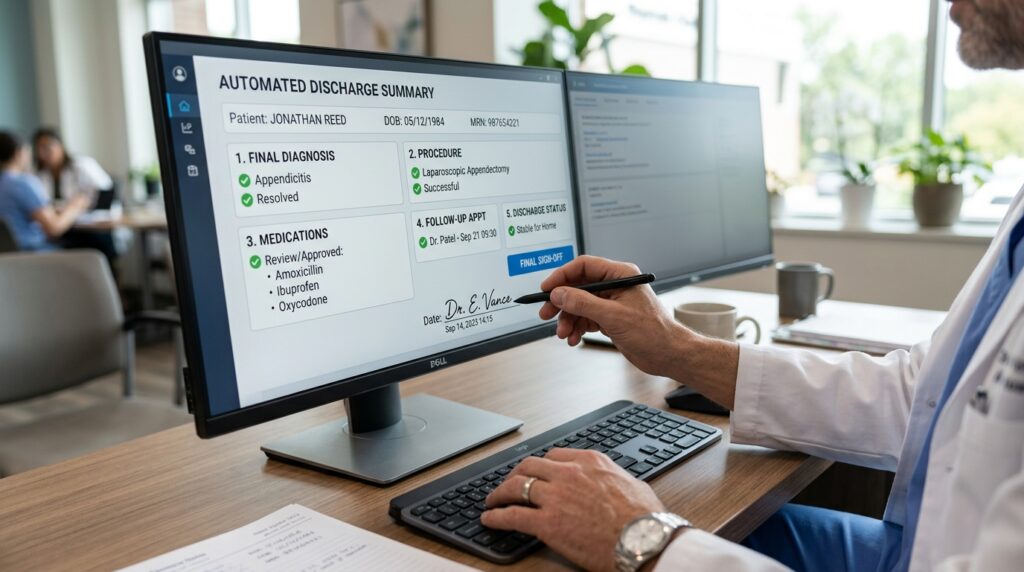
- Deep Process Integration: Automated the drafting of emergency department discharge summaries and preanesthetic assessments via real-time EHR event triggers.
- Regulatory Navigation: By maintaining the attending physician as the final reviewer and authorizer, the system functioned strictly as an administrative utility. This allowed the hospital to completely bypass prolonged diagnostic software (SaMD) regulatory approval pipelines, fast-tracking the technology into active production.
4. Balanced Evaluation: Operational Engineering Trade-offs
No enterprise architectural choice is without its downsides. When deciding to run the Zanus AI for healthcare & medical stack completely in-house, technology leaders must balance the following engineering trade-offs:
- Substantial Upfront CapEx: Unlike the pay-as-you-go flexibility of cloud computing, on-premises deployment demands dedicated initial capital for physical hardware, integration services, and internal pipeline configurations.
- On-Site Infrastructure Ownership: The hospital system inherits full responsibility for data center real estate (the Quantum chassis demands an 8U rack allocation), dedicated uninterruptible power supplies (UPS), and continuous thermal management.
- Internal Engineering Allocations: Although Zanus AI provides turnkey, pre-configured software environments, internal SecOps teams must still allocate dedicated engineering time (~0.3 FTE) to monitor physical hardware health, manage network zoning, and deploy periodic local model weights.
5. Strategic Recommendations and Next Steps
CTO Perspective
If your health system’s immediate goal is rapid prototyping with low, intermittent query volumes, public cloud APIs offer the fastest path to proof-of-concept. However, if you are looking to scale AI across core clinical operations handling millions of transactions daily—while demanding absolute immunity to data privacy breaches, compliance audits, or data-residency restrictions—investing in dedicated, on-premises infrastructure like Zanus AI yields the most secure and sustainable long-term ROI.
Action Plan for SecOps & Infrastructure Teams:
- Clinical Data Audit: Review the structural integrity of your current HL7 v2 messaging feeds and database architecture to ensure seamless compatibility with an on-premises FHIR Facade.
- Inference Load Profiling: Benchmark real-time telemetry throughput and daily PACS imaging data volumes to compute precise compute and memory requirements before finalizing hardware node configurations.
Your Next Step
Protecting sensitive clinical assets while scaling automation capabilities requires a fundamental shift toward hardware-level containment. To successfully architect your compliance matrix and present a clear procurement proposal to your hospital executive board, we recommend exploring our comprehensive enterprise cluster resources:
- Procurement Comparison: Determine the ideal computational and memory tier for your multi-site processing loads by exploring Zanus AI Prime vs Quantum.
- Component Architecture: Read our hardware technical specifications map and facility power profiles via the Zanus AI Hardware Infrastructure.
- System Capabilities Overview: Discover the complete suite of local document parsers and internal visual compute models in the Zanus AI Deep Review.
- Spatial Data Applications: For a detailed blueprint on how edge-AI computing automates drone inspection telemetry under regional regulations, see our tactical guide on managing the Florida SB-4D inspection cost.
Don’t let unpredictable public cloud token surges or external security exposures threaten your standard of patient care—audit your data pipelines and deploy your turnkey sovereign network today.
References
- U.S. Department of Health and Human Services (HHS): Summary of the HIPAA Security Rule. https://www.hhs.gov/hipaa/for-professionals/security/laws-regulations/index.html
- National Institute of Standards and Technology (NIST): SP 800-66r2: Implementing the Health Insurance Portability and Accountability Act (HIPAA) Security Rule. https://nvlpubs.nist.gov/nistpubs/SpecialPublications/NIST.SP.800-66r2.pdf
- JMIR Medical Informatics: A Bilingual On-Premises AI Agent for Clinical Drafting: Implementation Report of Seamless Electronic Health Records Integration in the Y-KNOT Project. https://medinform.jmir.org/2025/1/e59341/
- OpenAI Enterprise Compliance Documentation: Business data privacy, security, and compliance. https://openai.com/enterprise-privacy/
- Zanus AI Official Specifications: Zanus AI Quantum Server — Extended Deep Reasoning Private AI Architecture. https://zanusai.com/products/quantum-server