
The Legal Liabilities of Cloud-Hosted AI in HOA Operations
When implementing Air-Gapped AI for HOA systems, most Homeowners Association (HOA) boards don’t need another generic software platform.
Most Homeowners Association (HOA) boards don’t need another generic software platform. They need a definitive strategy to eliminate operational bottlenecks without exposing their community to multi-million dollar data breach liabilities.
The modern HOA has evolved from a simple neighborhood committee into a complex corporate and administrative entity. In managing residential communities, boards of directors and property management firms oversee an immense array of sensitive information: Personally Identifiable Information (PII) like real names, Social Security numbers, driver’s licenses, financial records, credit histories, bank routing codes, and continuous sensory data from common-area security cameras.
As HOAs adopt artificial intelligence to automate administrative operations, a critical compliance conflict emerges. Uploading these sensitive records to public, cloud-hosted AI networks exposes the association to severe legal and regulatory liabilities.
Key Takeaways
- Air-Gapped AI keeps sensitive HOA data entirely on local infrastructure, eliminating internet-based data transmission.
- Physical isolation provides stronger protection for resident records than contractual cloud privacy commitments alone.
- Air-gapped deployments are best suited for medium and large HOAs handling financial records, legal documents, and continuous CCTV analytics.
- Smaller associations with limited budgets may benefit more from enterprise cloud AI platforms that offer Zero Data Retention (ZDR) agreements.
- Before investing in any AI platform, boards should evaluate legal exposure, IT resources, long-term maintenance, and operational costs—not just AI capabilities.
The Regulatory Landscape: State-Level Privacy Mandates
State-level data privacy frameworks impose strict security mandates on entities processing consumer data, directly impacting property management firms and their technology vendors.
| State Regulation | Scope and Statutory Requirements | HOA and Vendor Risk Exposure under Cloud AI | Statutory Penalties and Civil Remedies |
| California (CCPA / CPRA) | Regulates entities processing CA residents’ PII. Grants rights to access, delete, and limit sensitive data. | Transmission of owner accounts, SSNs, and biometric CCTV records to third-party cloud models. | Statutory damages up to $7,500 per intentional violation; private right of action for data breaches. |
| New York SHIELD Act | Mandates administrative, technical, and physical safeguards for private computerized data of NY residents. | Uploading unencrypted login credentials, emails, or biometric markers to public cloud engines. | Civil penalties up to $5,000 per violation for safeguard failures; up to $250,000 for delayed notifications. |
| Texas Bus. & Com. Code Ch. 521 | Establishes identity theft prevention standards and rules for secure data protection and disposal. | Storing resident lease records, financial details, or government IDs within cloud databases. | Civil penalties ranging from $2,000 to $50,000 per violation for failing to protect sensitive personal data. |
| Virginia (VCDPA) | Grants consumers data control rights. Applies to large associations and nonstock corporate managers. | Passing precise geolocation data, biometric profiles, or sensory recordings to external neural networks. | Enforced by the State Attorney General with statutory civil penalties of up to $7,500 per individual violation. |
| Florida (FIPA) | Defines protected PII to include government IDs, medical histories, and financial accounts. | Transferring bank account numbers, credit history, or delinquency reports to cloud services. | Violations treated as unfair or deceptive trade practices under FDUTPA, triggering immediate state audits. |
In addition to state-specific regulations, statutory notification laws require HOAs to immediately notify affected residents of any actual or suspected breach of unencrypted computerized data. Delays in reporting or failures to mitigate a breach can escalate the legal consequences, leading to class-action lawsuits, regulatory audits, and severe reputational damage.
The intersection of these state-level data privacy frameworks creates a complex legal environment. For example, in North Carolina, unit owners hold a statutory right to inspect financial books, records, and meeting minutes. However, this right to inspect often conflicts with data privacy regulations.
Associations must redact sensitive personal details before allowing inspections. If an HOA uses cloud-hosted AI to automate this redaction process, it may inadvertently expose unredacted records to third-party cloud servers during processing, resulting in a severe data disclosure violation.
HOA Board Fiduciary Duties and Negligence Risks
HOA board members are bound by strict fiduciary duties to their communities: the Duty of Care, the Duty of Loyalty, and the Duty to Act Within the Scope of Authority. Under the Duty of Care, board members must exercise reasonable diligence when making operational decisions, which includes securing sensitive corporate and personal information.
Failing to implement adequate data protection measures can be considered fiduciary negligence. Such negligence can pierce the liability protection of the Business Judgment Rule, exposing individual board members to personal civil liability and leaving the association vulnerable to denied claims under Directors and Officers (D&O) liability insurance.
The financial consequences of a cyber incident or data breach can be devastating for an HOA. Threat actors routinely target community management platforms to gain access to bank routing information, approve fraudulent invoices, and intercept assessment payments. If a board is found to have compromised resident data by using insecure, public cloud-hosted AI tools, it faces significant exposure.
Furthermore, because disclosing confidential information without prior board approval falls outside a director’s scope of authority, a board member who exposes sensitive records to a public AI platform faces personal liability for invasion of privacy or negligence—claims that standard D&O insurance policies may refuse to cover.
The Heppner Precedent and the Destruction of Privilege
For community associations, a primary risk of cloud-hosted AI tools is the potential waiver of attorney-client privilege and work-product protection. The legal framework for this risk was established in the landmark federal court ruling United States v. Heppner (S.D.N.Y. Feb. 17, 2026).
In Heppner, the court addressed whether conversations with a generative AI platform regarding a pending investigation were protected by legal privilege. The court ruled that documents generated through the defendant’s prompts to a consumer-grade cloud AI platform were not protected under attorney-client privilege or the work-product doctrine based on three key holdings:
- Lack of Professional Relationship: AI platforms do not hold law licenses, owe no fiduciary duties, and are not subject to professional regulation or bar discipline. Consequently, they cannot form a privileged attorney-client relationship.
- No Expectation of Confidentiality: Analyzing the service’s privacy policy, the court found that users consent to the platform collecting both inputs and outputs, using this data to train neural network models, and potentially disclosing it to third parties or regulatory authorities. Entering data into a system with these terms destroys any reasonable expectation of confidentiality.
- Work-Product Limitations: Communications and materials generated by an AI platform do not qualify as attorney work-product unless they are prepared at the explicit direction and under the direct supervision of legal counsel.
The Heppner precedent has direct implications for HOA boards. If a board member uploads draft legal responses, dispute histories, or executive session minutes into a public cloud AI platform, they have shared that information with an unauthorized third party. Under the law, this action waives any future claims of attorney-client privilege for those documents.
If an HOA is involved in litigation—such as construction defect disputes, selective rule enforcement suits, or vendor contract challenges—opposing counsel can subpoena the association’s AI account records. The iterative questions and answers typed into a cloud interface can be used as trial exhibits to demonstrate the board’s internal strategies, motivations, and legal vulnerabilities.
| Deployment Model | Data Residency | Privilege Protection Status | Subpoena and Discovery Exposure | Contractual vs. Physical Controls | Operational Fees |
| Consumer Cloud AI (e.g., ChatGPT/Claude Free/Plus) | Transmitted to external vendor servers. | Permanently Waived due to lack of confidentiality and third-party data access. | High; conversation logs are stored and discoverable in civil or criminal litigation. | Contract terms permit data scraping, human review, and model training. | High recurring subscription or per-token fees. |
| Enterprise Cloud AI (with BAA / NDA Contracts) | Transmitted to vendor cloud databases. | Uncertain and legally at risk; depends on contract terms and zero-data-retention windows. | Subject to vendor-directed subpoenas, corporate breaches, and multi-tenant cyberattacks. | Governed purely by contractual promises and data processing agreements. | Variable usage-based billing; costs explode as prompt sizes scale. |
| On-Premise Air-Gapped AI (e.g., Zanus AI Platform) | Retained entirely on physical on-site hardware. | Fully Preserved; zero external data transmission protects confidentiality by design. | Zero exposure via the AI infrastructure; data governed solely by on-site retention policies. | Physical zero-trust architecture; security is enforced by physical isolation. | One-time investment with zero recurring token or usage-based fees. |
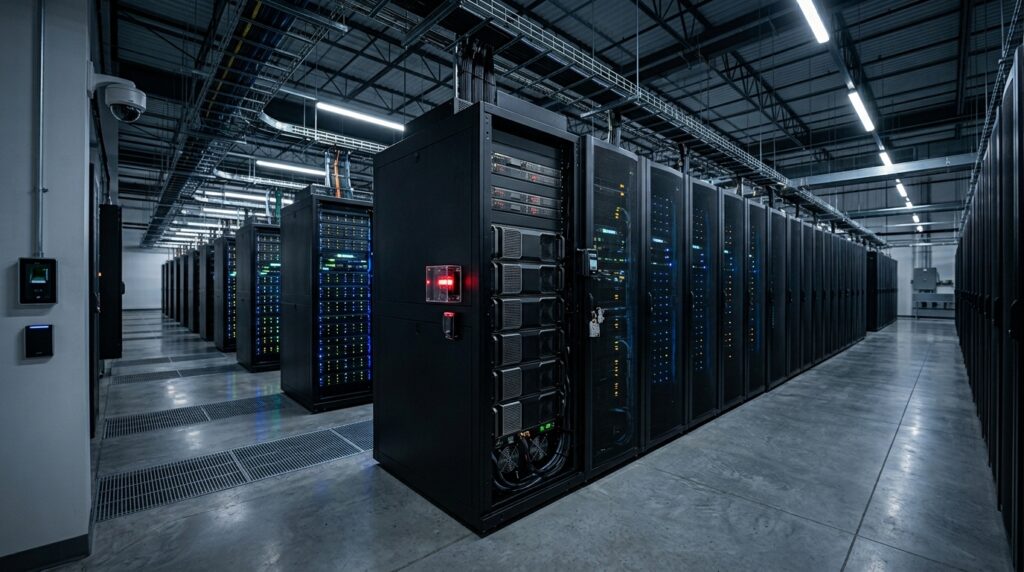
Engineering the Air-Gapped AI for HOA Advantage
Organizations generally have three deployment options when implementing Air-Gapped AI:
- Build a fully customized infrastructure using enterprise GPU servers, open-source LLMs such as Llama 3 or Mistral, and locally managed RAG pipelines.
- Purchase a turnkey AI appliance that combines enterprise hardware, optimized software, and integrated management into a single platform.
- Deploy a hybrid architecture that combines local inference with tightly controlled enterprise cloud services for selected workloads.
Each approach offers different trade-offs in deployment complexity, scalability, maintenance requirements, and long-term operational costs.
To eliminate the security and legal risks of cloud-hosted systems, organizations are adopting air-gapped on-premises architectures. An air-gapped network is physically isolated from the public internet. By removing all external network connections, this design replaces contractual privacy assurances with a security boundary defined by physical isolation.
In an air-gapped deployment, data sovereignty is maintained because sensitive records never leave the physical property or the local network. This complete control over data residency satisfies compliance frameworks like the CCPA and the NY SHIELD Act. Because no data is transmitted over the internet, the risk of interception, unauthorized third-party processing, and exposure to vendor subpoenas is eliminated. For HOA boards, this physical isolation ensures that communications, resident rosters, and architectural plans remain entirely confidential, preserving the attorney-client privilege at the architectural level.
Turnkey, on-premises systems like the Zanus AI Prime private AI server make this architecture practical for local operations. Unlike generic server hardware that requires custom software engineering and model integration, these platforms ship with an integrated operating system, pre-configured Retrieval-Augmented Generation (RAG) pipelines, and localized Large Language Models (LLMs).
The Zanus product line offers scalability across three distinct performance tiers:
- Zanus AI Prime: Built for boutique property management teams and local document libraries. It handles up to 50 real-time operations, storing 2,000,000+ documents and 50,000+ hours of video.
- Zanus AI Quantum: Optimized for medium to large multi-site community associations utilizing a multi-user localized RAG pipeline, advanced document generation, and continuous security intelligence.
- Enterprise Cluster: Designed for large master-planned communities or enterprise property management networks, supporting 50,000,000+ documents and robotic LTO tape archiving.
The technical and environmental specifications of the Zanus AI Prime system highlight its suitability for standard office environments:
- Form Factor and Deployment: Built as an 8U rackmount private AI server that can also be set up in a desktop configuration, allowing it to fit into standard utility closets or back offices without specialized datacenter infrastructure.
- Processor and GPU Array: Built on industry-standard enterprise hardware featuring standard CPUs and a turnkey array of enterprise-grade GPUs purpose-built for AI inference.
- Storage Infrastructure: High-speed NVMe drives configured in RAID 10, which automatically mirrors every byte in real-time to prevent loss from single-drive failures.
- Acoustics and Cooling: Engineered for whisper-quiet, office-level operation with no acoustic insulation required. It uses a patented mechanical air-cooling system operating entirely on standard office climate control.
- Power Requirements: Designed to run without special electrical rewiring, using 4 standard AC power circuits that plug into existing wall outlets (idle draw of approximately 1 kW total).
- Software Suite: Pre-installed with the Zanus AI Operating System, which includes over 15 business-ready modules (AI Chat Assistant, customer/client management, document intelligence, calendar, scheduling, and marketing automation) working on Day 1 with zero coding required.
The Cost–Complexity Trade-Off
Although Air-Gapped AI significantly reduces regulatory exposure and strengthens data sovereignty, it introduces operational trade-offs that organizations must understand before deployment.
Unlike cloud AI services, on-premises systems require upfront capital investment (CapEx), hardware lifecycle planning, backup strategies, periodic software updates, and local infrastructure maintenance. Organizations are also responsible for monitoring storage capacity, replacing failed components, and maintaining disaster recovery procedures.
For many enterprise organizations, these responsibilities are acceptable because they eliminate recurring cloud AI usage fees while providing complete control over sensitive information. However, smaller organizations without dedicated IT staff may find these operational requirements challenging.
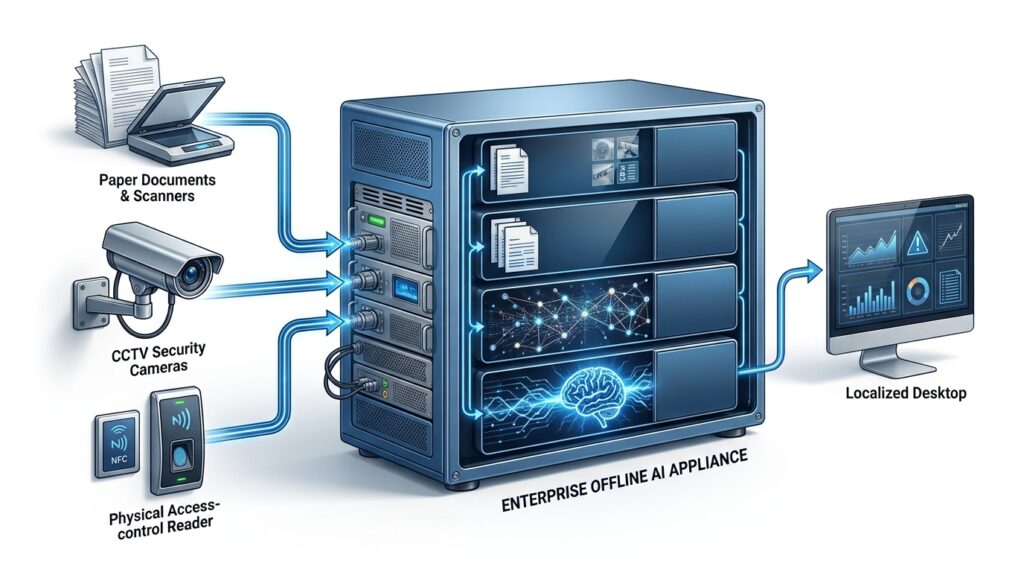
Architectural Ingestion Blueprint with Zero Internet Dependency
Deploying a local, air-gapped AI system requires a secure, structured data ingestion pipeline that handles both unstructured documents and high-throughput security footage with zero external network dependencies.
The mathematical demands of local storage highlight the efficiency of this on-premises configuration. Let $C$ represent the raw storage capacity required for security video retention. If an HOA records $N$ camera streams at a constant bitrate of $B$ Mbps over $H$ hours of retention, the raw storage size $S_{raw}$ in gigabytes is calculated as:
$$S_{raw} = \frac{N \times B \times 3600 \times H}{8000}$$
Under a mirrored RAID 10 configuration, the physical capacity required ($S_{physical}$) is scaled by a factor of 2 to guarantee total local hardware redundancy:
$$S_{physical} = 2 \times S_{raw}$$
This mathematical reality highlights the efficiency of local high-speed NVMe storage in handling high-throughput surveillance demands without external latency. The operational differences between the document and video ingestion streams are structured as follows:
| Ingestion Parameter | Document Processing Stream | Video Ingestion Stream |
| Primary Data Source | Delinquency logs, financial accounts, board minutes, and legal memos. | High-definition security camera footage and access-control entry logs. |
| Transmission Protocol | Secure local SFTP or internal Samba/NFS LAN file shares. | Continuous RTSP streams routed over an isolated, non-routed camera VLAN. |
| Processing Hardware | Local CPUs and high-speed system memory optimized for text tokenization. | Enterprise GPUs executing parallel frame decoding and convolutional analysis. |
| Core Software Task | Optical Character Recognition (OCR), text chunking, and local vectorization. | Real-time object tracking, facial/vehicle classification, and license plate recognition (ANPR). |
| Storage Redundancy | Replicated immediately to NVMe RAID 10 solid-state drives. | Recorded to local NVR or high-capacity NAS drives. |
| Internet Dependency | 100% offline; completely isolated from the WAN. | 100% isolated; WAN routing disabled on the physical network switch. |
Who Should Avoid Air-Gapped AI?
Air-Gapped AI is not the ideal solution for every organization.
An enterprise cloud AI platform may be a better choice if:
- Your HOA manages fewer than 80–100 residential units.
- Your organization has no dedicated IT administrator.
- Your annual technology budget is limited.
- Your primary AI use case involves document drafting, email summarization, or administrative productivity rather than processing regulated resident information.
In these situations, enterprise cloud AI platforms with contractual Zero Data Retention (ZDR) commitments may provide a more practical balance between security, operational simplicity, and cost.

The Implementation Blueprint
Implementing an air-gapped AI system requires a structured operational plan to ensure technical viability, legal compliance, and long-term security. HOA boards should follow this systematic deployment process to integrate this technology safely into their management workflows:
1.Implement Immediate Corporate AI Policies:Phase 1: Governance Audit.
Update the association’s corporate governance policies, employee handbooks, and board operating guidelines. Formally prohibit the transfer of any unencrypted owner files, delinquency records, litigation analyses, or CCTV visual data to public, cloud-hosted AI networks. Explicitly state that any use of generative AI for official communications must route through approved, secure local channels.
2.Transition to Private Local AI Infrastructure:Phase 2: Hardware Deployment.
Transition community records and daily workflows to a physical, turnkey on-premises private AI server, such as the Zanus AI Prime system. Install the server in a secure, climate-controlled physical location on-site—such as an administrative utility closet or locked back office. Configure the hardware to run strictly on the local area network (LAN) with wide area network (WAN) routing disabled.
3.Establish Role-Based Access and Auditing Controls:Phase 3: Software Configuration.
Configure the Zanus AI Operating System to enforce strict Role-Based Access Controls (RBAC). Set user permissions so that only authorized administrative staff and board members can access sensitive directories (e.g., homeowner financial details or common-area surveillance feeds). Enable automated, tamper-proof audit logging to maintain continuous compliance records.
4.Mandate Strict Data Provisions in Vendor Contracts:Phase 4: Vendor Realignment.
Update all third-party contracts with property management companies, legal counsel, and technology providers. Require partners to sign data protection agreements that explicitly prohibit the use of consumer-grade cloud AI platforms when processing the association’s records. Ensure all external tools meet equivalent enterprise-grade zero-data-retention or local on-premises standards.
Final Editorial Recommendation
Air-Gapped AI is not universally better than cloud AI—it is simply designed to solve a different class of problems.
Organizations responsible for highly sensitive resident information, legal documentation, financial records, or continuous surveillance data should strongly consider an air-gapped architecture because physical isolation provides a level of security that contractual cloud agreements cannot fully replicate.
Conversely, smaller HOAs with limited budgets, minimal compliance obligations, or no dedicated IT personnel may achieve a better balance by adopting enterprise cloud AI platforms with strict Zero Data Retention (ZDR) commitments.
The most important decision is not selecting the most advanced AI model. It is choosing the deployment architecture that best aligns with your organization’s operational risk, regulatory responsibilities, and long-term technology strategy.
Explore the Private AI Infrastructure Roadmap
Deploying secure, local AI for your community requires a complete understanding of physical hardware setups and financial realities. Continue your architecture blueprint with our dedicated deep dives:
- Physical Setup Blueprint: Learn the exact rack dimensions, power distribution rules, and cooling dynamics needed to run a secure appliance in our [Zanus AI Hardware Architecture & Server Setup Guide].
- Financial TCO Analysis: Calculate the exact return on investment and compare physical hardware costs against cloud token fees over a 5-year cycle in [Zanus AI Pricing & ROI: The Real Cost of On-Premises AI].
- Alternative Platform Review: Compare turnkey hardware solutions against open-source DIY setups and corporate virtualized frameworks in [5 Best Zanus AI Alternatives for Enterprise Private AI].
References
- California Consumer Privacy Act (CCPA)
- California Privacy Rights Act (CPRA)
- New York SHIELD Act
- Virginia Consumer Data Protection Act (VCDPA)
- Florida Information Protection Act (FIPA)
- NIST Cybersecurity Framework (CSF)
- NIST SP 800-207 Zero Trust Architecture
- OWASP Top 10
- Official NVIDIA AI Enterprise Documentation