
| Comparison Metrics | Zanus AI (On-Premises) | Cloud AI (OpenAI/AWS) |
|---|---|---|
| Data Sovereignty | 100% offline, air-gapped in your building. Zero leak risk. | Data sent to third-party servers. Risk of privacy breach. |
| Cost Structure | One-time hardware investment. Unlimited usage & seats. | Pay-per-token & monthly per-seat licenses. Escalating costs. |
| Internet Dependency | Runs normally without internet. No downtime. | Completely dead if the office internet goes down. |
| 5-Year Accumulation | $19,900 – $50,000 (Fixed Cost) | $720,000+ (Predictable SaaS Trap) |
*Note: Data verified based on average drone inspection and structural analysis data processing volume for medium-to-large HOAs.
Which Deployment Model Fits Your Enterprise Budget?
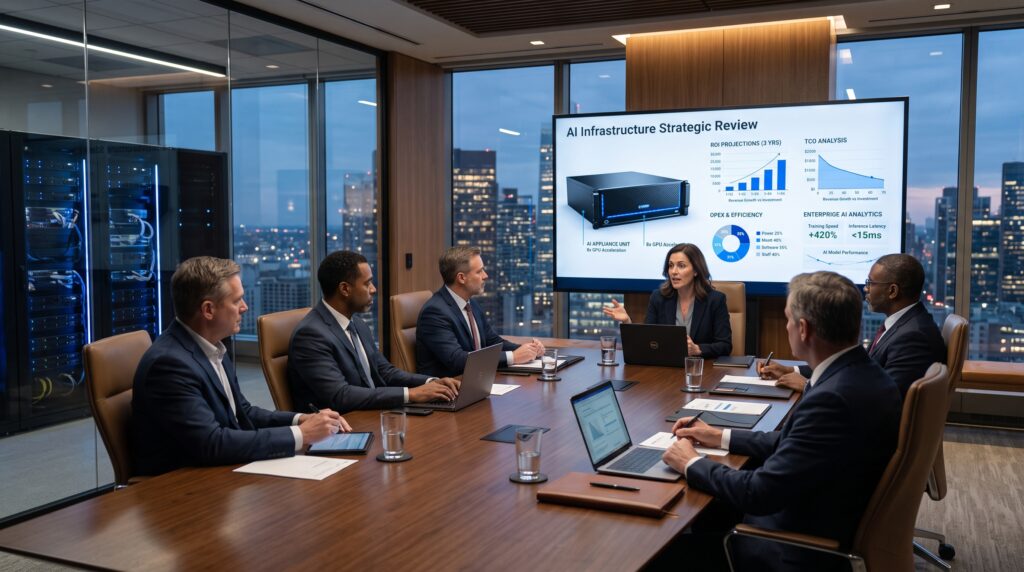
When evaluating Zanus AI Pricing & ROI, choosing the right deployment model is crucial for your enterprise budget.
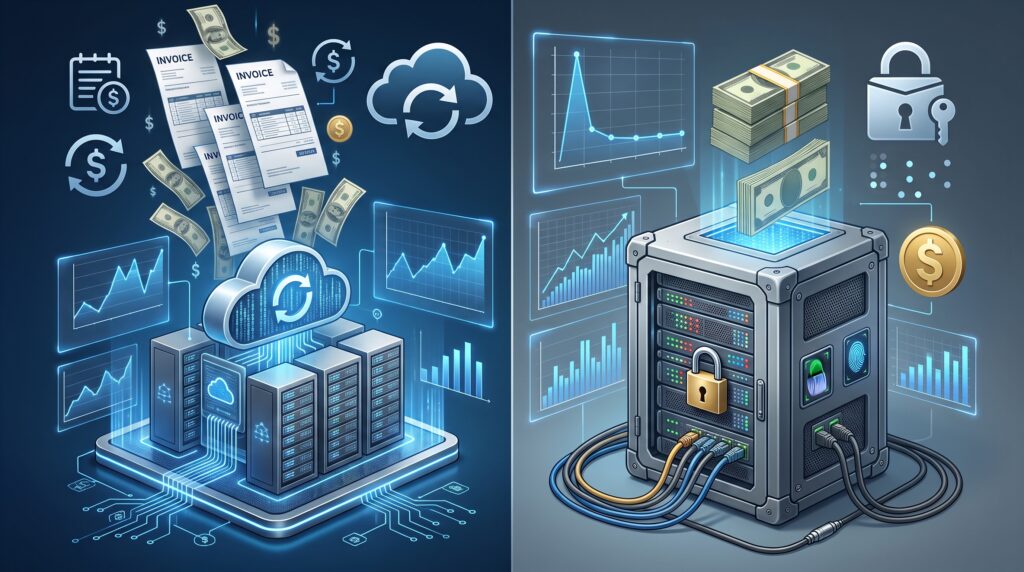
Most enterprise technology decisions fail because teams mistake purchase price for total cost. Buying cloud AI software looks simple on paper: zero upfront capital expenditure, a clean operational expense line item, and access to flagship models via an API.
However, as workloads scale from small experiments to heavy batch processing, that variable pricing structure turns into a predictable financial bottleneck. Every document processed, every customer email analyzed, and every hour of corporate video transcribed incurs a perpetual “token tax.”
For organizations handling high-volume workloads, switching from cloud APIs to private, on-premises infrastructure like the Zanus AI Quantum server shifts variable operational costs ($OpEx$) into depreciable capital assets ($CapEx$).
This guide breaks down the multi-year Total Cost of Ownership (TCO), analyzes hidden operational variables, and outlines the precise break-even points to help you make an objective, numbers-driven infrastructure choice.
Executive TCO Breakdown: The 5-Year Financial Reality
To establish a clear baseline, this comparison evaluates three distinct strategies for a business processing 1,000,000 documents per month (assuming an average of 3,000 input tokens and 1,000 output tokens per document).
- Zanus AI Quantum (On-Premises): A turnkey enterprise hardware appliance pre-configured with Zanus AI OS, integrated software modules, and local LLMs capable of handling over 5,000,000 documents without external API calls.
- OpenAI API Cloud Integration: Running workloads through cloud models via API, factoring in supplemental corporate SaaS licensing, data egress fees, and maintenance engineers.
- Do-It-Yourself (DIY) Private Server: Attempting to build a private architecture from scratch using individual hardware components (e.g., NVIDIA RTX series) and open-source models.
Initial Capital Investment ($CapEx$)
| Expense Category | Zanus AI Quantum | DIY Server (RTX 5090 Suite) | Cloud API Integration |
| Hardware & GPU Base | Included in Package | $12,000 | $0 |
| OS & Built-in AI Modules | Included (15+ Modules) | $0 (Open Source) | $100,000 – $500,000 (Custom Build) |
| Turnkey Appliance Fee | $80,000 | $0 | $0 |
| System Engineering & Setup | $0 (Plug-and-Play) | $150,000 – $300,000 | $0 (Bundled above) |
| Deployment Timeline | 1 Day | 6 – 18 Months | 1 – 2 Weeks |
| Total Upfront CapEx | $80,000 | $162,000 – $312,000 | $100,000 – $500,000 |
Editor’s Take: The Hidden Cost of DIY
If your IT department suggests building a private AI cluster manually to save on hardware, look closely at the engineering timeline. Hiring specialized DevOps and AI engineers costs between $150,000 and $300,000 annually per head. A 12-month development cycle to replicate enterprise RAG pipelines easily burns past $200,000 in labor costs alone—long before your first automated prompt goes live.
Calculating Long-Term Operational Expenses ($OpEx$)
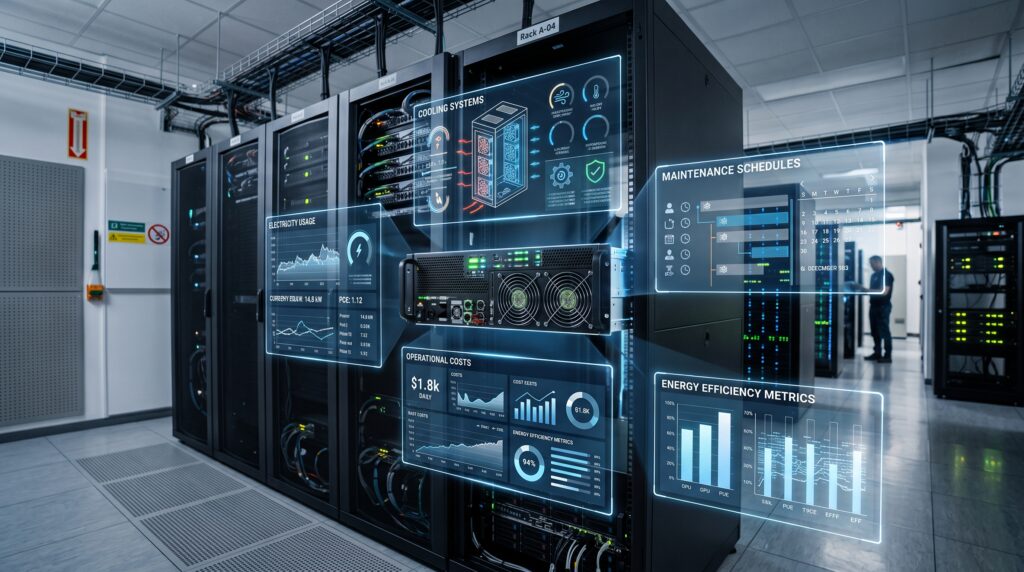
A common critique of on-premises hardware is the ongoing cost of utility power, server room cooling, and technical maintenance.
The Zanus AI Quantum utilizes a proprietary air-cooling system that runs quietly on standard AC power without specialized data center retrofits. To isolate the exact annual utility cost ($C_{\text{utility}}$) under heavy batch loads, we use the standard power equation:
$$E_{\text{weekly}} = (P_{\text{active}} \times H_{\text{active}}) + (P_{\text{idle}} \times H_{\text{idle}})$$
$$E_{\text{annual}} = E_{\text{weekly}} \times 52$$
$$C_{\text{utility}} = E_{\text{annual}} \times \text{PUE} \times R_{\text{electricity}}$$
Using certified technical parameters for the Quantum system:
- Active Power Draw ($P_{\text{active}}$): 4.0 kW
- Idle Power Draw ($P_{\text{idle}}$): 1.0 kW
- Active Processing Hours ($H_{\text{active}}$): 40 hours/week
- Idle Hours ($H_{\text{idle}}$): 128 hours/week
- Power Usage Effectiveness ($PUE$): 1.4
- Average Commercial Electricity Rate ($R_{\text{electricity}}$): $0.15 / kWh
$$E_{\text{weekly}} = (4.0\text{ kW} \times 40\text{ hr}) + (1.0\text{ kW} \times 128\text{ hr}) = 160\text{ kWh} + 128\text{ kWh} = 288\text{ kWh}$$
$$E_{\text{annual}} = 288\text{ kWh} \times 52 = 14,976\text{ kWh}$$
$$C_{\text{utility}} = 14,976\text{ kWh} \times 1.4 \times \$0.15 = \$3,144.96\text{ per year}$$
When we combine this utility baseline with secondary operational costs, the structural savings of an integrated hardware appliance become clear:
Annual Fixed Operating Costs (Excluding Token Fees)
| Annual OpEx Component | Zanus AI Quantum | Integrated Cloud Infrastructure |
| Power & System Cooling | $3,144.96 | $0 (Borne by Cloud Vendor) |
| Hardware Maintenance & Support | $8,000.00 (10% CapEx from Year 2+) | $0 (Borne by Cloud Vendor) |
| Internal IT Overhead | $1,200.00 | $0 |
| Dedicated System Engineers | $0 (Automated Administration) | $90,000.00 (0.5 FTE Cloud Engineer) |
| Supplemental Enterprise SaaS | $0 (15+ Pre-installed Modules) | $75,000.00 (Vector DB, Connectors) |
| Data Egress & Upload Fees | $0 (Local LAN Only) | $3,600.00 |
| Total Fixed OpEx (Year 1) | $4,344.96 | $168,600.00 |
| Total Fixed OpEx (Years 2+) | $12,344.96 | $168,600.00 |

5-Year Zanus AI Pricing & TCO vs. OpenAI API Cost
For volume processing, cloud vendors scale fees directly with usage. Using prevailing enterprise API pricing metrics for 1 Million Documents/Month (3,000M Input Tokens + 1,000M Output Tokens monthly), we analyze three cloud scenarios:
- GPT-5.4 Standard API: $2.50 / 1M input; $15.00 / 1M output.
- GPT-5.4 Batch API (50% Off-Peak Discount): $1.25 / 1M input; $7.50 / 1M output.
- GPT-5.5 Batch API (Flagship Tier): $2.50 / 1M input; $15.00 / 1M output.
Cumulative Cost Projection Matrix (CapEx + OpEx + Tokens)
[Year 1 TCO]
Zanus Quantum:  $84,345
GPT-5.4 Batch:  $303,600
GPT-5.4 Std:    $438,600

[Year 5 Cumulative TCO]
Zanus Quantum:  $133,725   =================== (Asset Owned)
GPT-5.4 Batch:  $1,518,000  ======================================================
GPT-5.4 Std:    $2,193,000  ================================================================================
| Amortization Period | Zanus AI Quantum TCO | Cloud GPT-5.4 Standard TCO | Cloud GPT-5.4 Batch TCO | Cloud GPT-5.5 Batch TCO |
| Year 1 | $84,344.96 | $438,600.00 | $303,600.00 | $438,600.00 |
| Year 2 | $96,689.92 | $877,200.00 | $607,200.00 | $877,200.00 |
| Year 3 | $109,034.88 | $1,315,800.00 | $910,800.00 | $1,315,800.00 |
| Year 4 | $121,379.84 | $1,754,400.00 | $1,214,400.00 | $1,754,400.00 |
| Year 5 | $133,724.80 | $2,193,000.00 | $1,518,000.00 | $2,193,000.00 |
| 5-Year Net Savings | Baseline Asset | $2,059,275.20 | $1,384,275.20 | $2,059,275.20 |

Break-Even Analysis & ROI Calculations
To determine the exact payback period ($T$, in months) for the $80,000 Quantum server infrastructure, we map the net monthly operational savings against the initial capital expenditure:
$$T = \frac{\text{CapEx}_{\text{On-Premise}}}{\text{Net Monthly Operational Savings}}$$
Scenario A: vs. GPT-5.4 Batch API (Lowest Cloud Cost Alternative)
- Total Cloud Expenses: $11,250 (Tokens) + $14,050 (Infrastructure/SaaS/Engineers) = $25,300.00 / month.
- Total On-Premises Expenses: $262.08 (Power/Cooling) + $100.00 (Internal IT Oversight) = $362.08 / month.
- Net Monthly Savings: $25,300.00 – $362.08 = $24,937.92 / month.
$$T = \frac{\$80,000.00}{\$24,937.92} = \mathbf{3.21\text{ Months}}$$
Scenario B: vs. GPT-5.4 Standard / GPT-5.5 Batch API
- Total Cloud Expenses: $22,500 (Tokens) + $14,050 (Infrastructure/SaaS/Engineers) = $36,550.00 / month.
- Net Monthly Savings: $36,550.00 – $362.08 = $36,187.92 / month.
$$T = \frac{\$80,000.00}{\$36,187.92} = \mathbf{2.21\text{ Months}}$$
5-Year Return on Investment (ROI) Formula
$$\text{ROI} = \frac{\text{5-Year Net Savings}}{\text{5-Year Total On-Premises Cost}} \times 100\%$$
- ROI against GPT-5.4 Batch: $(\$1,384,275.20 / \$133,724.80) \times 100\% = \mathbf{1,035.17\%}$
- ROI against GPT-5.4 Standard: $(\$2,059,275.20 / \$133,724.80) \times 100\% = \mathbf{1,539.94\%}$
Financial Metrics Summary Table
| Financial Efficiency Metric | vs. GPT-5.4 Batch API | vs. GPT-5.4 Standard API | vs. GPT-5.5 Batch API |
| Net Monthly Savings | $24,937.92 | $36,187.92 | $36,187.92 |
| Break-Even Payback Period | 3.21 Months | 2.21 Months | 2.21 Months |
| Cumulative 5-Year Savings | $1,384,275.20 | $2,059,275.20 | $2,059,275.20 |
| Projected 5-Year ROI | 1,035.17% | 1,539.94% | 1,539.94% |
Eliminating the “Context Anxiety” Premium
Beyond direct financial figures, variable cloud token structures impose a hidden operational penalty: context anxiety.
When every API call carries a clear financial cost, engineers often truncate document contexts, restrict search window sizes within RAG systems, or strip out multi-turn conversation histories to protect the budget. This artificial data starvation increases model hallucination rates and lowers output accuracy.
Furthermore, advanced reasoning models (like o3 or o4-mini) rely heavily on internal “thinking tokens” during execution. On cloud networks, these hidden thinking steps are billed at standard token rates, making multi-layered analytical jobs expensive and unpredictable.
Running these models locally on enterprise GPU infrastructure changes how teams use the system. Because processing capacity is fixed and fully owned, you can run complex, iterative prompts without checking a billing dashboard.

Operational Case Studies
- Financial Services Transition: A corporate wealth advisory group recently replaced an active AWS enterprise instance costing $18,000 monthly with a local private server setup. They achieved full capital amortization within 14 months while completely removing recurring cloud infrastructure line items.
- Insurance Batch Automation: A regional underwriting firm processing 500+ risk assessment files daily eliminated an ongoing $8,000 monthly OpenAI API bill immediately upon deploying an on-premises node.
Additionally, local deployments offer indirect financial benefits through data sovereignty. For industries governed by strict regulatory frameworks (such as HIPAA or GDPR), processing sensitive customer data inside an insulated, air-gapped network avoids the compliance risks and legal exposure of uploading corporate data to third-party servers.
Strategic Recommendations for Decision Makers
If your organization is currently re-evaluating its enterprise AI infrastructure strategy, use this three-step blueprint:
1. Audit Your Real-World Token Volumes
Work with your technical teams to audit your cloud API dashboard logs over the last 6 months. Map out your monthly token growth curves to determine when your volume will cross the point where cloud hosting becomes inefficient.
2. Move Budget Allocations from OpEx to CapEx
If your monthly cloud bill consistently matches or exceeds the cost of a hardware lease payment, talk to your financial directors about shifting that variable operational spend ($OpEx$) into an owned, depreciable corporate asset ($CapEx$).
3. Consider Financing and Lease Options
For organizations looking to keep their short-term cash flow flexible, commercial equipment financing options allow you to spread upfront hardware purchase prices across fixed multi-year payment terms. This often results in a predictable monthly payment that is lower than standard cloud usage fees.
What Decision Should You Make Next?
- Choose Cloud APIs if your monthly document volume is low or unpredictable, and you do not need to process sensitive or regulated corporate data.
- Choose Zanus AI Quantum if your business handles heavy, high-volume batch processing and requires a highly secure, private AI system with predictable long-term costs.
Ready to calculate your team’s specific break-even point? Explore the Zanus AI Interactive TCO Calculator or coordinate an infrastructure consultation with an enterprise solutions architect.
Deepen Your Enterprise AI Research
This ROI analysis is just one part of evaluating local infrastructure. To fully understand how this system operates, shifts budgets, and deploys without external dependencies, explore our complete technical deep dives:
- Full Capability Assessment: Read our in-depth evaluation of the platform’s core workflow, features, and security protocols in our [Zanus AI Review].
- Infrastructure & Deployment: Ready to understand the literal setup mechanics? Check out our step-by-step framework in the [Zanus AI Deployment Guide].
- Strategic Budget Decision: Is the hardware truly worth the shift from cloud models? Read our comprehensive analysis on [Is Zanus AI Worth It?].
If you are scaling your enterprise AI deployment and need robust, high-bandwidth bare-metal hosting without exorbitant cloud egress fees, check out our in-depth NovoServe Review and our NovoServe vs Hetzner Comparison to find the right server specs for your budget. Additionally, if your team manages multi-language workflows or cross-border project documentation, read our hands-on Palabra AI Review and Palabra AI vs Lokalise Breakdown to learn how automated AI localization can streamline your content pipeline.