Traditional supply chain planning is broken. Legacy systems that rely strictly on historical sales data cannot keep pace with modern market volatility, geopolitical disruptions, and shifting consumer behavior. For businesses carrying thousands of SKUs, relying on spreadsheets or reactive software results in two incredibly expensive outcomes: costly stockouts or millions in capital tied up in dead stock.
Modern AI supply chain software solves this by shifting operations from a reactive model to a predictive one. By analyzing both internal numbers and external demand signals (like weather patterns, economic indicators, and real-time transit data), these tools automate forecasting, dynamic safety stock calculations, and warehouse routing.
This guide reviews the top AI supply chain platforms available today to help you choose the right solution for your infrastructure, budget, and operational scale.
Best AI Supply Chain Software: Quick Summary
Busy operations leaders don’t have time to wade through software documentation. If you need a fast recommendation, here is how the top platforms stack up:
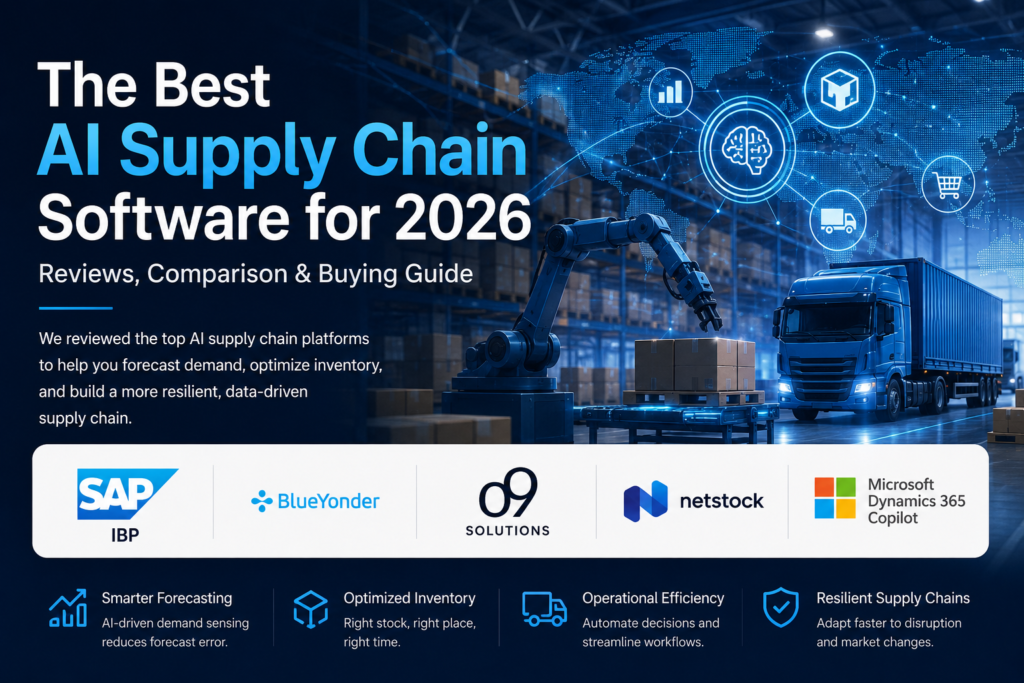
- SAP IBP: The definitive choice for global enterprises already locked into the SAP ecosystem who require deep, cross-functional S&OP planning.
- Blue Yonder: The strongest standalone machine learning platform for enterprise demand sensing and multi-channel logistics optimization.
- o9 Solutions: Best for massive organizations needing to model complex, end-to-end supply chain networks through advanced digital twin technology.
- Netstock: The premier choice for mid-market businesses and SMBs looking for rapid ROI, clear inventory optimization, and painless ERP integration.
- Microsoft Dynamics 365 Copilot: The top pick for organizations prioritizing Generative AI to automate manual procurement tasks, invoice matching, and supplier communication.
Comparison Table
| Platform | Best For | Pricing | Deployment | Learning Curve | Standout Feature | Free Trial |
| SAP IBP | Enterprise SAP Users | Custom Enterprise | Cloud | Steep | Demand Sensing via SAP HANA | No |
| Blue Yonder | Enterprise Demand Sensing | Custom Enterprise | Cloud (Azure) | Steep | Cognitive Demand Planning | No |
| o9 Solutions | Supply Chain Digital Twins | Custom Enterprise | Cloud | Steep | Enterprise Knowledge Graph | No |
| Netstock | Mid-Market & Growing SMBs | Tiered Subscription | Cloud | Moderate | Pivot-Ready Safety Stock Engine | No |
| Dynamics 365 Copilot | Procurement Automation | Per-User Add-on | Cloud | Low-Moderate | Natural Language Spend Queries | No |
Top Picks
- Best Overall: Blue Yonder Cognitive Demand Planning
- Best Enterprise Infrastructure: SAP Integrated Business Planning (IBP)
- Best Value for Mid-Market & SMBs: Netstock
- Best for Warehouse Operations: Manhattan Active Warehouse Management
- Best GenAI Innovation: Microsoft Dynamics 365 Copilot
Detailed Reviews
1. Blue Yonder Cognitive Demand Planning
Blue Yonder is a powerhouse in the enterprise supply chain space, specifically built to handle massive data scales across multi-channel distribution networks. Running on Microsoft Azure, its cognitive engine uses advanced machine learning to analyze hundreds of external demand signals simultaneously, virtually eliminating human bias from corporate forecasting.
- Best For: Enterprise organizations struggling with extreme demand volatility across multiple warehouses or retail locations.
- Key Strengths: Exceptional short-term demand sensing. It doesn’t just look at past invoices; it ingests live market trends, macroeconomics, and regional weather to adjust forecasts dynamically.
- Limitations: High implementation barrier. Deploying Blue Yonder requires significant data engineering resources and exceptionally clean historical data to train the machine learning models effectively.
- Pricing: Custom enterprise licensing only.
- Editor’s Take: If your business manages thousands of high-velocity SKUs across complex international channels, then Blue Yonder is one of the safest enterprise investments you can make, because its ability to reduce forecast error directly translates to millions saved in warehouse overhead.
Pros:
- Industry-leading machine learning demand sensing algorithms.
- Seamless handling of massive, multi-tiered enterprise data sets.
- Strong predictive logistics and dynamic vehicle routing capabilities.
Cons:
- Prolonged deployment timelines that often span months.
- Prohibitively expensive for small and mid-market organizations.
- High learning curve for everyday logistics staff.
2. SAP Integrated Business Planning (IBP)
For organizations whose operational backbone runs entirely on SAP ERP systems, SAP IBP is the logical evolutionary step. Powered by the in-memory SAP HANA database, IBP unifies sales and operations planning (S&OP), demand forecasting, inventory allocation, and financial tracking into a single source of truth.
- Best For: Large enterprises with an existing SAP architecture looking to unify corporate finance with physical supply chain execution.
- Key Strengths: Unmatched data unity. Changes made to production capacity or procurement limits within the ERP flow instantly into the supply chain model, allowing real-time scenario simulation.
- Limitations: Extreme configuration rigidity. Customizing workflows outside of the native SAP design ecosystem is notoriously complex and requires specialized consultants.
- Pricing: Custom enterprise pricing based on deployment scope.
- Editor’s Take: If your company is already an established SAP shop, then adopting SAP IBP is the most reliable path to end-to-end supply chain visibility, because trying to plug a third-party planning engine into a heavy SAP core often creates more data silos than it solves.
Pros:
- Native, real-time integration with SAP ERP and S/4HANA.
- Exceptional multi-scenario “what-if” modeling capabilities for S&OP.
- Highly secure, localized data handling compliant with global enterprise standards.
Cons:
- Highly dependent on specialized, high-cost SAP implementation teams.
- User interface can feel dated and overly mechanical compared to modern SaaS tools.
- Overkill for businesses that do not use SAP as their primary ERP.
3. Netstock
While platforms like SAP and Blue Yonder dominate the fortune 500 landscape, Netstock targets the mid-market. It strips away the academic data science bloat and focuses on the core problem: telling procurement managers exactly what to buy, when to buy it, and how much safety stock to hold to prevent stockouts without over-ordering.
- Best For: Mid-market distributors, manufacturers, and growing SMBs who need actionable inventory optimization without hiring a dedicated team of data scientists.
- Key Strengths: Fast ROI and intuitive UI. Netstock connects cleanly to standard mid-market ERPs (like Sage, NetSuite, and Microsoft Dynamics) and immediately flags surplus stock, items at risk of running out, and underperforming suppliers.
- Limitations: It lacks the deep, multi-layered network design capabilities found in tier-one enterprise tools. It will optimize your inventory, but it won’t redesign a global shipping network.
- Pricing: Tiered annual subscription models scaled to inventory value and SKU count.
- Editor’s Take: If you run a growing mid-sized manufacturing or distribution business, then Netstock is your best choice, because it delivers 80% of the optimization power of enterprise platforms at a fraction of the cost and implementation time.
Pros:
- Rapid deployment, frequently going live within weeks rather than months.
- Clear, actionable dashboards built for everyday inventory managers.
- Highly competitive, predictable pricing structures for mid-market budgets.
Cons:
- Limited advanced customization for complex, non-linear supply chain networks.
- Basic native reporting features compared to enterprise business intelligence tools.
- Fewer direct machine learning integrations for external macroeconomic variables.
4. Microsoft Dynamics 365 Copilot
Dynamics 365 Copilot takes an entirely different approach by injecting Generative AI directly into daily supply chain workflows. Instead of just optimizing data models in the background, Copilot acts as an intelligent assistant for procurement officers—summarizing vendor contract liabilities, catching invoice discrepancies via automated three-way matching, and drafting conversational emails to suppliers when shipping dates slip.
- Best For: Procurement and operations teams drowning in administrative overhead, manual order tracking, and unstructured email chains.
- Key Strengths: Unstructured data processing. It allows users to query complex spend data using natural language (e.g., “Which invoices are currently past due by 30 days?”) and can instantly draft contextual responses to negotiate with delayed suppliers.
- Limitations: It relies completely on the underlying Dynamics 365 ecosystem. If your business doesn’t use Microsoft’s core ERP software, this tool isn’t accessible.
- Pricing: Available as an enterprise license add-on to the Microsoft Dynamics 365 Supply Chain Management ecosystem.
- Editor’s Take: If your administrative team is wasting hours manually chasing vendor confirmations and parsing dense supplier contracts, then Dynamics 365 Copilot is an essential upgrade, because it transforms generative AI from an office novelty into a concrete time-saving tool for procurement.
Pros:
- Incredible natural language interface that eliminates custom SQL or Excel queries.
- Automated three-way matching (invoice vs. PO vs. warehouse receipt) that speeds up accounts payable.
- Native integration with Microsoft Teams and Outlook for immediate supplier collaboration.
Cons:
- Offers no standalone capability; strictly locked into the Microsoft Dynamics ecosystem.
- Does not replace heavy mathematical optimization engines for complex warehouse logistics.
- Requires strict organizational guardrails to prevent team members from leaking private contract data into public models.
Buying Advice
Before investing hundreds of thousands of dollars into an AI platform, understand one fundamental rule: The software isn’t your biggest risk; your data is.
Buying advanced AI before fixing broken workflows or cleaning up dirty product listings is like installing a racing engine into a car with flat tires. To make sure your investment delivers actual ROI, pay attention to these three core areas before pulling the trigger:
- Prioritize Master Data Integrity: If your product dimensions are wrong in your database, your AI-powered warehouse tool will design impossible shipping patterns. Clean your product master records (SKUs, weights, supplier lead times) before you sign a software contract.
- Evaluate Integration vs. Replacement: If you have a functional legacy ERP, do not try to replace it entirely. Look for agile planning add-ons like Netstock or ConverSight.ai that connect via API to extract value immediately without causing massive organizational upheaval.
- Choose Math for Planning, GenAI for Administration: Do not confuse traditional AI with generative AI. If you need to cut inventory carrying costs and lower your WMAPE (forecast error), invest in math-driven tools like Blue Yonder or o9 Solutions. If you need to cut down the time spent writing supplier emails or parsing vendor PDFs, invest in GenAI tools like Microsoft Copilot.
Who Should Use What
- Choose SAP IBP if: You are a global enterprise with multi-layered supply chains, heavy capital budgets, and your entire infrastructure is already built around the SAP ecosystem.
- Choose Blue Yonder if: You are a high-volume retail or consumer packaged goods (CPG) business that needs elite machine learning demand forecasting to react to fast-changing consumer trends.
- Choose o9 Solutions if: Your business operates a massive, highly complex manufacturing network that requires an absolute “digital twin” to model dependencies from raw materials down to the final retail customer.
- Choose Netstock if: You are an SMB or mid-sized distributor that needs a practical, easy-to-use tool to quickly lower safety stock levels and free up cash flow without an implementation headache.
- Choose Dynamics 365 Copilot if: Your team is already running Microsoft Dynamics and wants to drastically reduce the hours procurement managers spend manually managing vendor purchase orders.
Alternatives
If none of the core options align perfectly with your current technical roadmap, consider these highly targeted platforms:
- Manhattan Active Warehouse Management: The undisputed industry gold standard for complex warehouse floor orchestration, dynamic robot-human task allocation, and automated inventory slotting.
- Coupa or SAP Ariba: Elite, dedicated AI procurement platforms engineered specifically to eliminate rogue corporate spending, enforce contract compliance, and assess supplier risk.
- GEP Worldwide: An excellent alternative for global logistics leaders requiring a unified AI solution that covers both sourcing risk management and multi-modal freight tracking under one roof.
FAQ
How does traditional AI differ from Generative AI in supply chain management?
Traditional AI handles the math: it looks at structured numbers to calculate safety stock, reduce forecasting errors, and optimize delivery routes. Generative AI handles the text: it reads contracts, matches invoices, writes vendor emails, and lets you ask questions about your data using natural language.
Can small and mid-market companies actually afford AI supply chain tools?
Yes. While enterprise suites like SAP or o9 Solutions cost millions to deploy, modern mid-market SaaS platforms like Netstock and Datup.ai are designed for smaller budgets. They connect directly to standard ERPs and typically pay for themselves within the first twelve months by releasing cash tied up in dead stock.
What is the single biggest cause of failed AI supply chain implementations?
Data silos. When sales teams keep their projections in CRM, warehouse teams use a siloed WMS, and purchasing uses basic spreadsheets, the AI receives incomplete information. Success requires unifying your product, supplier, and location master data into a single, clean pipeline.
Final Recommendation
Never finalize a software decision by saying “it depends.” Look directly at your primary operational bottleneck right now to determine your next move:
- If your priority is slashing overstocking costs and stabilizing cash flow without breaking your budget, choose Netstock.
- If your priority is world-class demand forecasting accuracy across thousands of fast-moving products, choose Blue Yonder.
- If your priority is eliminating the administrative drag of supplier communication and manual purchase order tracking within your existing Microsoft stack, choose Microsoft Dynamics 365 Copilot.
Your Next Step: Audit your current forecasting error (WMAPE) and inventory turnover rate today. Use those real baseline numbers to schedule targeted product demos with the two vendors above that best match your operational scale.
Continue Exploring AI for Business
Choosing the right AI supply chain platform is only one piece of the puzzle. If you’re evaluating how artificial intelligence can improve business operations, you may also find these guides helpful:
- ChatGPT Review – Discover how ChatGPT fits into business workflows, documentation, and daily productivity.
- Best AI Tools for Teachers – See how AI is transforming education through lesson planning, grading, and classroom management.
- Best AI Tools for HOA Managers – Learn how AI automates resident communication, maintenance coordination, and administrative tasks for property management teams.
At AIReviewZones, every guide is independently researched and written to help professionals make practical technology decisions—not just compare feature lists.