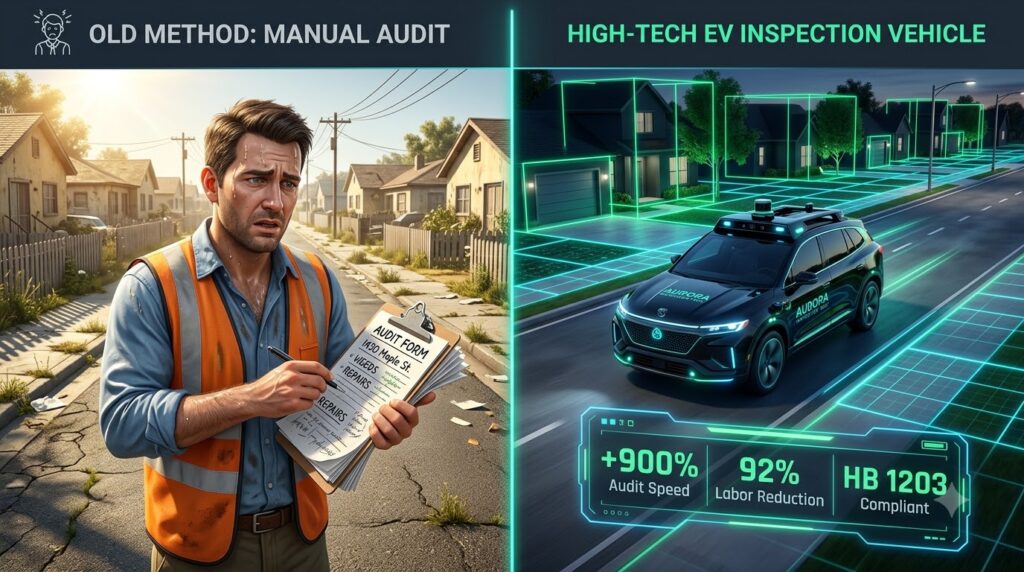
When evaluating manual vs ai property inspections, most property management companies don’t need another generic software dashboard. They need a way to solve the operational bottlenecks that are quietly burning out community managers and eroding operating margins every day. Drive-by CC&R (covenants, conditions, and restrictions) inspections have historically forced licensed managers to act as low-speed transit drivers, resulting in high labor costs and subjective, frequently contested violation notices.
Replacing manual clipboard audits with AI-driven computer vision changes the financial model of community management. However, choosing the wrong deployment path can trigger severe legal liabilities.
Quick Summary
- The Business Problem: Manual HOA inspections consume up to 75 direct labor hours per 1,000 doors monthly, driving a 15–22% resident dispute rate due to poor evidence quality.
- The AI Solution: Vehicle-mounted optical sensors combined with bounding-box computer vision algorithms reduce field capture and administrative logging to 6 hours per month.
- The Limitation: Fully autonomous “AI-to-fine” systems frequently violate statutory governance (such as Florida’s HB 1203). A Human-in-the-Loop (HITL) batch review is legally mandatory.
- Who Benefits Most: Mid-market to enterprise property management firms (2,500 to 50,000+ doors) seeking to scale portfolio coverage without proportional headcount growth.
Comparison: Manual vs. AI-Driven Compliance
| Operational Metric | Legacy Manual Workflow | Computer Vision AI Workflow | Net Business Impact |
| Audit Speed | 40 – 60 doors/hr | 400 – 600 doors/hr | +900% throughput expansion |
| False Positive Rate | 12.0% – 18.0% | 1.5% – 3.0% (post-human review) | 84.7% fewer inaccurate notices |
| Time-to-Notice | 10 – 14 calendar days | 1 – 3 calendar days | 78.6% faster compliance loop |
| Resident Dispute Rate | 15.0% – 22.0% | 3.0% – 5.0% | 77.3% reduction in legal friction |
| Direct Labor per 1k Doors | 75.0 hours/month | 6.0 hours/month | 92.0% reduction in labor overhead |
| Annual Cost per 1k Doors | $63,750 | $13,024 | 79.6% operating cost reduction |

Operational Impact
The manual process fails at scale because manager time scales linearly with unit count. AI decouples data collection from data analysis. By increasing audit throughput to 500 doors per hour, property management companies can safely increase a single manager’s coverage density from 500 doors to over 1,500 doors without sacrificing compliance quality.
Where Manual Workflows Break Down
The legacy inspection paradigm is inherently broken. A community manager drives a neighborhood at 5 to 10 miles per hour. When an infraction is spotted, they stop the vehicle, align a mobile phone camera, capture a blurry photo through a window, and manually transcribe the address against a parcel roster. Back at the office, those photos are manually downloaded, matched to resident ledgers, and pasted into word processing templates.
This introduces two massive operational liabilities. First, the time delay means notices often arrive 14 days after an infraction is resolved, frustrating residents. Second, the visual evidence is usually weak. When residents are presented with low-quality imagery lacking geographical context, they dispute the citation.
Editor’s Perspective
The software wasn’t the bottleneck. The subjective human evidence was. When dispute rates hover near 20%, management companies spend thousands of unbillable hours preparing for administrative hearings instead of acquiring new communities.

How Computer Vision Auditing Works
AI-driven platforms approach field operations entirely differently. A staff member drives the community at standard neighborhood speeds (15 to 25 mph) using continuous dashcam or edge-capture hardware.
- Geospatial Tagging: GPS modules tag video frames with spatial coordinates and parcel boundary polygons in real time.
- Bounding Box Detection: Machine learning networks (like YOLO) detect covenant anomalies—such as unapproved commercial vehicles, architectural modifications, or severe lawn neglect—drawing direct bounding boxes around the object.
- Digital Twin Baselining: The platform compares the current frame against a 3D digital twin of the community to ignore long-standing structural baselines and flag only net-new changes.
- Batch Approval: The manager logs into a web dashboard, views the high-resolution flagged images alongside the statutory rule, and clicks approve or reject. APIs handle the physical mail fulfillment.

The Legal Risk: Why Auto-Fining Fails
If your organization purchases an AI platform that promises fully automated, zero-human-touch fining, you are buying a lawsuit.
Recent statutory reforms severely restrict autonomous enforcement. Florida’s House Bill 1203 serves as the primary legislative blueprint. It caps non-safety HOA fines at $100 per violation, mandates explicit 24-hour grace periods for waste containers around collection days, protects seasonal holiday decorations, and enforces strict 14-day advance notice hearing requirements.
An autonomous camera driving past a house on a Tuesday will flag a visible garbage can. If the system automatically mails a $100 fine, and Tuesday happens to be the municipal collection day, the HOA has just violated state law.
Deployment Insight
Buying AI before understanding state governance usually automates compliance violations. Top-tier platforms embed business-logic rules engines that cross-reference municipal sanitation schedules and seasonal calendars before a manager ever sees the flagged image. Human-in-the-Loop (HITL) batch review is not an inefficiency; it is a legally required shield.
Financial Modeling: Manual vs AI Property Inspections ROI Breakdown
The unit cost of compliance enforcement must account for direct wages, software licensing, vehicle wear, and the administrative burden of resident appeals.
For a mid-market portfolio managing 2,500 single-family doors, the manual baseline requires approximately 2,250 labor hours annually, costing over $113,000 when accounting for labor, mail fulfillment, and dispute overhead. Shifting to an automated AI workflow—including a $0.75 per door/month SaaS subscription and initial hardware CapEx—drops that total operating cost to roughly $39,000 in Year 1.
Over a three-year horizon, an enterprise portfolio of 10,000 units stands to reclaim nearly 25,000 labor hours. That reclaimed time can be redirected toward board advisory services, vendor management, and portfolio expansion.
Final Recommendation
If your firm manages fewer than 500 doors and struggles with basic data cleanliness, upgrading to an AI vision platform will introduce unnecessary technical complexity. Fix your master property data first.
If your organization manages 2,500+ doors and compliance auditing accounts for a disproportionate share of manager turnover, integrating a vehicle-mounted computer vision platform is one of the strongest operational decisions you can make this year.
What to do next: Audit your field labor allocation. Ask your accounting team to isolate exactly how many unbillable hours were spent last quarter driving neighborhoods and responding to disputed violations. Compare that cost against a $0.75 per-door SaaS licensing fee. The decision will make itself.
🔍 Related PropTech, Building Inspection & Enterprise AI Guides
For community association managers, HOA boards, and commercial property executives optimizing inspection workflows, explore our related technical benchmarks and architectural frameworks:
- Computer Vision System Architecture: Deep dive into edge-to-cloud telemetry and GIS mapping in our Automated HOA Violation Enforcement & Computer Vision Architecture.
- Florida Milestone Engineering Compliance: Automate high-rise facade audits and SIRS reserve studies in Florida SB 4-D Compliance Guide: How AI Automates Milestone Property Inspections.
- Autonomous Building Envelope Audits: Discover top UAV photogrammetry tools in our Best AI Property Inspection Software & Drone Tools (2026 Review).
- Private Community AI & Resident Privacy: Protect association financial records and ARC submissions in Air-Gapped AI for HOA Management & Data Governance.
- Automated Violation Management Systems: Streamline notice workflows from capture to resolution in AI HOA Violation Management Guide.
References
- ManageCasaFlorida Community Association Management: 2026 Guidehttps://managecasa.com
- The AI Consulting NetworkAI Property Inspection Automation: Digital Walkthroughshttps://theaiconsultingnetwork.com
- Fix My HOA ViolationFlorida HB 1203: New HOA Fine Protections Explainedhttps://fixmyhoaviolation.com
- MapconComputer Vision AI for Asset Inspection and CMMS Reportinghttps://mapcon.com
- ARCH InspectARCH Inspect — AI-Powered HOA Property Inspectionshttps://archinspect.ai