
When evaluating Zanus AI Server ROI, enterprise software architecture is undergoing a structural economic shift. The rapid transition from fixed per-seat Software-as-a-Service (SaaS) subscriptions to variable, consumption-based artificial intelligence (AI) infrastructure has introduced significant financial volatility into corporate technology budgets. As enterprise organizations integrate Large Language Models (LLMs) into core operational workflows—ranging from automated code refactoring and contract ingestion to real-time process automation—the financial mechanics of public cloud AI Application Programming Interfaces (APIs) present growing cost management challenges.
Variable cloud token billing functions as an unhedged operational expenditure (OpEx) that scales directly with employee usage and data volume. Every incremental prompt, expanded context window, and automated multi-turn agent execution increases the enterprise monthly cloud bill. Replacing recurring cloud API token fees with private, on-premise AI infrastructure presents a clear capital allocation opportunity. Transitioning from public cloud LLM endpoints, such as OpenAI Enterprise or Anthropic Claude, to a dedicated hardware asset—specifically the Zanus AI Server platform—delivers quantifiable Net Present Value (NPV) improvements and accelerates capital payback schedules.
Quick Summary
| Metric / Dimension | Public Cloud AI APIs (OpenAI / Anthropic) | On-Premise Zanus AI Server |
| Accounting Model | Perpetual Variable OpEx | Fixed Capital Asset (CapEx) |
| Marginal Token Cost | $0.15 to $168.00+ per 1M tokens | $0.00 (Unlimited local processing) |
| Seat Licensing Fees | $30 to $60 per user/month | $0.00 (Unlimited users included) |
| Estimated 3-Year TCO | $599,277 | $33,098 |
| Payback Horizon | Never (Ongoing operational rental) | ~40 Days (1.32 Months) |
| Tax Optimization | Standard periodic expense | 100% Sec. 179 / Bonus Depreciation |
| Data Sovereignty | Third-party cloud processing | Air-gapped physical containment |
The Escalating Economics of Cloud AI API Tokens
Evaluating the true total cost of cloud-hosted AI requires enterprise financial modelers to analyze unit economics far beyond the baseline rate cards advertised by public cloud vendors. Public cloud LLM pricing is divided into input token ingestion and output token generation, creating structural cost asymmetries that penalize enterprise data processing at scale.
Token Unit Economics and Asymmetric Cost Structures
Enterprise API rates across flagship frontier models demonstrate a persistent cost disparity between input prompt ingestion and output token generation. Output tokens carry a 4x to 8x price premium over input tokens due to the autoregressive computational intensity of token generation, which requires sequential forward passes through hardware memory bandwidth.
| Model Tier & Provider | Input Rate (USD / 1M Tokens) | Output Rate (USD / 1M Tokens) | Output-to-Input Multiplier |
| OpenAI GPT-4o mini | $0.15 | $0.60 | 4.0x |
| OpenAI GPT-4o | $2.50 | $10.00 | 4.0x |
| OpenAI GPT-5.2 | $1.75 | $14.00 | 8.0x |
| OpenAI GPT-5.2 Pro | $21.00 | $168.00 | 8.0x |
| Anthropic Claude Haiku 4.5 | $1.00 | $5.00 | 5.0x |
| Anthropic Claude Sonnet 4.6 | $3.00 | $15.00 | 5.0x |
| Anthropic Claude Opus 4.6 | $5.00 | $25.00 | 5.0x |
Editor’s Perspective: This structural pricing model severely disadvantages enterprise applications that rely on synthetic document generation, automated software development, or iterative agent reasoning loops, where output volume expands rapidly relative to the initial user prompt.
The Context Window Inflation Tax and Rate Limit Overhead
The primary driver of unexpected expense in enterprise cloud AI deployment is context window inflation. Modern enterprise AI architecture heavily leverages Retrieval-Augmented Generation (RAG) to ground model responses in proprietary corporate knowledge. When an employee submits a query, the enterprise middleware retrieves background files, policy documents, or code libraries and prepends them to the prompt payload.
In multi-turn chat interactions or autonomous workflow agents, the entire cumulative conversation history must be re-sent to the API endpoint on every subsequent turn. While providers offer prompt caching mechanisms to reduce input costs on static system instructions, these savings are constrained by strict Time-To-Live (TTL) timeouts (typically 5 minutes) and require write-surcharges of 25% above standard input base rates. As a result, enterprises pay repeatedly for historical data that has already been ingested in earlier turns.
| Workflow Stage | Injected Context Volume | Direct Input Cost (Sonnet 4.6) | Cumulative Session Input Expense |
| Initial Query (Turn 1) | 1,200 tokens | $0.0036 | $0.0036 |
| Iterative Refinement (Turn 5) | 5,200 tokens | $0.0156 | $0.0480 |
| Complex Workflow (Turn 10) | 9,200 tokens | $0.0276 | $0.1560 |
| Deep RAG Ingestion (Turn 15) | 35,000 tokens | $0.1050 | $0.6810 |
Beyond raw token costs, high-volume API consumption triggers enterprise rate limits. Cloud providers enforce concurrent request and tokens-per-minute (TPM) caps. Operating above these thresholds requires purchasing dedicated throughput capacity—often starting at tens of thousands of dollars per month in commitments—or accepting operational latency, queuing delays, and application throttling that degrade employee productivity.
Modeling Monthly Token Consumption for a Mid-Market Enterprise
To establish a baseline financial model, consider a mid-market enterprise with 75 active knowledge workers utilizing AI tools across three primary business functions: document analysis (legal/compliance), automated coding (engineering), and workflow process execution (operations).
- Active Enterprise Users: 75 knowledge workers
- Operating Schedule: 22 business days per month
- Daily Interaction Volume: 40 discrete AI prompts per user per day
- Average Context Ingestion (Input): 35,000 tokens per interaction (including system prompts, RAG document injection, and conversation history)
- Average Generation Payload (Output): 1,200 tokens per interaction
Monthly Aggregate Token Volumes
Monthly Output Volume:3.6M tokens/day × 22 days = 79,200,000 output tokens/month (79.2 Million)
Daily Input Volume:75 users × 40 prompts × 35,000 tokens = 105,000,000 input tokens/day
Daily Output Volume:75 users × 40 prompts × 1,200 tokens = 3,600,000 output tokens/day
Monthly Input Volume:105M tokens/day × 22 days = 2,310,000,000 input tokens/month (2.31 Billion)
Direct Monthly Cloud Expenditure vs Zanus AI Server ROI
Applying standard enterprise tier pricing for a frontier mid-tier reasoning model (Claude Sonnet 4.6 at $3.00/1M input and $15.00/1M output) yields the baseline direct API usage expense:
Direct API Subtotal:$6,930.00 + $1,188.00 = $8,118.00/month
Monthly Input Cost:2,310M tokens × $3.00 = $6,930.00
Monthly Output Cost:79.2M tokens × $15.00 = $1,188.00
In addition to token usage fees, enterprise public cloud deployments incur fixed platform fees and seat licensing costs. Managed enterprise AI workspaces charge between $30.00 and $60.00 per user per month, while necessary middleware, vector storage, and workflow integration connectors add recurring SaaS costs.
| Expense Category | Monthly Expenditure | Annualized Expenditure | Cost Drivers & Parameters |
| Direct API Token Consumption | $8,118.00 | $97,416.00 | 2.39B total tokens processed / month |
| Enterprise Workspace Seat Licensing | $3,750.00 | $45,000.00 | 75 users at $50.00/user/month |
| Ancillary SaaS Stack & Integration | $3,500.00 | $42,000.00 | Vector DBs, connectors, and security tooling |
| TOTAL CLOUD ENTERPRISE EXPENDITURE | $15,368.00 | $184,416.00 | Fully loaded monthly operational cloud cost |
Under this model, a mid-market enterprise incurs over $184,000 annually in recurring cloud expenses, creating an ongoing operational liability without building long-term balance sheet equity.
The Zanus On-Premise Capital Asset Model
The Zanus AI Server architecture replaces variable, consumption-based operational cloud expenses with a fixed capital asset investment. By deploying enterprise hardware optimized for high-density local inference, organizations eliminate recurring API metering, seat licenses, and third-party rate limits.
Hardware Architecture and System Specifications
The Zanus AI Server product family (featuring the Zanus AI Prime and Zanus AI Quantum platforms) is engineered as a turnkey, air-cooled hardware asset designed for deployment in standard office environments or rack systems without requiring specialized datacenter modifications.
| System Specification | Zanus AI Prime Hardware Configuration | Operational Impact & Strategic Value |
| Capital System Base Price | $19,900.00 (SKU: ZAI-PRS-7700) | Single CapEx transaction; $0 lifetime license fees. |
| Chassis & Enclosure | 8U Whisper-Quiet Office Convertible Form Factor | Placed directly in server closets; zero datacenter rent. |
| Compute Hardware | High-Density Enterprise Inference GPUs | Parallel execution; local deep reasoning models. |
| Local Storage Architecture | Enterprise RAID 10 High-Speed NVMe Array | Holds 2M+ docs & 50,000+ hrs video locally. |
| Thermal & Power Profile | Patented Air Cooling; 90–240V AC Auto-ranging | Standard AC circuits; no 3-phase wiring or liquid loops. |
| Operating System Stack | Zanus AI OS (15+ Built-in Application Modules) | Pre-configured CRM, document analysis, ERP/MES APIs. |
| User & Token Capacity | Unlimited Concurrent Registered Users | Zero per-seat charges; infinite token execution. |
Operational Impact: By shifting compute workloads locally, enterprise organizations eliminate network transit latency, retain full control over data security, and insulate operations from external vendor service outages.
The Mathematics of Zero Incremental Marginal Cost
In public cloud models, total expenditure scales directly with operational activity:
Cloud Cost Function:
Cloud Cost = f(Users, Queries, Input Tokens, Output Tokens)
Because every token processed incurs a marginal unit cost, increasing corporate adoption leads directly to expanding operational expense.
The Zanus on-premise model transforms this financial structure into a fixed capital step-function:
Zanus Cost Function:
Zanus Total Cost = Initial CapEx + Facilities OpEx
Once the capital asset is acquired and operational, the marginal cost of processing an additional token approaches zero:
Marginal Cost per Token: $0.00
Whether an enterprise runs 10,000 queries or 10,000,000 queries per month, software licensing and API charges remain $0.00.
Facility Overhead and Electrical Operating Expense Model
Operating on-premise hardware introduces direct facility costs, primarily electrical power consumption. The Zanus AI platform’s power delivery system eliminates the need for expensive electrical infrastructure upgrades.
- Average Active Compute Load: 2.5 kW under normal operational conditions
- Monthly Operating Hours: 730 continuous operating hours per month
- Monthly Power Volume: $2.5 \text{ kW} \times 730 \text{ hours} = 1,825 \text{ kWh/month}$
- Commercial Electricity Rate (US Average): $0.14 per kWh
- Direct Electrical Expense: $1,825 \text{ kWh} \times \$0.14 = \$255.50/\text{month}$ ($\$3,066.00/\text{year}$)
Combining standard facility electrical costs with an ongoing hardware support and maintenance reserve ($2,000.00/year starting in Year 2) results in a low operational expense footprint compared to cloud alternatives.
3-Year Mathematical TCO Model and Break-Even Analysis
Evaluating the financial transition from cloud APIs to on-premise hardware requires a multi-year Total Cost of Ownership (TCO) model over a 36-month horizon.
Strategic Modeling Parameters
- Enterprise User Base: 75 active internal users.
- Cloud AI Expenditure Growth: Assumes a conservative 15% year-over-year increase in token consumption due to expanding usage and growing document context volume.
- Zanus Hardware Capital Investment: $19,900.00 initial turnkey purchase price (Zanus AI Server Prime) placed in service in Month 1.
- Hardware Maintenance & SLA Reserve: Budgeted at $0.00 in Year 1 (included under warranty) and $2,000.00 annually in Years 2 and 3.
- Facilities & Electrical Power Expense: Modeled at a constant $255.50 per month ($3,066.00 per year).
3-Year Mathematical Financial Comparison Table
| Cost Category | Year 1 Expenditure | Year 2 Expenditure | Year 3 Expenditure | Cumulative 3-Year Total |
| Cloud: Workspace Seat Licenses | $45,000.00 | $45,000.00 | $45,000.00 | $135,000.00 |
| Cloud: Direct API Token Fuel | $97,416.00 | $112,028.40 | $128,832.66 | $338,277.06 |
| Cloud: Ancillary SaaS & Integrations | $42,000.00 | $42,000.00 | $42,000.00 | $126,000.00 |
| CUMULATIVE CLOUD AI TCO | $184,416.00 | $199,028.40 | $215,832.66 | $599,277.06 |
| Zanus AI: Turnkey Hardware CapEx | $19,900.00 | $0.00 | $0.00 | $19,900.00 |
| Zanus AI: Maintenance & Hardware SLA | $0.00 | $2,000.00 | $2,000.00 | $4,000.00 |
| Zanus AI: Facilities Power & Cooling | $3,066.00 | $3,066.00 | $3,066.00 | $9,198.00 |
| CUMULATIVE ZANUS AI TCO | $22,966.00 | $5,066.00 | $5,066.00 | $33,098.00 |
| NET ANNUAL CASH SAVINGS | $161,450.00 | $193,962.40 | $210,766.66 | $566,179.06 |
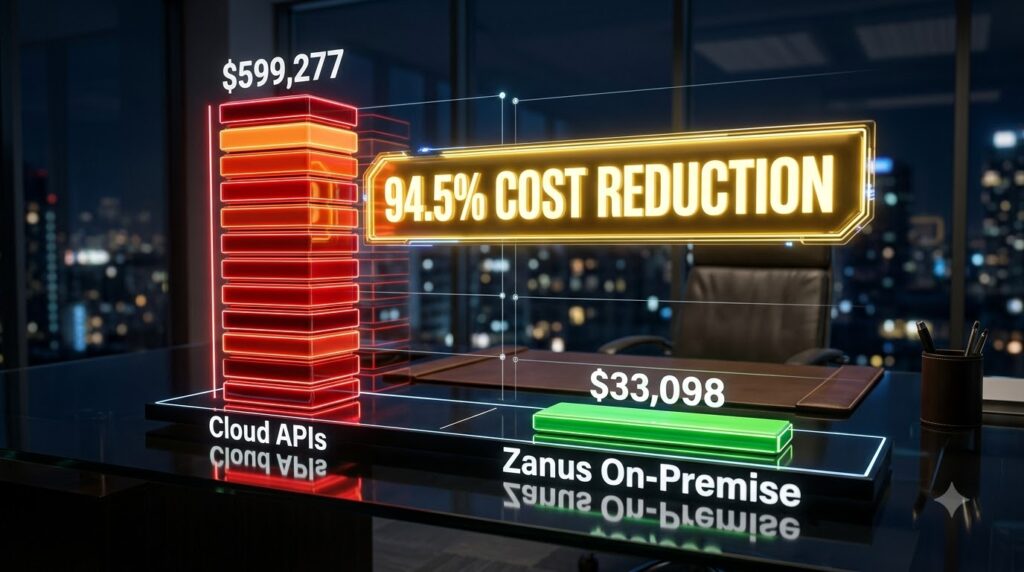
Over three years, deploying the Zanus AI platform reduces total AI infrastructure spend from $599,277.06 to $33,098.00, yielding a cumulative net cash savings of $566,179.06 (a 94.5% overall cost reduction).
   CUMULATIVE 3-YEAR INFRASTRUCTURE EXPENSE
   ─────────────────────────────────────────────────────────────
   Public Cloud APIs  ██████████████████████████████████ $599,277
   Zanus On-Premise   ██ $33,098  [NET SAVINGS: $566,179]
   ─────────────────────────────────────────────────────────────
Mathematical Break-Even and Payback Period Calculation
The exact Break-Even Point measures the time (in calendar months) required for net operational savings to amortize the initial hardware capital expenditure.
Payback Period Formula:
Payback Period (Months) = Initial Capital Expenditure / (Monthly Baseline Cloud Cost – Monthly Local Infrastructure OpEx)
Where:
- Initial Capital Expenditure: $19,900.00
- Monthly Baseline Cloud Cost: $15,368.00
- Monthly Local Infrastructure OpEx: $255.50
Calculations:
- Net Monthly Operational Savings:$15,368.00 – $255.50 = $15,112.50 / month
- Payback Period (Months):$19,900.00 / $15,112.50 = 1.316 Months
- Payback Period (Days):1.316 Months × 30 Days/Month ≈ 39.5 Days
Under standard enterprise operational workloads, the Zanus AI platform reaches full financial break-even in approximately 40 calendar days.nal workloads, the Zanus AI platform reaches full financial break-even in approximately 40 calendar days.
Payback Sensitivity Analysis Across Organization Sizes
| Organization Scale | Monthly Cloud Expenditure | Initial Zanus CapEx | Net Monthly Savings | Amortization Payback Period |
| 25 Active Users | $5,122.67 | $19,900.00 | $4,988.17 | 3.99 Months (~120 Days) |
| 50 Active Users | $10,245.33 | $19,900.00 | $10,030.83 | 1.98 Months (~59 Days) |
| 75 Active Users | $15,368.00 | $19,900.00 | $15,112.50 | 1.32 Months (~40 Days) |
| 100 Active Users | $20,490.67 | $19,900.00 | $20,176.17 | 0.99 Months (~30 Days) |
| 250 Active Users | $51,226.67 | $39,800.00 (2 Units) | $50,581.67 | 0.79 Months (~24 Days) |
Deployment Insight: Even for smaller teams of 25 users, capital amortization occurs within four months, making on-premise hardware financially viable across various enterprise operational scales.
Qualitative Financial Advantages and Strategic Risk Mitigation
Beyond direct TCO improvements, executive financial leaders must evaluate enterprise risk reduction, regulatory compliance, and corporate tax optimization strategies when making capital allocation decisions.
Enterprise Data Privacy Insurance and Breach Liability Mitigation
Transmitting proprietary corporate data, intellectual property, trade secrets, or regulated customer records to cloud-hosted API endpoints exposes organizations to material compliance liabilities. Under global regulatory frameworks such as HIPAA in healthcare, GDPR in the European Union, and the EU AI Act, organizations remain legally accountable for third-party data exposures. Cloud providers operate under standard Data Processing Agreements (DPAs) that limit vendor liability while transferring compliance obligations back to the enterprise client.
The financial impact of a data breach includes regulatory fines, legal defense fees, customer notification costs, and reputational damage. Deploying an air-gapped on-premise Zanus AI Server eliminates these external data transfer risks. Because corporate files, vector embeddings, and LLM inferences remain entirely within the physical premises of the company, the enterprise maintains absolute data sovereignty. This architecture functions as self-funded data privacy insurance, reducing exposure to third-party cloud breaches and simplifying regulatory audits.
IT Budgeting Predictability vs. Volatile Cloud Token Spikes
Consumption-based cloud billing introduces financial unpredictability into IT budgeting. Unforeseen spikes in monthly API bills can occur when engineering teams deploy recursive agent loops, business units run large document ingestion projects, or employees adopt new automated workflows. This volatility creates friction for corporate finance teams, who must manage unexpected budget overruns or enforce usage caps that constrain operational productivity.
Transitioning to on-premise hardware converts variable cloud bills into a fixed, predictable operating model. Facilities electricity cost remains stable and predictable, allowing finance leaders to project annual IT budgets with accuracy while enabling business units to utilize AI tools without cost concerns.
US Corporate Tax Strategy: Section 179 and Bonus Depreciation Optimization
Purchasing on-premise server hardware provides favorable corporate tax treatment compared to recurring cloud SaaS expenses. Under United States tax law, purchasing capital equipment allows businesses to accelerate expense deductions, reducing near-term corporate tax liabilities and preserving operational cash flow.

IRS Section 179 Expensing Provisions
Under Internal Revenue Code Section 179 regulations, qualified businesses can immediately expense the full purchase price of eligible hardware and off-the-shelf technology assets placed in service during the tax year. For tax years beginning in 2026, the maximum Section 179 deduction limit is $2,560,000, with phase-out thresholds beginning at $4,090,000 in total capital equipment purchases.
100% First-Year Bonus Depreciation
For purchases exceeding Section 179 limits or for enterprises optimizing broader capital equipment schedules, federal tax law permanently restored 100% first-year Bonus Depreciation under IRC §168(k) for qualifying assets placed in service. Computer hardware assets also qualify under the standard 5-year Modified Accelerated Cost Recovery System (MACRS) schedule if progressive multi-year depreciation is preferred.
Comprehensive First-Year Tax Savings Analysis
Assuming an enterprise acquires a Zanus AI Server asset for $19,900.00 and elects full Section 179 expensing or 100% Bonus Depreciation in Year 1:
Effective After-Tax Net Asset Outlay (35% Rate):$19,900.00 – $6,965.00 = $12,935.00
First-Year Tax Depreciation Asset Basis: $19,900.00
Tax Savings at 21% Federal C-Corp Rate:$19,900.00 × 0.21 = $4,179.00
Tax Savings at 35% Combined Federal & State Rate:$19,900.00 × 0.35 = $6,965.00
Effective After-Tax Net Asset Outlay (21% Rate):$19,900.00 – $4,179.00 = $15,721.00
| Financial Parameter | Standard Cloud SaaS Model | Zanus AI Asset (21% Tax Rate) | Zanus AI Asset (35% Tax Rate) |
| Gross Year 1 Cash Outflow | $184,416.00 | $22,966.00 | $22,966.00 |
| First-Year Tax Deduction Allowed | $184,416.00 (OpEx) | $22,966.00 (CapEx + Power) | $22,966.00 (CapEx + Power) |
| First-Year Direct Cash Tax Offset | $38,727.36 | $4,822.86 | $8,038.10 |
| NET EFFECTIVE YEAR 1 OUTLAY | $145,688.64 | $18,143.14 | $14,927.90 |

Factoring tax deduction benefits into the capital asset model reduces the net effective hardware cost, accelerating payback to under 31 calendar days.
Final Recommendation & Strategic Action Plan
Editor’s Take: Who Should Buy vs. Who Should Avoid
If your organization runs ongoing operational AI workflows with more than 20–25 active knowledge workers, processes sensitive corporate data, or utilizes high-context RAG pipelines, then transitioning to an on-premise hardware platform like the Zanus AI Server provides a clear ROI advantage because it converts unpredictable public cloud token billing into a fixed, tax-deductible capital asset that reaches full payback in roughly 40 days.
- Choose Zanus AI Server if:
- You spend more than $3,000/month on cloud LLM API tokens.
- You process sensitive regulatory data (HIPAA, GDPR, proprietary code/IP).
- Your organization wants stable IT budget forecasting without usage caps.
- You want to utilize Section 179 / Bonus Depreciation tax offsets.
- Avoid / Stay on Cloud APIs if:
- You are a early-stage startup with sporadic, low-volume AI queries.
- You require occasional access to massive multimodal models exceeding local GPU memory limits.
- Your organization lacks basic physical server cabinet space or local network facilities.
Recommended Next Steps for Technology Leaders
- Audit Monthly Token Spend: Review API invoice logs from OpenAI, Anthropic, and SaaS vendors to calculate your true 12-month fully loaded cloud spend.
- Evaluate Data Security Overhead: Assess the risk and compliance burden of transmitting proprietary customer or company documents through cloud API endpoints.
- Model Section 179 Capital Deductions: Work with your finance and corporate tax teams to evaluate the immediate tax offsets available for acquiring on-premise hardware before fiscal year-end.
- Schedule Infrastructure Evaluation: Request a hardware workload assessment and ROI comparison at Zanus AI.
Frequently Asked Questions (FAQ)
How does on-premise AI performance compare to frontier public cloud APIs?
Modern enterprise inference hardware running open-weights reasoning models delivers comparable output quality for standard enterprise tasks (document retrieval, contract analysis, code generation) with lower latency, as on-premise execution avoids public internet network round-trips and API queueing constraints.
What technical skills are required to manage a Zanus AI Server?
The Zanus AI Server runs Zanus AI OS, a pre-configured operating platform with built-in UI dashboards, CRM/ERP integration connectors, and automated hardware management tools. It functions as a plug-and-play appliance that does not require specialized machine learning engineering staff to maintain.
What happens if our AI token consumption doubles or triples next year?
Under a public cloud API model, doubling token consumption doubles your monthly bill. On a Zanus AI Server, local processing capacity remains unlimited at $0 additional cost, allowing your enterprise to scale usage without financial penalty.
🔍 Related Enterprise AI ROI & Infrastructure Guides
For CFOs, IT leaders, and procurement managers evaluating on-premises AI deployments, explore our related technical analyses and financial guides:
- Pricing & Hardware Tiers: Review detailed price points and specs in our Zanus AI Server Pricing Guide 2026.
- Sovereignty & Security: Discover how air-gapped systems eliminate breach liabilities in Unlocking Sovereign AI: Why Air-Gapped Zanus AI Servers Win.
- Zero-Cloud Voice AI: Evaluate contact center cost reductions in our guide to The Zero-Cloud Zanus AI Call Center Architecture.
- Full Platform Assessment: Read our comprehensive evaluation of software OS modules in the Zanus AI Comprehensive Platform Review.
- Appliance vs. Server: Compare turnkey appliances with custom builds in Zanus AI Appliance vs. Dedicated AI Server.
References
- Zanus AI Systems — Zanus AI Prime | Private On-Premises AI Server — No Cloud, Own Foreverhttps://zanusai.com/products/prime
- Zanus AI Manufacturing — On-Premises AI Software for Industrial and Manufacturing Workflowshttps://zanusai.com/industry/manufacturing
- Anthropic — Claude 3.5 & 4.6 Pricing Models and System Capabilitieshttps://www.anthropic.com/pricing
- Internal Revenue Service (IRS) — Section 179 Depreciation Deduction Limits & Qualifying Property Guidelineshttps://www.section179.org
- IntuitionLabs — Comprehensive LLM API Cost Analysis: OpenAI, Gemini, Claude & Grokhttps://intuitionlabs.ai/blog/llm-api-pricing-guide
- Block Advisors / H&R Block — Enterprise Hardware Tax Depreciation & Bonus Depreciation Guidehttps://www.blockadvisors.com/resource-center/small-business-tax/section-179-deduction-guide