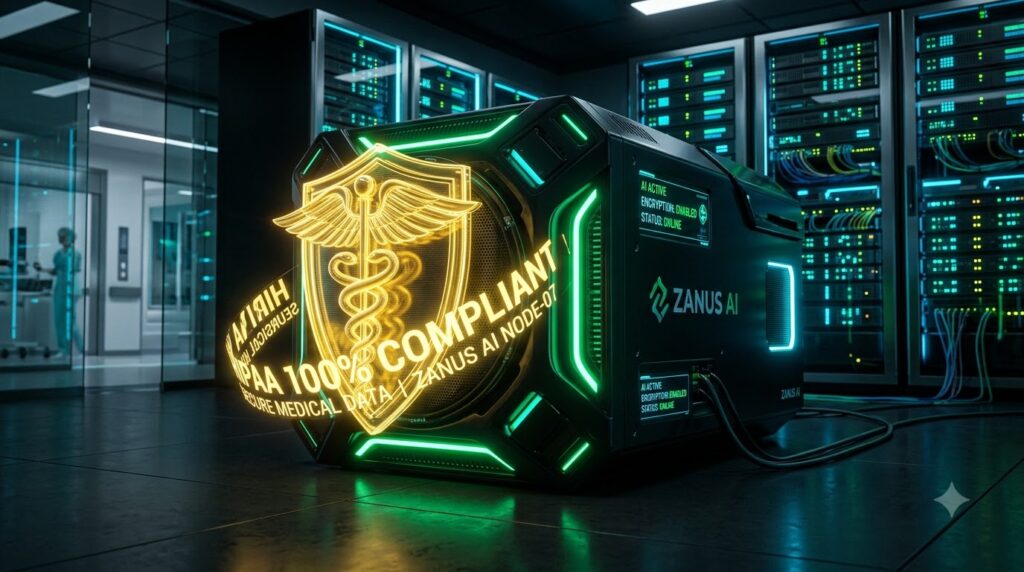
When evaluating a truly zanus hipaa compliant ai infrastructure, artificial intelligence has rapidly transitioned from an experimental pilot to an operational baseline across the United States healthcare ecosystem. Physician adoption climbed from 38% in 2023 to 81% in 2026. However, the overwhelming majority of early clinical AI deployments rely on public cloud infrastructure, remote Software-as-a-Service (SaaS) platforms, and hosted Large Language Model (LLM) APIs.
This dependence on external cloud architectures creates severe legal, financial, and operational vulnerabilities under the Health Insurance Portability and Accountability Act (HIPAA) Privacy and Security Rules.
Transmitting electronic Protected Health Information (ePHI) across public wide-area networks (WANs) exposes covered entities to systemic cyber threats, vendor supply-chain breaches, and impermissible disclosures. With healthcare data breaches reaching an all-time high of 772 major incidents in 2025—affecting nearly 139.7 million individuals at an average cost of $7.42 million per incident—health system leadership faces unprecedented regulatory scrutiny.
Civil monetary penalties enforced by the Department of Health and Human Services (HHS) Office for Civil Rights (OCR) now reach up to $2,190,294 per violation category annually for uncorrected willful neglect, making cloud-based compliance gaps an existential threat to healthcare organizations.
Standard Business Associate Agreements (BAAs) offered by cloud vendors often provide an illusion of security, shifting contractual liability post-breach without altering the underlying technical risk of external data egress. To achieve true compliance and operational resilience, healthcare institutions must move beyond contractual promises to hardware-enforced architectural containment.
Key Takeaway: A signed Business Associate Agreement (BAA) is a legal agreement, not a technical control. It does not stop a cloud subprocessor breach, prevent a WAN outage, or alter the physical location of your patients’ data.
1. Legal and Regulatory Vulnerabilities of Cloud AI
PHI Exposure Vectors Under HIPAA Rules
The HIPAA Privacy Rule (45 CFR Part 160 and Subparts A and E of Part 164) establishes strict standards for using and disclosing Individually Identifiable Health Information. Section 164.514 details 18 specific categories of Protected Health Information (PHI). These extend beyond patient names and Social Security numbers to include dates of service, geographic subdivisions smaller than a state, facility admission/discharge timelines, device serial numbers, full-face photos, and unique patient record numbers.
When a clinician inputs unstructured progress notes, dictation audio, or diagnostic summaries into a cloud-hosted AI application, the transmission inevitably contains multiple overlapping PHI identifiers. Under 45 CFR Section 164.502, any transmission of PHI to an external entity without a valid authorization or an enforceable BAA constitutes an impermissible disclosure.
The technical mechanics of public cloud AI endpoints present three inherent exposure vectors under the HIPAA Security Rule (45 CFR Part 164, Subpart C):
- Data Transmission Over External Infrastructure: Transmitting audio streams or unstructured text prompts over public wide-area networks introduces interception risks, transit routing vulnerabilities, and Man-in-the-Middle (MitM) exposure vectors before data ever reaches the destination data center.
- Remote Caching and Multi-Tenant Storage: Cloud AI vendors buffer, log, and temporarily store incoming API payloads across distributed server clusters. Even when data is encrypted at rest, multi-tenant cloud storage engines present cross-tenant leakage risks and unauthorized administrative access points.
- Ransomware and Third-Party Availability Threats: HHS guidance affirms that if ePHI is rendered inaccessible or encrypted due to a ransomware attack on a third-party vendor’s infrastructure, an impermissible disclosure and security incident has occurred, triggering statutory breach notification mandates.
HHS OCR has expanded its enforcement focus to target comprehensive risk analysis and risk management failures regarding third-party software integrations. Relying on cloud AI architectures means accepting perpetual breach exposure where a single technical vulnerability in a vendor’s remote stack can trigger multi-million dollar class-action litigation and OCR civil monetary penalties.
Contractual Illusion vs. Architectural Containment
A common compliance oversight among healthcare IT leaders is equating the execution of a BAA with absolute HIPAA compliance. A BAA is a legal risk-shifting instrument required under 45 CFR Section 164.502(e); it does not modify software architecture or eliminate technical security vulnerabilities. While a signed BAA binds a vendor to statutory obligations, it leaves the covered entity fully exposed to the operational and reputational fallout of a cloud-side security incident.
Public cloud AI providers operate under structural constraints that undermine standard BAAs:
- Unmonitored Subprocessor Supply Chains: Cloud AI architectures rarely operate in isolation. Modern LLM APIs rely on complex supply chains involving third-party hosting facilities, external vector database providers, model optimization services, and content moderation endpoints. Under 45 CFR Section 164.502(e)(1)(ii), a business associate must ensure that any subprocessors agree to the same restrictions. However, auditing multi-tiered, offshore, or dynamic cloud subprocessor networks is practically impossible for hospital compliance officers.
- Persistent Logging and System Telemetry: Cloud providers regularly retain API call logs, prompt metadata, and user telemetry for diagnostic, anti-abuse, or service-monitoring purposes. Even when vendors commit to “zero data retention” for model training, system logs containing embedded PHI often persist on remote servers for 30 days or longer, remaining vulnerable to cloud breaches, insider threats, or legal subpoenas.
- Model Fine-Tuning and Indirect Leakage: Unless explicit, custom enterprise contract clauses are negotiated at high cost, standard cloud AI terms may permit vendor systems to utilize user inputs for service improvement or model refinement. If clinical prompts containing rare medical histories or unique demographic combinations are processed into weights during model fine-tuning, that information can potentially be reconstructed or leaked through prompt-injection attacks executed by external users.
- Unilateral Policy Modifications: SaaS vendors reserve the right to update privacy policies, terms of service, and subprocessor lists with short notice. A platform that is compliant at initial procurement can become non-compliant following a corporate acquisition, infrastructure migration, or policy amendment.
In contrast to contractual risk-shifting, architectural containment eliminates compliance risk by making data egress physically and logically impossible. When AI processing occurs entirely on local hardware owned and controlled by the hospital, patient data never leaves the building, third-party subprocessors do not exist, and remote cloud breaches cannot compromise local operations.
| Architectural Domain | Public Cloud AI APIs & Medical SaaS | Private Zanus Medical AI Server | Compliance Implication |
| Physical Data Location | Distributed external cloud data centers | Local physical hardware inside hospital data closet | Direct compliance control over physical media under Section 164.310 |
| Data Perimeter | Transmitted across public WAN / Internet links | Restricted entirely to local network LAN | Eliminates WAN transit interception risks under Section 164.312(e) |
| Air-Gap Capability | None; completely dependent on WAN connectivity | Full air-gap operation; functions without internet | Ensures clinical continuity during internet outages or cyberattacks |
| Subprocessor Exposure | Multi-tiered third-party subprocessor supply chain | Zero third-party subprocessors or external vendors | Removes subprocessor auditing burdens under Section 164.502(e) |
| Model Training Risk | Contractual promise against training on prompts | Hardware-isolated models running read-only locally | Absolute guarantee that PHI never leaves local instance |
| System Telemetry & Logs | Stored remotely on vendor servers for 30+ days | Encrypted locally on server NVMe drives | Full control over log retention, auditing, and deletion |
| Financial / Fee Model | Perpetual per-seat fees + API token charges | One-time purchase / financed capital asset | Replaces variable SaaS debt with predictable CapEx asset |
Editor’s Perspective: The Legal Reality of BAAs
Do not let a vendor’s BAA lull your legal team into a false sense of security. When a cloud vendor suffers a breach, the BAA gives you standing to sue the vendor—it does not shield your health system from HHS OCR fines, reputational damage, or class-action lawsuits filed by patients whose data was exposed. Hardware-level isolation converts risk management from a game of legal damage control into total physical prevention.
2. Technical Architecture of Zanus HIPAA Compliant AI Server
Hardware Architecture and Air-Gapped Network Perimeter
The Zanus Medical AI Server is an enterprise hardware appliance engineered specifically for secure, low-latency clinical AI processing within healthcare environments. Unlike general-purpose IT hardware that requires complex manual configuration, the Zanus system arrives pre-configured as a dedicated private AI appliance housing enterprise-grade GPUs, high-speed encrypted NVMe storage arrays, and pre-installed clinical language models running on the Zanus AI Operating System.
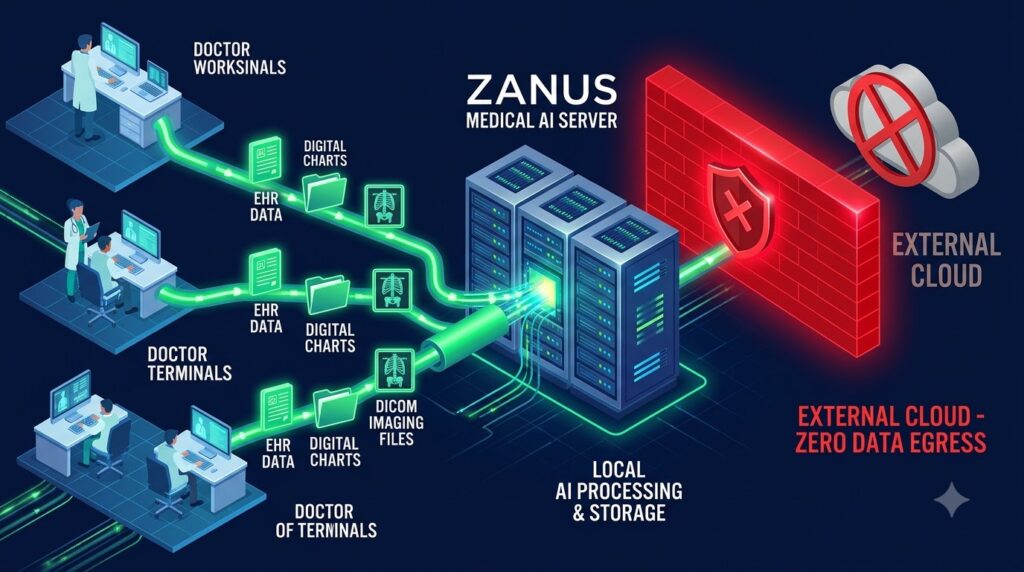
The physical deployment model follows a plug-and-play methodology designed for healthcare practices and regional hospitals without large internal software development or IT teams. The appliance integrates into the institution’s internal network architecture through a single Ethernet connection. It operates as a local network node, eliminating the need for rack reconfigurations, external proxy servers, or complex gateway setups.
A core technical differentiator of the Zanus architecture is its true air-gapped deployment capability. While cloud-dependent AI applications immediately cease functioning during internet connectivity disruptions, the Zanus Medical AI Server executes all model inference, vector searches, document generation, and speech-to-text processing locally on its internal GPU engines. During a wide-area network failure, fiber cut, or external cyberattack targeting hospital ISP infrastructure, local clinical workflows—including ambient scribing, emergency department intake triage, and EHR chart summarization—continue without interruption.
Physical and hardware-level authorization is anchored by a hardware USB activation security dongle shipped directly with the server chassis. This physical security component ensures that the operating system, cryptographic keys, and pre-installed clinical LLMs cannot be copied, transferred, or activated on unauthorized external hardware, providing physical access control aligned with NIST SP 800-66 Rev. 2 standards.
Ingestion Engine and Precision Vector Store
To deliver actionable clinical value, an AI system must interact seamlessly with existing clinical record systems while drawing context from institutional knowledge bases. The Zanus AI platform achieves this through a dual-architecture framework comprising universal healthcare software integration and a private, localized Retrieval-Augmented Generation (RAG) engine known as the Precision Vector Store.
System integration with existing hospital infrastructure is established via standard healthcare communication interfaces:
- HL7 and FHIR API Connectors: The server natively processes Health Level Seven (HL7) messaging streams and Fast Healthcare Interoperability Resources (FHIR) RESTful APIs, enabling bidirectional communication with leading EHR/EMR platforms, including Epic, Cerner, and athenahealth.
- Multi-Modal Document Parsing: The ingestion engine continuously processes unstructured clinical progress notes, History and Physical (H&P) documents, discharge summaries, and radiology report text.
- DICOM Text Summary Ingestion: While raw pixel-level radiological imaging remains within Picture Archiving and Communication Systems (PACS), the Zanus server ingests structured DICOM header data and textual radiologist impressions to construct comprehensive patient diagnostic summaries.
┌─────────────────────────────────────────────────────────────────────────┐
│              LOCAL HIGH-THROUGHPUT MEDICAL DATA PIPELINE                │
└─────────────────────────────────────────────────────────────────────────┘
                                     │
┌────────────────────────────────────┴────────────────────────────────────┐
│                       Ingestion & Interoperability                      │
│  • EHR/EMR Integration via HL7 / FHIR APIs (Epic, Cerner, athena)       │
│  • DICOM Radiologist Text Summaries & Imaging Reports                   │
│  • Unstructured Notes, H&Ps, Consults, & Dictation Audio                │
└────────────────────────────────────┬────────────────────────────────────┘
                                     │
                                     ▼
┌─────────────────────────────────────────────────────────────────────────┐
│                      Private Local Server Perimeter                     │
│  • Local Hardware GPU Inference Engine (Zero External WAN Egress)       │
│  • Hardware USB Security Dongle Physical Licensing                      │
│  • Precision Vector Store (Local Encrypted RAG Engine)                  │
└────────────────────────────────────┬────────────────────────────────────┘
                                     │
                                     ▼
┌─────────────────────────────────────────────────────────────────────────┐
│                   Standardized EHR & Clinical Outflow                   │
│  • Real-Time Ambient Dictation & Automated SOAP Note Synthesis           │
│  • Evidence-Based Diagnostic Risk Scores & Protocol Retrieval           │
│  • Automated Billing, Prior-Auth, & Structured EHR Field Population      │
└─────────────────────────────────────────────────────────────────────────┘
The operational engine behind context-aware retrieval is the Precision Vector Store. Operating directly on the server’s local NVMe storage arrays, this vector database converts clinical text into high-dimensional mathematical embeddings. Hospital administrators can upload institutional Standard Operating Procedures (SOPs), specialized clinical protocols, facility formulary lists, consent templates, and practice guidelines directly into the vector store.
When a provider queries the system, the Precision Vector Store performs semantic searches across the locally indexed knowledge base in milliseconds. The underlying language models generate precise answers anchored strictly in the hospital’s verified clinical protocols, complete with internal source citations. Because the vector store operates within the encrypted local perimeter, institutional intellectual property and clinical guidelines are never shared with external model developers or cloud repositories.
3. Clinical and Operational Use Cases Enabled Locally
Automated Pre-Charting and Scribing Synthesis
Clinical documentation represents one of the most resource-intensive administrative burdens in modern healthcare delivery, contributing directly to provider fatigue and operational inefficiencies. The Zanus Medical AI Server addresses this challenge through automated, real-time clinical note generation and pre-charting modules that function entirely within the hospital’s local network.
During a patient encounter, ambient audio captured via an endpoint device is streamed directly across the local LAN to the Zanus hardware GPU engine. The server processes the speech stream locally, performing speech-to-text conversion, speaker identification, and medical entity extraction without transmitting audio files to third-party cloud APIs.
The software automatically synthesizes ambient visit conversations into structured clinical formats:
- SOAP Note Synthesis: Extracts subjective patient complaints, objective examination findings, diagnostic assessments, and proposed treatment plans, populating standardized SOAP templates customized to specific medical specialties.
- Automated Physician Pre-Charting: Prior to a scheduled encounter, the AI reviews historical patient EHR records, synthesizing recent lab trends, active problem lists, historical surgical procedures, and outstanding consults into a concise pre-visit briefing for the attending clinician.
- Discharge & Referral Generation: Converts complex inpatient records into comprehensive discharge summaries, patient-facing care instructions written in plain language, and specialty referral letters ready for provider review and electronic signature.
By automating chart preparation and visit documentation, the platform reduces the manual keying of structured clinical data into the EHR. Once approved by the clinician, completed progress notes are injected directly into the EHR via local FHIR/HL7 interfaces, closing patient charts before the provider leaves the exam room.
Private Diagnostic Decision Support and Medical Literature Search
Beyond administrative documentation, the Zanus Medical AI Server acts as an on-demand, private clinical decision support assistant for attending physicians, residents, and nursing staff.
Because clinical decision support requires interacting with sensitive patient data—such as symptom profiles, lab values, and diagnostic imaging summaries—executing these workflows on public cloud LLMs presents severe privacy risks. Operating on-premise eliminates this concern, enabling providers to query the AI using full patient contexts.
Key clinical decision support functions include:
- Diagnostic Differential & Risk Stratification: The system analyzes complex, unstructured symptom profiles alongside real-time physiological inputs to suggest evidence-based differential diagnoses. Additionally, it computes automated risk scores for critical conditions such as hospital-acquired sepsis, acute cardiac events, and stroke progression based on longitudinal EHR data.
- Medication Interaction & Formulary Verification: When treatment plans are formulated, the AI cross-references proposed prescriptions against the patient’s active medication lists, allergy profiles, and the hospital’s locally uploaded formulary guidelines, flagging contraindications and recommending preferred therapeutic alternatives.
- Private Clinical Literature & Protocol Search: Clinicians can query institutional care pathways using natural language search queries. The Precision Vector Store retrieves exact protocol steps from internal medical guidelines, providing instant, cited guidance for complex cases such as rare disease management or specialized post-operative care.
Hospital Operational Workflow Automation
The Zanus AI software suite includes over 15 pre-installed modules that automate routine administrative tasks, consolidate software stacks, and streamline hospital operations.
┌─────────────────────────────────────────────────────────────────────────┐
│                  ZANUS AI INTEGRATED MODULE ECOSYSTEM                   │
└─────────────────────────────────────────────────────────────────────────┘
                                     │
┌────────────────────────────────────┴────────────────────────────────────┐
│                        Clinical Care & Documentation                    │
│  • Ambient AI Clinical Scribe & Progress Note Synthesizer               │
│  • Automated Physician Pre-Charting & Chart Summarization Engine        │
│  • Custom Role-Based Clinical AI Agents & Triage Assistant              │
└────────────────────────────────────┬────────────────────────────────────┘
                                     │
┌────────────────────────────────────┴────────────────────────────────────┐
│                     Revenue Cycle & Operations Engine                   │
│  • AI Medical Billing & Coding (ICD-10 / CPT Auto-Suggestions)          │
│  • Automated Prior-Authorization Documentation Drafting                 │
│  • Dynamic Patient Scheduling & Cancellation Management                 │
└────────────────────────────────────┬────────────────────────────────────┘
                                     │
┌────────────────────────────────────┴────────────────────────────────────┐
│                   Quality, Governance, & Administration                 │
│  • Real-Time Compliance Metric Tracking & Accreditation Dashboards      │
│  • Automated Staff Protocol Training & Interactive Competency Testing   │
│  • Private Patient Communication Portal & Outbound Engagement           │
└─────────────────────────────────────────────────────────────────────────┘
- AI Medical Billing and Coding: The software reviews finalized progress notes and diagnostic summaries, suggesting appropriate ICD-10-CM diagnosis codes and CPT procedure codes. By identifying missing documentation requirements prior to claim submission, the system reduces billing error rates and speeds up reimbursement cycles.
- Prior Authorization Automation: The system automatically aggregates clinical justification notes, diagnostic imaging reports, and historical conservative treatment records, drafting complete prior-authorization packets for insurance submission.
- Automated Patient Triage and Scheduling: A patient-facing virtual intake assistant evaluates incoming patient symptom descriptions, categorizing urgency based on clinical protocols. The module directs patients to appropriate care settings (telehealth, clinic visit, or emergency department) and books appointments directly in the scheduling module.
- Staff Protocol Onboarding and Training: When new medical equipment or clinical protocols are introduced, the AI delivers interactive, step-by-step training modules to nursing and administrative staff, executing local competency assessments without requiring third-party learning platforms.
Deployment Insight: Workflow Bottlenecks
Implementing AI for ambient scribing yields immediate physician satisfaction gains, but the administrative true ROI lies in pairing scribing with automated prior authorizations and billing code generation. Combining clinical input with automated administrative throughput addresses the operational bottlenecks that drive hospital revenue loss.
4. Security Framework & Compliance Mapping
Alignment with NIST SP 800-66 Rev. 2 Safeguards
The HIPAA Security Rule requires healthcare organizations to implement comprehensive Administrative, Physical, and Technical Safeguards to maintain the confidentiality, integrity, and availability of electronic PHI. The National Institute of Standards and Technology (NIST) Special Publication 800-66 Rev. 2 serves as the primary federal cybersecurity roadmap for operationalizing HIPAA Security Rule requirements.
The Zanus Medical AI Server aligns directly with NIST SP 800-66 Rev. 2 guidelines by enforcing security controls natively within its hardware and software layers.
Administrative Safeguards (45 CFR Section 164.308)
- Risk Management and Threat Containment (Section 164.308(a)(1)(ii)(B)): Local deployment eliminates entire classes of remote threats, including cloud API hijacking, third-party subprocessor breaches, and wide-area network eavesdropping.
- Information Access Management (Section 164.308(a)(4)): Enforces strict Role-Based Access Control (RBAC) protocols. Clinical staff access patient records and documentation tools based on job role, while administrative personnel are restricted to scheduling or billing interfaces.
- Multi-Tenant Isolation Management: For multi-hospital systems or regional practice groups operating on a single Zanus server, the software enforces logical multi-tenancy. Patient records, vector databases, and user access logs are cryptographically isolated per tenant, preventing cross-departmental or cross-facility data leakage.
Physical Safeguards (45 CFR Section 164.310)
- Facility Access Controls (Section 164.310(a)(1)): The server resides entirely within the hospital’s physically secure data room, protected by badge access controls, physical lock systems, and environmental monitoring.
- Device and Media Controls (Section 164.310(d)(1)): System licensing and cryptographic keys are tethered to a physical USB hardware dongle. System drives use hardware-based self-encrypting media, ensuring that media sanitization or disposal complies with federal standards.
Technical Safeguards (45 CFR Section 164.312)
- Access Control & Identity Authentication (Section 164.312(a)(1)): Integrates with local enterprise active directory systems, enforcing Single Sign-On (SSO) and Multi-Factor Authentication (MFA) across all local endpoints.
- Audit Controls & Monitoring (Section 164.312(b)): Centralized, tamper-resistant audit logging records every user interaction, system prompt, vector query, and clinical note generation. Logs are retained locally and can be ingested into central Security Information and Event Management (SIEM) systems for real-time threat detection.
- Local Data Encryption (Section 164.312(a)(2)(iv) & Section 164.312(e)(1)): All static data, vector indexes, and system databases are protected by AES-256 bit encryption at rest. Data transmitted across the hospital LAN between endpoint devices and the server is secured via local TLS 1.2+ encryption.
HIPAA Security Rule Compliance Mapping
| HIPAA Security Rule Standard | Implementation Specification (45 CFR) | Regulatory Requirement | Zanus On-Premise Technical Solution | Compliance Evidence Artifact |
| Access Control | Section 164.312(a)(1) Unique User Identification | Required | Assigns unique IDs to every user; integrates with enterprise LDAP/Active Directory | Active Directory user access logs and RBAC assignment matrices |
| Emergency Access | Section 164.312(a)(2)(ii) Emergency Access Procedure | Required | Local break-glass protocols allow authorized emergency access to clinical AI during outages | Documented break-glass access policies and emergency usage logs |
| Automatic Logoff | Section 164.312(a)(2)(iii) Automatic Logoff | Addressable | Inactive local user sessions terminate automatically based on configurable hospital timers | System timeout configuration files and session termination logs |
| Encryption at Rest | Section 164.312(a)(2)(iv) Encryption and Decryption | Addressable | Full-disk AES-256 bit hardware encryption across all NVMe drives and vector stores | Storage volume encryption status reports and key management logs |
| Audit Controls | Section 164.312(b) Audit Controls | Required | Immutable local audit logging of all logins, AI prompts, data access, and note creations | Automated audit log files and SIEM integration verification reports |
| Data Integrity | Section 164.312(c)(1) Mechanism to Authenticate ePHI | Addressable | Local database checksums and cryptographic hashing prevent unauthorized data alteration | Automated database integrity check reports and system file hash logs |
| Person/Entity Auth | Section 164.312(d) Person or Entity Authentication | Required | Mandatory MFA enforcement and local user credential validation prior to AI system access | MFA configuration documentation and user authentication logs |
| Transmission Security | Section 164.312(e)(1) Transmission Security | Required | TLS 1.2+ encryption for internal LAN traffic; 100% elimination of WAN internet egress | Network packet capture logs demonstrating zero outbound WAN traffic |
Executive Compliance Verification Checklist
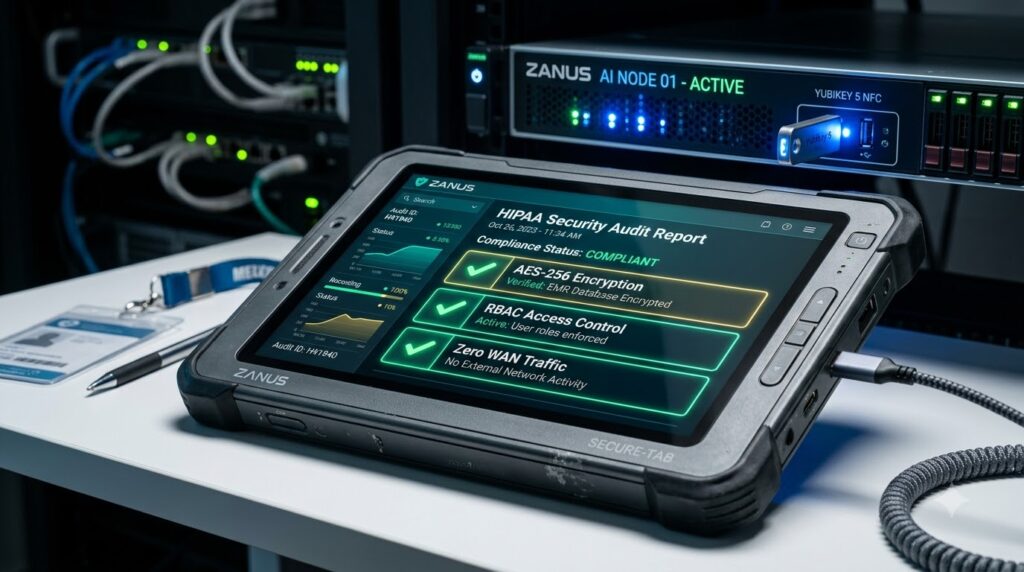
Hospital Compliance Officers and Chief Information Officers can utilize the following structured checklist during technical procurement and compliance audits to verify the architectural isolation of the Zanus Medical AI Server:
- [ ] Physical Perimeter Containment: Confirm that the Zanus AI server chassis is physically installed within a secure, badge-restricted server room or data closet.
- [ ] Hardware Security Activation: Verify that the physical USB hardware dongle is securely connected to the server chassis to enforce cryptographic licensing.
- [ ] Network Egress Verification: Conduct packet-level inspection at the hospital firewall to confirm that zero inbound or outbound network traffic occurs between the Zanus server IP address and external cloud networks.
- [ ] Air-Gap Resilience Testing: Temporarily disconnect the facility WAN connection and test clinical documentation, scribing, and vector database retrieval to verify offline functionality.
- [ ] Active Directory & SSO Integration: Validate that user access is authenticated through the hospital’s central identity management system with MFA enforced.
- [ ] Role-Based Access Control (RBAC) Auditing: Test permissions across different user roles (physician, nurse, billing clerk, practice administrator) to ensure least-privilege data access.
- [ ] Encryption Validation: Verify that AES-256 bit encryption is active across all NVMe storage volumes and that local endpoint sessions utilize TLS 1.2+ encryption.
- [ ] Audit Trail Generation: Perform test clinical queries and document generations, then export the immutable system audit log to confirm capture of user ID, timestamp, prompt metadata, and data access.
- [ ] Local Vector Store Indexing: Confirm that institutional SOPs, formularies, and clinical protocols are indexed within the Precision Vector Store locally without external cloud API calls.
- [ ] EHR Interoperability Validation: Test bidirectional HL7/FHIR communication with Epic, Cerner, or athenahealth to confirm secure chart population within the local network.
5. ROI, Financials & Operational Impact
Reducing EHR Fatigue and Restoring Clinician Time
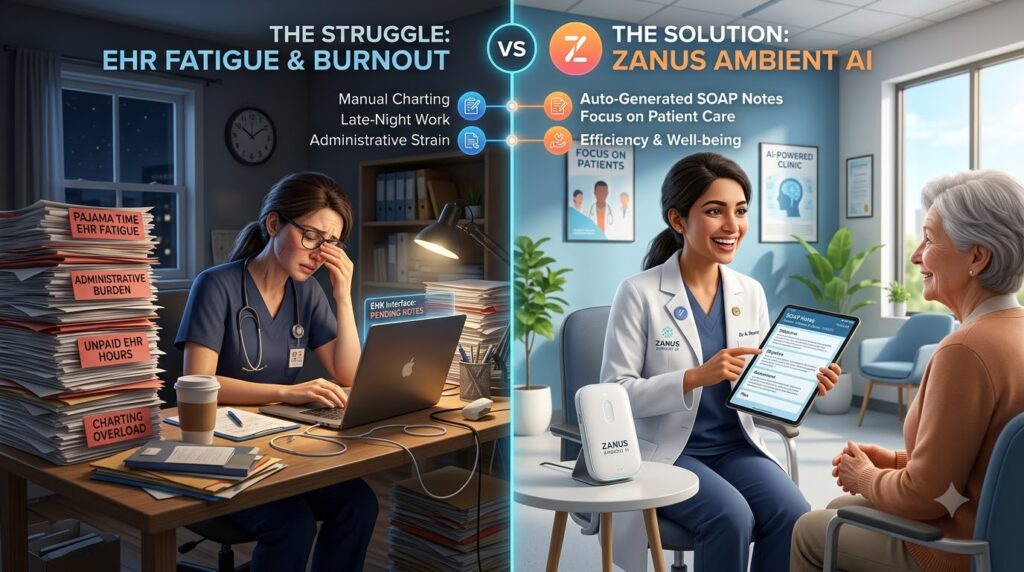
Physician burnout represents a major operational and financial challenge for American healthcare systems. Studies examining physician time distribution reveal that primary care providers and specialists spend up to two hours on administrative EHR documentation for every hour of direct patient care. A significant portion of this workload occurs after clinic hours—a phenomenon known as “pajama time”—which correlates directly with reduced professional satisfaction, increased clinical error rates, and accelerating provider turnover.
┌─────────────────────────────────────────────────────────────────────────┐
│               CLINICIAN DAILY WORKLOAD REDISTRIBUTION                   │
└─────────────────────────────────────────────────────────────────────────┘

Traditional Cloud / Manual EHR Workflow
[ Direct Patient Encounter: 35% ] [ EHR Documentation & Pre-Charting: 65% ]
                                  │
                                  └─► Heavy "Pajama Time" / High Burnout

Zanus On-Premise Local AI Workflow
[ Direct Patient Encounter: 70% ] [ Local AI Scribe & Review: 30% ]
                                  │
                                  └─► Eliminated "Pajama Time" / Increased Capacity
By deploying localized ambient scribing and automated pre-charting engines, the Zanus Medical AI Server transforms provider efficiency. Because the system generates SOAP notes and visit summaries in real time during the encounter, clinicians spend less time manually keying data into EHR fields.
The operational impacts of this efficiency gain include:
- Reduction in After-Hours Documentation: Automated progress note synthesis reduces evening chart completion time by 50% to 70%, effectively eliminating “pajama time” for participating providers.
- Expanded Patient Access and Revenue Capacity: Reducing administrative overhead per visit allows physicians to add one to three patient appointments daily without extending clinic hours, increasing clinical throughput and system revenue.
- Improved Retention and Workforce Stability: Mitigating EHR fatigue directly decreases physician turnover rates, helping health systems avoid the substantial recruitment and locum tenens costs associated with provider replacement.
- Enhanced Clinical Note Quality: Real-time automated synthesis reduces documentation gaps and memory decay errors, yielding richer, more consistent progress notes that support accurate coding and clinical continuity.
CapEx Asset Ownership vs. OpEx Cloud Debt
From a financial perspective, deploying cloud-based medical AI tools under Software-as-a-Service (SaaS) licensing introduces a compounding operational expense (OpEx) debt structure. Enterprise cloud platforms typically charge per-user monthly subscription fees ranging from $30 to $60 per seat for basic chat interfaces, alongside specialized documentation extensions that charge thousands of dollars per provider per year. These costs are exacerbated by variable API token fees, where processing long clinical notes, unstructured medical histories, or complex vector queries incurs additional usage charges.
As health systems expand AI usage across hundreds of clinicians, nurses, billing specialists, and administrative staff, monthly cloud SaaS invoices escalate unpredictably. Furthermore, SaaS subscription payments represent a sunk operational expense that yields zero long-term balance sheet value.
The Zanus Medical AI Server replaces this recurring SaaS debt model with a predictable Capital Expenditure (CapEx) asset model:
- $0 Monthly Subscription & Token Fees: The Zanus system operates on a one-time purchase or fixed lease structure. Once deployed, the server processes an unlimited volume of clinical notes, vector queries, and administrative tasks with zero per-user seat fees and zero API token overages.
- Unlimited Facility-Wide Licensing: Health systems can extend AI access across all departments—including physicians, mid-level providers, nursing staff, triage desks, and revenue cycle teams—without incremental software licensing costs.
- Turnkey Software Consolidation: Replacing multiple point solutions (dictation software, patient portal bots, scheduling software, and coding tools) with Zanus’s 15+ built-in modules consolidates the clinical software stack into a single system.
- Capital Depreciation and Tax Advantages: As a physical hardware appliance running local software, the Zanus AI server represents a depreciable capital asset. Organizations can utilize standard equipment depreciation models or take advantage of accelerated tax write-offs, such as U.S. IRS Section 179 expense deductions.
- Flexible Capital Financing: Health systems can utilize structured equipment leasing programs up to 60 months. The fixed monthly financing payment is frequently lower than the cost of a single administrative employee or a fraction of equivalent cloud SaaS seat licenses, while operating continuously to support the entire facility. Most healthcare practices fully recoup their initial deployment investment within 3 to 6 months solely through eliminated SaaS subscriptions and billing efficiency gains.
6. Executive Strategic Roadmap
A major administrative challenge of cloud AI deployments is the complex audit requirement. Compliance officers must continuously evaluate vendor security controls, track subprocessor amendments, verify remote encryption standards, and monitor external data flows to ensure audit readiness for OCR inspections.
The on-premise Zanus architecture simplifies compliance by establishing architectural audit readiness from day one. Because patient data never leaves the hospital’s physical and network perimeter, compliance officers can immediately verify data containment. Audit preparation shifts from evaluating third-party vendor risks to inspecting local hardware controls and system logs.
To successfully transition from vulnerable cloud AI APIs to a private, HIPAA-compliant on-premise infrastructure, hospital executives should execute the following four-phase strategic roadmap:
Phase 1: Compliance Risk Audit and Inventory (Days 1–2)
Execute a system-wide audit of all active clinical AI applications, ambient dictation tools, and third-party SaaS integrations. Identify unmonitored BAA gaps, multi-tiered subprocessor exposures, and variable API token costs across all departments.
Phase 2: Hardware Appliance Deployment (Days 3–4)
Unbox and install the Zanus Medical AI Server within the secure hospital data room. Connect the server to the local facility LAN via a single Ethernet link, insert the physical USB security dongle, and perform packet-level network testing to confirm complete WAN egress isolation.
Phase 3: EHR Integration and Vector Knowledge Ingestion (Days 5–7)
Configure local HL7 and FHIR API connectors to establish bidirectional communication between the server and the institution’s EHR (Epic, Cerner, athenahealth). Upload hospital SOPs, specialized care pathways, facility formularies, and clinical consent templates into the Precision Vector Store.
Phase 4: Role-Based Access Activation and Governance Sign-Off (Days 8–10)
Integrate user authentication with local Active Directory / LDAP systems, enforcing MFA and role-based access permissions across clinical, administrative, and billing teams. The Chief Information Officer and HIPAA Compliance Officer sign off on the local deployment, establishing continuous audit readiness and operational AI capability across the enterprise.
Final Recommendation
Choose the Private Zanus Medical AI Server if your health system wants to eliminate HIPAA breach vulnerabilities, control escalating SaaS token costs, and maintain full clinical operations during network outages.
Stick with public cloud AI APIs only if your organization does not handle ePHI, operates without strict regulatory mandates, and is comfortable accepting third-party subprocessor risks and perpetual subscription fees.
Frequently Asked Questions (FAQ)
What makes an AI solution truly HIPAA compliant?
HIPAA compliance requires meeting the Administrative, Physical, and Technical Safeguards outlined in 45 CFR Part 164. An AI system is compliant when it enforces strict role-based access controls, complete encryption at rest (AES-256) and in transit (TLS 1.2+), immutable audit logging, and guarantees that ePHI cannot be disclosed without authorization or accessed by unvetted third-party subprocessors.
Why is a signed BAA with a cloud vendor not always sufficient?
A Business Associate Agreement (BAA) is a legal contract that shifts post-breach financial liability; it does not alter underlying software mechanics. If a cloud vendor suffers a subprocessor breach, system misconfiguration, or subpoena, ePHI can still be exposed. Hardware containment eliminates the physical possibility of external data exposure.
Can the Zanus Medical AI Server operate without an active internet connection?
Yes. The Zanus AI server is fully capable of air-gapped operation. All model inferences, speech-to-text processing, clinical scribing, and vector database queries occur locally on the internal hardware GPU engine, allowing clinical documentation to continue uninterrupted during WAN or ISP failures.
How does on-premise AI integrate with existing EHR systems like Epic or Cerner?
The Zanus server includes pre-configured HL7 messaging interfaces and FHIR RESTful APIs. These protocols allow the server to ingest clinical records and feed structured progress notes, billing codes, and diagnostic summaries directly back into the hospital’s existing EHR workflows across the local network.
What is the financial advantage of an on-premise AI server over cloud SaaS subscriptions?
Cloud SaaS platforms charge per-user monthly seat fees and variable API token charges that scale upward as adoption grows. The Zanus server uses a CapEx asset model with zero monthly subscription fees and zero token charges, allowing health systems to extend AI tools across all staff while benefiting from asset depreciation and tax write-offs (such as IRS Section 179).
🔍 Related Enterprise AI Infrastructure & Compliance Guides
For healthcare CIOs, medical directors, and IT compliance officers evaluating local AI deployments, explore our related technical reviews and financial benchmarks:
- Financial & Pricing Breakdown: Compare hardware tier costs and tax incentives in our Zanus AI Server Pricing Guide 2026.
- Data Sovereignty & Air-Gap: Discover how air-gapped hardware isolates sensitive data in Unlocking Sovereign AI: Why Air-Gapped Zanus AI Servers Win.
- Zero-Cloud Voice AI: Evaluate sub-300ms local voice processing in our guide to The Zero-Cloud Zanus AI Call Center Architecture.
- Financial ROI Analysis: Model payback horizons and Section 179 tax offsets in Stop Wasting Millions on Cloud Tokens: Zanus AI Server ROI Guide.
- Full Platform Review: Read our comprehensive evaluation of local OS modules in the Zanus AI Platform Review.
References
- U.S. Department of Health and Human Services (HHS) Office for Civil Rights (OCR)Summary of the HIPAA Security Rule (45 CFR Part 160 and Part 164, Subparts A and C)https://www.hhs.gov/hipaa/for-professionals/security/laws-regulations/index.html
- National Institute of Standards and Technology (NIST)Implementing the Health Insurance Portability and Accountability Act (HIPAA) Security Rule: A Resource Guide (NIST SP 800-66 Rev. 2)https://csrc.nist.gov/pubs/sp/800/66/r2/final
- Zanus AI Technology ArchitectureAI Software for Healthcare & Medical: On-Premises Medical AI Infrastructurehttps://zanusai.com/medical/
- American Medical Association (AMA)AMA Physician Practice Benchmark Survey: AI Adoption Trends and Operational Impact in Healthcarehttps://www.ama-assn.org/about/research/physician-benchmarks-studies
- BastionGPT Privacy and Compliance FrameworksWhat Makes an AI Solution HIPAA Compliant? Technical Safeguards and Data Privacyhttps://bastiongpt.com/what-makes-an-ai-hipaa-compliant/