Most field service organizations and industrial asset maintenance teams do not need another generic cloud-based AI solution. They need infrastructure that eliminates the latency bottlenecks, high bandwidth transport fees, and structural security risks that silently erode operational margins.
When managing hundreds of electrical substations, automated production lines, or distributed mobile technician fleets, routing high-frequency sensor streams and technical maintenance logs to a centralized cloud database introduces severe inefficiencies. This centralized cloud approach incurs significant wide area network (WAN) data costs, introduces non-deterministic processing delays, and creates operational fragility during network dropouts.
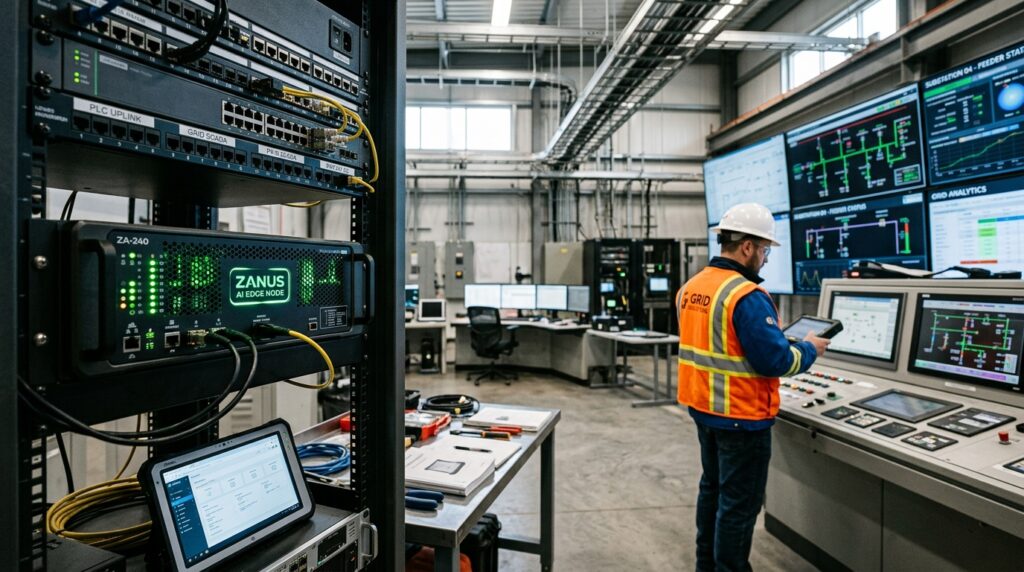
Zanus AI addresses this challenge by providing a turnkey, on-premises computing server and localized AI software pipeline designed to operate fully offline. For Chief Technology Officers (CTOs) and Chief Operating Officers (COOs), the core evaluation remains: Does this sovereign AI model satisfy rigorous industrial technical demands while delivering a predictable return on investment (ROI)?
This analysis evaluates the practical application of Zanus AI within modern enterprise field service environments to help technology decision-makers choose the right infrastructure strategy.
1. Core Infrastructure: Zanus AI for Field Service Integration
Cloud-native generative AI architectures generally rely on consumption-based pricing models, charging by the token or API call. This operational expense (OpEx) model creates financial unpredictability for enterprises that must continuously monitor thousands of industrial sensors. Zanus AI replaces this variable cost structure with a fixed capital expenditure (CapEx) model based on dedicated hardware deployed at the facility floor or local operations center.
The turnkey server integrates enterprise-grade graphics processing units (GPUs) capable of hosting local Large Language Models (LLMs) and vector embedding pipelines completely within the plant’s physical boundary. For field service applications, this localized architecture guarantees the immediate processing of raw telemetry, historical maintenance records, and warranty data without external transit.
Data Infrastructure Trade-offs
| Operational Metric | Centralized Cloud AI Architecture | Zanus AI On-Premises Architecture |
| Inference Latency | 100–500 ms (Highly variable; WAN-dependent) | 5–50 ms (Deterministic; local processing) |
| Bandwidth Costs | High; scales linearly with sensor volume | Low; only critical exceptions leave the plant |
| Offline Resilience | Fragile; operations halt during WAN dropouts | High; local vector buffers maintain continuity |
| Pricing Structure | Variable (Consumption-based per token) | Fixed (Predictable upfront hardware investment) |
Operational Trade-off: While eliminating recurring cloud computing bills, adopting Zanus AI shifts financial burdens to an upfront CapEx investment. Furthermore, internal IT departments must absorb the long-term operational overhead of managing physical server life cycles, hardware depreciation, and on-site hardware maintenance.
Deployment Insight
Migrating from “leased cloud intelligence” to “owned infrastructure ownership” eliminates third-party vendor dependencies. In high-stakes field service environments where asset downtime triggers severe Service Level Agreement (SLA) penalties, the single-digit millisecond response time of a dedicated on-site server provides a definitive operational advantage over remote cloud clusters.
2. Workflow Optimization: Automated Local RAG and Work Order Generation
Traditional field service dispatch workflows frequently bottle at the diagnostic stage. When a field technician encounters complex equipment failures, manually searching through thousands of pages of engineering schematics, maintenance manuals, and service logs consumes hours of valuable wrench time.
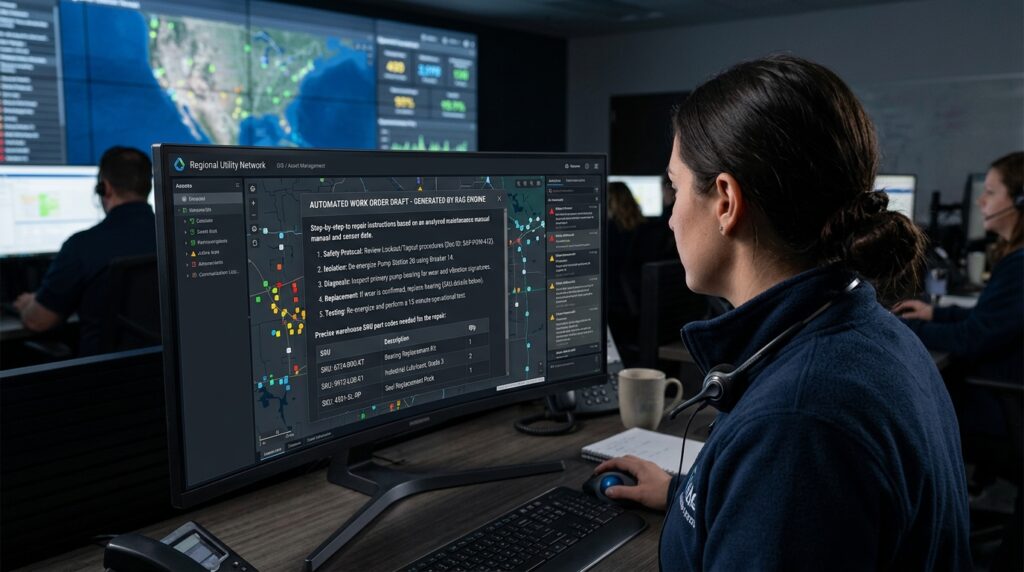
Zanus AI addresses this bottleneck by deploying an offline Retrieval-Augmented Generation (RAG) pipeline powered by localized vector databases like Qdrant or Milvus:
- Feature Extraction: The system ingests diagnostic error codes or telemetry signatures directly from local SCADA interfaces or technician mobile inputs.
- Semantic Vector Matching: An embedded machine learning model converts the input into a mathematical vector, traversing an offline Hierarchical Navigable Small World (HNSW) index to match the current fault against historical maintenance logs with high precision.
- Automated Drafting Engine: A local LLM parses the retrieved repair manuals, contextualizes the asset’s current failure, verifies inventory availability, and generates a structured technical work order containing step-by-step mitigation instructions.
This completely offline pipeline eliminates manual data entry. The resulting work order is pushed directly into core Enterprise Resource Planning (ERP) systems like SAP, Oracle, or Infor via secure local REST APIs.
[Asset Fault / SCADA Signal]
             │
             ▼
    [Zanus Turnkey Server] ──(Local Vector Search)──► [On-Premises Knowledge Base]
             │
             ▼
[Automated Work Order & Parts List]
             │
             ▼
   [Local ERP / SAP Nodes] ──► [Automated Fleet Technician Dispatch]
Operational Trade-off: The reliability of an automated RAG drafting pipeline depends entirely on the historical data hygiene of the organization. If the enterprise’s existing service logs contain unstructured, inaccurate, or conflicting reports, a localized model will replicate these errors without the broader, generalized correction capabilities found in massive public cloud models.
Real-world Consideration
A common pitfall for enterprise engineering teams is attempting to construct custom, piecemeal edge AI stacks using commodity hardware components and public open-source models. Enterprise deployments demonstrate that the hidden engineering costs of optimizing GPU drivers, configuring secure air-gapped networks, and maintaining model stability typically exceed the acquisition cost of a pre-configured, cohesive turnkey platform like Zanus AI.
3. Data Governance: Aligning with Strict IEC 62443 Security Architectures
In Operational Technology (OT) environments, cybersecurity directly impacts physical safety, asset protection, and systemic uptime. Exporting detailed maintenance records containing explicit infrastructural design vulnerabilities over the public internet exposes the enterprise to severe cyber threats.
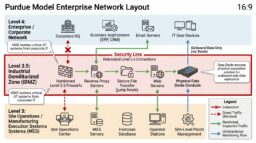
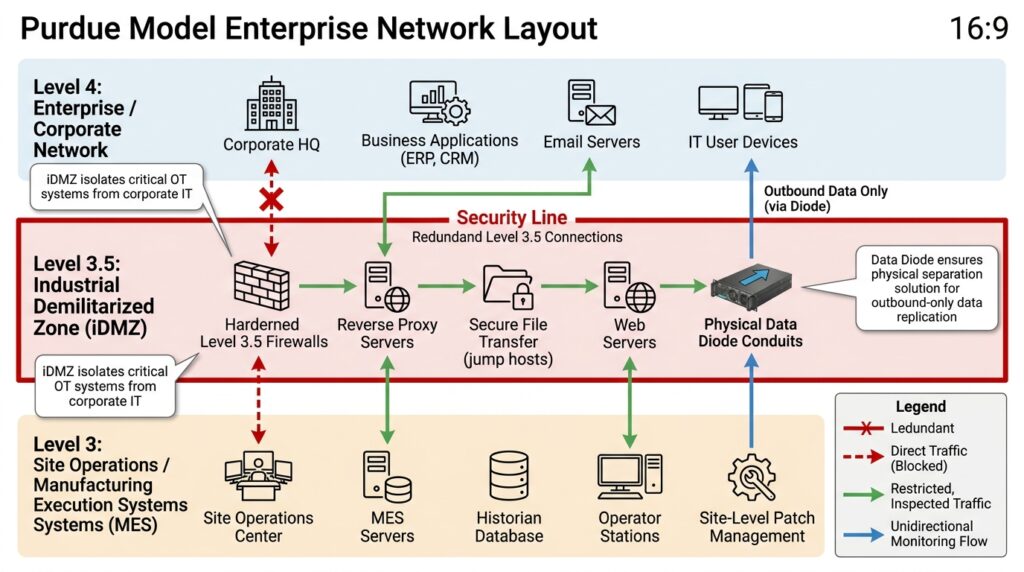
Zanus AI mitigates this exposure by operating within a strictly isolated, air-gapped infrastructure. This architecture ensures that sensitive operational metadata never leaves enterprise control, satisfying the stringent requirements of the IEC 62443 industrial security standard.
The platform implements a rigorous “Zones and Conduits” topology:
- Telemetry collection, vector storage, and model processing reside entirely within the OT Maintenance Zone.
- Lateral communication to the corporate network is governed by secure conduits running application-layer firewalls, multi-factor authentication (MFA), and deep packet inspection.
Furthermore, the system leverages metadata pre-filtering tied to local Role-Based Access Control (RBAC). When a technician queries the system via a signed JSON Web Token (JWT), the search engine filters the underlying HNSW graph before executing vector similarity calculations. Technicians can instantly retrieve technical manuals matching confidentiality_class: "operational", while sensitive corporate financial structures—such as contract margins or labor billing rates tagged as restricted_financial—remain mathematically inaccessible.
CTO-Level Perspective
True air-gapped security is an infrastructural property, not a software feature flag. Processing all data within local hardware boundaries simplifies enterprise compliance audits. Rather than relying on complex data-in-transit encryption schemes and continuous third-party cloud data center audits, Chief Information Security Officers (CISOs) can verify data boundaries through physical network isolation.
4. Procurement Blueprint: Enterprise Fit & Implementation Roadmap
Zanus AI is not a universal solution for every organization. Selecting this infrastructure requires a calculated assessment of operational scale, data volume, network stability, and existing IT support capabilities.
Enterprise Selection Matrix
- Organizations that SHOULD select Zanus AI:
- Enterprises managing high-consequence critical infrastructure (Utilities, Oil & Gas, Defense, Large-scale Manufacturing).
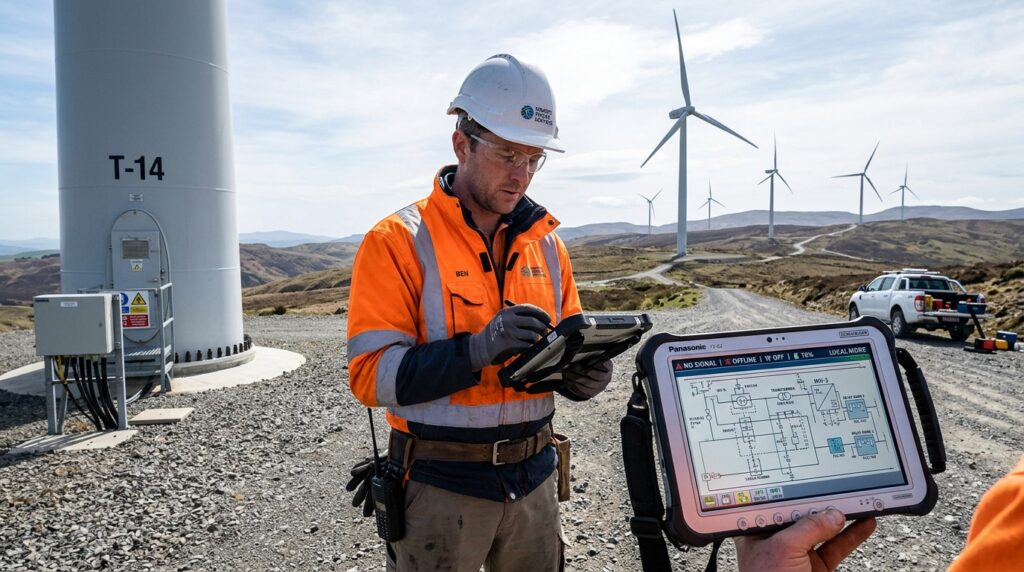
- Organizations operating fleets in remote, degraded, or zero-connectivity environments (Mining operations, Maritime shipping, Offshore wind farms).
- Operations with high-frequency diagnostic workloads where recurring cloud API token volume threatens predictable budget constraints.
- Industrial firms with dedicated on-site IT/OT staff capable of managing dedicated server infrastructure.
- Organizations that SHOULD AVOID Zanus AI:
- Small-to-medium businesses (SMBs) running small field service operations (fewer than 15 mobile technicians) handling low-complexity repairs.
- Companies whose core software ecosystem is already deeply integrated into public Cloud-as-a-Service (SaaS) environments.
- Organizations lacking climate-controlled server rooms, edge micro-data centers, or internal infrastructure engineering staff.
Editor’s Take
The Core Decision: If your organization prioritizes absolute data sovereignty, requires stable operational costs at a massive scale, and must maintain predictive maintenance capabilities during total network outages, Zanus AI presents a compelling, resilient alternative to standard cloud models. However, if your business requires minimal upfront capital investment, rapid integration into pre-existing SaaS applications, and immediate access to continuous global AI model updates, maintaining a cloud-centric field service strategy will yield a faster, more flexible return on investment.
What to do next: Before allocating capital toward local hardware procurement, execute a thorough data audit of your legacy maintenance records. An on-premises RAG pipeline can only generate actionable work orders if the underlying repository of technical knowledge is clean, structured, and accurately indexed.
Your Next Step
Achieving absolute physical isolation and shielding your field asset telemetry from public web exposure demands a deliberate pivot toward hardware-level server containment. To successfully evaluate your corporate technology readiness and pitch a clear capital asset allocation plan to your operations leadership team, we recommend exploring our separate enterprise cluster networks:
- Performance Scaling Matrix: Verify the exact compute density and memory thresholds required for your local dataset indexing by reading the Zanus AI Prime vs Quantum infrastructure tiers.
- Server Room Facility Sizing: Audit your internal data center layouts, cooling capacities, and physical short-depth dimensions via the Zanus AI Hardware Infrastructure manual.
- Operating System Core Features: Discover how the pre-installed private operating engine manages localized document parsing and agent automation modules in our detailed Zanus AI Deep Review.
- Structural Telemetry Applications: For a detailed engineering guide on how edge-native visual computing layers automate structural inspection profiles under regional statutes, see our technical blueprint on minimizing the Florida SB-4D inspection cost.
Don’t let variable public cloud API billing models or sudden network disconnections stall your active field operations—conduct your data maturity review and deploy your turnkey zanus ai for field service automation node today.
References
- Zanus AI Official Documentation: The Rise of Sovereign Enterprise Intelligence & Technical Architecture, Available at: https://zanusai.com/blogs/what-is-zanus-ai/zanus-ai
- Zanus AI Corporate Overview: Private On-Premises AI Servers and Software Solutions, Available at: https://zanusai.com/
- ISA/IEC 62443 Standard Committee: Security for Industrial Automation and Control Systems – Zones and Conduits Framework, Available at: https://www.isa.org/standards-and-publications/isa-standards
- Zinier Field Operations Analysis: AI Implementation Frameworks for Field Service Delivery Platforms, Available at: https://www.zinier.com/
- Qdrant Vector Database Core: Local Implementation and Metadata Filtering in High-Performance Contexts, Available at: https://qdrant.tech/documentation/concepts/filtering/