

Most enterprises do not need another generic AI subscription. They need a way to deploy large language models (LLMs) over highly sensitive data without sending proprietary IP, patient records, or legal contracts past their corporate firewall.
While public cloud APIs offer convenience, they introduce uncontrollable operational expenses (OpEx), compliance risks, and vendor lock-in. For heavily regulated sectors like healthcare, finance, defense, and legal services, the priority has shifted toward Sovereign AI—running private, air-gapped infrastructure entirely on-premises.
f you are looking to move away from public clouds or are evaluating Zanus AI alternatives, this guide breaks down the top private AI platforms to help you make the right structural decision.
Quick Summary
- Zanus AI Prime: Best for mid-to-large enterprises wanting an immediate, plug-and-play AI appliance without hiring specialized AI engineers.
- DIY Open-Source Stack (Ollama/vLLM): Best for software-driven organizations and startups with skilled internal engineering teams who demand complete code-level customization.
- VMware Private AI Foundation: Best for large enterprises with existing VMware Cloud Foundation environments looking to virtualize and share GPU pools.
- HPE Private Cloud AI: Best for machine learning teams needing a fully integrated “AI factory” to continuously fine-tune models on massive datasets.
- SambaNova Suite: Best for high-performance computing and complex multi-agent setups that require extreme inference speeds and massive context windows.
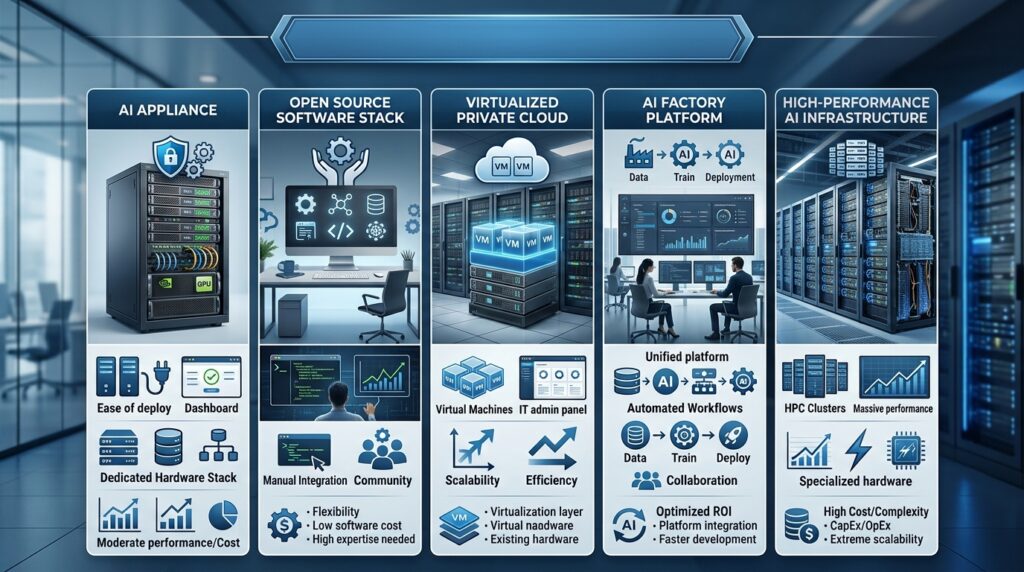
Platform Comparison Table
| Platform | Best For | Pricing Model | Deployment Type | Learning Curve | Standout Feature |
| Zanus AI Prime | Non-technical enterprises wanting a turnkey solution | Single CapEx purchase (No token/seat fees) | Physical 8U Rackmount Appliance | Minimal (Ready on Day 1) | Integrated AI OS with 15+ native business modules |
| DIY Stack (Ollama/vLLM) | Technical teams needing complete control | Free software; variable hardware costs | Custom bare-metal or cloud-native | Steep (Requires active DevOps/MLOps) | Absolute flexibility to swap models and front-ends |
| VMware Private AI Foundation | Organizations heavily invested in VMware | Enterprise licensing + hardware | Virtualized private cloud infrastructure | Moderate to Steep | Advanced fractional GPU virtualization via NVIDIA NIM |
| HPE Private Cloud AI | Large-scale model training and fine-tuning | GreenLake consumption or CapEx purchase | Standardized hardware/software stacks | Moderate | Global namespace via HPE Alletra X10000 storage |
| SambaNova Suite | Advanced multi-agent systems and ultra-long text | Custom enterprise pricing | Special RDU-based hardware architectures | Steep | Reconfigurable Dataflow Units (SN40L) with 3-tier memory |

Detailed Reviews: The Top 5 Private AI Platforms
1. Zanus AI Prime
The Zanus AI Prime (SKU: ZAI-PRS-7700) is a physical, turnkey 8U rackmount appliance designed to function as an entirely self-contained corporate brain. It arrives with pre-configured compute hardware, vector databases, and an AI operating system that requires zero external cloud connections.
- What problem does it solve? It eliminates the extreme complexity of building, securing, and maintaining on-premises AI infrastructure for traditional business settings.
- Who should use it? Mid-market and enterprise organizations in legal, healthcare, manufacturing, or government sectors that need localized AI tools but lack a dedicated machine learning department.
- Who should avoid it? Data science labs that want to conduct deep academic research or train foundational models from scratch.
- Where does it outperform competitors? Day 1 readiness. You plug it into local power and LAN, upload your documents via a web UI, and the system immediately works without developer configuration.
- What are its limitations? The system is built for business outcomes, meaning you cannot easily modify the low-level architecture or swap out the core operating system framework.
Pros:
- Zero recurring seat or token fees; predictable one-time CapEx.
- Operates flawlessly in 100% air-gapped environments via physical hardware keys.
- Quiet air-cooled design integrates easily into standard server rooms or office spaces.
Cons:
- High upfront acquisition cost compared to starting with free software.
- Limited flexibility for experimental deep-learning engineering.
Editor’s Take
If your primary objective is to safely automate document analysis, internal workflows, and compliance checks without managing a complex software stack, then Zanus AI Prime is the safest choice because it bypasses the multi-month engineering timeline typical of custom on-premises deployments.

2. DIY Open-Source Stack (Ollama & vLLM)
Building your own localized stack involves assembling open-source components on your own hardware. This typically leverages Ollama for lightweight local execution, vLLM for high-throughput enterprise inference, and Open WebUI as the user interaction layer.
- What problem does it solve? It removes vendor lock-in and software licensing fees, giving developers direct access to the latest open-source models (e.g., Llama 3.1, Mistral) the hour they are released.
- Who should use it? Tech-first organizations, software development agencies, and startups with seasoned DevOps teams.
- Who should avoid it? IT departments with limited personnel or businesses that require strict service-level agreements (SLAs).
- Where does it outperform competitors? Code-level agility. You can change your quantization configurations, adjust hyper-parameters, and write custom middleware to connect any database to your local model.
- What are its limitations? Total lack of unified support. When memory leaks occur during high-concurrency continuous batching, your team must debug the code themselves.
[Open WebUI / Front-End] ──> [vLLM / Ollama Inference Engine] ──> [Local VRAM / System RAM]
Pros:
- Free software licensing lowers the initial financial barrier to entry.
- Massive community support ensures rapid optimization updates.
- Granular configuration over parameters like
num_ctx(context size) andkeep_alive.Cons:
- High hidden operational costs via internal engineering hours.
- Security, SSL management, and access controls must be manually hardened.
Editor’s Take
If you already employ dedicated infrastructure engineers who can build and maintain custom APIs, then a DIY open-source stack is highly viable because it grants your development team complete autonomy over the software architecture.

3. VMware Private AI Foundation with NVIDIA
This software-defined architecture sits directly on VMware Cloud Foundation (VCF). Instead of relying on a dedicated single-use physical appliance, it virtualizes hardware resources so enterprises can allocate fractional GPU power to AI workloads across their existing data center footprint.
- What problem does it solve? It stops GPU underutilization by allowing enterprise IT to pool, partition, and secure physical hardware across multiple business units.
- Who should use it? Large corporate enterprises that run their operations on VMware infrastructure and want to incorporate AI services into their existing management stack.
- Who should avoid it? Small businesses or lean startups that do not already maintain a massive VMware virtualized ecosystem.
- Where does it outperform competitors? Resource virtualization and enterprise access controls. It uses NVIDIA NIM microservices to quickly deploy optimized models within secure Deep Learning VM templates.
- What are its limitations? Complex air-gapped logistics. Deploying this platform without internet access requires managing a strict two-tier local Harbor registry system to manually push updates.
Pros:
- Integrates smoothly with existing enterprise IT monitoring and security tools.
- NSX vDefend provides excellent Zero-Trust network micro-segmentation.
- High performance via DirectPath I/O, which bypasses virtualization overhead.
Cons:
- Requires a highly mature infrastructure administration team to deploy.
- Tied directly to Broadcom/VMware licensing structures.
Editor’s Take
If your organization is already anchored to a VMware corporate ecosystem, then the Private AI Foundation offers the most logical path because it leverages your existing infrastructure investments and internal security policies.
4. HPE Private Cloud AI
Part of the “NVIDIA AI Computing by HPE” initiative, this platform offers a tightly pre-engineered hybrid architecture that provides a public cloud-like developer experience completely on-premises. It scales up across standardized “T-Shirt sizes” ranging from small developer setups to large enterprise multi-node systems.
- What problem does it solve? It eliminates data transfer bottlenecks when fine-tuning AI models on large corporate datasets scattered across separate storage networks.
- Who should use it? Enterprise data engineering groups that focus heavily on localized Retrieval-Augmented Generation (RAG) and customized model training.
- Who should avoid it? Teams looking for a simple, single-server document management tool.
- Where does it outperform competitors? Unified storage access. Its integration with HPE GreenLake for File Storage (utilizing Alletra X10000) creates a global namespace that feeds data to GPUs at massive speeds.
- What are its limitations? It functions primarily as a infrastructure-as-a-service platform for developers; it does not come with pre-packaged end-user business applications out of the box.
Pros:
- Standardized, factory-tested configurations minimize deployment risk.
- Highly scalable architecture that expands easily from prototyping to production workloads.
- Excellent native toolkits (JupyterLab, Apache Spark) for data scientists.
Cons:
- Requires significant data center footprint, power allocation, and cooling.
- Consumption-based pricing models can become complex over multi-year cycles.
Editor’s Take
If your roadmap involves building an internal “AI factory” where data scientists continuously train or fine-tune models across terabytes of local storage, then HPE Private Cloud AI is an excellent foundation because its data pipelines are specifically built for heavy file-system throughput.
5. SambaNova Suite (SN40L RDU Platform)
SambaNova completely abandons traditional GPU architectures. Instead, it relies on custom Reconfigurable Dataflow Units (RDUs) paired with a unique three-tier memory layout (SRAM, HBM, and high-capacity DDR) to execute massive enterprise workloads.
- What problem does it solve? It removes the hardware bottlenecks caused by traditional GPU-to-CPU memory transfers when running extremely complex multi-agent workflows or scanning huge context windows.
- Who should use it? Advanced technology divisions, Tier-1 financial institutions, and research organizations running ultra-large models (e.g., DeepSeek-671B or dense mixture-of-experts).
- Who should avoid it? Standard corporate environments that only need everyday text summarization, email drafting, or search features.
- Where does it outperform competitors? Multi-agent speed and context retention. Its hardware allows model swapping in milliseconds and supports ultra-long sequence processing at speeds exceeding thousands of tokens per second.
- What are its limitations? The platform relies entirely on SambaNova’s proprietary RDU silicon, meaning your team must adapt their software compilation steps to their unique SDK.
Pros:
- Unmatched inference speeds for ultra-large models using speculative decoding.
- Massively expanded memory capacity per node reduces the total physical server count.
- Ideal for complex multi-agent coordination.
Cons:
- Proprietary hardware architecture removes the option to use standard off-the-shelf components.
- Demands highly advanced computational engineering skills.
Editor’s Take
If your operational scaling relies on executing massive multi-agent tasks over hundreds of thousands of context tokens simultaneously, then the SambaNova Suite is uniquely powerful because its RDU dataflow design fundamentally resolves the memory constraints inherent to legacy GPU setups.

Strategic Advice: Build vs. Buy
When evaluating Zanus AI alternatives, the biggest pitfall in enterprise AI is chasing low software-licensing costs while ignoring the reality of internal labor requirements.
Choosing an enterprise AI path is rarely a question of software capability; it is a question of organizational maturity.
[Determine Internal Skillset]
       │
       ├─► Has MLOps/DevOps Team? ──► YES ──► [Consider DIY Stack / VMware / HPE]
       │
       └─► Standard IT Department ──► NO  ──► [Choose Turnkey Appliance like Zanus AI]
The biggest pitfall in enterprise AI is chasing low software-licensing costs while ignoring the reality of internal labor requirements. A DIY approach using open-source tools appears cost-effective on paper because the code is free. However, if your team spends three months manually hardening security, configuring local databases, and fixing runtime failures, you are burning capital on infrastructure assembly rather than solving business problems.
Conversely, buying a dedicated physical appliance like Zanus AI Prime involves a significant upfront capital expenditure (CapEx). However, it sets a predictable financial ceiling. For non-tech-first companies, eliminating recurring token fees, user licensing, and the need to hire $200k/year machine learning engineers creates a much faster path to real return on investment (ROI).
Frequently Asked Questions
Do these platforms require an active internet connection to function?
No. All the platforms covered in this guide can be deployed in a 100% air-gapped configuration. They validate licenses and execute model inference locally inside your private facility.
Can an air-gapped system be updated when new models come out?
Yes. Updates are handled through secure, offline processes. For turnkey hardware appliances, this is typically done via encrypted physical drives provided by the vendor. For software frameworks, administrators use a clean, internet-connected proxy machine to download vetted container images and model weights, verify their file hashes, and manually transfer them into the secure environment.
What happens if our internal database has messy formatting?
AI performance relies directly on the cleanliness of your internal documentation. If your corporate files contain conflicting information or broken structures, any on-premises model will generate inaccurate or hallucinatory answers. Clean your data repositories before deploying any hardware or software.
Final Recommendation
To make a clear decision today, look at your primary operational objective:
- If your priority is an immediate, business-ready solution that your current staff can use without deep software engineering or AI training, choose Zanus AI Prime.
- If your priority is total control over the source code and your team wants the freedom to modify underlying algorithms, build out a DIY Open-Source Stack via vLLM.
- If your priority is maximizing existing enterprise hardware resources, choose VMware Private AI Foundation or HPE Private Cloud AI based on your current data center software commitments.
Deepen Your Private AI Research
Evaluating different sovereign platforms is just the first step in reclaiming your data sovereignty. To build a complete financial and technical blueprint for your on-premises infrastructure, explore our dedicated deep dives:
- Financial TCO Analysis: Is deploying a physical hardware appliance more cost-effective than cloud hosting over a 5-year cycle? Read the exact data breakdown in [Zanus AI Pricing & ROI: The Real Cost of On-Premises AI].
- Physical Setup Blueprint: Ready to understand the literal server specifications, power distribution rules, and cooling dynamics? Check out our [Zanus AI Hardware Architecture & Server Setup Guide].
- Comprehensive Platform Review: Examine the core workflow capabilities, native business modules, and security protocols of our top-rated turnkey system in our full [Zanus AI Review].
- Strategic ROI Assessment: Is shifting your budget from OpEx to CapEx truly worth the upfront investment? Read our strategic analysis on [Is Zanus AI Worth It?].