Buying a new software platform is surprisingly easy. Integrating it into daily property operations without exposing sensitive resident profiles or running afoul of strict data privacy laws is where most organizations struggle.
In an era where artificial intelligence drives modern property management, data has become both your greatest asset and your biggest liability. Every time an employee pastes a lease agreement into a public chatbot to extract data, or uploads surveillance footage to a third-party server, your community is exposed.
To bridge the gap between innovation and data sovereignty, the real estate industry is pivoting to a new standard: Private AI. This guide cuts through the technical jargon to help property managers and board members understand what Private AI is, why it matters, and how to implement it safely.
1. Quick Summary
- The Core Problem: Public AI platforms (like the free tiers of ChatGPT or Claude) use your uploaded text and images to train their global models. For property managers handling private resident data, this constitutes an immediate security breach.
- The Solution: Private AI isolates the artificial intelligence engine within infrastructure you control—either an on-premises local server or an encrypted private cloud. Your operational files never leave your system.
- The Bottom Line: With the activation of strict regional data protection laws, using unprotected public AI to process resident information now carries massive financial penalties. Private AI is no longer a luxury tech upgrade; it is a legal shield.
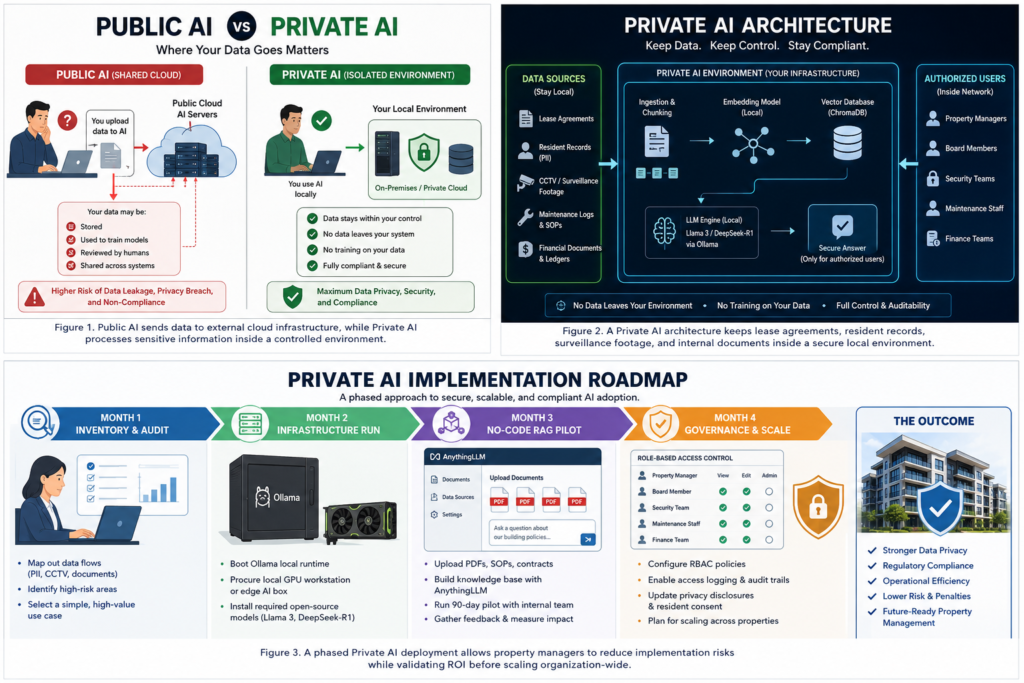
2. Head-to-Head: Public AI vs. Private AI
| Evaluation Criteria | Public AI (Shared Cloud) | Private AI (Isolated Environment) |
| Data Ownership | Reassigned to the third-party cloud vendor. | Retained 100% by the property management firm. |
| Data Leakage Risk | High; inputs are ingested to optimize public models. | Zero; data is structurally ring-fenced locally. |
| Customization | Limited to generic prompts and standard configurations. | Deeply fine-tuned on your specific property documents. |
| Compliance Alignment | Fails strict national biometric and PII storage laws. | Fully matches the highest regulatory privacy standards. |
| Upfront Investment | Low; flexible pay-as-you-go or tier-based subscriptions. | Higher initial setup costs for dedicated local hardware. |
Editor’s Note: Private AI does not always mean offline AI. Many organizations deploy Private AI inside dedicated cloud environments where customer data is fully isolated and never used to train public AI models.
3. Why Property Management Needs Private AI
Guarding Biometrics and Personally Identifiable Information (PII)
Property management offices process mountains of PII daily, including phone numbers, government IDs, vehicle license plates, facial recognition signatures, and granular entry/exit timestamps. If this structural data leaks to the public web, it exposes residents to targeted digital fraud. Private AI ensures that data-driven convenience never compromises resident safety by keeping behavioral analytics enclosed.
Defending Operational Intellectual Property
Property blueprints, HVAC wiring schematics, emergency fire-response protocols, and vendor contracts are highly confidential. If a building’s physical security layout or financial balance sheets are inadvertently exposed via public cloud queries, it creates a severe physical and digital vulnerability.
The Real Cost of Non-Compliance
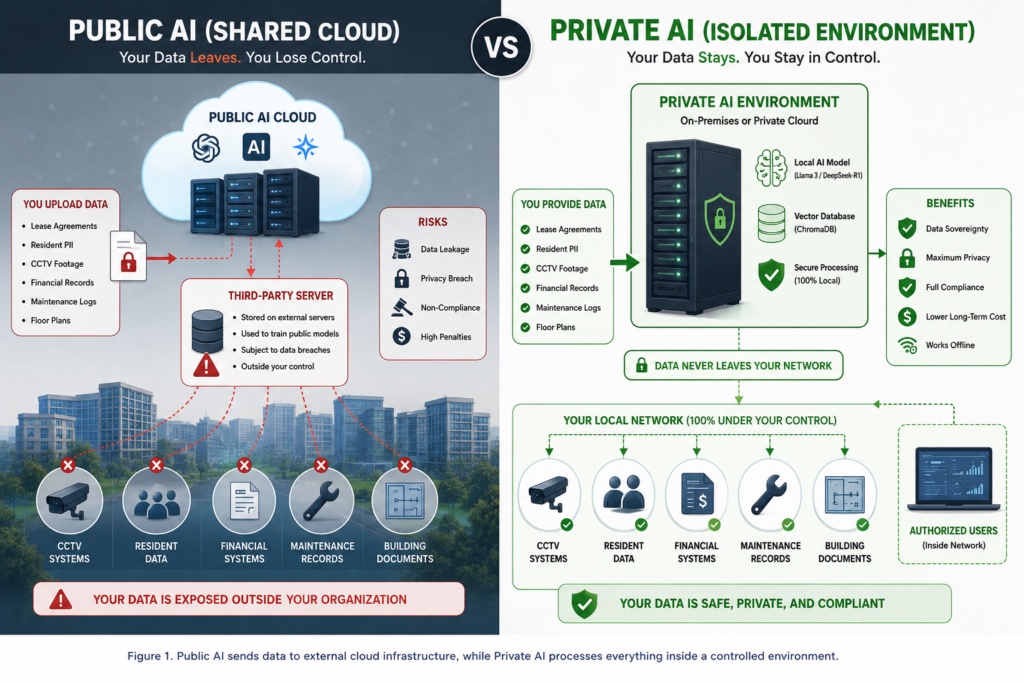
The global legal landscape surrounding data privacy is tightening rapidly. In jurisdictions like Vietnam, Decree 13/2023/NĐ-CP and the enforceable Personal Data Protection Law have transformed privacy oversight from a simple administrative box to check into an active risk management mandate.
Under these frameworks, processing large-scale biometric profiles or automated facial analytics without a certified Data Protection Impact Assessment (DPIA) can trigger severe penalties—reaching up to 3 billion VND ($118,000 USD) or 5% of an organization’s annual revenue for critical cross-border leaks. Private AI avoids these penalties by processing data strictly where it is gathered.
[Regulatory Standard] ──> [Property Management Requirement] ──> [Private AI Actionable Solution]
Decree 13/2023/NĐ-CP  ──> Secure Resident CCTV & PII Profiles ──> Compute localized feeds; cut internet transmission
Data Protection Law   ──> Mandatory DPIA Compliance & Audit    ──> Log access trails via embedded Role-Based Controls
4. Practical Real Estate Applications
Local Knowledge Assistants (Secure RAG)
Property managers lose hours digging through complex HOA bylaws, maintenance history logs, and commercial lease clauses. A localized Retrieval-Augmented Generation (RAG) architecture automates this search securely.
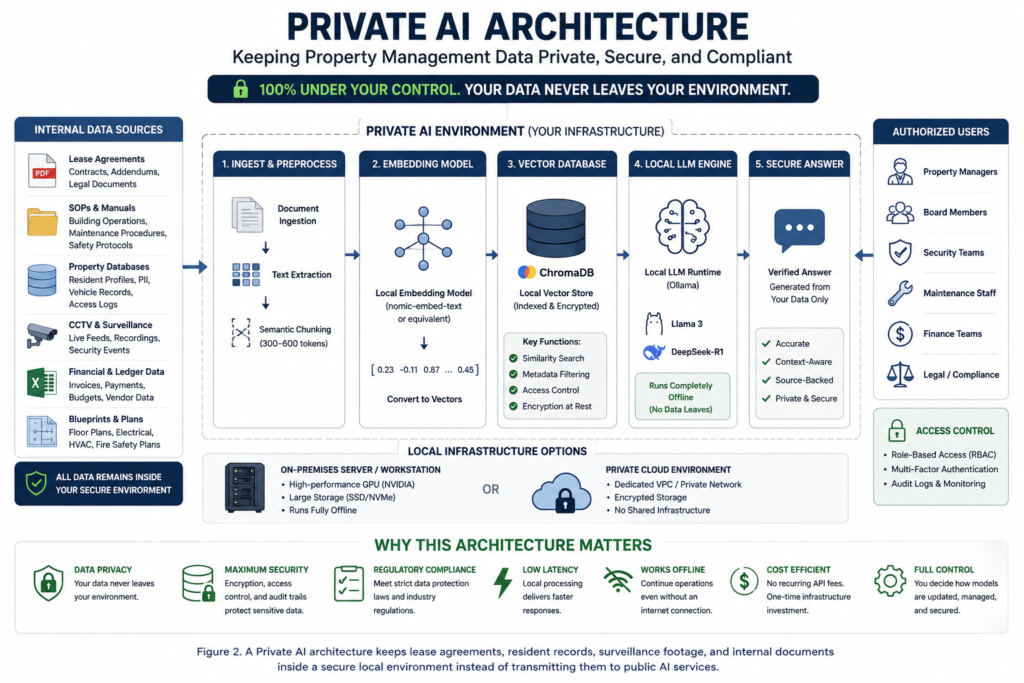
[Internal PDFs/SOPs] ──> [Semantic Chunking (300-600 tokens)] ──> [Local Vector Store (ChromaDB)]
                                                                             │ (Local Semantic Search)
[User Search Query]  ──> [Local LLM Engine (Llama 3 / DeepSeek-R1)] ◄────────┘
                               │
            [Instant Verified Answer via Local LAN]
The system splits text into structural “chunks” (300–600 tokens) with a 10%–20% overlap to preserve context. These are mapped into multi-dimensional vectors via an embedding model (like nomic-embed-text) and saved to a local vector store (ChromaDB). When an employee queries a policy, a local open-source Large Language Model (Llama 3 or DeepSeek-R1) running via Ollama generates an accurate response entirely offline.
Edge Computer Vision Surveillance
Traditional security systems only record incidents after they occur. Private AI upgrades legacy IP cameras into proactive alert systems using an Edge AI Box (such as an industrial embedded system with integrated NPUs like the Rockchip RK3588).
Video feeds stream directly to the Edge Box via local RTSP or ONVIF protocols. The AI processes the video at the point of capture with sub-1ms latency, detecting uncollected waste, blocked emergency exits, loitering, or early smoke and fire indicators. Because processing occurs entirely on physical hardware at the property, biometric profiles are kept safe from external data harvesting.
Automated Ledger Communications
Drafting individualized billing notifications, balance statements, and repair windows manually consumes valuable staff time. By linking Private AI with your internal Property Management System (PMS) or ERP, this workflow is safely automated. The local AI pulls ledger states directly from the secure server, drafting personalized emails. Because it is backed by strict Role-Based Access Control (RBAC), private tenant financial records never flow through an unvetted public API.
5. Implementation Roadmap for Real Estate Teams
  Month 1: Inventory & Audit   ──>   Month 2: Infrastructure Run    ──>   Month 3: No-Code RAG Pilot   ──>   Month 4: Governance & Scale
  • Map out PII data flows           • Boot Ollama local runtime          • Upload PDFs to AnythingLLM       • Configure RBAC policies
  • Pick an entry-level use case     • Procure local GPU desktop          • Run 90-day internal trial        • Update community disclosures
Step 1: Inventory and Core Use-Case Selection
Map out your current data touchpoints: resident databases, leasing logs, and camera arrays. Identify where PII is most vulnerable. Avoid trying to automate your entire business on day one; pick one high-value, low-risk pilot—such as an internal chatbot to help staff query technical building maintenance SOPs.
Step 2: Establish Your Hardware Footprint
You do not need an enterprise-grade data center to launch a private network. Choose between two scalable approaches:
- The On-Premises Path: Set up a dedicated local workstation equipped with a high-performance consumer GPU. Use the open-source platform
Ollamato run lightweight, distilled open-source models likeLlama 3 8BorDeepSeek-R1 8B. This setup runs 100% offline with zero recurring software licensing costs. - The Private Cloud Path: If your team lacks specialized IT staff, secure a private cloud partition with a trusted local provider. Ensure they sign a strict Service Level Agreement (SLA) legally prohibiting them from storing your prompt histories or using your data to train public models.
Step 3: Run a Low-Code Pilot
To cut deployment time from months to minutes, link your local Ollama runtime to a user-friendly frontend like AnythingLLM. This interface allows non-technical staff to build a functional secure chatbot simply by uploading building rules and standard vendor contracts into an isolated vector database.
Step 4: Configure Governance and Access Control
Before opening the system to your wider team, configure strict Role-Based Access Controls (RBAC) so employees only access information relevant to their duties. Finally, update your community privacy disclosures with an explicit “Data Processing Consent” button on your resident application portal to ensure full compliance with modern regional data laws.
Related Reading
Choosing the right AI deployment model is only one part of building a secure property management ecosystem. If you’re evaluating AI solutions for HOAs or commercial real estate, these in-depth guides can help you compare technologies, understand implementation strategies, and make better long-term investment decisions.
- AI HOA Violation Management: Automating Enforcement with Zanus AI – Learn how AI automates violation detection, compliance tracking, and resident notifications while reducing manual inspections.
- Cloud AI vs. On-Premises AI: The Ultimate Buying Guide for HOA & Property Managers – Compare deployment models based on privacy, performance, cost, and regulatory compliance before choosing your infrastructure.
Frequently Asked Questions:
What Is Private AI?
Private AI is an artificial intelligence system that processes data inside an organization’s own infrastructure rather than sending information to public cloud AI services. It can run on local servers, dedicated private clouds, or hybrid environments, giving businesses full control over sensitive information such as resident records, financial documents, surveillance footage, and operational procedures.
Is Private AI the Same as On-Premises AI?
Not exactly.
On-Premises AI is one deployment method for Private AI, where all computing resources remain inside a company’s local network.
Private AI can also run in an isolated private cloud managed by a trusted provider, as long as customer data is never shared with public AI models or used for model training.
Can Private AI Work Without an Internet Connection?
Yes.
Many Private AI solutions can operate entirely offline when deployed on local hardware. Models running through platforms such as Ollama or other on-premises AI frameworks continue processing documents and answering questions even if the internet connection is unavailable.
This makes Private AI especially valuable for property managers who require uninterrupted access to building documentation and security systems.
Does Private AI Improve Data Security?
Yes.
Because sensitive information never leaves your controlled environment, Private AI significantly reduces the risk of data leakage, unauthorized access, and third-party model training. It also helps organizations comply with modern privacy regulations by keeping resident information, surveillance data, and financial records inside secure infrastructure.
Is ChatGPT Enterprise Considered Private AI?
Not entirely.
ChatGPT Enterprise provides enterprise-grade security and does not use customer conversations to train OpenAI’s public models. However, it is still a cloud-based service operated by OpenAI.
Organizations that require complete infrastructure ownership, offline operation, or strict data residency generally choose dedicated Private AI deployments instead.
Is Private AI Worth It for Property Managers?
For many property management companies, yes.
If your organization handles lease agreements, resident databases, CCTV footage, access control systems, or financial records, Private AI can improve security while reducing compliance risks. Smaller organizations with limited budgets may begin with enterprise cloud AI solutions before migrating to a fully private deployment as their operational needs grow.
What Hardware Is Needed to Run Private AI?
The required hardware depends on the AI model and workload.
For document search, internal chatbots, and Retrieval-Augmented Generation (RAG), many organizations can start with a workstation equipped with a modern NVIDIA GPU. Larger deployments that process hundreds of surveillance cameras typically require dedicated GPU servers or edge AI appliances for real-time performance.
Buying Advice & Next Steps
If your real estate business operates a single mid-market building or handles non-sensitive administrative files, then you can rely on standard Enterprise Cloud AI subscriptions. Because as long as the provider signs an enterprise-grade data exclusion agreement, the low upfront cost outbalances the overhead of dedicated hardware.
However, if you manage luxury portfolios, multi-tower complexes, or high-security residential communities, then you must invest in an On-Premises or Hybrid Private AI architecture. Because buying private AI before your data is exposed is the only way to safeguard your community from expensive data leaks, maintain sub-10ms operational response times, and insulate your business from severe regulatory penalties.
Your Immediate Action Item: Do not buy any new vendor software today. Instead, conduct an internal 48-hour audit to find out exactly where your property managers are pasting resident details online. Identifying that vulnerability is your first step toward an ironclad, private operational framework.
Final Thoughts
Private AI is no longer reserved for large enterprises. As privacy regulations continue to evolve, organizations that process sensitive resident information should prioritize AI solutions that keep data under their own control. Whether deployed on-premises or inside a dedicated private cloud, Private AI provides a secure foundation for modern property management.